Geopolitika: Institutional Profiles – Labor Friends of Israel, Australia
How Labor Friends of Israel, Australia solicits money, packages policy and works inside Labor-facing politics while its legal form, governance and financial destination remain undisclosed in the supplied record.
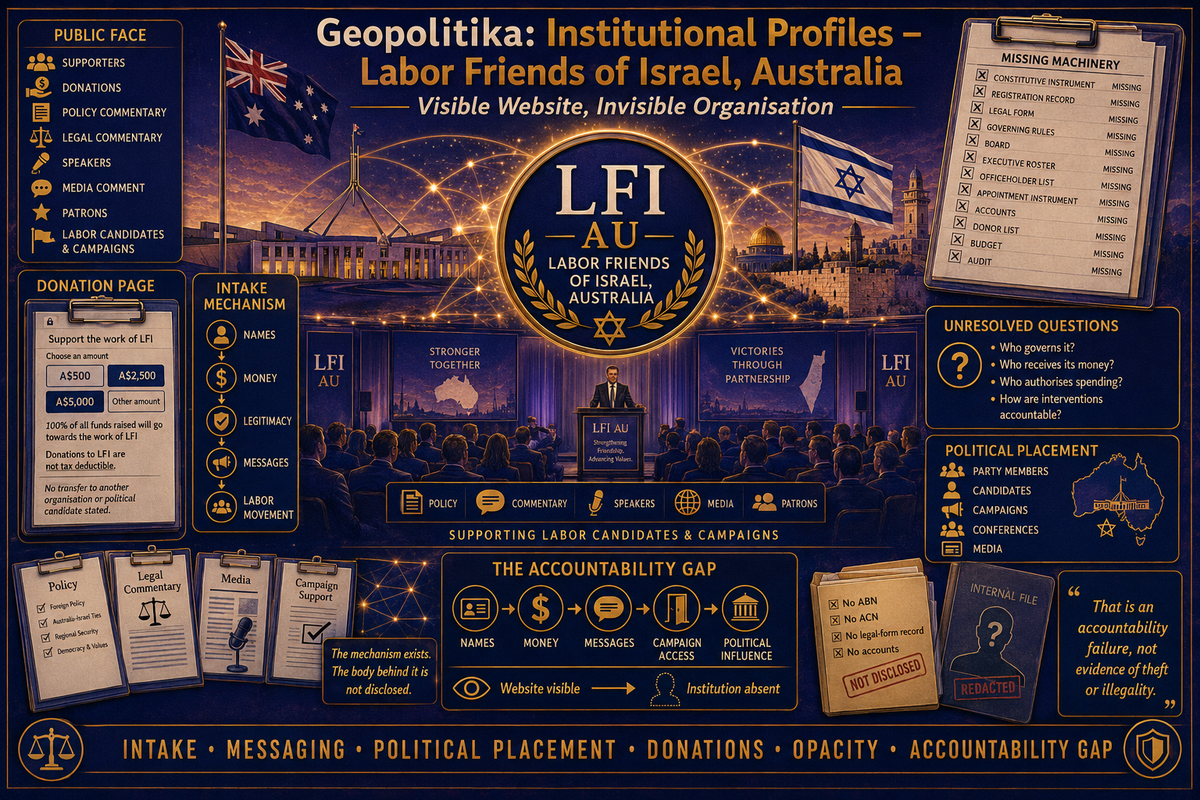
This institutional profile forms a part of the Geopolitika project to map Anglo-American power structures by examining their founding mythologies, leadership, linkages to power, public face, the nature of their outputs and who these are directed towards. These profiles are primarily generated from materials provided on their own websites, which are then analysed using a structured institutional analysis framework—see methodology statement at foot of article.
—
Labor Friends of Israel, Australia (LFI AU) presents as a political organisation. It recruits supporters, asks individuals and companies for money, publishes policy and legal commentary, offers speakers and media comment, names prominent patrons, and says it will support Labor candidates and campaigns.
What it does not present is the institutional machinery behind those activities.
Across the publicly facing materials, no constitutive instrument, registration record, legal-form statement, governing rules, board, executive roster, officeholder list, appointment instrument, accounts, donor list, budget or audit was found. That is not proof that none exists elsewhere. It is, however, the controlling fact for any public assessment of the organisation: the website is visible; the body behind it is not.
This matters because the website is not merely informational. It is an intake, publication and political-placement mechanism aimed explicitly at the Australian Labor movement. It gathers names, money and legitimacy, converts them into Labor-compatible messages, and offers those messages back to party members, candidates, campaigns, conferences and media. The unresolved question is not whether the mechanism exists. It does. The unresolved questions are who governs it, who receives its money, who authorises its spending and how its political interventions are accountable.
A donation page that does not identify the institution receiving the money
The clearest material route on the site is the donation page, captured on 30 June 2026.
It accepts card donations from individuals and companies and offers preset amounts of A$500, A$2,500 and A$5,000, as well as another amount. The page says: “100% of all funds raised will go towards the work of LFI” and “Donations to LFI are not tax deductible.” As at early August 2026, a search for LFI AU on the Australian Chatritiesd Regier reveals no entry for the organisation. The donations page says money will not go to another organisation to or political candidate, while failing to mention what organisation the money does go to.
Those sentences sound like disclosure, but they do not answer the basic institutional question. “The work of LFI” is circular unless the public can identify the legal recipient, decision-makers, accounts and spending categories behind the name.
No Australian Business Number (ABN), Australian Company Number (ACN), incorporated association number, registered-charity status, trust deed, company name or other legal-form record appears on the website. No governing body is identified. No officer is shown as responsible for the payment account. No accounts reveal whether donations fund the website, staff, events, research, advertising, speakers, campaign services, travel or other activity. No donor totals or concentration data show whether the platform is sustained by many small contributors or a few large ones.
The page’s statement that donations are not transferred to candidates also leaves a material gap. The homepage separately declares an objective to “Support Labor candidates and campaigns, consistent with our values, to win elections and form and retain Labor governments.” Candidate support need not involve a cash transfer. It can take the form of research, events, introductions, speakers, content, volunteer labour, media work or services paid for by the organisation itself. The corpus does not identify which, if any, of those forms are used.
So where do the donations go? The only supported answer is: LFI AU says they go to “the work of LFI.” Beyond that, the supplied public record does not allow the money to be followed.
That is an accountability failure, not evidence of theft or illegality. The distinction matters. The absence of disclosed structure cannot prove misconduct, but it prevents the public from testing who controls resources raised in the name of influencing Labor politics.
The website is the operating institution
LFI AU may lack a demonstrated legal form in the corpus, but it has practical institutional capacity. The website provides a name, a mission, a join form, a donation channel, publications, patron profiles, issue framing, a media contact and reusable political material.
Its mission is explicit: “fostering strong connections between the Australian Labour movement and the state of Israel.” Its objectives include strengthening support for Israel and a two-state solution across the Labor Party, encouraging a particular framing of Jewish-community respect within Labor discussion, fostering ties with the Israeli Labor Party and other organisations, and supporting Labor candidates and campaigns.
The site also offers journalists comments, interviews, speakers and presenters. That makes it a distribution point, not just an archive.
Prominent names supply legitimacy. The patrons page identifies former Victorian premier Daniel Andrews and former senator Nova Peris as patrons, while disclosing no patron appointment process, duties, governing authority or financial role. Their public standing can validate the platform without proving that either controls it.
Specialist contributors supply authority of a different kind. On its issues page LFI AU publishes material credited to former minister and former Army legal officer Mike Kelly, strategic-policy analyst Anthony Bergin, and a speech attributed to Michael Easson at the 2023 ALP National Conference. The roles are not interchangeable: patrons lend prestige; contributors lend policy and security credentials; conference material lends Labor-specific relevance; the website selects and distributes the result.
The handoff is visible:
Labor history and public prestige → expert and political content → Labor-native policy language → media and party-facing circulation → supporters and donations → capacity to repeat the process
This is the institution working. It does not require formal power over the ALP. It requires only a credible platform, recognisable messengers and material that Labor actors can use.
The two-state promise without a route
LFI AU repeatedly presents a two-state solution as evidence of a moderate political stance.
Its homepage says it wants to strengthen support for both Israel and a two-state solution across Labor. Its undated LFI AU Vision supports coexistence, peacebuilders, a two-state outcome and the dismantling of settler outposts. Its motion template calls for secure and defensible Israeli borders alongside a viable Palestinian state that accepts Israel and renounces violence.
The problem is not that the phrase “two-state solution” appears. The problem is that the supplied record contains almost none of the institutional work required to turn the phrase into a programme.
There is no timetable, negotiating architecture, territorial map, settlement-removal pathway, enforcement mechanism, security transition, sovereignty arrangement, counterpart commitment, resource plan or implementation authority. There is no evidence of a Palestinian participant helping define the proposal. There is no adoption result inside Labor and no demonstration that the organisation has converted the slogan into a practical political route.
Within this record, the two-state solution functions less as a plan than as a fantasy: a desirable—and realistically speaking, unobtainable—future is invoked while the actors, powers and enforceable steps needed to create it remain absent.
That function is politically useful. Two-state language allows LFI AU to present its position as reformist and peace-oriented while maintaining a more durable pro-Israel alignment. The same vision document opposes boycotts, links delegitimisation to antisemitism, seeks ALP adoption of the contested IHRA definition, celebrates Israel as aligned with Labor values and advocates wider economic, political and security ties.
The result is not neutrality between two peoples. It is a Labor-compatible pro-Israel programme carrying a limited reform horizon. The reform language matters, but it does not become executable merely by repetition.
A 2023 crisis frame still offered as party language in 2026
The temporal problem is clearest in the Pass a Motion Template, provided on the website.
The document is anchored to the period after 7 October 2023. It attributes grave acts to Hamas, excludes Hamas from any future Palestinian state, makes hostage release a condition for ceasefire, and states that “Hundreds of Israeli hostages remain in captivity.” It then declares: “All hostages must be released immediately in order for there to be a cease fire.”
The LFI AU web pages captured in June 2026 show no revision history, update date, or status note, leaving unclear whether the hostage figure, ceasefire language, or political context have been reassessed. A crisis-specific text may be defensible as a dated intervention, but it becomes problematic when left online as a standing policy instrument with no indication that its factual premises have been overtaken.
This analysis did not independently verify the motion’s attributions, legal claims, branch adoption, conference receipt, or policy impact. Yet the broader mechanism matters: an opaque organisation preserves a charged, time-bound crisis frame in a format intended for ongoing Labor Party use.
The template’s first line is not the issue. The real story is the conversion—wartime claims repackaged as durable party language, with no editorial oversight or visible effort to update the site for current realities—and how that mechanism circulates within the Labor movement.
How the mechanism is played into the Labor movement
LFI AU’s own materials identify the Labor movement as both audience and field of intervention in that they:
- Claim historical continuity – The site invokes Ben Chifley, H. V. Evatt and Labor’s recognition of Israel to present current advocacy as part of Labor tradition rather than an external pressure campaign.
- Use Labor-linked prestige – Andrews, Peris and the publication of Easson’s conference speech place familiar political identities around the platform.
- Translate specialist authority into party content – Kelly’s defence and legal biography and Bergin’s strategic-policy standing make security and war arguments appear institutionally credentialled.
- Seek formal and informal policy uptake – The vision supports ALP adoption of the IHRA definition of anti-semitism. The homepage declares support for Labor candidates and campaigns. The motion template offers language that can be carried into branch and conference procedures.
- Position the site as a Labor Party voice – The media interface offers comments, interviews, speakers and presenters, allowing the organisation’s framing to travel through journalism, meetings and events.
- Build the organisation’s base – Join and donation forms convert agreement into names, contacts and resources.
These routes do not prove control of Labor, coordination with party officials or success at conference. The supplied record identifies no candidate service, branch adoption, conference vote, expenditure or policy outcome attributable to LFI AU. But lack of proven outcome does not erase the mechanism. The website is designed to inhabit Labor’s language, history, personnel ecology and procedural openings.
It also attempts to define the boundaries of legitimate Labor dissent. The Vision associates Israel with Labor and liberal-democratic values, rejects boycott campaigns and links delegitimisation to antisemitism. A separate publication argues that modern anti-Zionism is inherently antisemitic and that Zionism remains progressive. These are LFI AU’s claims, not independently established universal facts.
Their function is nevertheless plain: they seek to make one political alignment appear naturally Labor, while making some opposing positions appear outside progressive legitimacy.
The people spoken for are not shown governing the message
LFI AU says it wants to strengthen friendship between the Australian Jewish community and the ALP and to encourage respect in Labor discussion. Yet the website materials fail to establish a representative mandate from the Jewish community, an internal membership process or a method by which contested community views shape the organisation.
The record also contains no direct Palestinian source, no Arab or Muslim Australian source, no Labor dissenter and no independently sampled Jewish-community perspective. No affected-population voting right, grievance mechanism, appeal route or public editorial correction process is shown.
That absence matters because the organisation’s outputs concern ceasefire conditions, Palestinian statehood, antisemitism, boycotts, candidate support and the boundaries of acceptable Labor debate. People materially or politically affected by those positions are represented in the content, but are not shown participating in the institution that produces it.
This is not proof of intentional exclusion. It is a limit on claims of balance, representation and consent.
POSIWID: what the platform is built to do
Judged by observable operation rather than declared ideals, Labor Friends of Israel Australia is best understood as a Labor-adjacent policy-framing and legitimacy platform with an undisclosed institutional back end.
Its purpose-in-operation is to make a durable pro-Israel position easier to carry through Labor politics. It does this by:
- Claiming continuity with Labor history
- Attaching recognised patrons and specialist contributors
- Publishing political, legal and security arguments
- Presenting two-state language as a progressive credential
- Turning a post-October-2023 crisis frame into reusable party material
- Seeking candidate, campaign and policy relevance
- Offering media voices and speakers
- Converting supporters into contacts and donations
The website is therefore not peripheral to the institution. On the supplied evidence, it is a highly visible face of the institution.
The central contradiction is stark. LFI AU asks to be treated as a credible participant in Labor politics, accepts money in that name and declares an ambition to support Labor candidates and campaigns. Yet the corpus does not show what legal body receives the money, who governs the platform, who authorises its interventions or how its claims are revised when the facts and political context change.
The strongest defensible verdict remains bounded. The evidence does not show that LFI AU controls the ALP, directs government, transfers donations to candidates, acts under foreign command or has changed an election, conference vote or policy. It shows a public mechanism built to translate pro-Israel advocacy into Labor-native legitimacy, language, personnel and mobilisation while the institutional structure behind that mechanism remains largely invisible.
That is the subject working.
Published via Mindwars Ghosted.
Geopolitika: Tracing the architecture of power before it becomes the spectacle of history.
—
Methodology Note: This article draws on a structured public-source corpus concerning Labor Friends of Israel Australia (LFI AU), principally captured on 28 June 2026, together with adjacent Australia Israel Labor Dialogue (AILD) material captured through 30 June 2026. The corpus includes LFI AU’s public website, objectives, supporter and contact functions, donation page and model-motion materials; AILD’s about, parliamentary, policy, news, media, event and archive pages; Australian Labor Party endorsement correspondence; Labor conference resolutions; public statements; and linked labour-movement materials. LFI AU and AILD were treated as distinct institutional subjects. The Australian Labor Party, Israeli Labor Party, Histadrut, parliamentary friendship groups, individual parliamentarians, unions and other friends-of-Israel organisations were treated as separate counterparties rather than presumed parts of one organisation or command structure. The analysis examined institutional identity, chronology, legal form, governance, personnel, patron and founder roles, practical authority, funding, donation destination, website-based mobilisation, policy outputs, model language, party and conference routes, affected populations, accountability and missing disclosure layers. Particular attention was given to how friendship, historical Labor–Israel association, antisemitism, security, hostage and two-state language are converted into supporter recruitment, donations, motions, conference interventions, campaign activity and legitimacy within the Labor movement. Hostage-related assertions and Hamas-exclusion clauses were periodised to their dated source context and were not treated as automatically current. Two-state language was tested for an identifiable implementation pathway—including actors, borders, sequencing, enforcement, settlements, security, Palestinian agency and material power—rather than accepted as a self-executing solution. The public materials record AILD’s relationships with Histadrut and the Israeli Labor Party and its solicitation of donations, while not resolving the complete legal and financial architecture behind those activities. The absence of a disclosed legal entity, governing instrument, financial accounts, donor register, bank-account holder or clearly identified donation recipient was treated as bounded institutional opacity, not as proof of illegality, diversion, foreign control or misconduct. Supported relationships were distinguished from coordination, control, common command and funding. Claims are limited to what the corpus supports: a Labor-adjacent advocacy mechanism, documented routes into Labor policy and conference arenas, historical-legitimacy transfer, public mobilisation and unresolved opacity around legal form, governance, money, accountability and outcomes. Base analytic outputs are available on request. For methodological details—including transparency score definitions, typology classifications, and confidence calibration—see the Geopolitika Series Methodological Statement.
Mindwars Ghosted is an independent platform dedicated to exposing elite coordination and narrative engineering behind modern society. The site has free access and is committed to uncompromising free speech, offering deep dives into the mechanisms of control.