Geopolitika: Institutional Profiles – American Israel Public Affairs Committee (AIPAC)
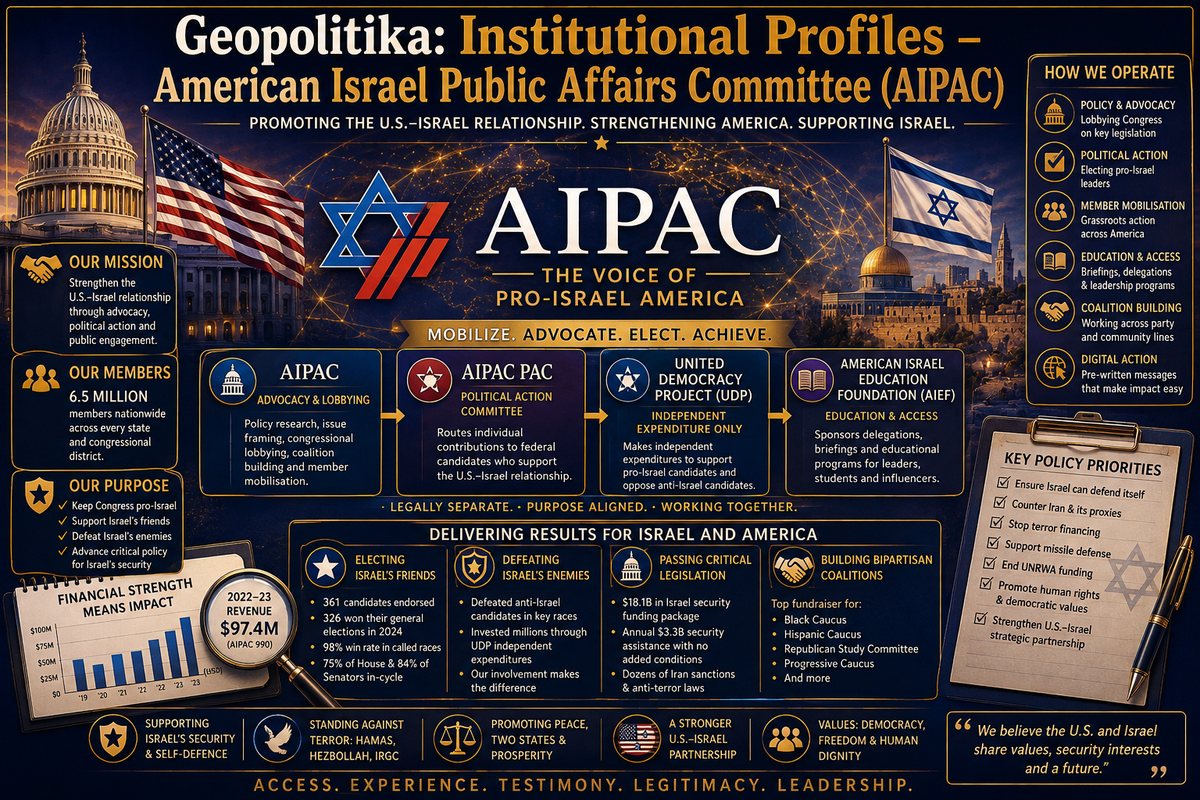
This article is published as part of the Geopolitika project to map Anglo-American power structures by examining their founding mythologies, leadership, linkages to power, public face, the nature of their outputs and who these are directed towards. This series is primarily generated from materials provided on the institution’s own websites, which are analysed using a structured analytic framework—see methodology statement at foot of article.
—
Executive Summary
The American Israel Public Affairs Committee (AIPAC) describes itself as an American, bipartisan organisation whose 6.5 million members advocate for the United States–Israel relationship, lobby Congress and help elect supportive Democrats and Republicans.
That public description presents AIPAC as mass civic participation. The institutional record reveals something more structured: a board-governed organisation connected to legally distinct bodies that perform different parts of a political conversion process.
AIPAC frames policy, mobilises members and lobbies. AIPAC PAC routes individual contributions to candidates. United Democracy Project conducts independent electoral spending. The American Israel Education Foundation sponsors educational access. AIPAC’s memo operation classifies events, ranks authorities and identifies preferred responses. Digital action pages convert those prescriptions into pre-written messages to Congress.
The result is not a single command centre. It is a division of labour.
Taken together, these bodies convert private contributions, institutional knowledge, political classification and structured access into electoral and legislative capacity. The public record supports that repeatable mechanism. It does not establish foreign-government direction, donor control of particular outputs, candidate coordination, unified command or exclusive responsibility for elections and policy outcomes.
AIPAC is neither powerless nor omnipotent. It is a non-sovereign intermediary built to make one political alignment easier to finance, transmit, legitimate and repeat.
Legally Separate Bodies, Complementary Functions
AIPAC’s legal centre is the American Israel Public Affairs Committee, a District of Columbia corporation formed in 1963. For the fiscal year ending 30 September 2023, it reported as a tax-exempt 501(c)(4) organisation under EIN 53-0217164. The legal identity, formation year and tax status appear in the organisation’s Form 990.
The wider architecture contains several distinct entities.
AIPAC PAC is the connected political committee through which individual contributors support candidates. United Democracy Project (UDP) is an independent-expenditure-only committee. The American Israel Education Foundation (AIEF), is a separate educational nonprofit that sponsors travel and other programmes.
AIPAC’s Schedule C reported that UDP makes expenditures in federal races consistent with AIPAC’s objectives. The filing also recorded a $2 million AIPAC contribution to UDP during the reporting period. Schedule R contained additional control labels and related-organisation transactions involving AIPAC PAC, UDP, AIEF and other entities. Those disclosures establish formal relationships and material movement. They do not erase the entities’ separate legal identities or prove that every operational decision is centrally commanded. Source: AIPAC Form 990, Schedule C Part I-A and Schedule R, related organisations and transactions.
The division of labour is nevertheless visible:
AIPAC supplies advocacy and policy framing; AIPAC PAC supplies a contribution route; UDP supplies independent electoral spending; AIEF supplies organised access; public authorities retain the power to vote, appropriate, regulate and implement.
That combination—formal separation with documented complementary functions—is the institutional foundation of the pipeline.
Mass Legitimacy, Board-Centred Authority
AIPAC’s public legitimacy rests heavily on membership scale. Its disclosed governance rights are much narrower.
The 2022–23 Form 990 reported a 44-member voting governing body, of whom 42 were classified as independent. Schedule O states that members may elect one member of the board and vote on organisational action principles at an annual meeting. The filing does not give the wider membership equivalent authority over the remaining board seats, executive appointments, political priorities, candidate selection or related-entity strategy.
AIPAC’s leadership and governance page says the board establishes organisational policy and political directives. In the material captured on 2 August 2026, it named Bernie Kaminetsky as president, Michael Tuchin as board chair and Elliott Brandt as chief executive officer.
The leadership sequence shows institutional continuity across offices. Kaminetsky moved from long-term board membership to president-elect and then president; Tuchin moved from president to board chair; and Brandt, a long-serving internal executive responsible for regional offices, development, events, marketing, communications and political activity across more than 100 congressional districts, was selected in June 2024 to succeed Howard Kohr and became chief executive at year-end. AIPAC’s appointment statement credited Brandt with motivating members and “expanding the circle of donors”.
The board therefore does more than announce directives. It is the disclosed centre of organisational policy and political authority, while executive officers carry those decisions into administration, mobilisation and public action. Leadership succession helps preserve that authority and operating infrastructure across personnel change. The underlying appointment criteria, candidate slate, board deliberations and dissent record remain undisclosed.
The structural tension is clear. AIPAC presents its legitimacy through millions of members, but the wider membership possesses only limited disclosed governance rights: members elect one director and vote on organisational action principles, while the board sets institutional policy and political direction.
Donors occupy a different position. By choosing whether, how much and through which available vehicle to contribute, they reveal preferences and determine the pool of resources available for advocacy, political programmes and candidate support. This can create a structural incentive for the institution to remain attentive to the priorities of those who sustain it. But resource dependence is not the same as decision authority.
The public material does not disclose donor concentration, contribution conditions, restricted-purpose giving, donor access to directors or a route by which particular contributors shape appointments, strategy or specific outputs. It therefore supports a board-led formal decision structure and donor-supplied material capacity, but not a finding of donor governance or donor control. That unresolved space is a disclosure boundary, not evidence of capture.
Follow The Money
For the fiscal year from October 2022 through September 2023, AIPAC reported $79,401,004 in total revenue and $83,081,062 in expenses.
Contributions and grants supplied $72,023,025, approximately 90.7 per cent of total revenue. Programme-service revenue contributed $4,742,794, while investment income supplied $2,635,185.
At the end of the reporting period, AIPAC proper reported $170,596,173 in assets and $59,478,666 in liabilities.
The expense structure shows what those resources sustained. The organisation reported $40,766,306 in salaries, compensation and employee benefits; $21,701,936 in fundraising expenses; $34,880,341 in programme-service expenses; $14,922,162 in political-programme expenses; $14,225,466 for information and member education; and $5,732,713 for lobbying programmes. See: AIPAC Form 990, Parts I, III, VIII and IX.
These are not incidental administrative costs. They are the recurring capacity through which contributions become professional staff, political programmes, member communications and lobbying.
The compensation record shows the scale of that professional apparatus. For calendar year 2022, AIPAC reported total compensation of $1,290,869 for Howard Kohr, then chief executive officer; $1,292,761 for Richard Fishman, then co-chief executive officer; $807,492 for Arne Christenson, managing director of policy and politics; and $697,371 for Robert H. Bassin, identified as UDP’s chief executive. The filing also reported $1,006,428 in supplemental executive-retirement-plan expense. See: AIPAC Form 990, Part VII and Schedule J, pages 1–3.
Christenson appears in AIPAC’s filing as managing director of policy and politics and later in AIEF travel records as the foundation’s executive director. Bassin appears in AIPAC’s compensation disclosure as UDP’s chief executive. These are documented personnel bridges across separate institutions: plausible routes for administration, institutional memory and policy priorities to move without establishing that either person commanded the whole ecology.
Classification First, Money Second
Brandt described the conversion model directly at AIPAC’s 2019 policy conference. Calling AIPAC a “movement” built around “policy, not protest” and “partnership, not partisanship”, he told participants: “We are here to move passion. And we are here to move people. And ultimately, we are here to move policy.” He asked them to recruit others, engage their networks and carry the organisation’s positions to Capitol Hill.
In a later account of House Resolution 246, Brandt said the campaign began with 18,000 AIPAC members visiting Washington and that more than 70 per cent of each party ultimately co-sponsored the measure.
These issuer-reported figures do not isolate AIPAC’s causal contribution, but they show the intended route from executive framing through member mobilisation to a claimed congressional result. The PAC route moves money; this route moves organised constituent presence and prepared policy claims.
AIPAC’s electoral mechanism begins before a contribution is made. It begins by deciding which candidates count as aligned.
The AIPAC Political Portal presents endorsed Democratic and Republican candidates and allows contributors to divide money among selected recipients. AIPAC supplies the classification and interface; individuals supply the funds; the PAC reports and distributes the resulting contributions.
Independent Federal Election Commission records establish the scale.
For the period from 1 January 2025 through 30 June 2026, AIPAC PAC reported $47,521,820.85 in receipts, including $45,182,130.82 in individual contributions. It reported $46,330,183.47 in disbursements, of which $43,960,130.82 went as contributions to other committees.
For calendar year 2024, the PAC reported $35,811,462.88 in receipts and $36,725,508.89 in disbursements.
Its amended 2025 filing reported $29,282,349.11 in receipts, $28,221,374.61 in disbursements and $2,088,581.28 in ending cash.
AIPAC’s own retrospectives explain how the institution interprets those flows.
Its 2022 report “AIPAC Stands With Those Who Stand With Israel” claimed 365 endorsements, a 98 per cent general-election success rate and $17.5 million in member contributions through AIPAC PAC.
Keeping Congress Pro-Israel
AIPAC’s 7 November 2024 memo, “Policy & Politics: Keeping Israel Safe and Congress Pro-Israel”, provides the clearest issuer-authored account of how the organisation understands its electoral and legislative machinery.
Its declared objective is direct:
- “Keeping Congress pro-Israel”
- “Supporting Israel’s friends”
- “Defeating Israel’s enemies”
The memo says AIPAC is “leading the political fight” to help Israel’s friends win elections and defeat what it calls enemies of the US–Israel relationship.
It reported 361 endorsed candidates during the cycle, including 75 per cent of House members and 84 per cent of senators facing election. Of those candidates, 326 had won their 2024 general elections—120 Democrats and 206 Republicans—and AIPAC claimed a 98 per cent success rate in races that had been called.
Through the AIPAC Political Portal, the organisation said more than 10,000 members contributed over $53 million to pro-Israel candidates, which it described as more than any other American PAC. It also claimed to be the leading fundraiser for members of several ideologically and demographically distinct congressional groupings, including the Congressional Black Caucus, Congressional Hispanic Caucus, Republican Study Committee, Congressional Progressive Caucus, Main Street Partnership, Asian Pacific American Caucus and Equality Caucus.
These claims show the breadth AIPAC seeks across the party and caucus structure. They are issuer-reported measures, not an independent audit of comparative fundraising or electoral causation.
The memo then moves from aggregate figures to named interventions by United Democracy Project.
It credits UDP spending and AIPAC-member support with helping:
- George Latimer defeat Representative Jamaal Bowman;
- Wesley Bell unseat Representative Cori Bush;
- Representative Jimmy Gomez defeat David Kim;
- Adam Schiff advance against Representatives Katie Porter and Barbara Lee;
- block Kina Collins from reaching the general election;
- help Mark Messmer defeat John Hostettler;
- help Sarah Elfreth overcome an initial polling deficit against Clarence Lam, Terri Hill and John Morse;
- help Representative Tony Gonzales defeat Brandon Herrera by 407 votes;
- and help John McGuire unseat Representative Bob Good after Good opposed the $14.3 billion Israel funding package.
The memo uses different levels of causal language. In some races UDP “engaged” or made a “significant investment”. In others AIPAC says its activity “helped”, “propelled” or was a “determining factor”.
Those are institutional claims of effect. The memo does not provide a counterfactual model separating UDP spending from candidate quality, endorsements, district composition, other donors, turnout or wider campaign conditions. It nevertheless demonstrates how AIPAC publicly converts electoral expenditure into a narrative of political effectiveness.
The classifications are also explicit. Candidates are sorted as “pro-Israel leaders”, “anti-Israel candidates”, “extremists” or “hostile critics”. Opposition to US support for Israel, support for conditions on aid, accusations of genocide and votes against particular funding packages become criteria for adverse electoral treatment.
The supported route is therefore:
candidate position → institutional classification → endorsement or opposition → member contributions and UDP expenditure → election result → claimed proof of effectiveness.
The same memo links those electoral results to congressional policy outputs. It says AIPAC worked with Congress to pass $18.1 billion for Israel’s security, including:
- $4 billion for Iron Dome and David’s Sling
- $4.4 billion in US weapons
- $3.5 billion in security assistance
- $1.2 billion for the Iron Beam system.
It also identifies annual funding of:
- $3.3 billion in security assistance “with no added conditions”
- $500 million for missile-defence cooperation
- $47.5 million for anti-tunnel cooperation
- $40 million for counter-drone cooperation.
The memo presents restrictions on UNRWA funding and a series of Iran-, Hamas- and sanctions-related bills as further products of the same pro-Israel congressional field.
This creates a more complete conversion chain than the financial filings alone can show:
candidate classification → electoral resources → claimed victories → favourable congressional composition → appropriations, sanctions and institutional restrictions → renewed evidence that political mobilisation works.
The memo does not prove that AIPAC alone caused those legislative outcomes. Congress retained formal authority, and many other political, institutional and strategic forces contributed. But it shows AIPAC explicitly treating elections and policy as connected stages of one political programme.
Access As A Material Political Resource
Money is not the only input. AIEF’s sponsored-travel record shows how funding becomes structured access.
From 26 May to 3 June 2024, AIEF sponsored an Israel programme involving nine congressional staff travellers. One disclosed participant was James “Jim” Notter, chief of staff to Representative Steny Hoyer. Arne Christenson signed for AIEF as executive director, and Rachel Hirsch appeared as chief legal counsel. For Notter, the disclosure reported $10,817.21 for transportation, $2,886.31 for lodging, $1,191.90 for meals and $5,440.06 in other expenses—a total of $20,335.48.
The itinerary assembled meetings and visits involving government officials, diplomats, military and security personnel, academics, civil-society representatives, business figures and affected residents. Named speakers and hosts included Amir Ohana, Karine Elharrar, Jonathan Conricus, Miri Eisin, Mohammad Darawshe, Sarit Zehavi and US diplomat Stephanie Hallett.
The programme covered Israeli politics, Palestinian perspectives, the Knesset, Gaza, humanitarian aid, international law, missile defence, Hezbollah, shared society and the aftermath of 7 October.
The mechanism can be followed step by step:
AIEF funding → House ethics procedures → congressional-office approval → travel and itinerary curation → concentrated exposure to selected people, places and interpretations.
AIEF supplied resources and organised access. Congressional offices approved participation. Speakers and institutions supplied content. The travel record does not establish what participants believed afterwards or whether any meeting changed a vote.
The leadership collection shows additional forms of access.
On 11 December 2024, Azerbaijan’s presidential office recorded a meeting between President Ilham Aliyev, AIPAC president Michael Tuchin and president-elect Bernie Kaminetsky. The official account said the AIPAC representatives recalled previous meetings, praised Azerbaijan’s record of interfaith and intercultural dialogue and discussed their visit to Krasnaya Sloboda. The meeting shows AIPAC titles functioning as recognised representational authority:
institutional office → delegation status → presidential access → reciprocal public legitimacy
The official record supports the meeting, roles and statements. It does not establish a resulting change in American policy.
However, while access is not command, it remains a material political resource because it structures who receives sustained attention, which institutions are encountered and which interpretations arrive with official or expert authority attached.
Classification Is Policy Technology
AIPAC’s financial and access infrastructure supplies capacity. Its memo operation supplies a reusable political grammar.
The analysed public faciing materials contained 33 AIPAC memo webpages, published between 9 November 2023 and 13 July 2026 and captured on 2 August 2026 as 188 pages. The topics ranged from Gaza, Iran, Hezbollah and the Muslim Brotherhood to elections, appropriations, UNRWA, famine assessments, Palestinian recognition, journalist classifications and defence technology.
Across changing subjects, the institutional voice remains consistent. The memos select a problem, rank authorities, assign actors to political and moral categories and identify an American response.
The shortest labels often perform the most work:
- AIPAC organises criticism of its status and political role through “Myths and Facts” in “AIPAC and Israel: Myths and Facts”
- A memo on the Muslim Brotherhood becomes “Terrorism Incorporated” in “The Muslim Brotherhood: Terrorism Incorporated”
- An international famine assessment becomes a “Deeply Flawed Famine Determination” in “U.N. Organization Makes Deeply Flawed Famine Determination”
- Genocide allegations become “Dangerous Lies” and are further classified as a “blood libel” in “Israel Is Not Committing Genocide: Refuting Dangerous Lies”.
- A database of journalists killed in Gaza becomes “Journalists’ Exposed” in “Gaza ‘Journalists’ Exposed”
Another memo, “Israel Works to Protect Palestinian Civilians; Hamas Uses Them as Human Shields”, opens its civilian-harm argument with the declaration:
“There is no moral equivalence between Israel’s actions and those of Hamas.”
These formulations do not independently prove the external propositions attached to them. They are direct evidence of AIPAC’s classification practice and of the interpretive positions it offers its audience.
The titles do not simply introduce evidence. They instruct the reader how the evidence should be understood before it is encountered. “Myth” and “fact” pre-sort propositions into falsehood and truth. “Deeply flawed” frames an external assessment as methodologically defective. Quotation marks around “journalists” place the professional category itself under suspicion. In the genocide memo, “Dangerous Lies” is intensified by the description “blood libel”: the allegation is moved beyond a disputed legal claim and placed within a historically charged category of anti-Jewish calumny. The device therefore positions the accusation not merely as incorrect, but as a moral affront before the memo proceeds through its legal and evidentiary rebuttal.
Taken together, these label-and-rebuttal pairings supply a menu of particularly powerful portable responses. A receptive reader is equipped not only to deny the genocide allegation but to reclassify its repetition as participation in a historically antisemitic form of defamation. The communicative effect is to narrow the space for an ordinary dispute over evidence, legal standards and intent: before those questions are considered, the opposing claim—and potentially anyone advancing it—has already been morally categorised.
In this sense, “Friend” and “enemy” organise electoral choice, while “Ally” and “threat” organise support and coercion. “Myth” and “fact” rank propositions before the reader reaches the evidence. “Biased”, “flawed” and “terror-linked” prepare the ground for review, designation, defunding or institutional replacement.
The memos also rank authorities. Israeli military and intelligence claims, US officials, courts, legal texts, experts, media reports and international organisations are selected and arranged. Some enter as authoritative knowers. Others enter primarily as objects to be rebutted, narrowed or displaced.
The resulting sequence is observable:
contested event or claim → institutional classification → ranked authority → ready-made rebuttal → prescribed political or administrative response
The memos therefore do more than communicate positions. They offer a structured account of reality, equip receptive readers with repeatable language and make particular responses appear legitimate, necessary and administratively thinkable.
The public facing materials do not contain audience-reception data, message testing or evidence showing that every reader accepted or repeated these formulations. What they establish is the production of a portable interpretive and response system—not its uniform adoption.
From Frame To Congressional Ask
The pipeline becomes clearest when a classification is followed into an executable political route.
AIPAC campaigns hosted through Speak4 have supplied pre-written messages supporting security assistance, missile-defence funding, stronger Iran sanctions, defence-technology legislation and expansion of the Abraham Accords. One example asks Congress to support $3.3 billion in security assistance and $500 million for missile defence.
The participant is not simply shown an argument. The page supplies a standardised message, collects identity and contact information and directs the communication to lawmakers. It can also enrol the user in AIPAC email or text communications.
The route is explicit:
institutional frame → prepared policy language → individual constituent identity → congressional inbox
AIPAC selects the issue and requested response. The platform carries the message. The individual supplies the constituent signal. Congress retains the authority to receive, ignore, answer or act.
The mechanism lowers the transaction cost of mobilisation. The public record does not report campaign-level submission totals, congressional reception or the marginal effect of any individual message.
The same conversion logic appears in appropriations material.
As mentioned above, the memo titled “$14.3 Billion for Israel’s Security” says AIPAC helped ensure passage of a package containing security assistance, missile-defence, weapons and sanctions provisions. A later memo says AIPAC worked with pro-Israel leaders to secure more than $4 billion for fiscal year 2026, including $3.3 billion in security assistance, $500 million for missile defence and $80 million for anti-tunnelling cooperation.
AIPAC’s account of the 2016 memorandum of understanding contained in “U.S. Security Assistance to Israel: The 10-Year MOU” describes a recurring channel of $3.3 billion annually in security assistance and $500 million annually for cooperative missile defence through fiscal year 2028, while acknowledging that Congress must appropriate the funds each year.
Coordination Without Transferred Command
A memo outlining a proposed “United States–Israel Defense Technology Cooperation Initiative” provides a particularly clear institutional handoff.
AIPAC’s memo says provisions in the fiscal-year 2027 National Defense Authorization Act would direct the Pentagon to “synchronise, expand and accelerate” bilateral defence-technology cooperation with Israel.
The limitations are equally important. According to the memo, the initiative would create no joint command, require no new funding and transfer no US acquisition authority. Existing security and acquisition controls would remain, while the mechanism would add briefings, annual reports and public updates.
This is a documented procedural coordination route bounded by retained US authority.
Research priorities and technology candidates would enter a Pentagon-led evaluation process. Information and oversight would return through reporting. The case shows policy conversion and institutional cooperation without supporting a claim of merged sovereignty or unified command.
Humanitarian Language Becomes Institutional Conditionality
The memo series does not simply deny Palestinian suffering. Several texts acknowledge severe humanitarian conditions. The more revealing question is how suffering is classified—and what administrative prescription follows.
A 2026 memo, “Israel Is Working to Relieve the Suffering in Gaza, Surge Aid”, says the war had a severe impact on Palestinians. It then foregrounds Israeli aid and infrastructure-repair activity and locates the preferred way forward in continued US support for Israel, Hamas’s removal and disarmament, and delivery through partners judged transparent and reliable.
Humanitarian concern is converted into institutional conditionality:
select the partner → regulate the route → attach security conditions → exclude the actor classified as the principal cause
The memo “UNRWA: An Obstacle to Peace that Must Be Replaced” makes the handoff even more explicit. It calls on Congress to end US funding, urges the administration to pressure allies to do the same and demands an alternative mechanism to deliver aid.
The corpus does not supply an operational replacement design. It contains no complete transition plan, capacity test, cost estimate, continuity guarantee or accountability structure for the proposed alternative.
That absence does not prove an intention to disrupt aid. It exposes a policy dependency: an existing institution could lose resources and authority before its replacement is shown to possess equivalent operational capacity.
The administrative neatness of these prescriptions stands against the material landscape in which they would operate. In October 2024, Francesca Albanese, the UN Special Rapporteur on the occupied Palestinian territory, described Gaza as a “wasteland of rubble and human remains”. Her October 2025 report, “Gaza Genocide: a Collective Crime”, characterised the continuing destruction as genocide sustained through the complicity of influential third states. These are the Special Rapporteur’s findings, not a binding judicial determination. Their relevance here is not to settle the legal classification, but to expose a competing account centred on physical destruction, external support and responsibility.
The territorial setting has continued to contract. Reuters reported in July 2026 that Israel effectively controlled an estimated 64 per cent of Gaza by late April and that Prime Minister Benjamin Netanyahu had stated an intention to expand the area under Israeli control to 70 per cent. Residents in at least five locations said Israeli forces had advanced the Yellow Line, producing renewed displacement in neighbourhoods already devastated by the war. Nearly all of Gaza’s roughly two million residents were concentrated in a narrow coastal area, many living in damaged buildings or makeshift shelters. The Israeli military said its posture was defensive and that the line was being marked to reduce contact between troops and civilians.
The contrast is therefore not simply between rhetoric and suffering. It is between an administratively ordered vocabulary—“surge aid”, “reliable partners”, “defund”, “replace”—and a landscape of destroyed infrastructure, repeated displacement, institutional dependency and progressively restricted civilian space.
In that setting, partner selection is not a neutral technical choice. It determines which institutions retain funding and standing, which authorities are accepted as credible, which populations bear the risks of transition and who possesses the capacity to define whether humanitarian provision is adequate.
The distribution of voice is correspondingly unequal. US policymakers, AIPAC members, Israeli officials, legal authorities and selected experts repeatedly appear as knowers and implementers. Palestinians and other people subject to the resulting security, territorial and aid arrangements appear mainly as populations assessed, classified and administered by others.
The issue is not simple invisibility. It is unequal control over the categories, institutions, territory and remedies through which their circumstances are governed.
The material contrast does not establish that AIPAC created Gaza’s physical conditions or controlled the actors responsible for them. It establishes why the memo’s classifications and institutional prescriptions matter: they supply a Washington audience with a framework for interpreting those conditions and deciding which authorities, aid routes and policy responses should survive them.
Three Partial Cycles
Across the institutional and memo records, three recurring sequences emerge.
- Capital–capacity–output cycle:
Contributions fund personnel, lobbying, fundraising, policy production and political programmes. AIPAC PAC routes individual money to candidates. UDP conducts independent expenditure. AIEF supplies access. AIPAC publishes the resulting activity as evidence of relevance and success, strengthening the case for further participation and resources. - Crisis–classification–policy cycle:
A war, famine assessment, legal accusation, institutional dispute or security threat generates a memo. The memo selects authorities, classifies the dispute and identifies a response. Digital tools translate that response into constituent messages, while lobbying and policy engagement carry it towards Congress and the executive branch. - Candidate-support cycle:
AIPAC identifies and endorses candidates. Members contribute through AIPAC PAC. UDP conducts independent spending. Winners and defeated opponents appear in later institutional reports. Those reports reinforce the argument that electoral intervention is necessary to keep Congress pro-Israel.
These cycles are made more durable by orderly succession and the preservation of institutional networks across office-holders.
These are partial, supported cycles—not closed causal systems. The record shows the recurring logic and institutional routes. It does not measure the complete return flow, isolate AIPAC’s effect from other political forces or establish that every claimed success resulted from its activity.
What Disclosure Reveals—And What It Does Not
AIPAC reports formal accountability mechanisms, including conflict-of-interest, whistleblower, document-retention and compensation-review policies. Its Form 990 was reviewed by financial officers and an audit committee before filing.
IRS disclosure exposes governance, high-level finances and related-party transactions. FEC reporting exposes committee receipts and disbursements. House ethics records expose sponsored-travel costs and itineraries.
These systems matter. They make the pipeline partially visible. They also stop before several consequential questions.
The public rendering of AIPAC’s Schedule B does not show contributor names or amounts. The record therefore cannot establish major-donor concentration, contribution conditions or whether particular funders possess informal access to board, policy or candidate decisions.
Schedule L reported a $242,012 office-space transaction involving Cordish Power Plant Limited and a “former board member” relationship label. The analysed record does not identify that former board member or resolve the detailed terms and approval route. However, the Times of Israel identifies realestate developer, Reed Cordish, as being on the AIPAC board in 2017. This disclosure representeds as a bounded research signal, ratehr than evidence of impropriety.
On 26 January 2025, the FEC issued AIPAC PAC a preliminary request for clarification concerning $10,570 in earmarked contributions associated with a recipient-name and committee-identification mismatch. The authorised record contains the request, not a final enforcement finding or adjudicated violation.
AIPAC’s memo operation presents another missing layer. The public sees the finished classification and requested action but not the full production process. The captured pages identify no individual authors, editors or commissioning officials. They provide no editorial policy, revision history, correction log, audience data or memo-specific funding trail.
The leadership record adds further opacity: no public board minutes explain the appointments or delimit the practical authority of the president, board chair and chief executive, while complete donor-delegation selection and funding records were unavailable.
Opacity is not concealment. A public denial of foreign direction is not independent proof of complete practical autonomy. The supplied record established neither foreign-government command nor universal independence from every undisclosed influence.
Who Benefits, Who Pays and Who Cannot Exit
The most immediate beneficiaries are identifiable.
Endorsed candidates receive contributions and political legitimacy. Candidate committees receive money. Congressional staff receive funded access and concentrated information. AIPAC and its related institutions receive success narratives capable of supporting further fundraising, membership and political access.
The Government of Israel and Israeli defence institutions are intended beneficiaries of security, diplomatic and technological support. US military bodies, servicemembers, manufacturers and workers are presented in AIPAC’s materials as beneficiaries of Israeli technology, domestic production and alliance cooperation.
The burdens are less completely measured but remain visible.
Opposed candidates can face electoral and fundraising pressure. Criticised institutions can face reputational damage, funding restrictions or replacement. People reclassified from journalist or civilian categories can lose public credibility and perceived claims to protection. US taxpayers finance appropriations and programmes while alternative uses are not analysed in the corpus.
The weakest meaningful-exit position belongs to affected regional populations, particularly Palestinians in Gaza.
They face war, displacement, infrastructure destruction, border constraints and dependence on aid systems controlled by institutions over which they exercise little direct authority. If an aid provider is defunded or replaced, recipients cannot simply select another institution. Even a formally reversible policy can produce capacity loss, interruption and path dependence before reversal becomes meaningful.
AIPAC members can leave or withhold contributions. Candidates can reject endorsements. Congress and executive agencies retain formal authority. The populations most affected by the resulting military, sanctions and aid-governance decisions have far less direct access to the Washington routes through which those decisions are framed.
This asymmetry is central to the political economy of the pipeline. Those closest to its financial, institutional and congressional channels possess the greatest capacity to define problems, select authorities and propose remedies. Those who bear the most immediate material consequences possess the least ability to alter the categories or policy options presented in Washington.
What the Pipeline Observably Does
AIPAC’s stated purpose is to persuade the US government to strengthen the United States–Israel relationship and to mobilise Americans behind that objective.
Its observable function is more specific. AIPAC operates as a board-governed policy-framing, legitimacy and political-resource intermediary. It converts contributions, classification, membership, related-entity finance, sponsored access and selected authorities into legislative requests, candidate support, independent expenditure and renewed institutional relevance.
The result is a bounded bipartisan pro-Israel policy corridor: aligned positions arrive repeatedly with money, prepared language, organised access and electoral reinforcement behind them. Leadership succession helps keep that capacity intact across personnel change.
POSIWID — the purpose of a system is what it does:
AIPAC reproduces and selectively expands a pro-Israel political field by making aligned intervention easier to finance, transmit, legitimate and repeat.
That is not the same as controlling the American political system. AIPAC possesses no sovereign authority. It cannot vote, appropriate funds or implement foreign policy. The record does not establish Israeli-government direction, donor control, unlawful coordination, congressional obedience or sole responsibility for outcomes.
Its power is practical: it allocates money, access, categories and ready-made policy language before formal authorities act.
It is not the only well-resourced pressure group in Washington. Defence, pharmaceuticals, agribusiness, finance, energy, labour and others also convert private resources into influence over appropriations, regulation and legislation. AIPAC should not be measured against an imaginary pressure-free Congress.
Nor should it be flattened into merely another sectoral lobby. Those interests organise mainly around domestic industries and commercial advantage. AIPAC is a domestically constituted American organisation whose infrastructure is organised principally around a bilateral relationship whose primary foreign beneficiary is Israel. It presents that relationship as serving American as well as Israeli interests. The record does not establish foreign direction, divided loyalty or donor command.
What it does establish is comparatively unusual scale and depth: mass-membership mobilisation, candidate finance, independent expenditure, sponsored access, policy production, digital action and leadership representation concentrated on one bilateral relationship. Each function has analogues; their combination around another state’s security and diplomatic position is the distinctive feature. Other diaspora and bilateral groups also seek to shape US foreign policy; this corpus cannot support a claim that AIPAC is literally without parallel.
The democratic issue is broader than lobbying. It concerns a system in which organised actors can repeatedly place preferred definitions and remedies before lawmakers. AIPAC is consequential because those interventions concern another country and can affect populations with little equivalent access to the American decision channel.
The central question is not whether AIPAC commands Washington—the evidence does not support that claim. It is how a domestically constituted organisation dedicated to strengthening another sovereign state can accumulate enough professional capacity, political access, classification power and electoral reinforcement to make its preferred foreign-policy interventions routine—while many of the people most affected by those interventions remain the least able to enter the decision channel on equal terms.
—
Published via Mindwars Ghosted.
Geopolitika: Tracing the architecture of power before it becomes the spectacle of history.
Methodology Note: This article draws on publicly available AIPAC webpages and policy memos, AIPAC’s Form 990 for the fiscal year ending 30 September 2023, Federal Election Commission committee records and filings, and US House Committee on Ethics sponsored-travel disclosures. The principal artefact corpus contained 33 AIPAC memo webpages published between 9 November 2023 and 13 July 2026 and captured on 2 August 2026. The evidence was examined through structured cross-analysis of legal identity, governance, personnel, financial flows, related entities, political outputs, classification practices, access routes, institutional handoffs, recurrence cycles, affected populations and accountability limits. The article also incorporates a separately completed artefact-centred analysis of a 111-page AIPAC leadership collection captured on 3 August 2026. Its 17 source groups, dated from 2019 to 2026, included speeches, official meeting records, congressional biographies, appointment reporting, delegation coverage, electoral commentary, opposition material and an excerpted recording. Those sources are used only for completed findings concerning leadership chronology, succession, public mobilisation, representation and documented access routes. Official host records establish the host institution’s account of meetings; institutional and executive statements establish wording and self-described mechanisms; promotional, media and adversarial sources remain attributed rather than treated as independent proof of control or causal success. The leadership material does not substitute for person-centred investigations, and private board deliberations, donor decision rights, complete delegation records and controlled outcome evidence were unavailable. AIPAC-produced material is used as direct evidence of the organisation’s wording, priorities, classifications, prescriptions and reported activity—not as independent proof of every external factual assertion or claimed outcome. Financial records establish material scale, transactions and supported institutional relationships; they do not automatically establish intent, misconduct or control. Personnel bridges are preserved without treating overlap as command. The article does not claim knowledge of private intentions, undisclosed communications or conduct not established by the cited public record. Base analytic outputs are available on request. For methodological details—including Transparency Score definitions, typology classifications, and confidence calibration—see the Geopolitika Series Methodological Statement.
Mindwars Ghosted is an independent platform dedicated to exposing elite coordination and narrative engineering behind modern society. The site has free access and is committed to uncompromising free speech, offering deep dives into the mechanisms of control.