Geopolitika: Institutional Profiles – Federation of State Medical Boards (FSMB)
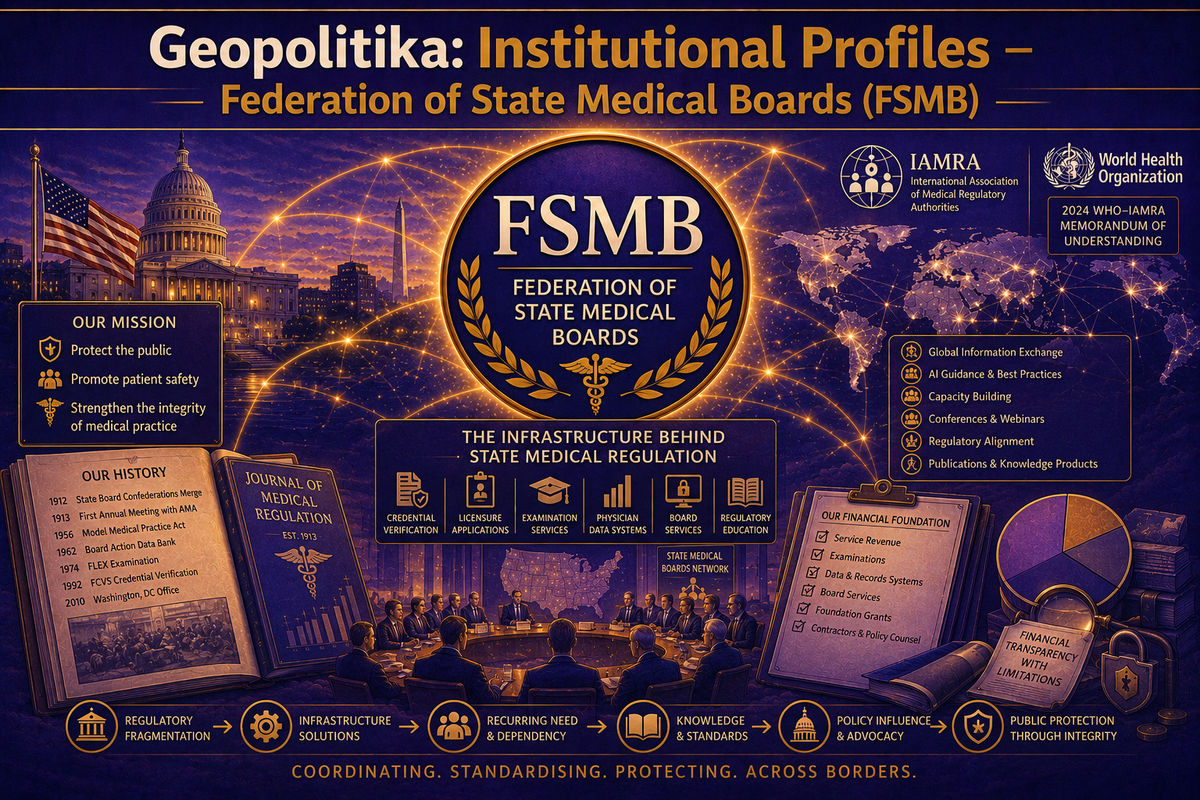
This institutional profile forms a part of the Geopolitika project to map Anglo-American power structures by examining their founding mythologies, leadership, linkages to power, public face, the nature of their outputs and who these are directed towards. These profiles are primarily generated from materials provided on their own websites, which are then analysed using a structured institutional analysis framework—see methodology statement at foot of article.
—
Executive Summary
The Federation of State Medical Boards (FSMB) presents itself as a national non-profit entity, supporting US state medical boards, protecting the public, promoting patient safety, and strengthening the integrity of medical practice. Its public face is domestic, technical and service-oriented.
This article’s structural finding is sharper: FSMB functions as a state-adjacent professional-regulatory infrastructure hub. State boards retain formal licensing and disciplinary authority; FSMB supplies the connective machinery that makes decentralised regulation workable—credential verification, physician data systems, licensure applications, closed-programme records, examination services, board portals, regulatory education, policy advocacy, medical-regulatory scholarship, AI guidance and FSMB Foundation grants.
These roles create the central contradiction of the FSMB: while ostensibly a US-based coordinator of state medical boards, it simultaneously functions as a node in wider transnational medical-regulatory infrastructures. Through the International Association of Medical Regulatory Authorities (IAMRA), FSMB’s domestic infrastructure logic enters a global regulator-to-regulator field of cross-border information exchange, AI guidance, conference convening, shared ‘best practice’ protocols and regulatory alignment.
The 2024 WHO-IAMRA Memorandum of Understanding (MOU) sharpens that international layer. It does not make FSMB a formal party or create a world regulator (yet!). Rather, it formalises a pathway through which World Health Organisation (WHO) guidance, evidence agendas, technical experts, capacity-building programmes, conference themes, webinars, publications and regulatory knowledge products can move through IAMRA’s medical-regulatory network.
The money follows the same pattern. FSMB’s material base rests on service revenue from credentialing, records infrastructure, examination functions, board services, Foundation grantmaking, contractors, policy counsel and financial opacity. Financial disclosures show structural relationships and material flows, not intent.
FSMB reproduces power through infrastructure. It converts regulatory fragmentation, credentialing burden, physician mobility, AI uncertainty, misconduct concerns, board-capacity gaps and public-protection demands into recurring need for its services, data systems, guidance, publications, advocacy and grants.
The article’s question is therefore not whether FSMB is good or bad. It is what kind of power emerges when public protection becomes infrastructure—first nationally, then internationally—and who governs that infrastructure.
History and Founding
On its History page the Federation of State Medical Boards dates its origin to 1912, when the National Confederation of State Medical Examining and Licensing Boards and the American Confederation of Reciprocating Examining and Licensing Medical Boards, merged. In 1913, FSMB launched its Quarterly, later the Journal of Medical Regulation, and held its first annual meeting alongside the American Medical Association (AMA) meeting in Chicago, a practice that continued until 1982. FSMB’s official history presents this as state-board cooperation in the service of public health protection.
The timing matters. FSMB emerged in the institutional aftermath of the 1910 Flexner Report, when American medicine was being reorganised around university affiliation, laboratory science, credentialed training, licensing discipline and professional standardisation. FSMB did not create that settlement alone. The available article corpus does not prove that FSMB was a direct instrument of Flexner, Carnegie, Rockefeller philanthropy or the AMA. Its significance is more precise: FSMB entered the field when licensing boards, accreditation standards, professional associations, philanthropic capital and state authority were converging around a narrower definition of what was and was not “legitimate” medicine.
That convergence did not merely seek to improve medicine. It defined what counted as medicine. Allopathic, laboratory-centred and increasingly pharmaceutical practice moved into the licensable centre. Eclectic medicine, homeopathy, naturopathy, botanical practice, midwifery and other non-allopathic systems were pushed toward the margins. The issue is not whether every displaced practice was effective. The issue is boundary power: who could practise, what knowledge counted, and which therapies remained inside the recognised professional order?
FSMB’s first two years already showed a pattern. In 1912, medical-board coordination became institutionalised. In 1913, regulatory publication began, and FSMB embedded its annual meeting alongside the AMA. Licensing authority, professional association infrastructure and regulatory knowledge production were fused early. FSMB was not merely discussing regulation. It was helping build the machinery through which medical legitimacy would be examined, published and enforced.
Its later history extends the same accumulation logic. The 1956 model medical practice act expanded model-law influence. The 1962 Board Action Data Bank turned discipline into shared regulatory data. The Federation Licensing Examination (FLEX) and later the United States Medical Licensing Examination (USMLE®) linked licensure to national examination architecture. FCVS made credentials into source-verified portfolios. The Uniform Application, Physician Data Center (PDC), GME Records for Closed Programs, Washington advocacy, licensure-compact work, opioid collaboration and AI guidance added further layers. In 2010, the FSMB opened an office in Washington, D.C., to take a more proactive role in advocating for state and federal legislation impacting medical regulation.
The official history calls this growth. The structural reading calls it institutional accumulation. FSMB stabilised the regulatory architecture that made state-based medical licensure durable: records, exams, applications, data, publications, model policy and professional-regulatory coordination.
That domestic architecture now has an international extension. Through IAMRA, FSMB’s infrastructure logic enters a wider regulator-to-regulator field. The historical pattern therefore runs from state-board coordination to national operating architecture, and from national operating architecture to transnational medical-regulatory adjacency.
FSMB’s founding mythology is not simply wrong. It is incomplete. It tells a story of public protection through professional order. The missing layer is that professional order also means boundary control. FSMB’s historical role was not to command American medicine. It was to help make one model of medical regulation administratively durable—a function now operating at both national and international scales through networked regulatory infrastructure.
The People
The Federation of State Medical Boards is not held together only by programmes and services. Its personnel layer functions as a production network. Senior figures route distinct forms of institutional capacity: executive continuity, advocacy, professional development criteria, qualification and competency assessment, finance, physician data, education, Foundation grantmaking, board legitimacy and international regulatory coordination. These are role-based power channels, not evidence of covert orchestration. The profiles of the principal individuals of FSMB are as follows:
- Humayun J. Chaudhry is the central continuity node. As FSMB President and Chief Executive Officer, he links executive management to board governance. He also appears in FSMB Foundation materials, sits ex officio in AI-related work, serves as Secretary of the IAMRA, and previously chaired that organisation from 2016 to 2018. The 2024 WHO-IAMRA MOU signing account also places him in the signing context as IAMRA Secretary, alongside WHO, IAMRA and then-FSMB Chair Jeffrey Carter. Chaudhry’s role connects domestic FSMB authority, Foundation legitimacy, emerging-risk guidance and international medical-regulatory coordination.
- Lisa A. Robin anchors advocacy and communications. As Chief Advocacy Officer, she has led FSMB’s Washington, D.C. presence, government affairs, policy development, communications and Foundation interface. A 2026 transition note places Carolyn Mullen in the successor advocacy lane, linking government affairs, public policy and legislative engagement.
- Mark L. Staz anchors the learning and ethics-policy layer. As Chief Learning Officer, he directs education, medical-regulation policy, ethics and professionalism work, and FSMB’s international collaborations, including IAMRA. His role links training, norm-setting and emerging-technology guidance.
- Additionally, Todd A. Phillips sits at the material-capacity node. As Chief Financial Officer, he connects operating revenue, service infrastructure, compensation, contractors and the Foundation’s financial layer. Aaron Young leads research and data integration, tying the institution to the PDC and the systems that make physician status and regulatory trends legible across jurisdictions. David A. Johnson oversees assessment infrastructure, including examination-related services that shape licensure eligibility and professional mobility.
At board level, Christy L. Valentine Theard links governance to state-board representation and AI ethics work. Mark B. Woodland connects future leadership to medical education and ethics-policy infrastructure. Shawn P. Parker provides finance oversight. George M. Abraham bridges FSMB governance, Foundation continuity and academic-medical authority.
The Foundation board and staff layer routes capital into board-capacity grants, technology modernisation, emergency preparedness and regulatory projects. This creates a feedback loop: accumulated assets fund “support” for the ecosystem in which FSMB remains central.
The international layer sharpens the personnel map. Chaudhry’s IAMRA role places FSMB leadership inside a global regulator network. The WHO-IAMRA MOU signing context places Carter, then FSMB Chair, visibly inside the WHO-IAMRA artefact field, although FSMB was not a formal party to the agreement. Joan Simeon, former IAMRA Chair and Chief Executive of the Medical Council of New Zealand (MCNZ), adds a second high-value personnel bridge between IAMRA and a national medical regulator. Heidi Oetter and other IAMRA directors from Canada, Australia, the United Kingdom, Africa, Asia and South America widen the same regulator-to-regulator ecology.
Advocacy group New Zealand Doctors Speaking Out for Science (NZDSOS) critiques show why these personnel edges became politically salient. In “Dark Truth Revealed: Medical Censorship, Dubious Networks and the Medical Council of New Zealand,” “MCNZ: Alarming Evidence of Subversion?,” and “NZ Administrator Joan Simeon Commits Global Medical Regulation Into World Health Organisation Hands,” NZDSOS connects Chaudhry’s FSMB/IAMRA role, Simeon’s MCNZ/IAMRA role, FSMB-IAMRA proximity and the WHO-IAMRA MOU to concerns about medical-council independence, professional speech and sovereignty. The articles are not treated here as proof of capture. They show the contested field: regulatory authority remains formally national while regulator-network participation becomes increasingly international.
Collectively, this personnel network operationalises FSMB’s infrastructural power. It translates regulatory complexity into standardised tools, physician data, education, policy guidance, grant-funded modernisation and international alignment while retaining the language of public protection.
Funding and Material Flows
The Federation of State Medical Boards’ material base is the operating substrate of its authority. The same public-protection architecture that supports state boards also produces service revenue, data dependence, grantmaking authority, contractor relationships, policy capacity, education infrastructure and financial reserves.
Financial disclosures are treated here as structural evidence. They show relationships and flows. They do not prove intent, orchestration or misconduct.
The first flow runs from regulated professionals and applicants into FSMB-linked services. Physicians, physician assistants, resident applicants, internationally trained doctors, mobile practitioners and closed-programme trainees need records, applications, transcripts, verification, examination histories and board-recognised documentation. FSMB answers through FCVS, the Uniform Application, GME Records for Closed Programs, transcript and examination-history services, examination functions and the PDC. The user pays for a service; the licensing system creates the need.
The scale matters. FSMB’s 2025 Form 990 financial accounts identify approximately $67.0 million in revenue, $65.3 million in expenses, $115.9 million in assets, $26.4 million in liabilities and $89.6 million in unrestricted net assets. Programme-service revenue includes approximately $36.6 million from examinations, $14.8 million from FCVS, $8.6 million from examination-history reports and $2.2 million from PDC membership dues. These figures show FSMB as a service-revenue infrastructure institution rather than merely being a convening body.
The second flow runs from state-board capacity gaps into FSMB Foundation support. Boards need technology upgrades, emergency preparedness, licensing and discipline systems, public communication tools, portability infrastructure, Provider Bridge capacity and compact-related implementation. The Foundation reports that, in 2024, it surpassed $1 million in grant distributions over 20 years, allocated nearly $400,000 for grants, offered awards up to $50,000 and had funded more than 30 state medical and osteopathic boards. This is a feedback mechanism: accumulated assets fund board-facing modernisation, strengthening the ecosystem in which FSMB remains central.
The third flow runs from operating revenue into professional-service infrastructure: compensation, legal work, policy counsel, audit, consulting, branding, IT, meetings, travel and institutional maintenance. Identified contractor examples include Mekanic for branding and creative services, CliftonLarsonAllen for audit or consulting, Brownstein Hyatt Farber Schreck and Alston & Bird as policy counsel, and Anne K. Lawler for consulting. The policy-counsel layer matters because it sits beside FSMB’s Washington advocacy function. That alignment is structurally relevant; specific policy effects require contracts, deliverables, lobbying records and adoption evidence.
The fourth flow runs into education and knowledge production. FSMB staff, committees, publication systems and training infrastructure produce the Journal of Medical Regulation, educational modules, professional-boundaries content, ethics materials, complaint-process education and regulatory training. This is norm production: FSMB teaches the field how to understand licensure, professionalism, public trust, physician wellbeing, ethics and regulatory responsibility.
The fifth flow runs from emerging risks into guidance authority. AI, telemedicine, opioids, professional misconduct, public trust and workforce concerns become occasions for workgroups, model guidance, newsletters, modules, reports, advocacy and board-facing recommendations. The AI workstream is the clearest example: uncertainty becomes a guidance problem; the guidance problem becomes a new site of FSMB interpretive authority.
These flows create the accumulation loop. Licensure fragmentation generates verification needs; FSMB tools answer them. Closed programmes create records gaps; FSMB supplies repository infrastructure. Physician mobility creates portability burdens; FSMB supplies shared applications and data systems. Board capacity gaps generate Foundation grants. Regulatory complexity repeatedly produces demand for FSMB-mediated solutions.
The international layer adds a further material-flow question. The WHO-IAMRA MOU states that each party funds its own activities unless later letters of agreement provide otherwise, and that collaborative activities are agreed case by case. The MOU therefore does not disclose project budgets, sponsorships, staff allocations, expert payments, LMIC travel support, webinar funding, publication costs, product arrangements, IP terms or royalties. It creates the architecture for later flows; it does not reveal those flows.
The opacity boundary is decisive. The public materials do not fully show data-sharing agreements, policy-counsel deliverables, USMLE governance or revenue-sharing structures, Foundation grant obligations, related-organisation arrangements, service pricing logic, cost-allocation rules, contractor scopes or downstream data-use terms. The related-organisation layer also remains incomplete: the public materials do not fully show shared services, cost allocation, staff support, grant administration or operational dependencies between FSMB and the Foundation. Those absences prevent stronger causal claims. They mark the point where structural analysis stops and document demand begins.
The Machine Beneath the System
The Federation of State Medical Boards operates as a stack. At the base is the legal licensure gate. State medical and osteopathic boards retain formal authority to license, discipline, suspend, reinstate and regulate physicians. FSMB does not abolish that authority. It makes it interoperable.
Above the state gate sits the infrastructure layer. FCVS turns credentials into primary-source verified portfolios. GME Records for Closed Programs turns fragile training records into retrievable licensure evidence. The Uniform Application standardises repeat state applications. The PDC makes physician status, board actions and regulatory trends legible across jurisdictions. The Journal of Medical Regulation, educational modules and professional training turn licensure, ethics, professionalism, complaint handling and public trust into teachable regulatory doctrine. AI workgroups and model guidance turn emerging technological uncertainty into board-facing policy architecture. The FSMB Foundation turns board-capacity gaps into grant-funded modernisation.
This is the operating machine:
problem → standardising tool → institutional authority → recurring dependence
Licensure fragmentation creates verification problems; FSMB supplies credentialing and application tools. Closed programmes create records gaps; FSMB supplies repository infrastructure. Physician mobility creates portability burdens; FSMB supplies shared forms and data systems. Misconduct and public-trust concerns create education demand; FSMB supplies training and ethics materials. AI creates oversight uncertainty; FSMB supplies workgroups and guidance. Board technology gaps create capacity needs; the Foundation supplies grants.
The WHO-IAMRA Memorandum of Understanding shows the same machine in international administrative form. Health-practitioner regulation gaps become a World Health Organisation (WHO) guidance-uptake problem. Evidence uncertainty becomes a research-agenda problem. Normative statements become an expert-identification problem. Low- and middle-income country regulatory capacity becomes a technical-support, conference and webinar problem. Publications and products become review, intellectual-property and access-governance problems. The point is not coercion. The point is that international regulatory alignment can be built through ordinary administrative instruments.
The system defended is state-based professional medical licensure and disciplinary governance in the United States. FSMB’s role is not to replace that system, but to stabilise it. It preserves the public story of decentralised state authority while supplying the practical infrastructure beneath it.
That is the central contradiction: state-based authority, national operating architecture.
The contradiction is productive. State boards remain legally sovereign within their jurisdictions, but the practical conditions of regulation—credentials, records, applications, data, education, publications, guidance and grant-funded capacity—increasingly move through shared FSMB-linked systems – as do the individuals involved within this architecture. Legal authority remains dispersed. Practical administration becomes nationally aligned.
The machine can be useful. It can reduce duplication, preserve records, support boards, improve portability, educate regulators and help the system respond to misconduct or AI. But usefulness is how dependence forms. Each real problem becomes an occasion for a standardised tool. Each tool becomes part of the operating environment. Each operating environment reinforces FSMB’s position as infrastructure provider.
FSMB therefore does not need to command state boards to shape the system. It helps define the systems through which state-board authority becomes usable. Its power is not sovereignty. Its power is operational necessity.
The infrastructure-hub reading does not depend on hidden control. It follows from documented functions: credentialing, records, applications, data systems, education, publication, guidance and grants.
Ecosystem and Worldview
The Federation of State Medical Boards sits at the junction of seven regulatory ecosystems, described as follows:
- The state-board system: State medical and osteopathic boards hold formal licensing and disciplinary authority. FSMB gives that dispersed field a national support structure, shared vocabulary and common operating tools.
- Credentialing and physician data: FCVS, GME Records for Closed Programs, the Uniform Application, the PDC, board portals and disciplinary-data tools make professional status legible across jurisdictions.
- Examination and assessment: Through USMLE-related services, SPEX and examination-history infrastructure, FSMB sits near the testing architecture that shapes licensure eligibility and professional mobility.
- Policy advocacy: FSMB’s Washington, D.C. presence, government-affairs work, advocacy communications, model policies, licensure-compact work, opioid collaboration and AI guidance place it inside the rule-formation environment.
- Regulatory education: FSMB produces modules, professional-boundaries materials, ethics and professionalism content, complaint-process education and board-facing training. Regulation becomes a taught worldview.
- Medical-regulatory scholarship: The Journal of Medical Regulation gives the field a publication venue, memory system and expert language. Editorial independence may be real; the journal still operates inside FSMB’s institutional ecology.
- Foundation-supported modernisation: The FSMB Foundation routes grants into board capacity, technology upgrades, emergency preparedness, public communication, licensing, discipline, portability and related projects. It funds the ecosystem in which FSMB remains central.
The strongest public-facing reading places FSMB in three overlapping institutional families:
- Medical-regulatory professional governance
- Credentialing and physician-data infrastructure
- State-adjacent expert governance
Around those sit key adjacencies: medical education assessment, public-health policy advocacy, healthcare AI governance, Foundation-backed regulatory modernisation and international medical-regulatory coordination.
The international layer is now material. Through the IAMRA, FSMB enters a regulator-to-regulator field of global convening, shared learning, AI guidance, cross-border information exchange and policy diffusion. IAMRA’s Physician Information Exchange turns doctor mobility and disciplinary history into a cross-border information-sharing problem. The 2024 WHO-IAMRA MOU gives this layer a formal global-health governance channel: World Health Organisation (WHO) guidance uptake, evidence-gap work, regulatory perspectives for normative statements, technical expert identification, capacity building, conference themes, sponsored participation for low- and middle-income countries, and webinar development.
FSMB is not a formal party to the WHO-IAMRA MOU. Its relevance is adjacency and infrastructure transfer. The WHO’s account places IAMRA Secretary Humayun J. Chaudhry and then-FSMB Chair Jeffrey Carter in the signing context. The MCNZ enters through Joan Simeon, identified by WHO as both IAMRA Chair and MCNZ Chief Executive.The WHO side of the MOU is represented by WHO Director-General Tedros Adhanom Ghebreyesus, who signed the agreement with Simeon; FSMB enters the signing context through Carter and Chaudhry, not through formal party status. Later IAMRA newsletters show the MOU becoming programme language: WHO Guidance workshops, low- and middle-income country peer learning, conference themes, webinars and technical-support language.
This international layer is politically contested. NZDSOS treats FSMB-IAMRA-WHO-MCNZ linkages as a sovereignty, professional-speech and regulator-accountability problem in the articles cited in The People section above. Those pieces are used here as a counter-archive, not as proof of command or capture.
The significance is infrastructural. The same logic visible domestically in FSMB—fragmented authority made workable through tools, data, guidance, education and expert systems—appears internationally through IAMRA and WHO-linked collaboration. WHO guidance becomes an uptake object. Evidence gaps become a research agenda. Expert identification becomes a power channel. Conferences and webinars become diffusion sites. Publications and products become governed outputs.
The worldview holding these ecosystems together is public-protection expert regulation. Its doctrine is simple: state boards protect the public; regulation requires expert coordination; licensure integrity requires standardised verification and data; professionalism and trust are regulatory concerns; emerging technology requires guidance; board capacity can be improved through grants; scholarship improves regulation.
That worldview is coherent and often persuasive. It also narrows the field. Its preferred solutions are expert guidance, credential verification, data systems, educational modules, model policies, grants, publications and professional-regulatory collaboration. Less visible are patient-led accountability, applicant-fee reduction, IMG burden audits, privacy review, independent complaint-system evaluation, state-board dissent and contract transparency.
That is the blind spot. The people most affected by licensure, discipline, complaint systems, credentialing and data infrastructure are not equally central as knowledge producers. Patients, complainants, applicants, IMGs, disciplined practitioners and dissenting boards appear mostly as objects of regulation or beneficiaries of protection, not as actors capable of defining what protection should mean.
Accountability and Omissions
The Federation of State Medical Boards has visible accountability forms: board governance, a House of Delegates, FSMB Foundation governance, a public-protection mandate, and the Journal of Medical Regulation’s peer-review and editorial-independence claims. While these structures matter, the question is whether they have enough force to alter FSMB’s material architecture when affected populations object.
The affected populations are visible but not centred. Patients justify the system, but appear mostly as beneficiaries rather than narrators of complaint-system experience, disciplinary delay, regulatory failure or medical harm. Physicians, physician assistants, resident applicants, mobile practitioners, closed-programme trainees and international medical graduates are governed through licensure, credentialing, records, examination histories and data systems, but their experience of fees, delays, correction burdens, repeated documentation and appeal friction is not materially central.
The IMG gap is especially important. Internationally trained physicians sit at the intersection of workforce need, credential recognition, licensing exclusion, examination pathways and board discretion. Their position is structurally central to national credentialing and licensure infrastructure, yet their burden is not centred in the public corpus.
Data governance is the core promoted omission. FSMB-linked systems make physicians, applicants, credentials, board actions and professional histories legible across jurisdictions. The public materials do not fully show access rules, retention periods, correction rights, reuse terms, pricing, downstream users, dispute procedures, appeal rights or cross-border sharing terms. In a system built on professional data, those agreements are power documents—especially once data moves through international channels such as IAMRA’s Physician Information Exchange Working Group—featuring Natalie Pattinson (General Medical Council, UK) and Nisha Patel (shown as MCNZ’s Manager, Registration) .
The WHO-IAMRA Memorandum of Understanding adds a second omission layer. It points to later case-by-case letters or agreements, but the current corpus does not show them. It names World Health Organisation (WHO) guidance uptake, evidence gaps, research agendas, technical experts, low- and middle-income country participation, webinars, publications and products, but does not show implementation plans, national adoption records, expert-selection criteria, conflicts, curricula, speaker lists, funding sources, sponsorship terms, review correspondence, intellectual-property allocations or royalty arrangements.
The IAMRA newsletters sharpen the point. Early post-MOU public material gives limited implementation detail. Later newsletters turn the MOU into programme language: capability-building in global workforce regulation, a Dublin low- and middle-income country workshop, joint initiatives to advance WHO Guidance, technical support, educational programmes, conference themes and webinars. The record moves from limited public detail to claims of implementation activity—without publishing the project agreements, funding arrangements, expert-selection records, curricula, publication-review exchanges or adoption evidence needed to test the framework. Another MOU handoff sits in knowledge-product governance: the agreement anticipates publications, products, review rights, intellectual-property terms, access commitments and possible royalties, but the public record does not show what outputs, if any, were produced under those clauses.
NZDSOS is useful here as an opacity signal. In “NZ Administrator Joan Simeon Commits Global Medical Regulation Into World Health Organisation Hands,” NZDSOS said press releases about the MOU were available from IAMRA, WHO and the MCNZ while the operative document itself had not been publicly shared and was difficult to obtain. The point is not to adopt NZDSOS’s capture frame. The point is document demand: if the MOU strengthens public protection and health-practitioner regulation, later implementation letters, funding arrangements, expert-selection records, webinar curricula, sponsorship details, publication-review exchanges and adoption pathways should be inspectable.
Policy-counsel deliverables are also absent. FSMB’s advocacy function is visible, and financial material identifies policy counsel as structurally relevant. But without contracts, deliverables, lobbying records or work-product descriptions, the money-to-policy chain cannot be traced. Policy influence remains possible; specific causal effects remain unproven.
State-board dissent is not centred. FSMB speaks as a national support body and representative voice, but the corpus does not foreground contested votes, dissenting boards, rejected proposals, governance disputes or disagreements over services, fees, data systems, AI guidance, compact priorities or advocacy positions. If FSMB represents a field, dissent is part of the evidence needed to test representation.
Foundation grant agreements remain missing. Grant categories are visible—technology, emergency preparedness, licensing, discipline, public communication, Provider Bridge, portability, compact-related work and education—but obligations are not. The public corpus does not show whether grants require particular vendors, sub/contractors, data standards, reporting templates, interoperability commitments or continuing platform relationships.
Contract transparency is incomplete. Contractor names and categories appear in financial material, but scope, recurrence, deliverables, procurement logic, conflicts of interest and performance criteria do not. That prevents stronger claims about vendor influence or policy effect.
These omissions are not accusations. They are validated absences against FSMB’s own public-protection domain. They mark where the institution’s self-description would need outside evidence to become fully testable.
The Trap and the Contradictions
The Federation of State Medical Boards is difficult to critique because it is plausibly useful. Licensure is fragmented. Credentials need verification. Closed training programmes create records gaps. Boards need education, technology, data, emergency preparedness and policy support. AI creates real oversight uncertainty. Professional misconduct requires regulatory response. Patients need protection.
That usefulness is the trap.
Power is strongest when it attaches itself to real needs. Ask about fees, and the answer is credential integrity. Ask about data governance, and the answer is patient safety. Ask about policy counsel, and the answer is sound regulation. Ask about Foundation grants, and the answer is board capacity. Ask about applicant burden, and the answer is licensure standards. Ask about state-board dependence, and the answer is support.
The public-protection frame absorbs critique of the public-protection infrastructure. The WHO-IAMRA Memorandum of Understanding and World Health Organisation (WHO) update frame global health-practitioner regulation through safety, competence, capacity building and public protection. NZDSOS frames the same artefact field as censorship, sovereignty loss and regulatory capture. The contradiction matters more than either total frame: benevolent purpose can describe a real benefit while narrowing the space to question who drafts guidance, selects experts, funds projects, reviews publications and governs downstream adoption.
That does not make the public-protection frame false. It makes it powerful. FSMB’s language can operate as weaponised altruism: benevolent purpose narrows scrutiny of material flows. Its education and guidance products can create closure mimicry: a problem appears addressed while generating new cycles of training, reporting, interpretation and oversight. Credentialing and data systems can claim technical neutrality, presenting verification as administrative rather than political. Expert regulation can become an expertise shield, displacing patients, applicants, international medical graduates, complainants and dissenting boards as knowledge producers. Support can become support-as-nonpower, where assistance conceals infrastructural centrality.
The following contradictions do not cancel FSMB—they explain it:
- Decentralised law vs. centralised infrastructure. State boards hold formal authority, but FSMB supplies shared records, applications, data, education, guidance, publications and grants. Legal sovereignty remains dispersed while practical administration becomes nationally aligned.
- Public protection vs. regulated-population dependence. Patients justify the system, but physicians, physician assistants, applicants, international medical graduates and mobile practitioners carry many of the fees, records burdens, verification requirements, examination histories and data dependencies that sustain it.
- Support vs. dependence. FSMB supports boards, and that support may be real. Repeated reliance on shared services, model guidance, data systems and Foundation-funded capacity can still make support structurally sticky.
- Evidence-based regulation vs. narrow evidence visibility. FSMB’s publication and education infrastructure present regulation as expert and evidence-based, yet patient experience, applicant burden, IMG exclusion, privacy concerns and dissenting-board perspectives are not equally centred.
- Innovation grants vs. agenda-setting. FSMB Foundation grants may modernise boards, but funding also selects what counts as modernisation: technology, portability, Provider Bridge, communication, licensing, discipline and compact-related projects.
- AI safety vs. institutional expansion. AI governance is a real problem. FSMB’s workgroup may help boards respond. It also extends FSMB’s relevance into healthcare AI regulation.
- Editorial independence vs. institutional ecology. The Journal of Medical Regulation may be peer-reviewed and editorially independent. It still functions inside FSMB’s broader knowledge-production ecosystem.
- National sovereignty vs. international alignment. FSMB retains a domestic focus and state boards retain legal authority, yet IAMRA and the WHO-IAMRA MOU show how medical-regulatory alignment can occur through guidance uptake, expert selection, evidence agendas, conferences, webinars, capacity building and cross-border information exchange rather than formal command. Sovereignty remains legal; alignment becomes practical.
- Domestic mandate vs. transnational function. FSMB presents as a US-domiciled coordinator of state medical boards, focused on domestic licensure, discipline, credentialing and public protection. In practice, it also operates as a node in a broader international medical-regulatory architecture. Its leadership has held senior IAMRA positions, including Humayun J. Chaudhry as current IAMRA Secretary and former Chair. FSMB figures appear in the public signing context of the 2024 WHO-IAMRA MOU: WHO identified Dr Jeffrey Carter, then Chair of FSMB, and Chaudhry, IAMRA Secretary, as present in that signing environment. FSMB is not a formal party to the MOU, but its visibility in the artefact field matters. Its domestic infrastructure logic—credentialing, data, guidance, education, public-protection framing and regulator support—now sits beside international regulator coordination, cross-border information exchange, AI guidance and WHO-linked health-practitioner regulation pathways. Formal authority remains domestic. Operational reach, personnel networks and infrastructural logic have become transnational.
The trap is escaped only by refusing the binary. FSMB is not rendered here as a benevolent support body or covert control apparatus. The evidence supports a more uncomfortable structure: a public-protection institution whose useful functions reproduce its centrality, and whose contradictions make that centrality harder to challenge.
Downstream Power and Stakes
The Federation of State Medical Boards’ downstream power is the power to define normal solutions. It does not only respond to regulatory problems. It helps decide which responses become thinkable, fundable, publishable, teachable and administratively usable.
Licensure fragmentation becomes a problem of shared applications, verification, records and data systems. AI risk becomes a problem of workgroups, model guidance and board-facing recommendations. Professional misconduct becomes a problem of education, ethics, professionalism and reporting norms. Board capacity gaps become a problem of FSMB Foundation grants, technology upgrades, Provider Bridge, public communication, licensing, discipline and compact implementation. Regulatory uncertainty becomes a problem of scholarship, conferences, reports, modules, newsletters and expert interpretation.
That solution set benefits identifiable actors. State boards gain tools, capacity, guidance, data, grants and national support without surrendering formal sovereignty. FSMB gains institutional centrality, service relevance, policy authority, publication authority and recurring demand for its infrastructure. The Foundation gains legitimacy as a funder of board modernisation. Contractors, policy counsel, auditors, consultants and technology providers gain work around the regulatory system. Credentialing bodies, employers, hospitals and boards gain more legible physician data. Patients may benefit if better systems improve discipline, communication, safety and board responsiveness.
The burdens do not fall evenly. Physicians, physician assistants, resident applicants, international medical graduates, closed-programme trainees, mobile practitioners and credentialing-dependent professionals pay through fees, documentation demands, repeated verification, examination histories, correction burdens, administrative friction and dependence on recognised systems. Patients and complainants may also pay indirectly if public-protection infrastructure remains opaque, slow, expert-controlled or insufficiently responsive to lived harm. State boards may gain capacity while becoming reliant on shared tools, grants, data standards and model guidance.
The stakes are larger than FSMB because the same infrastructure logic now extends internationally through IAMRA-linked coordination.
- Professional mobility. A system that improves portability can also define the gate through which portability must pass. FCVS, GME Records for Closed Programs, the Uniform Application, examination histories and PDC data can reduce duplication, but they also make movement depend on recognised infrastructure—increasingly including cross-border information exchange.
- Patient protection. FSMB’s public-protection frame may support safer regulation, better board capacity and faster access to information. But patient protection cannot be tested only through institutional claims. Patients and complainants must appear as evidence producers, not merely beneficiaries.
- Data governance. Physician credentials, board actions, examination histories, licensure status and disciplinary data shape careers, reputations, employment, mobility and public trust. Access rules, correction rights, retention periods, pricing, downstream sharing, cross-border use and appeal mechanisms are therefore power questions.
- Policy influence. FSMB’s advocacy office, model policies, compact work, opioid collaboration, AI guidance, newsletters and policy-counsel layer place it in the rule-formation environment. Policy influence remains possible; specific causal effects require deliverables, lobbying records, adoption records and board-level implementation evidence.
- Regulatory imagination. Once a field learns to solve problems through expert guidance, credentialing tools, data systems, modules, model policies, grants, publications and professional-regulatory collaboration, other solutions become less visible: patient-led accountability, independent complaint-system audits, fee reduction, privacy audits, IMG burden studies, publication of state-board dissent and contract transparency.
- AI governance. AI creates real oversight problems. FSMB’s workgroup and model guidance may help boards respond. They also move FSMB toward the next regulatory frontier, where clinical responsibility, machine output, physician supervision, patient safety and board discipline will be defined—increasingly alongside international guidance environments.
- Public trust. Trust cannot rest on public-protection language alone. It requires visible accountability where power is exercised: fees, data, contracts, grants, policy counsel, complaint systems, disciplinary outcomes, guidance adoption and affected-population experience.
The WHO-IAMRA Memorandum of Understanding adds a second international pathway beside cross-border data exchange: guidance and expertise diffusion. Through the MOU, World Health Organisation guidance, research priorities, technical experts, regulatory perspectives, conference themes and webinar curricula can circulate through IAMRA’s regulator network. That pathway may improve regulatory capacity. It may also shift the centre of gravity away from national public contestation and toward expert-network alignment.
The IAMRA’s newsletters make FSMB’s transnational function more concrete. The September 2025 newsletter presents the Dublin conference as a high-level regulator gathering: more than 460 participants from 37 countries, hosted by the Medical Council of Ireland, opened by WHO Director-General Tedros Adhanom Ghebreyesus, and addressed by former Irish Prime Minister Leo Varadkar. Conference imagery shows Suzanne Crowe of the Medical Council of Ireland, Joan Simeon as IAMRA Immediate Past Chair, the Lord Mayor of Dublin and Medical Council of Ireland CEO Maria O’Kane meeting at the opening; the same page identifies Beverly Shelton of FSMB working the IAMRA booth with Sarah Heermans, IAMRA’s Director of Operations. The newsletter then turns the conference into programme architecture: a pre-conference LMIC workshop advanced the 2024 IAMRA-WHO MOU; IAMRA’s 2025–27 initiatives include a Global Peer Learning Program for regulator knowledge exchange, implementation of WHO Guidance through joint initiatives, technical support and educational programmes, an AI and Emerging Technologies network for future-ready regulation, and compassionate, culturally safe approaches to fairness and community responsiveness. The November 2025 Physician Information Exchange webinar adds the data layer, with Dustin Dollar, Director of FSMB’s Physician Data Center, presenting alongside the aforementioned Natalie Pattinson and Nisha Patel on cross-border physician-information exchange. FSMB is not shown as commanding IAMRA or WHO. Its people, support functions and data expertise appear inside the practical machinery of IAMRA’s international regulator network.
In that context, the downstream question is not whether public protection matters. It is who gains power when public protection is made dependent on systems FSMB helps build, price, maintain, interpret and internationalise.
FSMB’s tools may solve real problems. They also organise who benefits, who pays, who becomes legible, who remains unheard, and which futures medical regulation can imagine — nationally and across borders.
Ostensible Purpose, Actual Function, and Remaining Questions
The Federation of State Medical Boards’ ostensible purpose is public protection through support for state medical boards. Its public language centres patient safety, licensure integrity, professional discipline, regulatory best practice and public welfare. That purpose is not dismissed here. FSMB performs real functions that can assist boards, professionals and patients.
Its actual function is more specific: FSMB makes fragmented state-based medical regulation administratively possible at national scale. It converts public-protection mandates into material infrastructure: verifiable credentials through FCVS, standardised applications through the Uniform Application, retrievable training records through GME Records for Closed Programs, searchable physician data through the PDC, educable professional norms through modules and the Journal of Medical Regulation, governable emerging risks through AI guidance, fundable board-capacity gaps through FSMB Foundation grants, and policy influence pathways through advocacy and counsel.
This infrastructure can deliver genuine benefits: reduced duplication, preserved records, improved portability, stronger board capacity and tools for addressing misconduct or emerging technologies. The same system also produces dependency, fee burden, data concentration, professional immobilisation and narrowed solution spaces. Physicians, physician assistants, applicants, international medical graduates, closed-programme trainees, disciplined practitioners, patients and state boards encounter different sides of the same architecture.
The evidentiary boundary remains clear. The public corpus does not fully disclose data-governance terms: who accesses physician and applicant data, how long records are retained, what correction rights exist, where data travels, how disputes are resolved, or what appeal mechanisms apply. It does not reveal policy-counsel deliverables, contractor scopes, USMLE Step 3 governance or revenue-sharing structures. It does not show whether Foundation grants require particular vendors, platforms, data standards, interoperability commitments or ongoing alignments. It does not centre patient and complainant experience of complaint systems, disciplinary processes or regulatory outcomes. It does not adequately document applicant, IMG and mobile-physician experience of fees, delay, repeated documentation or administrative dependence. It does not establish whether FSMB governance, the House of Delegates, Foundation structures or the journal’s editorial independence can materially reverse institutional priorities when affected populations object.
The international layer adds a second evidentiary boundary. The WHO-IAMRA MOU raises unresolved questions about later project agreements, funding, expert selection, evidence-gap prioritisation, webinars, conference themes, publications, products, review clauses, intellectual-property terms and adoption pathways. It also leaves open whether FSMB or the MCNZ had any role beyond signing-context or personnel adjacency.
Beyond the 19 February 2024 media release, IAMRA’s newsletters show limited immediate engagement with the WHO-IAMRA MOU. That changes in December 2024, when the MOU-adjacent WHO work appears under the heading “Groundbreaking WHO Global Guidance on Regulation.” IAMRA reports that its September 2024 Baltimore symposium hosted the launch of WHO Health Practitioner Regulation: Design, Reform and Implementation Guidance, describes the Guidance as the first comprehensive WHO document on health practitioner regulation, and states that IAMRA was discussing with WHO how to support implementation through training and education.
By August 2025, the newsletter makes the MOU relationship explicit: “Since signing the IAMRA–WHO Memorandum of Understanding in February 2024, we have worked closely together to contribute to capability building in global workforce regulation.” Joan Simeon frames that collaboration as evidence of IAMRA’s role as “a trusted voice in international regulation” and thanks Humayun Chaudhry and FSMB for their continued support of IAMRA.
The following month, the IAMRA 2025 Dublin conference and Member General Assembly material set out the programme layer more clearly: WHO Director-General Tedros opened the conference; a pre-conference LMIC workshop advanced the 2024 MOU; IAMRA identified implementation of WHO Guidance through joint initiatives, technical support and educational programmes as a 2025–27 initiative; and later newsletters introduced PEER after nearly 50 LMIC regulators explored applying WHO Guidance across diverse contexts.
The record therefore moves from limited immediate public detail to claims of implementation activity. What remains absent are the documents needed to test that activity: project agreements, funding records, expert-selection files, curricula, publication-review exchanges, IP arrangements, implementation metrics and national adoption evidence.
The NZDSOS material adds a legitimacy signal rather than a proof claim. Its 2022–24 critiques indicate that many practising doctors and public critics outside the United States were only beginning to encounter FSMB and IAMRA as politically meaningful actors through controversies involving MCNZ, professional speech, COVID-era regulation and the WHO-IAMRA MOU. That supports a narrower finding: the network’s public salience appears to have lagged behind its institutional activity. It does not by itself prove that “very few” non-US medical professionals knew of FSMB or IAMRA before 2022–23.
The gaps revealed in this trail of events are not allegations of concealment. The structural reading stands: FSMB operationalises public protection through credentialing, records, data systems, education, publications, guidance, advocacy, assessment and grants, while its domestic infrastructure logic now appears inside wider international regulator coordination. Stronger claims about causation, capture, intent or control require primary documents the public-facing materials do not provide.
Conclusion
The Federation of State Medical Boards is best understood neither as a benign trade association nor as a hidden command centre. Both frames are too simple. The evidence supports a more durable structure: FSMB converts state-based medical regulation into a usable national operating system, and that operating system now connects to wider international regulatory alignment.
Its power sits between formal authority and practical necessity. State medical boards retain the legal power to license and discipline. FSMB supplies many of the tools, records, data systems, educational frames, publications, guidance mechanisms, advocacy channels and grant pathways that make dispersed authority function. That is not sovereignty. It is infrastructural power.
The public-protection mission does two things at once. It names a real social purpose: patients should be protected, unsafe practice should be disciplined, and medical regulation should be competent. It also legitimates a material architecture of services, revenue, physician data, professional expertise, contractor relationships, policy capacity and Foundation-backed modernisation.
The same infrastructure can make regulation more efficient while concentrating dependence, narrowing alternatives and making affected populations harder to hear. Its power does not require deception. It follows from ordinary operation. Each regulatory problem becomes a pathway into infrastructure. Each infrastructure layer becomes a source of relevance. Each claim of support reinforces FSMB’s position as the body that can define, service, teach, publish, fund and interpret medical regulation.
The international layer sharpens the finding. Through IAMRA and the WHO-IAMRA Memorandum of Understanding, FSMB’s domestic infrastructure logic appears in a wider regulator-to-regulator environment of guidance diffusion, expert-network alignment, cross-border information exchange, AI governance and capacity-building. FSMB is not shown as commanding WHO or IAMRA. The more precise point is that a US-domiciled organisation formally dedicated to state-board support has become a visible participant in transnational medical-regulatory coordination.
The unresolved issue is governance. FSMB has formal structures, professional legitimacy and public-facing commitments. What remains less clear is whether patients, complainants, physicians, physician assistants, international medical graduates, applicants, disciplined practitioners, dissenting boards and privacy critics can meaningfully reshape the infrastructure when it produces burden, opacity, delay, exclusion or dependency.
The article therefore ends with the governance problem created by FSMB’s own success:
When public protection becomes infrastructure—at national and international scales—who governs the infrastructure?
—
Methodology Note: This analysis draws on publicly available materials produced by the Federation of State Medical Boards (FSMB): institutional history, website materials, leadership biographies, service descriptions, Foundation materials, public reports, policy and advocacy materials, Journal of Medical Regulation references, and publicly available financial-disclosure material. It also draws on the draft corpus assembled for this profile, including FSMB-related source analysis, IAMRA materials, IAMRA newsletters, the 2024 WHO-IAMRA Memorandum of Understanding, WHO’s public signing update, and NZDSOS critiques concerning FSMB, IAMRA, MCNZ, WHO and the MOU. External institutional references include IAMRA, WHO, the Medical Council of New Zealand, US state medical and osteopathic boards, the USMLE ecosystem, and selected national or transnational medical-regulatory bodies referenced in the source corpus. Financial references are treated as structural indicators of material flows, not as proof of impropriety. NZDSOS materials are used as a contested-legitimacy record and counter-archive, not as proof of their strongest conclusions. IAMRA newsletter references are used to track public programme language and visible MOU-related evolution, not to prove undisclosed implementation. Base analytic outputs are available on request. For methodological details, including Transparency Score definitions, typology classifications, confidence calibration and protocol logic, see the Geopolitika Series Methodological Statement.