The Operators: Addendum 6a – Historical Behaviourists
Addendum 6a traces the pre-digital operators who made conscience, fear, motive, desire, conformity and judgement available for behavioural governance, and shows how those surfaces later feed the modern runtime of nudging, platform steering, dissent diagnosis and permission-based administration.
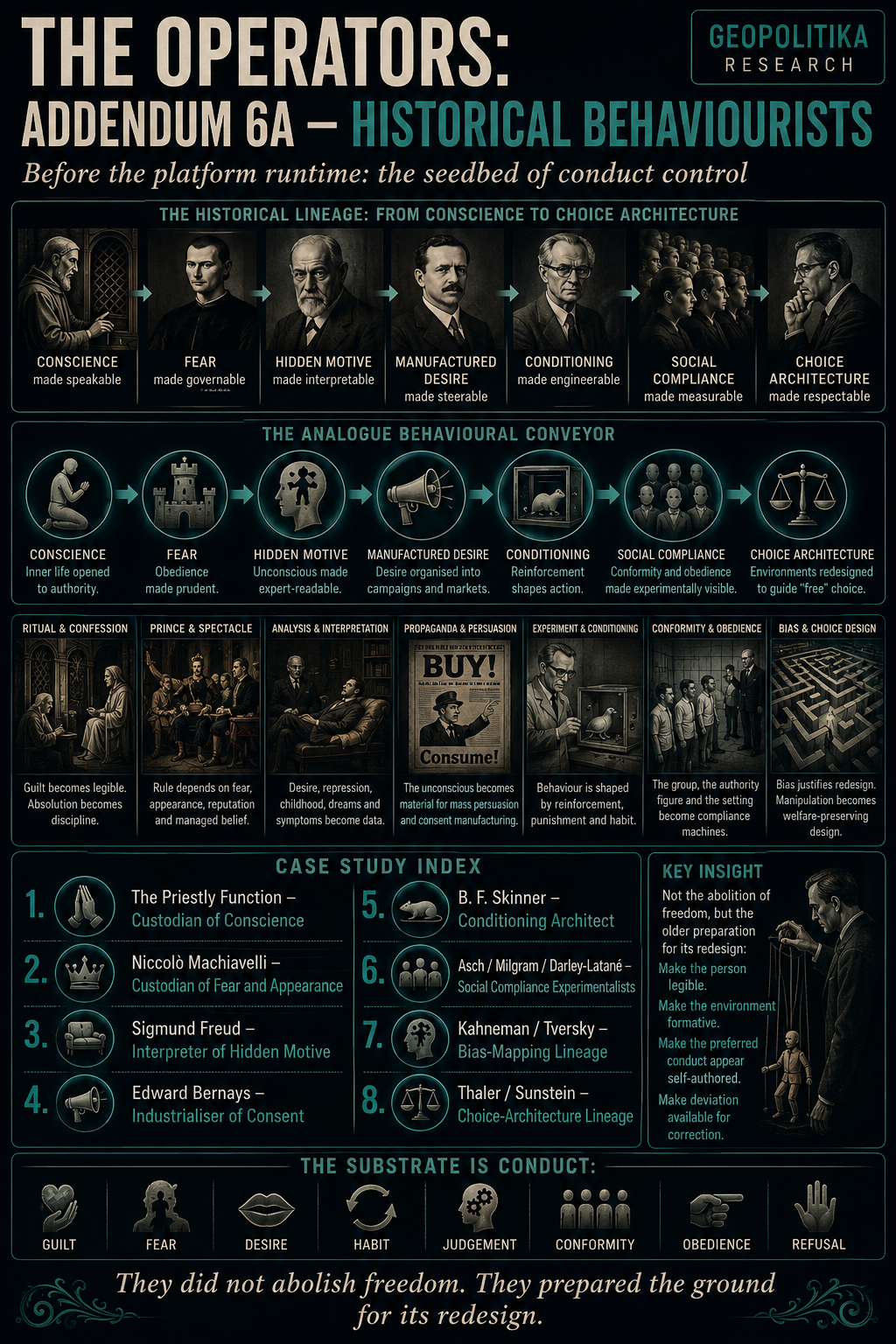
Before behavioural governance became a world of dashboards, nudges, A/B tests, digital interfaces, recommender systems, crisis messaging and epistemic-security programmes, it ran through older machinery: ritual, confession, fear, spectacle, interpretation, propaganda, reinforcement, conformity experiments and bias mapping. This addendum traces that pre-platform lineage across the figures and archetypes that made conduct governable before the behavioural state and platform runtime made it continuous.
Part 6 mapped the modern runtime: signal, segment, predict, nudge, measure, diagnose refusal, escalate and iterate. This addendum moves backward into the seedbed. It asks how conscience became legible, fear became governable, desire became steerable, behaviour became conditionable, conformity became measurable, obedience became experimentally visible, and judgement became redesignable.
The chain is simple:
Conscience → Fear → Hidden Motive → Manufactured Desire → Conditioning → Social Compliance → Choice Architecture
Addendum 6a follows the analogue behavioural conveyor. Part 6 showed the modern runtime: platform, nudge unit, crisis cell, misinformation manager, trust expert, digital identity gate and epistemic-security perimeter. This addendum shows the earlier version: priest, prince, analyst, advertiser, behaviourist, social psychologist and choice architect.
That is the historical movement this addendum maps. Not the abolition of freedom, but the older preparation for its redesign: make the person legible, make the environment formative, make the preferred conduct appear self-authored, and make deviation available for correction. Readers wanting to explore the development of modern mind control might also find the excellent video "The Minds of Men" of value in its deep exploration of the CIA's MK-Ultra programme.
Case Study Index
- The Priestly Function – Custodian of Conscience
- Niccolò Machiavelli – Custodian of Fear and Appearance
- Sigmund Freud – Interpreter of Hidden Motive
- Edward Bernays – Industrialiser of Consent
- B. F. Skinner – Conditioning Architect
- Asch / Milgram / Darley-Latané – Social Compliance Experimentalists
- Kahneman / Tversky – Bias-Mapping Lineage
- Thaler / Sunstein – Choice-Architecture Lineage
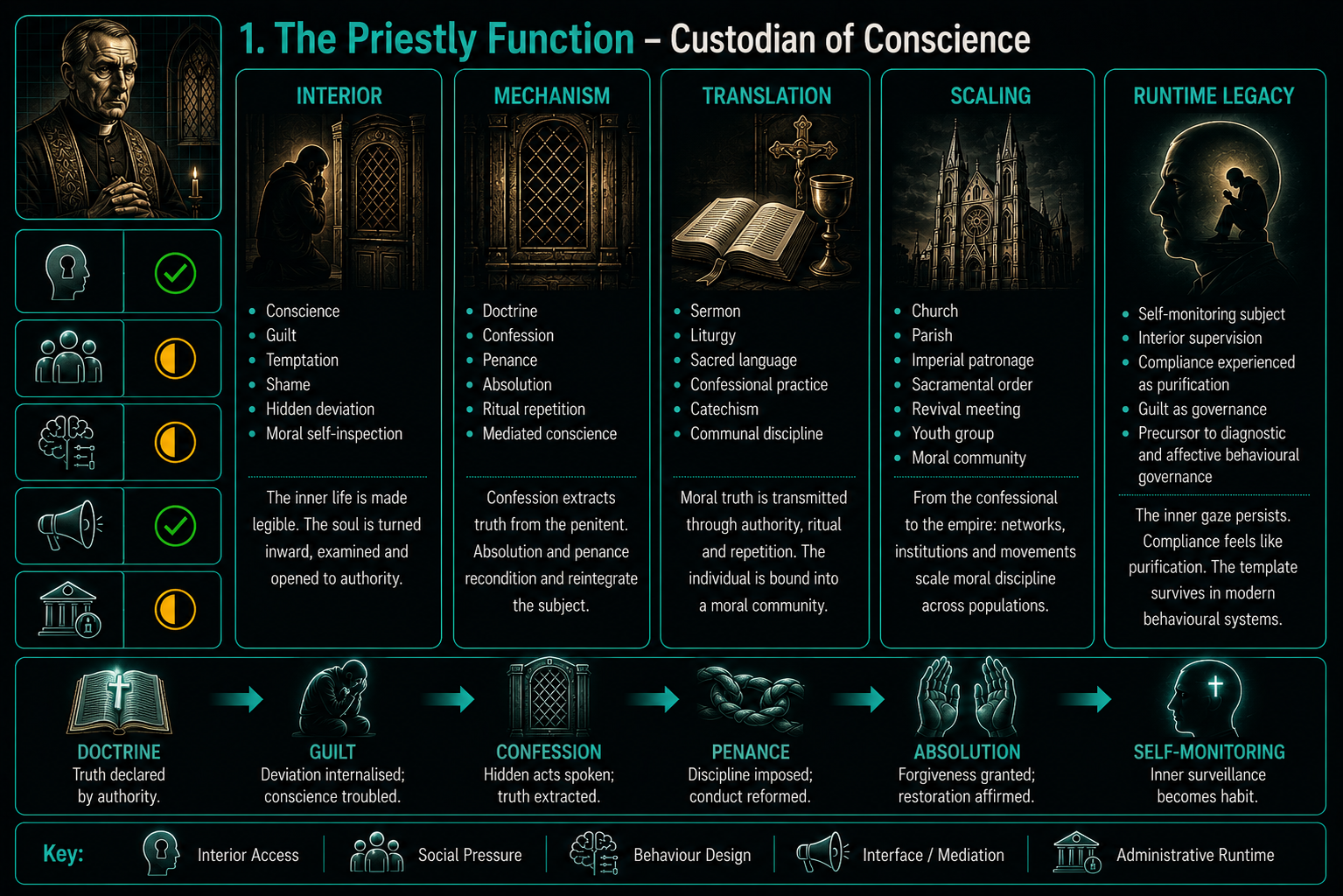
1. The Priestly Function – Custodian of Conscience
Ribbon: Doctrine → Guilt → Confession → Penance → Absolution → Self-Monitoring
Lane / Era: Institutional religion, moral discipline and mediated interiority | Late antiquity to modern evangelical affect
House(s): Church, parish, pulpit, confessional, liturgy, sacramental order, revival meeting, youth group
Imprint: Make inner life legible to authority; make deviation speakable; make correction routine.
Placement & Core Operator Function
The Priestly Function sits at the conscience layer of the behavioural lineage. Before the platform captures the click, before the nudge unit redesigns the form, before the Behaviourist measures adherence, the priestly system opens the interior. It teaches the subject to inspect himself before enforcement arrives.
Its core operator function is to convert hidden inward life into authorised speech. Guilt, doubt, temptation, shame, desire, impurity, failure and fear are made speakable to a recognised interpreter. The person is not left alone with conscience. Conscience is mediated. Deviation becomes not merely an act, but an inner condition requiring disclosure, correction and restoration.
This does not require reducing religion to control. The point is institutional form. A priestly system can organise conduct by placing an authorised interpreter between the person and the highest moral order. Doctrine names the fault. Ritual structures time. Liturgy structures attention. Sermon translates metaphysics into moral instruction. Confession turns hidden deviation into supervised speech. Penance routinises correction. Absolution returns the subject to order.
The Constantinian hinge matters because priest and prince were never fully separate. Constantine legalised and patronised Christianity after the Edict of Milan, and convened the Council of Nicaea, helping turn a once-persecuted faith into an imperial unity instrument. Christianity became Rome’s official imperial religion later, under Theodosius I, but the operator move had already been made: imperial power recognised the administrative value of a church capable of organising doctrine, conscience, hierarchy and mass belonging across a fractured empire.
Mechanism & Institutional Translation
The mechanism is interior supervision.
The priestly system does not merely punish visible offence. It extends governance inward. Original sin, personal sin, temptation, confession, penance and absolution form a behavioural grammar. The subject learns that deviation is not simply external disobedience. It is a burden carried inside the person. Once guilt is induced, confession is not only extracted. It becomes relief. Disclosure becomes release. Correction becomes purification.
The translation is institutional. The mechanism moves through sermon, catechism, ritual calendar, sacred language, moral instruction, confession, penance, absolution and communal belonging. The individual learns to narrate himself in the institution’s categories. He learns what counts as sin, what counts as temptation, what must be disclosed, what can be absolved, and what kind of self must be monitored.
In modern evangelical form, the same mechanism can become affective rather than sacramental. Concerts, singing, bands, youth groups, repetition, uplift, rhythm, group energy, testimony and emotional release organise belief through belonging. The form is not coercive in the crude sense. It is conditioning by synchronisation: moral language carried through music, group affect and shared identity. Doctrine becomes atmosphere. Belonging becomes reinforcement. Emotion becomes evidence.
That affective layer is important because it anticipates later behavioural governance. The state nudge will use salience, messenger, norms and affect. The platform will use notification, feed, identity and belonging. The crisis adviser will use fear, shame, solidarity and duty. The priestly function is the older template: access the interior, define the deviation, mediate correction, and make return to order feel like restoration.
Behavioural Chain
The priestly chain runs:
Doctrine → Guilt → Confession → Penance → Absolution → Self-Monitoring
At the doctrine layer, authority names the moral order. At the guilt layer, deviation becomes intimate. At the confession layer, hidden life becomes legible. At the penance layer, correction becomes routine. At the absolution layer, the institution restores the subject to order. At the self-monitoring layer, the subject carries the gate inside himself.
This is the first behavioural loop because enforcement is displaced inward. The subject learns to anticipate judgement before judgement arrives. He scans his own motives. He rehearses disclosure. He experiences correction not as domination, but as purification.
Operator reading
The operator reading is inferential, not psychological. The claim is not that every priest is a manipulator, every believer is duped, or every religious practice is reducible to power. The claim is structural: the priestly system supplies a durable behavioural technology for making inner life governable.
Its significance in the Operators map is foundational. Later Behaviourists secularise and automate what this function first organises. Freud inherits confession and converts it into interpretation. Bernays inherits desire and converts it into campaign architecture. MINDSPACE inherits affect, norms, messenger and commitment. SPI-B inherits fear, duty and solidarity. CTTs inherit the diagnostic habit and turn refusal into mentality.
The Priestly Function matters because it made conscience available to authority, deviation available to speech, correction available to routine, and obedience available to the subject as inner restoration.
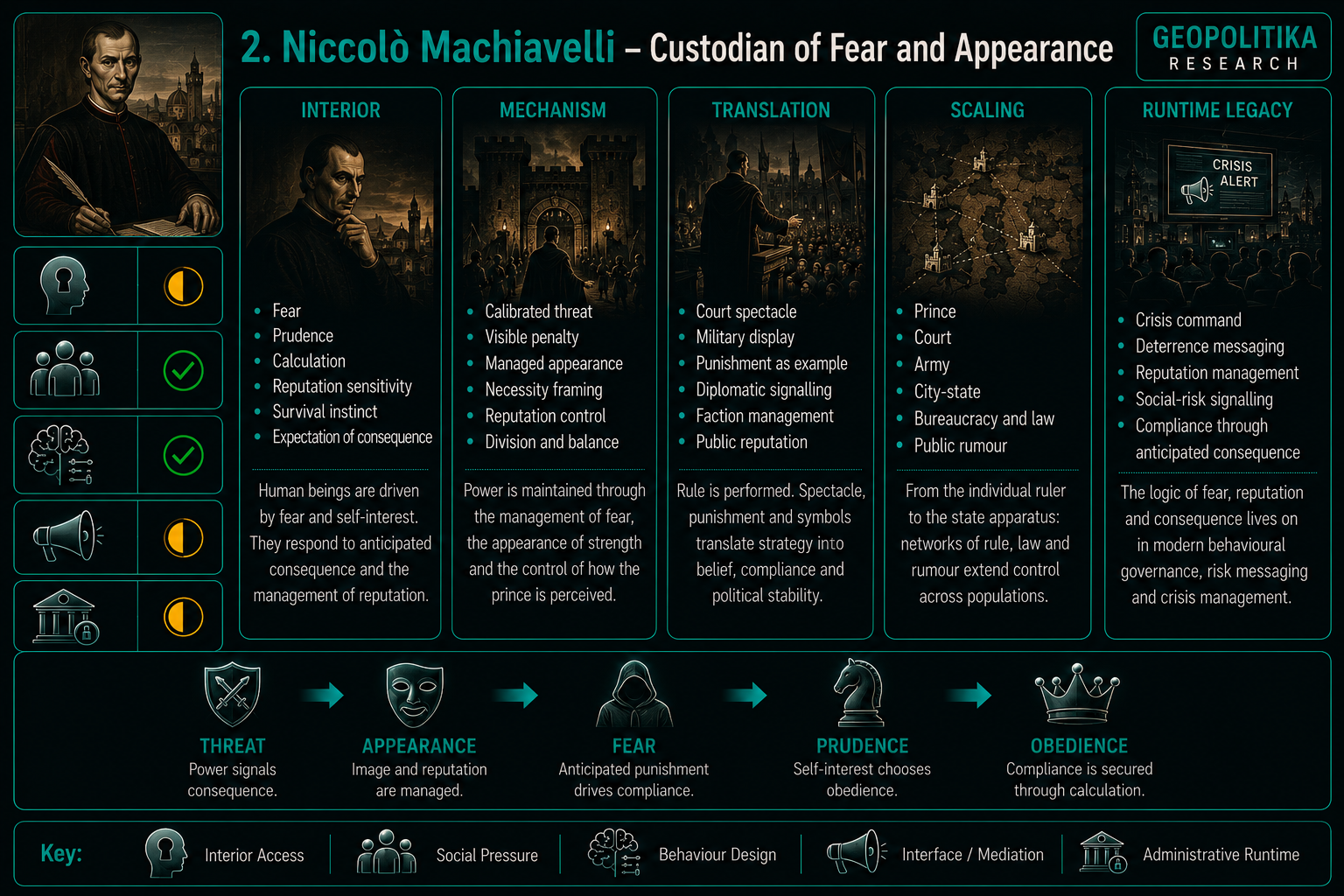
2. Niccolò Machiavelli – Custodian of Fear and Appearance
Ribbon: Threat → Appearance → Fear → Prudence → Obedience
Lane / Era: Renaissance statecraft, princely rule and secular political technique | Florence and Italian city-state politics, late fifteenth to early sixteenth century
House(s): Florentine Republic, diplomatic service, chancery office, Medici restoration, political exile, The Prince
Imprint: Make obedience calculable; make fear governable; make appearance a political instrument.
Placement & Core Operator Function
Niccolò Machiavelli sits at the fear-and-appearance layer of the behavioural lineage. If the priestly function governs conscience by making inward life speakable to authority, Machiavelli secularises behavioural custody by moving the problem into political calculation. The subject is no longer first addressed as sinner. He is addressed as citizen, enemy, ally, courtier, faction member, soldier or governed population calculating consequence.
His core operator function is to convert obedience into prudence. In The Prince, rule is not treated as a sentimental compact between virtuous ruler and grateful subject. It is a problem of force, fear, reputation, timing, spectacle, necessity and managed belief. The ruler must know how conduct is actually produced, not how moralists pretend it should be produced.
Machiavelli’s hard behavioural insight is that love is discretionary, while fear can be organised. Love depends on the subject’s continuing affection. Fear depends on the ruler’s management of consequence. A subject may stop loving. He can be made to remember penalty. That does not mean indiscriminate cruelty. Crude terror can destroy legitimacy and generate hatred. The durable political art is calibrated fear: enough to discipline, not so much as to provoke rebellion; enough spectacle to mark the boundary, not so much arbitrariness that rule appears chaotic.
This is why Machiavelli belongs in the Behaviourists lineage. He does not yet offer a psychology laboratory, public-relations campaign or nudge framework. He supplies an earlier political grammar: govern expectation, stage authority, manage appearance, and make obedience the rational path through danger.
Mechanism & Institutional Translation
The mechanism is calibrated fear mediated through appearance.
Machiavelli’s prince governs less by constant force than by arranging the field in which subjects anticipate force. The question becomes: what will happen if I disobey, resist, defect, mock, expose or refuse? The behavioural unit is not only the command. It is the expectation formed around the command. A ruler who is feared in a disciplined way does not need to punish everyone. He needs consequences to be visible, credible and memorable.
Appearance supplies the second mechanism. Rule depends not only on what the prince is, but on what he is seen to be. Reputation, spectacle, ritual, severity, mercy, piety, military competence and necessity become behavioural cues. The prince must appear stable enough to command, dangerous enough to deter, virtuous enough to legitimise, and flexible enough to survive. The governed population reads the signs and adjusts.
Necessity is the laundering term. Harsh action becomes politically usable when framed as unavoidable. Severity is not presented as appetite. It is presented as duty. The ruler does not say merely, “I dominate.” He says, in effect: disorder required correction; enemies required suppression; unity required decision; survival required severity. Necessity converts coercion into responsibility.
The institutional translation is statecraft. Fear and appearance move through court ceremony, punishment, public example, diplomatic signalling, military display, faction management, patronage, law, rumour and reputation. Machiavelli’s terrain is not the soul but the political surface: the visible theatre where rulers, subjects and rivals infer the cost of action.
This anticipates later behavioural governance because the mechanism is environmental. The prince does not need to debate every subject. He shapes the field of expectation. Later crisis managers will use fear and solidarity. Platforms will use warning labels and visibility penalties. Bureaucracies will use risk flags, audits, sanctions and access conditions. Machiavelli supplies the secular skeleton: make refusal calculable, make compliance prudent, and make power appear as order.
Behavioural Chain
The Machiavellian chain runs:
Threat → Appearance → Fear → Prudence → Obedience
At the threat layer, the possibility of penalty is established. At the appearance layer, authority is staged as capable, necessary and credible. At the fear layer, subjects internalise the cost of defiance. At the prudence layer, obedience becomes the rational adjustment to the field. At the obedience layer, conduct aligns without continuous direct force.
The loop works because fear is not only an emotion. It is a decision environment. A person asks not simply “What is right?” but “What will happen?” The prince governs that question.
Operator reading
The operator reading is inferential rather than psychological. The claim is not that Machiavelli invented political fear, nor that all statecraft is reducible to manipulation. The claim is structural: Machiavelli gives later operators a secular doctrine of behavioural realism. Power must be read through consequences, appearances, incentives, reputation and compliance effects.
His significance lies in the transition from moral order to political technique. The priestly function makes the subject inspect himself before God. The Machiavellian function makes the subject inspect his situation before power. One governs through guilt and restoration. The other governs through fear and prudence. Both reduce the need for constant enforcement because the boundary is carried inside the subject.
Machiavelli also clarifies why visible freedom can coexist with behavioural control. Subjects may still choose. They may speak, trade, assemble, flatter, scheme, comply or defect. But the field is structured so that some choices appear costly, reckless or suicidal, while others appear responsible and safe. This is the deep continuity with later behavioural administration. The modern system does not always need to say “you must.” It can make refusal feel imprudent.
Machiavelli matters because he made fear, reputation and appearance available as techniques of social ordering. He turned rule into behavioural design before behavioural science had a name.
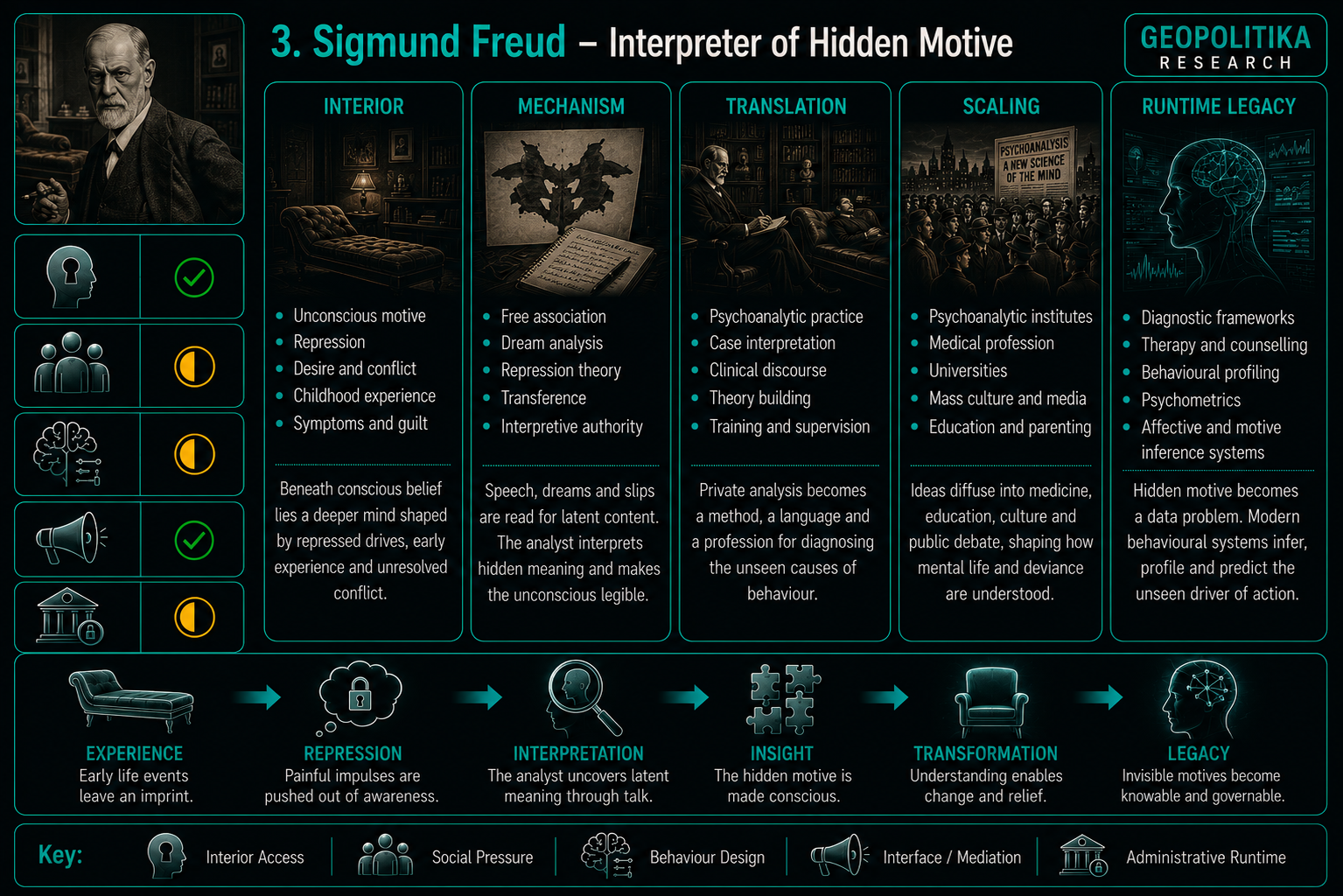
3. Sigmund Freud – Interpreter of Hidden Motive
Ribbon: Symptom → Confession → Interpretation → Insight → Adjustment
Lane / Era: Psychoanalysis, modern subjectivity and expert interpretation | Late nineteenth to early twentieth century
House(s): Vienna medical culture, psychoanalytic clinic, International Psychoanalytical Association, therapeutic profession, twentieth-century cultural theory
Imprint: Make motive expert-readable; make the self opaque to itself; make behaviour interpretable as symptom.
Placement & Core Operator Function
Sigmund Freud sits at the hidden-motive layer of the behavioural lineage. If the priest makes conscience speakable, and Machiavelli makes obedience prudent, Freud makes the self uncertain in its own account of itself. The person is no longer presumed transparent to himself. He may speak sincerely and still not know why he acts. His desires, fears, dreams, slips, symptoms, attachments and aversions may point to a hidden layer requiring expert interpretation.
Freud’s core operator function is to convert motive into expert-readable material. Sin becomes repression. Temptation becomes desire. Confession becomes analysis. Priesthood becomes interpretation. The subject still speaks, but his speech is no longer final. It is evidence. What he says may matter less than what his words disclose, conceal, displace or repeat.
That is the decisive behavioural hinge. Once the self is not sovereign even in its own self-description, authority can move inward in a new way. The expert does not merely ask what the subject did. He asks what the action means. The symptom becomes a sign. The dream becomes a document. The childhood memory becomes an origin point. The slip becomes leakage. The preference becomes displacement. The refusal becomes resistance.
Freud therefore belongs in the Behaviourists lineage not because psychoanalysis is identical to later nudging or platform control, but because it opens the hidden interior as a field of organised interpretation. Later Behaviourists will speak in different registers—bias, motivation, hesitancy, vulnerability, identity-protective cognition, conspiracy mentality, misinformation susceptibility – but the older move is already present: the subject’s declared reason is not enough. His behaviour requires decoding.
Mechanism & Institutional Translation
The mechanism is interpretive confession.
Freud’s analytic setting secularises the confessional while changing its object. The priest asks the sinner to disclose fault before moral authority. The analyst asks the patient to speak freely before interpretive authority. The material is not only guilt, but dream, fantasy, association, symptom, memory, sexuality, fear and repetition. The mechanism is not absolution, but interpretation: the expert hears beneath the speech.
This produces a new kind of interior access. The subject becomes layered. There is the conscious explanation, and then there is motive beneath it. There is the stated belief, and then there is the desire it masks. There is the symptom, and then there is the conflict it expresses. There is the refusal, and then there is resistance. The person becomes readable through a framework he does not fully control.
The institutional translation is broad. Freud’s clinical practice became psychoanalysis; psychoanalysis became a professional movement; the movement entered medicine, therapy, literature, education, advertising, political theory and popular culture. The analytic posture spread beyond the couch. Modern institutions learned to ask not only what people say, but what their words reveal about insecurity, repression, fantasy, trauma, attachment, projection, resentment or desire.
This matters because the Freudian inheritance supplied a grammar for managed subjectivity. Once hidden motive becomes legible, later systems can claim authority over the subject’s own account. The advertiser can speak to unconscious desire. The propagandist can attach symbols to fear and status. The therapeutic institution can turn maladjustment into an interpretive object. The political psychologist can translate dissent into grievance, paranoia, projection or identity defence.
Freud does not build the modern behavioural state. He supplies one of its interior maps.
Behavioural Chain
The Freudian chain runs:
Symptom → Confession → Interpretation → Insight → Adjustment
At the symptom layer, conduct appears as evidence of an unresolved interior conflict. At the confession layer, the subject produces speech, memory, association and fantasy. At the interpretation layer, the expert assigns meaning. At the insight layer, the subject is invited to recognise the hidden motive. At the adjustment layer, behaviour is re-narrated and re-ordered through expert mediation.
The chain changes the status of the subject’s own words. Speech is no longer only testimony. It is data. The subject may think he is explaining himself. The expert hears what exceeds explanation.
Operator reading
The operator reading is inferential rather than psychological. The point is not to reduce Freud to social control, nor to deny the therapeutic value many people have found in psychoanalysis. The point is structural: Freud makes hidden motive available to expert interpretation, and that move becomes foundational for later behavioural governance.
The modern Behaviourist inherits Freud less as doctrine than as permission. Permission to distrust the subject’s stated reason. Permission to treat behaviour as symptomatic. Permission to locate the real cause beneath speech. Permission to intervene not at the level of argument, but at the level of motive, framing, affect, association and identity.
The continuity with Bernays is direct. Freud’s nephew, Edward Bernays, will turn the unconscious from an analytic field into an operating field. If Freud opens hidden motive to interpretation, Bernays opens hidden motive to manipulation. Desire can be linked to products. Status can be linked to consumption. Political consent can be organised through symbol and affect.
The later runtime secularises the same reflex. Vaccine hesitancy, climate dissent, institutional distrust, conspiracy belief, populist anger and platform refusal are not encountered first as arguments. They are often treated as expressions of underlying psychology. The claim recedes. The claimant becomes the object.
Freud matters because he made the subject opaque to himself and available to expert reading. He turned motive into a governable surface.
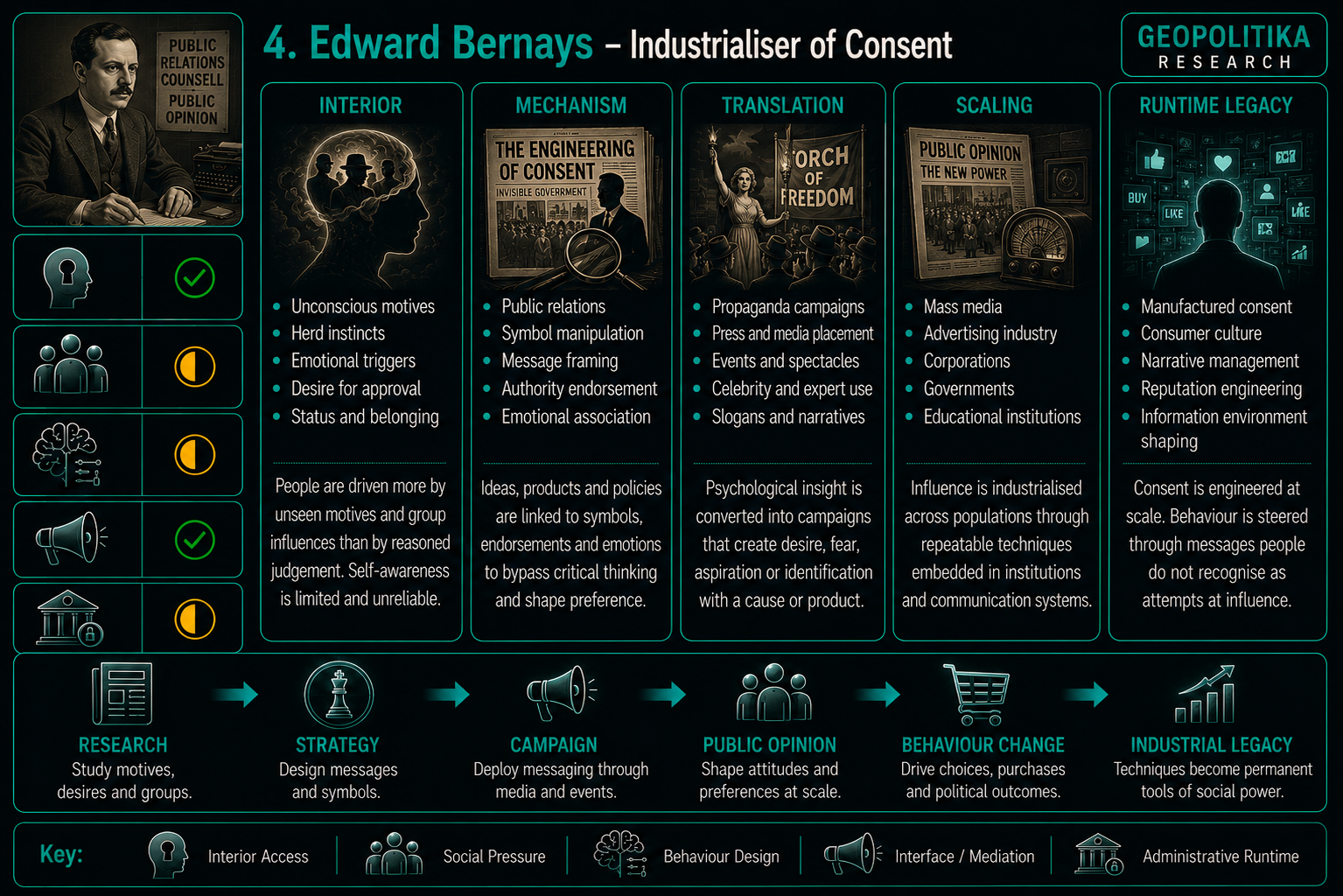
4. Edward Bernays – Industrialiser of Consent
Ribbon: Unconscious Desire → Symbol → Campaign → Social Proof → Consent
Lane / Era: Public relations, propaganda, consumer culture and mass democracy | Early to mid-twentieth century
House(s): Creel Committee, public-relations industry, corporate campaigns, media culture, advertising, Crystallizing Public Opinion, Propaganda
Imprint: Convert hidden desire into campaign architecture; make mass persuasion appear as choice, aspiration and public opinion.
Placement & Core Operator Function
Edward Bernays sits at the manufactured-desire layer of the behavioural lineage. Freud makes motive expert-readable. Bernays makes motive operational. The unconscious is no longer only interpreted in the analytic room. It is targeted in the market, the newspaper, the cinema, the rally, the charity drive, the political campaign and the corporate press office.
Bernays’ core operator function is to convert desire into organised consent. He does not address the public primarily as a rational assembly of citizens weighing arguments. He addresses it as a field of appetites, fears, symbols, identities, status anxieties, herd instincts and social aspirations. The question is not simply what people think. It is what they can be induced to want, admire, repeat, buy, join, fear or approve.
This makes Bernays the bridge between Freud and modern behavioural administration. Freud’s subject is opaque to himself. Bernays’ public is steerable through that opacity. If people do not fully know why they desire, then desire can be attached to objects, policies, persons, brands and causes. A product can become freedom. A cigarette can become emancipation. A corporation can become public service. A political programme can become progress. An elite interest can become common sense.
The importance of Bernays is not that he invented persuasion. Priests, princes, merchants and propagandists had always persuaded. His contribution was to give persuasion a modern professional form: research the public, locate the motive, select the symbol, recruit authority, stage the event, circulate the image, generate imitation, and call the resulting alignment public opinion.
Mechanism & Institutional Translation
The mechanism is symbolic association.
Bernays understood that modern publics do not respond only to information. They respond to meanings attached to information. The operator does not merely say, “Buy this,” or “Support this.” He builds a symbolic bridge between the desired conduct and a deeper motive: status, health, modernity, patriotism, care, rebellion, sophistication, safety, belonging or liberation.
This is why his work belongs inside the Behaviourists map. He translates unconscious motive into public interface. The old sermon told the subject what was good. The Bernays campaign makes the desired action feel like self-expression. The subject experiences participation not as obedience, but as identity.
The institutional translation runs through public relations. Bernays helped define the public-relations counsellor as an expert mediator between organisations and publics. Corporations, governments, charities, trade associations and political movements could use publicity not merely to announce decisions, but to manufacture the conditions under which the public would accept them. Press releases, staged events, expert endorsements, third-party organisations, surveys, headlines, photographs, celebrity cues and social proof became tools of behavioural steering.
The “Torches of Freedom” campaign is the clean signature. Cigarettes were attached to female emancipation and public defiance. The product was not sold only as tobacco. It was sold as symbolic liberation. That is the Bernays mechanism in miniature: identify the blocked desire, attach it to an object, stage a public ritual, recruit media circulation, and convert a commercial objective into cultural meaning.
His larger significance lies in the normalisation of managed opinion. In Propaganda, Bernays described the conscious and intelligent manipulation of organised habits and opinions as an important element in democratic society. The sentence remains notorious because it states openly what later systems bury under softer language: engagement, outreach, awareness, behaviour change, trust building, resilience, inclusion, public education.
Bernays does not merely persuade. He professionalises the management of perception.
Behavioural Chain
The Bernays chain runs:
Unconscious Desire → Symbol → Campaign → Social Proof → Consent
At the desire layer, latent motive is identified: status, fear, aspiration, resentment, care, modernity, belonging. At the symbol layer, the desired conduct is attached to an image, phrase, object, expert or cause. At the campaign layer, the association is staged and repeated. At the social-proof layer, people see others apparently accepting the frame. At the consent layer, the manufactured preference appears self-authored.
The subject does not experience the chain as command. He experiences it as recognition: this is who I am, what people like me do, what the future requires, what responsible people support, what enlightened people consume.
That is the operating trick. Desire becomes the soft gate.
Operator reading
The operator reading is inferential rather than psychological. The claim is not that Bernays single-handedly created mass manipulation, nor that every public-relations act is sinister. The claim is structural: Bernays helped convert motive, symbol and media circulation into a professional technology of consent.
His position in the lineage is exact. The priest governs guilt. Machiavelli governs fear. Freud opens hidden motive. Bernays industrialises the motive field. He takes the interpretive insight that people are moved by forces beneath rational explanation and turns it into campaign procedure.
The modern runtime inherits Bernays everywhere. Behaviour-change campaigns attach health conduct to care. Climate campaigns attach consumption change to virtue. Platform campaigns attach sharing to belonging. Corporate social-responsibility campaigns attach brand preference to moral identity. Political campaigns attach policy alignment to safety, progress, compassion or national survival. The mechanism is the same: find the motive, attach the symbol, circulate the cue, measure the uptake.
Bernays also prefigures the trust-and-safety state. Third-party validators, expert authorities, front groups, media amplification and managed consensus become part of the environment in which “public opinion” appears. The public does not merely discover its view. It receives a staged field of meanings and then recognises itself inside them.
Bernays matters because he made desire administrable at scale. He turned the unconscious from an analytic object into a mass operating surface.
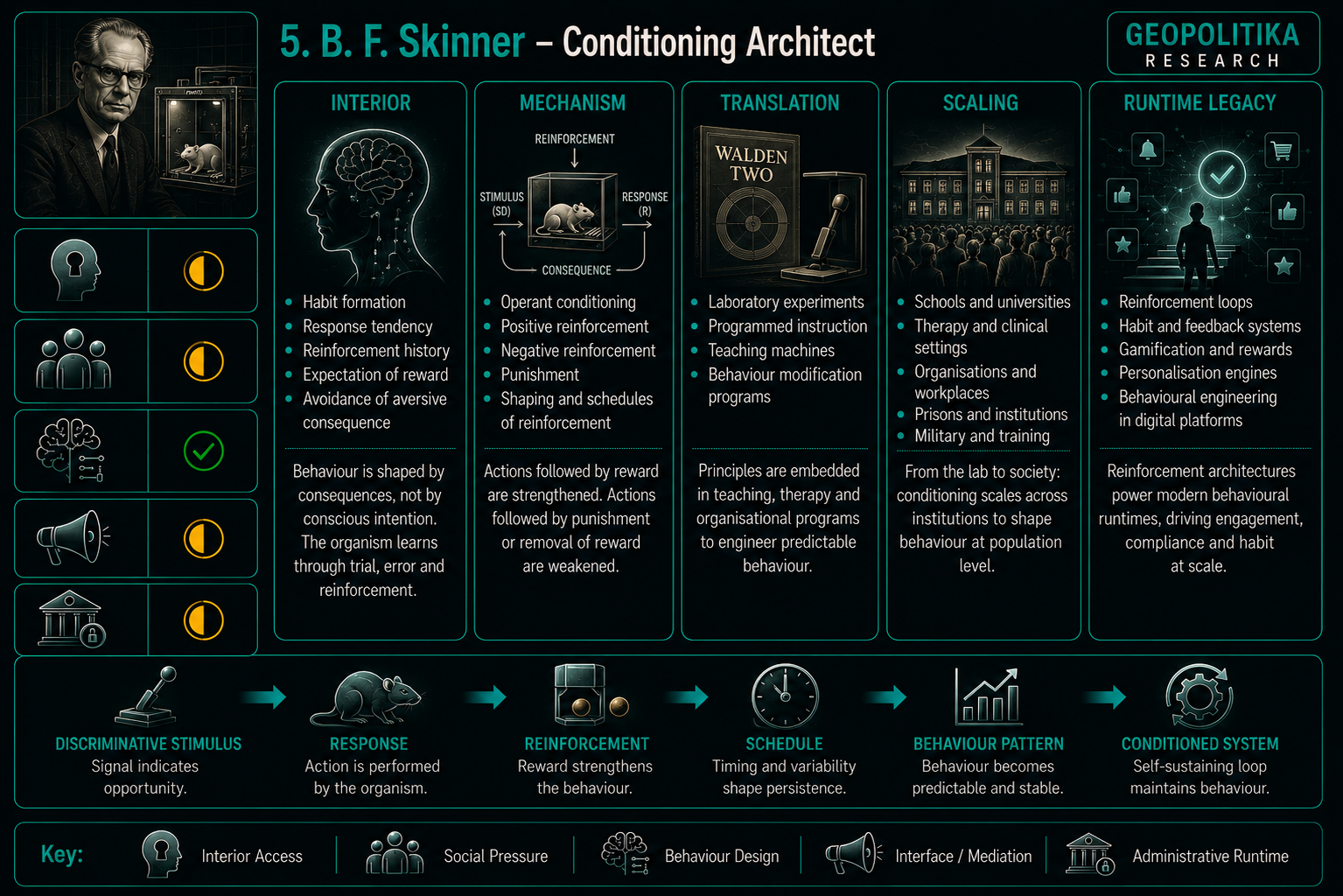
5. B. F. Skinner – Conditioning Architect
Ribbon: Stimulus → Response → Reinforcement → Habit → Behavioural Design
Lane / Era: Behaviourism, experimental psychology and conditioning science | Mid-twentieth century
House(s): Harvard psychology, experimental laboratory, operant-conditioning chamber, behaviourist school, education and behaviour-modification fields
Imprint: Make behaviour conditionable; make freedom look like an environment badly arranged.
Placement & Core Operator Function
B. F. Skinner sits at the conditioning layer of the behavioural lineage. The priest opens conscience. Machiavelli organises fear. Freud makes hidden motive interpretable. Bernays turns desire into campaign architecture. Skinner strips the question down further: behaviour is shaped by environment.
His core operator function is to convert action into contingency. The subject does not need to be persuaded through doctrine, spectacle, insight or symbolic aspiration. He can be shaped by the consequences attached to action. Reward the conduct. Remove the reward. Punish the conduct. Alter the schedule. Repeat the association. Stabilise the pattern.
This is the hard behavioural turn. Inner life recedes. Motive becomes less important than observable action. The relevant unit is not what the subject says he believes, nor what desire lies underneath, but what he does under specified conditions. Skinner’s subject is not primarily sinner, citizen, patient or consumer. He is an organism responding to contingencies.
That placement matters because it supplies later Behaviourists with a spare operating grammar. Behaviour is not sacred mystery. It is not only moral choice. It is not merely unconscious drama. It is adjustable output inside an environment. If the behaviour is wrong, redesign the environment. If the behaviour is desired, reinforce it. If the behaviour decays, alter the schedule. Freedom becomes ambiguous because the subject’s action can be produced without directly commanding his will.
Mechanism & Institutional Translation
The mechanism is operant conditioning.
Skinner’s work turns reinforcement, punishment, stimulus, response, reward schedule and environmental control into the core vocabulary of behavioural design. The famous laboratory chamber—the “Skinner box”— is not just an experimental device. It is a miniature runtime. The organism acts. The environment responds. The response reinforces or discourages the action. The pattern stabilises. Behaviour becomes measurable, repeatable and programmable.
The institutional translation moves through psychology, education, behaviour modification, animal training, classroom design, workplace systems, therapy, institutional management and later interface design. Teaching machines and programmed instruction extend the method into education: break conduct into steps, reward correct response, move the learner through controlled sequences. Behaviour-modification programmes apply the same grammar to habit, discipline, productivity and institutional order.
Skinner’s significance is not that every later nudge is Skinnerian in a strict doctrinal sense. The significance is that he normalises environmental control as a serious technology of conduct. The operator does not ask first whether the subject has been morally persuaded. He asks what consequences surround the action.
That logic travels easily. A platform notification is reinforcement. A streak is a schedule. A like is a variable reward. A workplace dashboard is behavioural feedback. A school behaviour chart is contingency management. A welfare sanction is punishment. A tax reminder is a prompt. A loyalty programme is reinforcement architecture. A social-media feed turns attention into conditioned return.
Skinner’s cleanest operator move is the removal of romance from choice. Choice becomes a point in a designed field. Conduct is not abolished as personal action, but personal action is relocated inside an engineered environment. The subject still presses the lever. The system decides what follows.
Behavioural Chain
The Skinnerian chain runs:
Stimulus → Response → Reinforcement → Habit → Behavioural Design
At the stimulus layer, the environment presents a cue or condition. At the response layer, the organism acts. At the reinforcement layer, the environment rewards, punishes or withholds. At the habit layer, repeated contingency stabilises conduct. At the design layer, the operator arranges conditions to produce desired behaviour more reliably.
This chain is brutally efficient because it does not require full belief. The subject does not need to endorse the system. He only needs to respond within it. Compliance can be built from repetition, reward, avoidance, friction and consequence.
That is why Skinner bridges the laboratory and the later runtime. The nudge unit will soften the vocabulary. The platform will hide the chamber inside the interface. The state will attach reinforcement and punishment to portals, reminders, sanctions and eligibility. But the operating grammar is already present: conduct follows contingency.
Operator reading
The operator reading is inferential rather than psychological. The claim is not that Skinner personally built the platform state or that all reinforcement is illegitimate. The claim is structural: Skinner makes behaviour available to design through environmental contingency.
His place in the lineage is exact. The priest governs by conscience. The prince governs by anticipated consequence. Bernays governs by desire and symbol. Skinner governs by feedback. He supplies the technical confidence that behaviour can be shaped without persuading the inner life at all.
That confidence becomes foundational for later behavioural administration. Governments can alter defaults and incentives. Platforms can tune rewards and friction. Schools can structure tasks and reinforcements. Workplaces can score, rank and prompt. Welfare systems can condition access. Health campaigns can reward uptake and punish non-compliance through social or material cost. Each presents itself as practical design. Each inherits the Skinnerian premise: arrange the environment and the behaviour will follow.
Skinner also sharpens the rights-to-permissions problem. A formally free subject can be placed inside a field where every action has been contingently loaded. The choice remains visible. The architecture does the work.
Skinner matters because he made behaviour programmable. He turned freedom into a problem of environmental design.
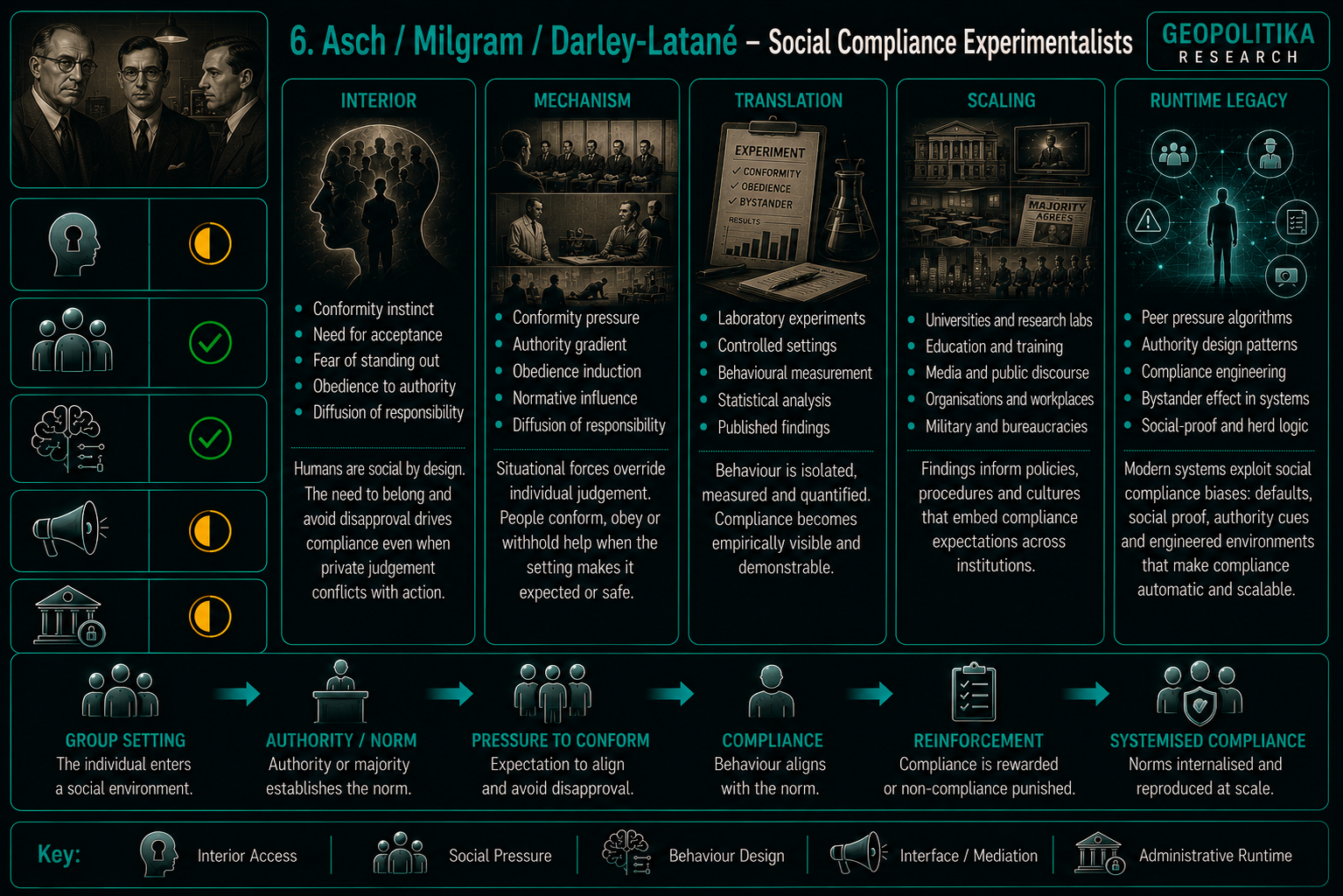
6. Asch / Milgram / Darley-Latané – Social Compliance Experimentalists
Ribbon: Consensus → Authority → Ambiguity → Responsibility Diffusion → Compliance
Lane / Era: Mid-century social psychology, conformity research and obedience experiments | 1950s–1970s
House(s): Swarthmore College, Yale University, Columbia University, Princeton social psychology, experimental laboratory, post-war conformity and authority research
Imprint: Make the social setting experimentally visible as a machine for suppressing independent judgement and action.
Placement & Core Operator Function
Solomon Asch, Stanley Milgram, John Darley and Bibb Latané sit at the social-compliance layer of the behavioural lineage. Skinner makes behaviour conditionable through consequence. These experiments show that conduct is also shaped by group pressure, authority staging, role assignment, ambiguity and diffusion of responsibility.
Their shared operator function is to convert the social setting into a behavioural machine. The person is not an isolated rational chooser. He is embedded in a field of cues: what do others believe, what does authority expect, who is responsible, what does the situation define as normal, what will happen if I refuse? Judgement and action shift inside that field.
Asch exposes consensus pressure. In his conformity experiments, subjects could be moved to deny the evidence of their own eyes when surrounded by a unanimous group giving the wrong answer. The lesson is not that everyone always conforms. It is that social unanimity can make perception unstable. The group becomes an instrument for pressuring judgement.
Milgram exposes staged authority. In his obedience experiments at Yale, ordinary participants were induced to administer what they believed were increasingly severe electric shocks when instructed by an experimenter in a legitimate institutional setting. The mechanism was not only cruelty or ignorance. It was role, escalation, scientific authority, procedural framing and displacement of responsibility.
Darley and Latané expose responsibility diffusion. Their work on bystander behaviour showed that people may fail to intervene not because they do not perceive danger, but because social context disperses obligation. When others are present, responsibility becomes ambiguous. The individual waits, looks sideways, reads the room, and often does nothing.
Together, these figures supply the social-pressure grammar later used by behavioural governance: norms, trusted messengers, peer comparison, institutional legitimacy, gradual escalation, role compliance and responsibility displacement.
Mechanism & Institutional Translation
The mechanism is situational pressure.
Asch’s mechanism is unanimity. The individual is placed against the group. The visible consensus tells him that either everyone else is wrong or he is. Many subjects resolve that tension by conforming, even when the answer is obvious. The institutional lesson is direct: make the norm visible and the individual must spend energy resisting it.
Milgram’s mechanism is authority plus sequence. The subject is not asked to commit the final act immediately. He is moved step by step. The laboratory, white coat, scripted instructions, machine, role assignment and claim of scientific necessity build a corridor of obedience. Each small step makes the next one easier. Refusal becomes a breach not only of conscience, but of role and procedure.
Darley and Latané’s mechanism is ambiguity plus plural presence. When responsibility is unclear, people infer from others’ inaction that action may not be required. The group does not only pressure action. It can suppress it. Nobody commands the bystander not to act. The setting dissolves obligation.
The institutional translation is broad. Public-health messaging uses social norms. Tax agencies use peer comparison. Platforms use likes, shares, trending lists and visible consensus. Crisis communication uses trusted messengers and duty frames. Bureaucracies diffuse responsibility through committees, dashboards, protocols and procedural chains. Workplaces stage compliance through role expectations, HR rules and escalation ladders. The individual experiences himself as merely following process. The system produces the instruction.
This is why the mid-century experiments matter beyond the laboratory. They show that social environments can govern conduct without direct coercion. Authority can be staged. Consensus can be displayed. Responsibility can be dispersed. Compliance can emerge from the arrangement.
Behavioural Chain
The social-compliance chain runs:
Consensus → Authority → Ambiguity → Responsibility Diffusion → Compliance
At the consensus layer, the subject reads what the group appears to believe. At the authority layer, the instruction is given legitimacy. At the ambiguity layer, independent judgement weakens because the situation is socially unclear. At the responsibility-diffusion layer, the burden of action or refusal is displaced onto the group, institution or role. At the compliance layer, the subject acts, conforms or fails to intervene while experiencing the behaviour as situationally required.
This chain becomes central to later behavioural administration. The trusted messenger supplies authority. The norm comparison supplies consensus. The staged pathway supplies escalation. The committee, platform rule or expert body diffuses responsibility. Nobody commands alone. The environment coordinates obedience.
Operator reading
The operator reading is inferential rather than psychological. The claim is not that Asch, Milgram, Darley or Latané designed modern governance systems, nor that their experiments exhaust social behaviour. The claim is structural: they made social pressure experimentally legible. They showed that perception, obedience and action can be shaped by the arrangement of people, roles, authority and ambiguity.
Their place in the lineage is distinct. Skinner shows that consequences shape behaviour. The social-compliance experimentalists show that context shapes conscience. A person may know what he sees and still conform. He may feel discomfort and still obey. He may recognise possible need and still wait. The social setting intervenes between judgement and action.
The modern runtime inherits this directly. Behavioural campaigns display “most people” doing the desired thing. Platforms rank popularity and manufacture salience. Crisis states invoke duty to others. Employers stage mandates through policy and compliance departments. Scientific committees, regulators and platforms diffuse responsibility across process. The subject is not told only what to do. He is shown what normal people do, what experts require, and why refusal would be socially costly.
Asch, Milgram and Darley-Latané matter because they made conformity, obedience and inaction available to design. They turned the group, the expert and the ambiguous setting into behavioural control surfaces.
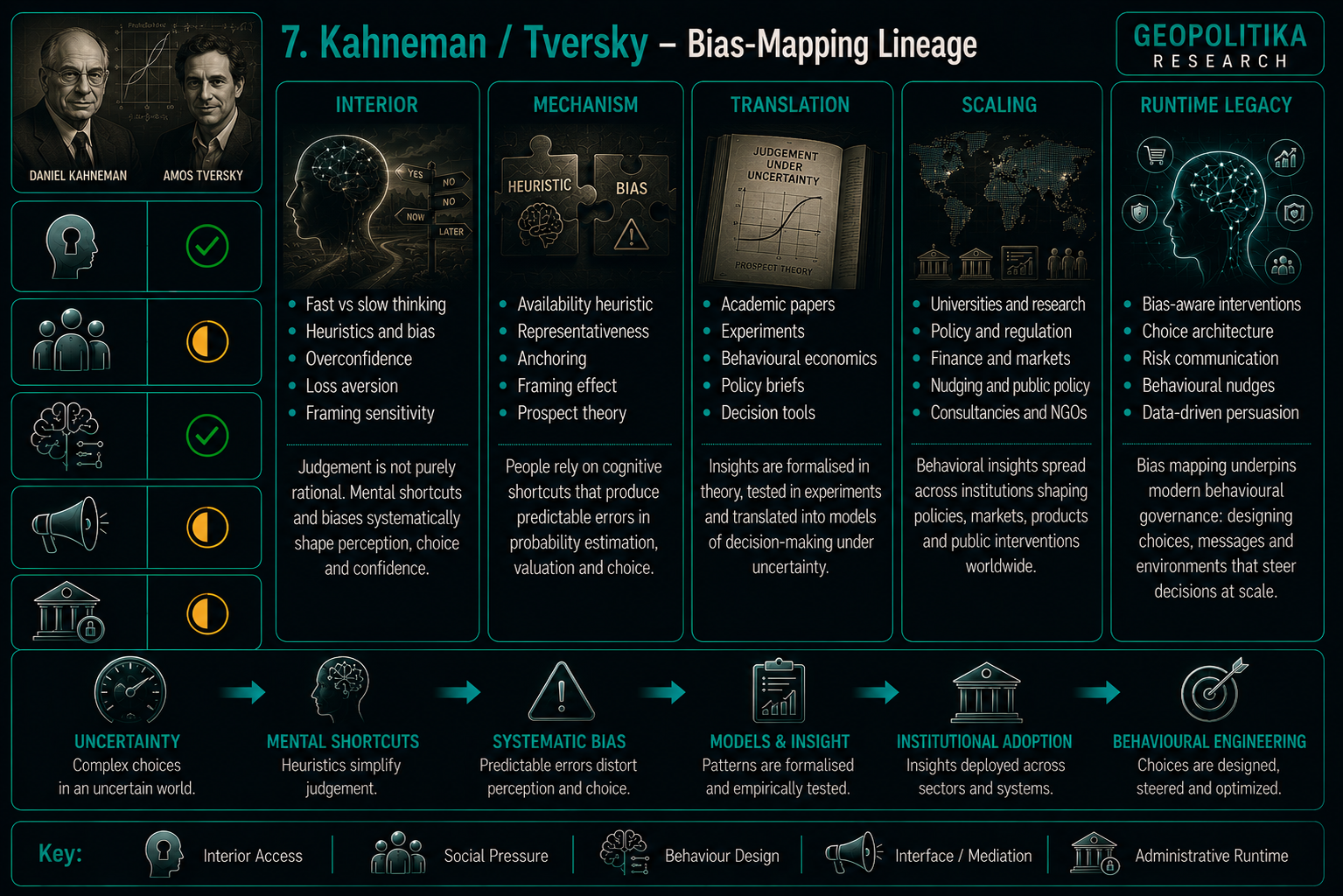
7. Kahneman / Tversky – Bias-Mapping Lineage
Ribbon: Judgement → Heuristic → Bias → Predictable Error → Design Opportunity
Lane / Era: Cognitive psychology, decision science and behavioural economics | 1970s–2000s
House(s): Hebrew University, Stanford, Princeton, decision-science networks, Nobel economics afterlife, behavioural-economics policy field
Imprint: Make judgement map-readable as predictable error; turn cognitive limitation into a design surface.
Placement & Core Operator Function
Daniel Kahneman and Amos Tversky sit at the bias-mapping layer of the behavioural lineage. Skinner makes behaviour conditionable. Asch, Milgram, Darley and Latané make social pressure experimentally visible. Kahneman and Tversky make judgement itself unstable, patterned and map-readable.
Their core operator function is to convert human judgement into a catalogue of predictable error. The subject is no longer treated as a rational calculator who merely needs better information. He is a bounded, shortcut-using, risk-misreading, frame-sensitive decision maker. He anchors on first numbers. He overweights vivid examples. He fears loss more than he values equal gain. He changes judgement when identical options are framed differently. He mistakes availability for probability and confidence for accuracy.
This is a crucial hinge in the Behaviourists lineage. Once human judgement is shown to be systematically biased, choice environments cease to look neutral. Presentation matters. Order matters. Framing matters. Salience matters. Default matters. The architecture around decision begins to look like part of the decision itself.
Kahneman and Tversky do not yet supply the administrative nudge state. That is the next profile. Their function is upstream. They make the weakness legible. They show that error is not random noise but patterned behaviour. Once mapped, the pattern becomes available to designers, policymakers, marketers, platforms and regulators.
The older Behaviourists sought the soul, the fear response, the unconscious, the desire field, the conditioned action, the obedient subject and the conforming group. Kahneman and Tversky open the decision apparatus. They show that even the thinking subject is governable through the way the world is presented to him.
Mechanism & Institutional Translation
The mechanism is heuristic exposure.
A heuristic is a shortcut: a practical mental rule that allows fast judgement under uncertainty. Kahneman and Tversky’s decisive move was to show that these shortcuts produce systematic distortions. The availability heuristic makes vivid or recent events feel more likely. Anchoring pulls estimates toward an initial figure. Framing changes decisions without changing underlying facts. Loss aversion makes potential loss loom larger than equivalent gain. Prospect theory challenges the simple economic picture of rational expected utility by showing that people evaluate gains and losses relative to reference points.
The institutional translation is decision science. Their work travels into economics, law, policy design, finance, medicine, risk communication, consumer behaviour, insurance, military planning, public health and administrative reform. It gives institutions a new language for explaining why people do not act as experts expect: they misperceive probability, overweight losses, respond to frames, follow anchors, neglect base rates, or rely on what is salient.
This language can be used defensively or operationally. In its benign form, bias mapping helps institutions communicate risk more clearly, design safer systems, reduce error and protect people against manipulation. In its operator form, the same map becomes a steering manual. If people anchor, choose the anchor. If they follow salience, choose what is made visible. If they fear loss, frame non-compliance as loss. If defaults matter, set the default. If vivid examples move behaviour, select the example.
That is the hinge between Kahneman/Tversky and Thaler/Sunstein. Bias mapping does not by itself mandate nudging. But it creates the justification. If the public is predictably irrational, then expert redesign of choice can be presented as correction rather than manipulation. The weakness of judgement becomes the authority of the architect.
Behavioural Chain
The Kahneman/Tversky chain runs:
Judgement → Heuristic → Bias → Predictable Error → Design Opportunity
At the judgement layer, the subject attempts to decide under uncertainty. At the heuristic layer, he uses shortcuts. At the bias layer, those shortcuts distort perception, probability and value. At the predictable-error layer, the distortion becomes measurable and repeatable. At the design-opportunity layer, institutions can redesign the environment around the error.
This chain changes the political status of choice. A choice is no longer simply the expression of preference. It may be the output of framing, salience, anchoring, reference point and loss aversion. The chooser remains formally free, but the structure around choice becomes decisive.
Operator reading
The operator reading is inferential rather than psychological. The claim is not that Kahneman and Tversky designed a control system, nor that the study of bias is illegitimate. The claim is structural: their work made human judgement available for redesign by showing that error is patterned, measurable and context-sensitive.
Their significance is therefore double. Scientifically, they weakened the model of the fully rational actor. Operationally, they strengthened the position of the expert designer. If people choose poorly because of predictable cognitive limits, then the institution that maps those limits can claim to rearrange choice in the subject’s own interest.
That claim becomes the moral bridge to the nudge state. Thaler and Sunstein will take the bias map and convert it into choice architecture. MINDSPACE will turn the architecture into administrative checklist. BIT will turn the checklist into government procedure. Platforms will make the procedure continuous.
Kahneman and Tversky matter because they made judgement governable without calling it obedience. They turned cognitive limitation into a behavioural surface.
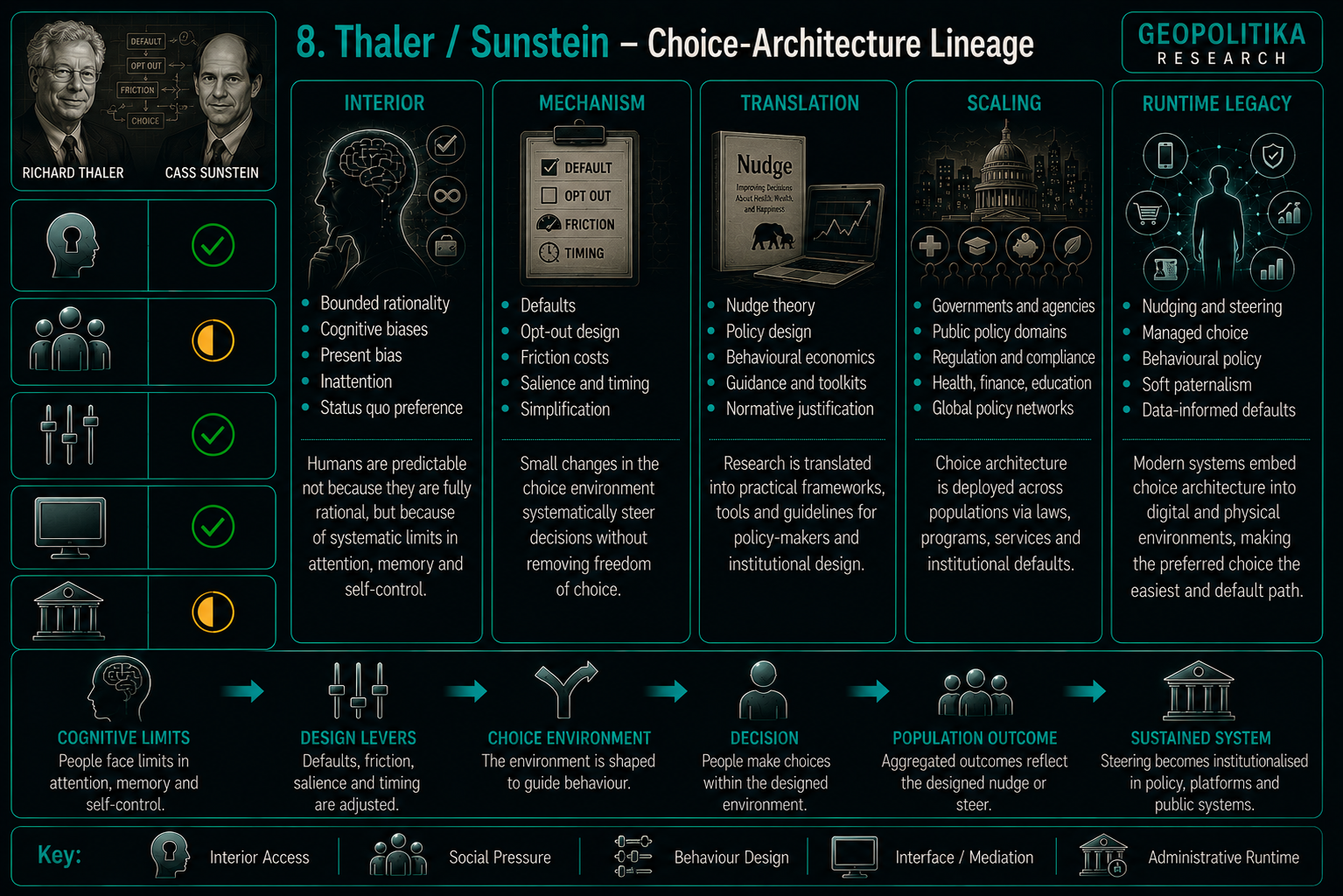
8. Thaler / Sunstein – Choice-Architecture Lineage
Ribbon: Bias Map → Choice Architecture → Default → Nudge → Behavioural Administration
Lane / Era: Behavioural economics, legal theory and public-policy design | 1990s–2010s
House(s): University of Chicago, Harvard Law School, behavioural-economics networks, policy advisory circuits, Nudge
Imprint: Make intervention respectable by preserving formal choice while redesigning the environment in which choice occurs.
Placement & Core Operator Function
Richard Thaler and Cass Sunstein sit at the choice-architecture layer of the behavioural lineage. Kahneman and Tversky make judgement map-readable as predictable error. Thaler and Sunstein convert that map into a policy technology. They take the cognitive weakness and give the institution a design role.
Their core operator function is to convert bias mapping into welfare-preserving steering. The subject remains formally free. Options remain visible. Coercion is denied. But the environment is arranged: the default is set, the order is chosen, the salient option is highlighted, the reminder is timed, the friction is placed, the warning is framed, the opt-out path is made more burdensome than the opt-in path. The chooser still chooses. The architect structures the field.
This is the central laundering move of modern behavioural governance:
Manipulation → Choice Architecture → Welfare
The older behaviourists were easier to see. The priest governed conscience. Machiavelli governed fear. Bernays organised desire. Skinner arranged contingencies. Thaler and Sunstein make the softer claim: people are already influenced by choice environments, so institutions should design those environments better. There is no neutral architecture. Therefore, the architect should choose deliberately.
That argument is powerful because it appears modest. It does not demand dictatorship. It does not require banning alternatives. It does not announce propaganda. It offers helpful steering: healthier food at eye level, pension enrolment by default, tax compliance reminders, organ-donation prompts, simplified forms, better disclosure, better timing, better salience. But the operator significance lies in the principle: once choice architecture is accepted, every administrative surface becomes a behavioural surface.
Mechanism & Institutional Translation
The mechanism is the nudge.
In Nudge, Thaler and Sunstein popularise “choice architecture” and “libertarian paternalism”. The terms matter. “Libertarian” preserves the language of choice. “Paternalism” legitimises steering in the chooser’s own interest. The institution claims not to force, but to help. It protects freedom by designing around predictable error.
The tools are simple and therefore scalable: defaults, reminders, framing, simplification, social norms, salience, feedback, incentives, disclosure, friction and opt-out design. These are not spectacular instruments. Their power lies in placement. They attach to forms, letters, websites, apps, tax notices, pension schemes, organ-donor registers, health messages, energy bills, welfare portals and government services.
The institutional translation is decisive. Choice architecture migrates from behavioural economics into public administration. The MINDSPACE report turns influence into a government checklist: Messenger, Incentives, Norms, Defaults, Salience, Priming, Affect, Commitment and Ego. The Behavioural Insights Team then gives the approach a state venue: test, prompt, simplify, measure, iterate. The behavioural insight becomes a programme. The programme becomes a unit. The unit becomes a method.
This is why Thaler and Sunstein belong at the end of the historical addendum rather than the start of the modern one. They are the hinge. They inherit the older lineage—bias, conditioning, social pressure, desire, fear—and translate it into the administrative idiom that Part 6 mapped in full. The nudge is the bridge from psychological insight to runtime governance.
Behavioural Chain
The Thaler/Sunstein chain runs:
Bias Map → Choice Architecture → Default → Nudge → Behavioural Administration
At the bias-map layer, judgement is understood as predictably frame-sensitive. At the choice-architecture layer, the decision environment becomes the intervention site. At the default layer, one option is pre-positioned as normal. At the nudge layer, friction, salience, reminders or social cues move behaviour without formal compulsion. At the behavioural-administration layer, the method spreads through policy, service design, welfare, tax, health, pensions, climate behaviour and digital government.
The chain preserves the appearance of autonomy. That is its political advantage. The subject can still decline. But decline may require more time, more clicks, more forms, more courage, more explanation or more social cost. The formal option remains. The behavioural path has been loaded.
Operator reading
The operator reading is inferential rather than psychological. The claim is not that Thaler and Sunstein are uniquely malign, nor that every nudge is coercive. The claim is structural: they make behavioural steering respectable inside liberal administrative language. They solve the optics problem. Intervention can now proceed without appearing as command.
Their significance is therefore architectural. They give institutions a way to say: we are not removing choice; we are improving the environment. We are not manipulating; we are helping people overcome bias. We are not coercing; we are setting better defaults. We are not governing conduct; we are making welfare-enhancing decisions easier.
That language travels because it is useful. Governments can redesign forms. Employers can redesign enrolment. Platforms can redesign prompts. Public-health agencies can redesign uptake. Climate programmes can redesign consumption. Welfare systems can redesign compliance. Each intervention can be defended as small, evidence-based, humane and efficient. In aggregate, the person’s environment becomes continuously managed.
This is where the historical lineage arrives at the modern runtime. The priest made inner life legible. Machiavelli made obedience prudent. Freud made motive interpretable. Bernays made desire steerable. Skinner made behaviour conditionable. The social psychologists made conformity and obedience measurable. Kahneman and Tversky made judgement error map-readable. Thaler and Sunstein make the mapped subject governable through design.
They matter because they turned manipulation into choice architecture, and choice architecture into the administrative common sense of behavioural governance.
Final Reflection – From Historical Behaviourists to Runtime Operators
Addendum 6a has mapped the pre-digital behavioural lineage. The figures and functions profiled here do not belong to one profession, one ideology, one century or one institution. They belong to a sequence of operating discoveries: conscience could be made speakable; fear could be organised; motive could be interpreted; desire could be manufactured; behaviour could be conditioned; conformity could be measured; judgement could be mapped; choice could be redesigned.
The chain now stands complete:
Conscience → Fear → Hidden Motive → Manufactured Desire → Conditioning → Social Compliance → Bias Mapping → Choice Architecture
This is the older behavioural conveyor. The priest did not need a dashboard to make the subject self-monitor. The prince did not need an algorithm to make obedience prudent. Freud did not need a platform profile to make motive expert-readable. Bernays did not need behavioural targeting to attach desire to symbols. Skinner did not need an app to turn conduct into reinforcement loops. Asch, Milgram, Darley and Latané did not need social media to show that consensus, authority and ambiguity can suppress independent judgement. Kahneman and Tversky did not need digital analytics to make judgement error map-readable. Thaler and Sunstein did not need AI to show how formal freedom can coexist with managed choice.
That is the continuity. The modern behavioural runtime does not appear from nowhere. It inherits older arts of interior access, social pressure, environmental design, symbolic mediation and administrative translation. What changes is not the basic operator function. What changes is the speed, scale, granularity and institutional integration.
In the older sequence, behavioural custody is episodic and venue-bound. The subject enters the church, court, clinic, campaign, laboratory, experiment or policy office. The mechanism acts in defined settings. There is still an outside. The person can leave the sermon, close the newspaper, exit the laboratory, ignore the campaign, avoid the analyst, resist the prince, or decline the form.
The modern runtime reduces that outside. Where Addendum 6a shows how conduct was made governable, Addendum 6b shows how governable conduct becomes infrastructure.
Published via Mindwars Ghosted.
Overlords: Mapping the Operators of reality and rule.
—
Author’s Note
Produced using the Geopolitika analysis system—an integrated framework for structural interrogation, elite systems mapping, and narrative deconstruction.