Geopolitika: Mapping Power - Part 1. The Map of Absences
Introduction
Over the past several few weeks I have been running a systematic diagnostic process on major institutions and networks using the latest incarnation of the Geopolitika protocol suite. The first step of the process involves taking detailed snapshots of primary sources such as institutional websites and associated public facing materials—annual reports, 10-K filings, UN resolutions, donor lists, governance documents, and operational highlights. These are gathered into a collection documents for each institution and run through dedicated custom protocols run on a standard LLM. The distilled outputs from these protocol runs have been combined into a structured Core Knowledge database file that functions as institutional memory—not a conventional database of claims or a replacement for Wikipedia, but a map of institutions, people, patterns, signals, and structural features.
Each of the protocols anchors claims in evidence from the inputs (a website dump, a report or an article) and registers material flows, accumulation loops, immobilisation patterns, handoffs, coordination roles, expected omissions, and contradictions, while maintaining strict traceability to the source document(s).
As at 19 June the file contains structured records on over 1600 institutions and nearly 1400 named individuals, drawn from runs on entities including the Center for a New American Security (CNAS), Rothschild & Co and associated entities, Corteva, Nestlé, UN DESA and the Agenda 2030 architecture, the monetary stack (IMF, World Bank, BIS, Paris Club, central banks), defense contractors (Leidos and others), and multiple philanthropic, think-tank, and corporate networks.
To make this memory analytically useful, the file registers recurring structural signals rather than exhaustive histories. Four of the most important record types are:
- Handoff Patterns (HO): Conversions where one form of power or resource is reliably translated into another (e.g., capital into policy language, threat framing into procurement, norms into technical standards). These reveal the relay architecture of the system.
- Missing Donors / Missing Linkages (MD): Signals of partial disclosure—donor names or categories may appear, but program-level mapping, exact amounts, terms, beneficial ownership, or output linkages remain opaque. These highlight where influence pathways are hard to reconstruct.
- Coordination Roles (CR): Positions, offices, committees, or platforms that actively manage routing—converting access into agenda control, expertise into policy permission, or private discussion into public alignment. These are the operational “switchboards.”
- Absent Geographies (AG): Records of places, populations, or communities that are systematically underrepresented or treated as objects/metrics in institutional outputs. These flag where burdens, consequences, or lived realities are depoliticised or rendered invisible.
Additional types (family networks, cycles, opacity signals, personnel pipelines, etc.) complement these, but AG, MD, HO, and CR form the core diagnostic quartet used in this series.
This first article focuses on absent geographies and missing donors (the AG and MD layers). It asks what picture of power emerges when we read the file “upward” from what is not fully visible. Subsequent parts will examine handoffs (how power moves) and coordination roles (who actively routes it).
The goal of the current series is not exposé in the conventional sense. It is structural cartography: to describe the recurring patterns of visibility and opacity, conversion and routing, legitimacy and immobilisation that appear across diverse institutions. The protocol’s discipline—anchor-before-claim, candidate-only recommendations, mixed/partial hypotheses, and refusal of unsupported command narratives—is maintained throughout. The resulting view is realist: power as a distributed, hybrid stewardship system that converts real constraints into reproducible governance while maintaining curated boundaries around full accountability.
What follows is the map of absences—and what it reveals about where consequences are displaced and where benefits are kept difficult to trace.
What Patterns Emerge?
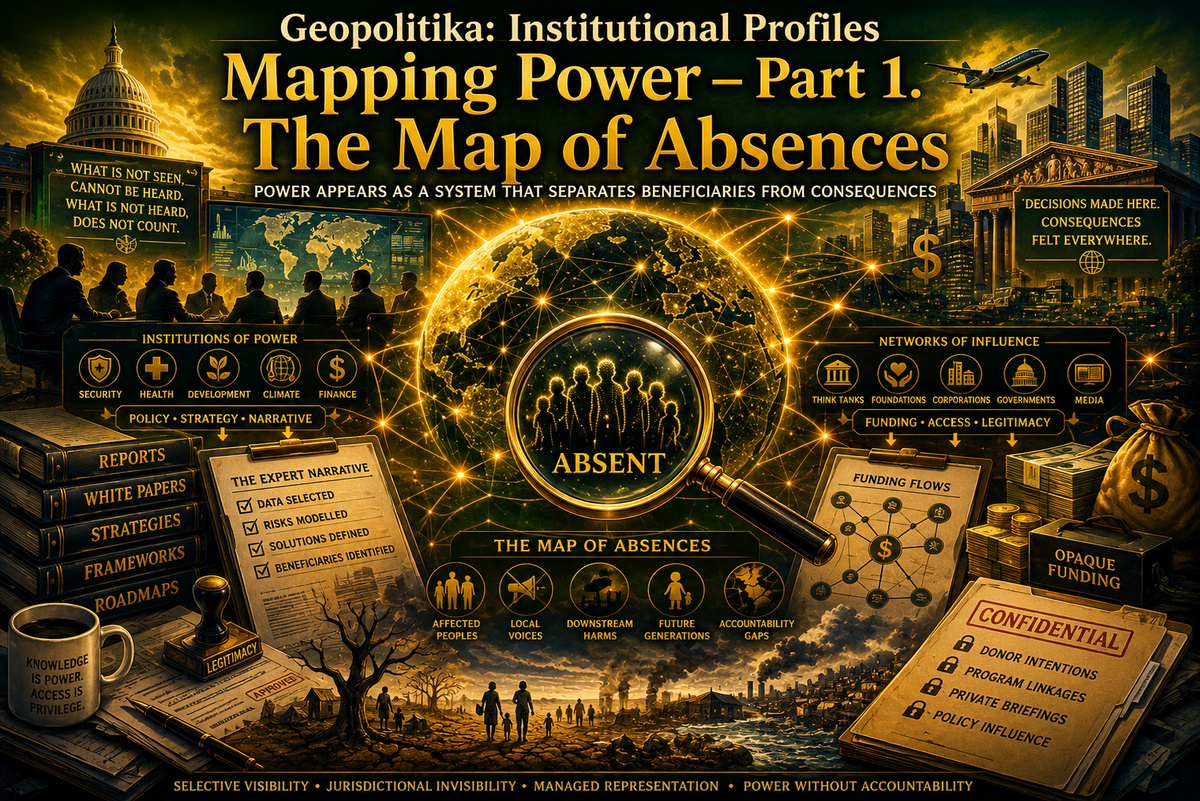
Reading the file upward from absent geographies and missing donors, the picture of power that emerges is not a simple “who funds whom” map. It is a map of who must remain unnamed for the institution’s story to hold together.
The core pattern is this:
Power appears as a system that separates beneficiaries from consequences.
The file repeatedly shows institutions speaking about security, health, development, climate, finance, labour, migration, technology, food, and energy while the people or places most affected appear as objects, risks, metrics, or beneficiaries, not as counterparties with equal voice.
Across the core knowledge file as at writing this article there are 160 absent-geography signals and 165 missing-donor signals. Of those, 60 geography signals and 70 donor signals are marked high confidence. The strongest combined picture is a network of elite policy production, opaque funding, jurisdictional invisibility, and managed representation.
1. The missing geographies are mostly burden zones
The absent geographies are not random. They cluster around places and people that absorb cost:
- Offshore jurisdictions
Crown Dependencies, Jersey, Guernsey, Isle of Man, Cayman, BVI, Bermuda, Gibraltar appear as absences in tax and money-laundering discourse. The file’s interpretation is that Western institutions demand transparency outward while protecting their own offshore architecture. - Extraction zones
DRC mining regions, Katanga, Kolwezi appear as absent from health/security narratives around Ebola and cobalt. The file’s claim is that causal responsibility gets displaced onto local ecology or governance while the Western EV, finance, and commodity chains remain unnamed. - Military sacrifice zones
Chagos, Bahraini dissidents, host communities around basing, Iranian civilians, service-member families, and regional civilian populations recur as excluded from “rules-based order,” deterrence, or security-policy discourse. - Domestic affected publics
Welfare recipients, migrants, workers, NHS patients and staff, digitally excluded populations, families affected by temporary labour routes, communities near energy infrastructure, ratepayers, and consumers are repeatedly absent. These groups are treated as policy variables, not political subjects.
So the geography layer says: power’s map is not where decisions happen; it is where consequences are made voiceless.
2. The missing donors are mostly the missing economic mechanism
The donor absences show a complementary pattern. The problem is often not that no donor is disclosed. It is that disclosure stops just before causality becomes traceable.
The major missing-donor categories are:
- State and official funding opacity
This is the largest cluster I found: host-nation MoUs, government funding terms, NATO/common funding, public-risk allocation, official-sector relationships, and public-private procurement economics. The file treats this as a way to make state power look neutral or procedural. - Donor amounts and donor-output mapping
Many institutions disclose donor names, tiers, or broad categories, but not exact amounts, program-level allocation, grant terms, or project-to-output ledgers. That means influence can be acknowledged in the abstract while remaining unprovable in any specific case. - Corporate, advisory, and client opacity
Commercial advisory clients, corporate donor lists, contract terms, lobbying clients, tariff formulas, commodity-trading margins, and beneficial ownership recur as missing. This is where policy discourse touches money flows but does not allow reconstruction of who benefits. - Division of labour among donor blocs
The file explicitly flags a separation: health is associated with Rockefeller/Gates/pharma-style power; security with defence, tech, state, and corporate donors. Mining power is said to flow indirectly through finance, asset management, legal arbitration, and commodity infrastructure rather than direct donations.
That means the donor layer says: power is not always hidden by secrecy; it is hidden by partial disclosure. Names appear, but amounts, conditions, program mapping, beneficial owners, and contract economics disappear.
3. The strongest picture: a power system with “clean rooms”
The core knowledge file highlights a recurring pattern: domain separation. Different sectors of elite activity are kept relatively siloed so each can maintain its own coherent public legitimacy without obvious contradictions.
In practice, this means:
- Health and global development institutions can present themselves as purely humanitarian actors because they are not visibly tied to arms manufacturers or defence interests.
- Security and defence institutions can maintain their focus on “hard power” and national interest without visible funding or leadership crossover from health philanthropies.
- Mining or resource companies can operate through finance, insurance, arbitration, commodity trading and procurement channels without needing direct, traceable donations to think tanks or policy groups.
- Think tanks can claim independence and editorial autonomy because donor funding is often disclosed only at a high level, with limited visibility into which donor supported which specific output.
- Governments can maintain the appearance of open debate and press freedom because influence often flows through quieter mechanisms—funding priorities, access to officials, research grants, and partnership terms—rather than overt censorship.
So the picture is not one conspiracy hub. It is more like a set of clean rooms:
Domain | Visible story | Missing piece |
Security | strategy, deterrence, rules-based order | host populations, defence funding amounts, |
Health | disease, resilience, philanthropy, | extraction, pharma interests, donor conditions, |
Climate/energy | transition, security, infrastructure | ratepayers, workers, landholders, public-risk |
Finance | stability, innovation, public goods | end-users, beneficial owners, private |
Development | empowerment, partnership, capacity | local refusal, subgrant terms, donor conditions, |
Food/agriculture | productivity, resilience, regenerative transition | farmers’ dependency, input control, water rights, |
The system’s coherence comes from not letting these domains contaminate each other analytically.
4. The central actor is often not a person; it is the boundary
If we work from absences rather than names, the core actor is the boundary-making institution.
Institutions in the core knowledge file include a host of bodies, think tanks, and companies such as ECFR, BIS, Nestle, Atlantic Council, European Commission, Bloomberg Philanthropies, UN, Corteva, CNAS, WHO, NATO, Bank of England, World Bank, RAND, BP, Microsoft, and NVIDIA. Each has its own characteristics and linkages to networks within the power structure, but the more important finding is that institutions appear as boundary managers.
They decide:
- who counts as expert
- who counts as affected
- which funders may be named but not measured
- which geographies are treated as operational terrain rather than political communities
- which alternatives are serious
- which archives remain accessible
- which harms are to be considered local accidents versus systemic outputs.
That is the most important structural inference from the file: power is exercised by controlling the perimeter of legitimate analysis.
5. The absent geography and missing donor signals fit together
The two absence layers are mirror images.
- Missing geography answers: who pays?
- Missing donor answers: who benefits?
The gap between them is where institutional legitimacy is manufactured.
A recurring pattern is:
- A policy institution frames a problem technically or morally.
- The affected geography is represented abstractly or omitted.
- Donors, clients, states, or commercial beneficiaries are disclosed only partially.
- The institution can claim independence because there is no explicit donor-output smoking gun.
- But the absence pattern itself reveals alignment.
So the file suggests that power is less a pyramid than a corridor:
Extraction / affected publics → finance, law, procurement, philanthropy, state funding → think tanks and expert bodies → policy narratives → costs returned to publics as necessity.
6. What picture of power emerges?
A compact formulation:
Power in the core knowledge file looks like a transnational elite operating through curated visibility. It names threats, risks, and beneficiaries, but often not the communities bearing the cost or the economic actors capturing the upside. It does not always hide itself; it discloses enough to appear accountable while withholding the connective tissue needed to prove dependency, conditionality, or capture.
The deepest pattern is not “secret donors control institutions.” It is subtler:
institutions remain credible by making causality hard to reconstruct.
Absent geographies show where harm is depoliticised.
Missing donors show where benefit is denarrated.
Together they reveal a political economy of managed opacity: visible expertise on top, invisible dependency underneath, and voiceless burden-bearers at the edge.
Part 2 will examine handoff patterns, points where one kind of power becomes another.
—
Published via Mindwars Ghosted.
Geopolitika: Tracing the architecture of power before it becomes the spectacle of history.