Geopolitika: Mapping Power – Part 3. The Switchboards
The Switchboards are where authority becomes portable.
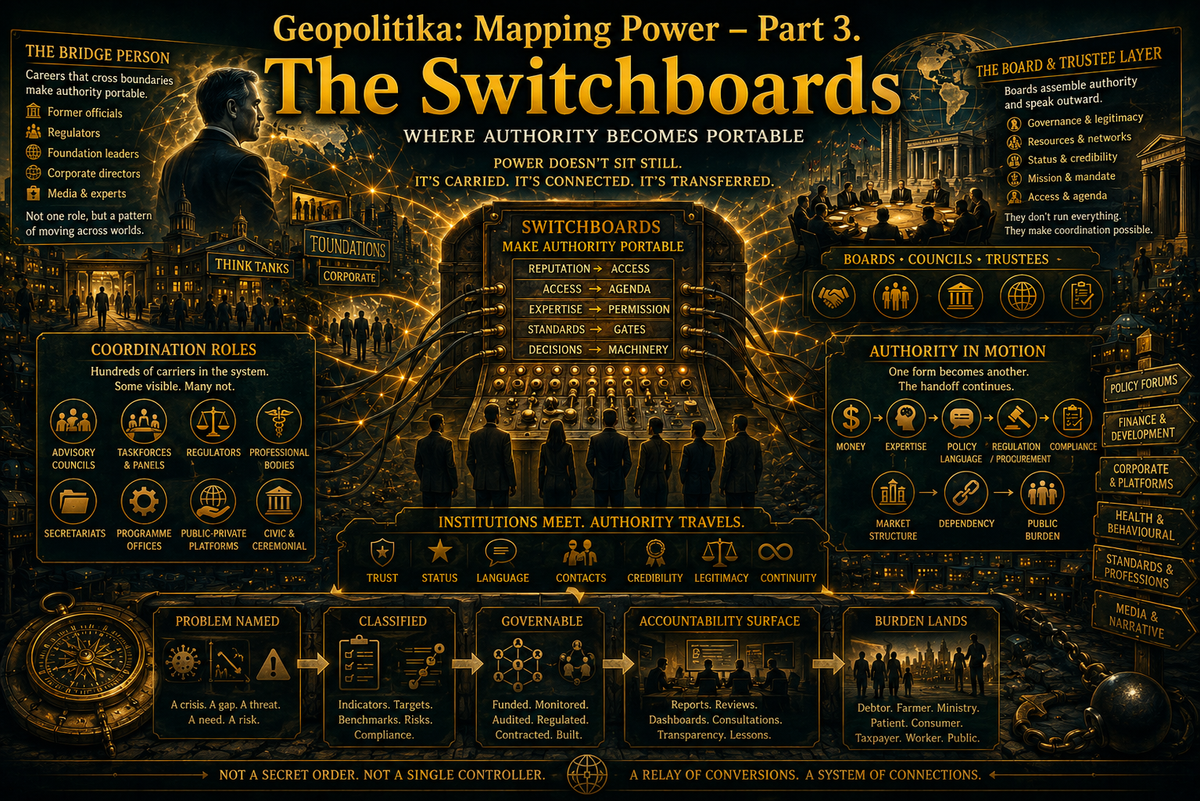
Part 1 in this series looked at power through absence: the missing geographies, missing donors, unnamed beneficiaries, and missing linkages that make the institutional record partial. Part 2 looked at handoffs: the points where power changes form as it moves from one institution to another. Money becomes expertise. Expertise becomes policy language. Policy language becomes regulation, procurement, standards, or compliance. Those systems eventually become burdens carried by people and institutions further downstream.
Part 3 looks at the carriers. Once money has become expertise, expertise has become policy language, and policy language has become a standard or programme, who carries that authority into the next room?
The Core Knowledge file described in Part 1 records hundreds of these carriers as defined Coordination Roles. Some are people. Some are boards, committees, advisory councils, regulators, professional bodies, secretariats, programme offices, public-private platforms, civic institutions, or ceremonial roles. They are not all powerful in the same way. They do not command the whole system. Many look ordinary, technical, administrative, charitable, professional, or ceremonial.
Their importance is more precise. They make authority portable. A former official carries state credibility into a think tank. A board carries financial, legal, political, or corporate status into an institution’s public face. A foundation programme team carries private wealth into public-good language. A regulator carries public authority into professional permission. A secretariat carries temporary decisions into durable workplans. A civic or ceremonial office carries history, prestige, and continuity into present legitimacy.
We can think of these as switchboards. In this sense, a switchboard is not where power simply sits, it is where power becomes transferable. It is where one form of authority is made usable in another setting. That is why switchboards are easy to miss. They rarely look like domination. They look like governance: boards, panels, trustees, taskforces, councils, fellows, convenors, standards groups, expert committees, liaison offices, advisory bodies, and professional associations.
But where handoffs define the relay, switchboards are about who keeps appearing at the junctions. Part 3 asks: Who sits where institutions meet? Who makes one world intelligible to another? Who turns reputation into access, access into agenda, expertise into permission, standards into gates, and temporary decisions into permanent machinery?
The Bridge Person
The simplest switchboard is a person whose career crosses institutional boundaries.
This does not mean the person controls all the institutions they touch. The important point is more modest: a bridge person makes authority portable. Trust, status, language, contacts, and credibility gained in one setting can be carried into another.
A former official who becomes a think-tank executive does not arrive empty-handed. They bring government experience, policy memory, security culture, donor confidence, media usefulness, and access to people still inside the state. A regulator who enters an international professional network brings local statutory authority into a wider field of standards, guidance, conferences, memoranda, and shared language. A foundation officer who sits on advisory boards can move grant logic into programme design. A corporate director who joins a public-policy board can move market assumptions into the language of public purpose.
In many cases, these connections are not incidental. Alongside qualifications, knowledge, reputation, and interpersonal skill, bridging capacity may be part of the reason the person was invited into the role. Institutions often recruit people not only for what they know, but for the worlds they can make reachable.
This does not make every board member or committee member a bridge person in the stronger sense. Many people hold one or two roles and contribute within a fairly limited institutional field. Their presence may still add expertise, credibility, or representation, but it does not necessarily create a durable cross-boundary corridor.
A bridge person becomes more visible when the pattern repeats: government to think tank, regulator to international body, foundation to advisory board, corporate board to policy institute, finance to standards body, legal office to public inquiry, media platform to security forum. The significance lies not in one appointment, but in the accumulated portability of the career.
A bridge person is also not exactly the same as an Operator. The Operators series looked at people by function: security operators, legal guilds, financial governors, policy framers, biopolitical custodians, behavioural engineers. It asked what lever they operate.
The bridge-person concept asks a different question: what worlds does this person connect?
Some people are both. A financial governor who moves between central bank, treasury, international institution, and private market may be an Operator because they work the machinery of money, and a bridge person because they carry authority across sectors. A policy framer who moves between government, think tank, foundation, media, and advisory boards may also be both.
But the overlap is not complete. Some bridge people mainly carry legitimacy, prestige, trust, or access. They may not design the machinery itself. Some Operators work mostly inside one institution or technical field. They shape the system without necessarily being the public bridge between worlds.
Richard Fontaine is a useful example. In the CNAS profile he appears not only as CEO of a major Washington national-security think tank, but also as a figure linked to the Trilateral Commission’s North America group, the Anthropic Long-Term Benefit Trust, and prior roles in State, NSC, Senate Armed Services, Defense Policy Board, and academia. The point is not that this proves hidden control. It does not. The point is that one career can connect national-security policy, elite convening, AI governance, government experience, and think-tank authority. That is bridge-person logic.
Mark Carney provides another example of the same pattern. His career has moved through Goldman Sachs, the Bank of Canada, the Bank of England, the Financial Stability Board, UN climate-finance roles, Brookfield, Bloomberg, elite convening bodies such as the Group of Thirty and the World Economic Forum, and Canadian political leadership. The point is not hidden control. It is portability. Central-bank authority can travel into climate finance. Climate finance can travel into private-capital mobilisation. Private-capital credibility can travel into political leadership. One career becomes a bridge between money, markets, climate policy, global governance and the state.
Bridge people matter because institutions rarely move ideas by themselves. People carry them. They sit on panels, sign memoranda, chair committees, brief governments, join boards, advise foundations, appear at conferences, and translate between professional languages.
A bridge person is therefore not the whole switchboard. But they show the switchboard function in human form.
The Board and Trustee Layer
The next switchboard is the board.
If the bridge person makes authority portable through a career, the board formalises that function. It gathers several bridge persons, or several kinds of recognised authority, into one visible institutional structure.
A board is easy to treat as administrative furniture: a list of trustees, governors, directors, advisers, patrons or committee members attached to an institution’s governance page. Sometimes that is all it is. But across the coordination records, boards repeatedly appear as places where authority is assembled.
A board does not only govern inward. It also speaks outward.
Its composition tells other institutions what kind of body this is, which worlds it can talk to, and what forms of trust it can claim. A board containing former ministers, financiers, lawyers, military figures, scientists, philanthropists, media executives, corporate directors or senior academics is not just a management structure. It is a formalised bridging mechanism.
Each person brings a different kind of recognition. The former official brings state memory. The financier brings market credibility. The lawyer brings procedural authority. The scientist brings technical seriousness. The philanthropist brings moral purpose. The corporate director brings scale and implementation. The academic brings expertise. The media figure brings public reach.
Together, they make the institution readable to multiple audiences at once.
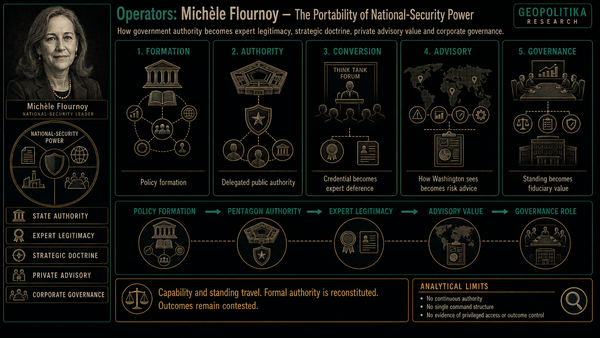
The published CNAS profile gives a useful example. CNAS is not just a research shop with a board attached. Its board layer helps make the institution readable across several worlds at once. Kurt Campbell connects it to senior U.S. foreign-policy and Indo-Pacific strategy networks. Michèle Flournoy connects it to defence-policy and public-private strategic-advisory circles. Douglas Beck connects defence innovation, Apple, McKinsey, Pentagon advisory work and military service. Denis Bovin connects finance, MIT-linked networks, defence advisory structures and intelligence-adjacent worlds. The point is not guilt by association or hidden command. It is routing. CNAS draws authority from people who connect it to institutional worlds beyond the think tank itself: state policy, defence, technology, finance, advisory networks and government-facing uptake.
The same pattern appears in many public-policy institutions. A think-tank board may combine former officials, donors, academics, corporate figures and media-facing experts. A foundation board may combine private wealth, public-service language and technical authority. A professional board may combine standards, discipline, training and access to a field. In each case, the board makes the institution legible to several audiences at once.
To government, it may look serious. To donors, reliable. To media, quotable. To corporations, practical. To professionals, respectable. To the public, independent.
This does not mean the board secretly controls everything the institution does. That is too simple. Nor does it mean the board’s formal governance role is irrelevant. Boards may approve strategy, oversee risk, appoint executives, guard reputation and discharge legal duties.
But the switchboard function exceeds the formal governance function.
A trustee body can make private wealth look civic. A corporate board can make market power look responsible. An advisory board can make a policy campaign look expert-led. A foundation board can make strategic giving look like public service. A professional board can make access control look like standards protection.
That is why board composition matters. It shows not only who governs the institution, but how the institution packages itself for circulation.
The board is not always the place where decisions are made.
Often it is the place where authority is assembled, displayed and made portable.
The Forum Before the Policy
Some switchboards are not formal governing bodies. They are forums.
A forum can be a conference, commission, roundtable, council, summit, private meeting, expert workshop, public-private platform, or recurring invitation-only gathering. Its power is not usually binding decision. Its power is familiarity.
This is where institutions such as Bilderberg and the World Economic Forum fit into the map. Their significance is not that they issue secret orders to governments. Their importance is that they gather people from different institutional worlds before the public policy moment arrives.
The earlier Bilderberg profile series gives a useful example. Its Steering Committee is not just a background organising body. It is the standing mechanism that prepares the meeting programme and selects participants. In the profile, the committee appears as a concentrated bridge across finance, media, technology, defence, corporate power and transatlantic politics. Names such as Mathias Döpfner of Axel Springer, John Micklethwait of Bloomberg, Zanny Minton Beddoes of The Economist, Fareed Zakaria of CNN, Gerhard Zeiler of Warner Bros. Discovery International, Alex Karp of Palantir, Eric Schmidt, Satya Nadella of Microsoft, Peter Thiel, André Hoffmann of Roche, John Sawers, and Nadia Schadlow illustrate the point. The significance is not that this committee publicly governs states—it would be a stretch to say that. The significance is that it maintains a room in which different forms of authority can recognise one another.
Officials, donors, executives, academics, journalists, military figures, regulators, foundation officers, lawyers and technical experts can test language, share assumptions, identify risks, rehearse solutions and learn which ideas are already acceptable to the room.
This matters because policy rarely begins as a finished proposal. It often begins as a mood, a phrase, a concern, a shared diagnosis, or a sense that “something must be done.”
The forum gives that early material a place to settle.
By the time an idea appears later as a report, recommendation, communiqué, procurement priority, regulatory principle or reform package, much of the alignment may already have happened. Not as conspiracy. As conversation. As professional familiarity. As repeated exposure. As the gradual narrowing of what serious people think serious people may say.
That is why convening power matters.
A forum does not need to command the institutions represented in the room. It only needs to make them mutually legible. It allows a banker to understand the security argument, a regulator to understand the technology argument, a foundation officer to understand the development argument, a journalist to understand the expert frame, and an official to understand which solutions already have institutional support.
The forum is where language becomes portable before policy becomes public.
It is also where absence matters. The most affected people are often not in the room where the first grammar is formed. They may appear later as stakeholders, beneficiaries, communities, patients, users, consumers, workers, or affected populations. But by then, the vocabulary may already be set.
The forum before the policy is not the final decision. It is the place where the decision begins to sound inevitable.
The Regulator and Professional Gate
Some switchboards do not look like networks at all. They look like rules.
A regulator, professional body, licensing board, standards authority, medical council, bar institution, certification scheme, online-safety office or credentialing system can sit between a person and the ability to act.
This is different from ordinary influence. A think tank may shape the language of policy. A forum may make ideas familiar. A board may lend legitimacy. But a professional gate can decide whether recognition is usable.
Can the doctor practise? Can the lawyer appear? Can the teacher remain registered? Can the platform operate? Can the product enter the market? Can the worker hold the credential? Can the applicant pass the character test? Can the institution keep its licence?
The language is usually protective: public safety, professional standards, trust, ethics, competence, safeguarding, consumer protection, risk management. Often that language is not false. Societies need standards. Professions need rules. Dangerous products should be restricted. Fraud should be prevented. Patients, clients, students and users need protection.
But the switchboard question is not whether regulation is necessary. It is what the gate connects.
For example, prior Geopolitika profiles make this visible in medicine:
- FSMB presents itself as a support body for U.S. state medical boards, which retain formal licensing and disciplinary authority. But the profile shows FSMB as something more than a service provider. It supplies connective infrastructure: credential verification, physician data systems, licensure applications, closed-programme records, examination services, board portals, regulatory education, AI guidance and medical-regulatory coordination. It does not replace the state gate. It makes dispersed state gates interoperable.
- MCNZ shows the national version of the same structure. It registers doctors, issues practising certificates, sets standards, monitors competence and disciplines practitioners. Its public language is protection of health and safety. Its operational position is more exact: it sits between the doctor and the lawful ability to practise medicine in New Zealand.
The historical background matters. Modern medical regulation did not emerge only as neutral administration. The Flexner-era settlement, backed by Carnegie and Rockefeller philanthropy, helped consolidate laboratory-based, university-linked, licensing-board medicine as the recognised centre of legitimate practice. The point is not that every later regulator is simply an instrument of that settlement. The point is that professional regulators do more than keep out fraud. They define what counts as the profession.
In this sense, a medical council connects statutory authority to professional livelihood. A bar institution connects training, character, tradition and court access. A standards body connects technical language to market entry. A digital-identity or age-assurance system connects verification to participation. An online-safety regulator connects risk categories to platform design. A certification body connects compliance to supply-chain access.
The regulator makes authority portable by turning trust into permission.
That is why these roles matter. A person may be skilled, but without recognised status the skill may not be usable. A platform may be technically capable, but without meeting the standard it may be excluded or redesigned. A product may exist, but without approval it cannot circulate. A professional may disagree with the rule, but refusal may threaten livelihood, insurance, reputation, registration or mobility.
Here the switchboard becomes a gate. And once authority becomes a gate, the question changes. It is no longer only who shaped the policy or who sat in the room. It is who must pass through the gate, who controls the terms of passage, and what happens to those who cannot or will not comply.
The Secretariat and Programme Office
Some switchboards are powerful because they are permanent.
A minister may change. A chair may retire. A campaign may end. A crisis may leave the headlines. But the secretariat, programme office, implementation unit, foundation desk, treaty body, grant team, standards office or project-management layer remains. Its power is continuity.
These offices rarely look dramatic. They organise meetings, maintain records, circulate drafts, prepare agendas, track indicators, manage grants, coordinate partners, monitor milestones, write minutes, compile reports, update workplans and keep the calendar moving.
That sounds administrative because it is administrative. But administration is often where temporary decisions become durable systems.
- The WTO Secretariat is a useful example. WTO decisions are formally member-driven. The Secretariat does not simply command trade policy. But it provides technical support, legal assistance, trade analysis, meeting support, accessions work and capacity-building. That support layer matters because it turns member-state processes into continuing institutional machinery. The decision may belong to members, but the continuity belongs to the office.
- UN DESA shows the same pattern in the sustainable-development field. Intergovernmental language does not implement itself. DESA helps carry it through SDG reporting, data and statistics, process inventories, capacity-building metrics, HLPF and ECOSOC support, partnership architecture and implementation platforms. A goal announced at the political level becomes a calendar, a report, a dataset, a forum, a review cycle and a capacity-building programme.
This is not the spectacular face of power. It is the maintenance layer.
It preserves vocabulary after the speech is over. It keeps indicators alive after the launch event. It remembers which partners are approved, which metrics matter, which timelines apply, which reports are due, and which forms must be completed.
That is why secretariats and programme offices matter in the switchboard layer. They do not merely support decisions. They carry decisions forward. They turn moments into machinery.
The Ceremonial and Civic Switchboard
Not every switchboard looks technical.
Some look ceremonial, historical, charitable, educational or civic. A royal patronage, mayoral office, livery company, professional inn, university court, heritage trust, archive, honours system, public ceremony or civic foundation may seem far removed from the machinery of policy. But these institutions can also route authority.
Their currency is prestige. Sometimes that prestige is mainly symbolic. Sometimes it is attached to real governance functions.
The City of London is a useful example because it contains both. Its ceremonial offices, livery networks, courts, charities, property structures and financial institutions turn commercial power into civic continuity. Finance appears not only as finance, but as service, tradition, stewardship and public responsibility.
But the City is not only ceremonial. Roles such as the Remembrancer show the harder edge of civic switchboard power. The Remembrancer’s function is not merely to preserve custom or host dignitaries. It is a parliamentary and constitutional interface: a role that monitors legislation, briefs on proposed bills and amendments, liaises with parliamentary and government actors, and protects the City’s institutional position.
That is a different kind of switchboard. It converts civic status into legislative presence.
The same contrast appears in the UK’s Inns of Court. Some of their authority is ceremonial: dining, robes, halls, libraries, portraits, rituals and professional memory. But some of it is also practical. Scholarships, admission, advocacy training, disciplinary expectations, student support, professional networks and links to the courts all shape how entry into the profession is governed. Access to the legal profession is made to feel not merely technical, but custodial: an inheritance one must be formed into before one can fully enter.
This does not mean ceremony is fake. Traditions can carry real memory. Civic institutions can support real public goods. Archives, scholarships, professional rituals and charitable offices can preserve things worth preserving.
But they also do political work.
They attach respectability to networks. They soften the appearance of power. They provide rooms, titles, rituals, histories, honours, dinners, committees, scholarships, parliamentary interfaces and public-service language through which status can circulate.
A ceremonial office can make private wealth look public-spirited. A civic institution can make commercial power look rooted in service. A heritage body can make present authority appear continuous with history. A professional tradition can make access control feel like stewardship. A role such as the Remembrancer can make institutional-interest protection appear as constitutional maintenance.
This matters because governance does not only move through reports, standards and contracts. It also moves through recognition, access and constitutional habit.
Who is honoured? Who is invited? Who is trusted? Who has standing? Who is treated as a steward? Who is given the language of service, continuity, duty or tradition? Who has an office through which institutional interests can be carried into legislative space?
The ceremonial and civic switchboard answers those questions quietly. It turns prestige into access, and access into legitimacy.
Summarising the Switchboard Layer
The switchboard does not need to rule the whole system. It only needs to make one form of authority usable somewhere else. That is the specific layer Part 3 adds to the map.
A bridge person carries trust across institutions. A board assembles legitimacy. A forum creates pre-public familiarity. A regulator turns recognition into permission. A secretariat turns a decision into a durable workplan. A civic office turns prestige into access.
These roles are easy to miss because they rarely look like domination. They look like governance, professionalism, expertise, service, standards, tradition, accountability or administration. But this is exactly why they matter.
Power does not only move through commands. It also moves through people who can translate between worlds, boards that make institutions credible, forums that make ideas familiar, regulators that decide who is recognised, offices that keep programmes alive, and civic roles that convert prestige into legitimacy.
Part 3 has therefore not been about the final decision. It has been about the machinery that makes decisions possible before they appear as decisions. The switchboard is where authority becomes portable. That is the layer to notice: not the throne, not the spectacle, but the junction.
Part 4 turns to immobilisation: the condition of the people, institutions and places at the receiving end of the relay, where governance becomes dependency and refusal becomes a problem.
Published via Mindwars Ghosted.
Geopolitika: Tracing the architecture of power before it becomes the spectacle of history.