Geopolitika: Institutional Profiles – Center for a New American Security (CNAS)
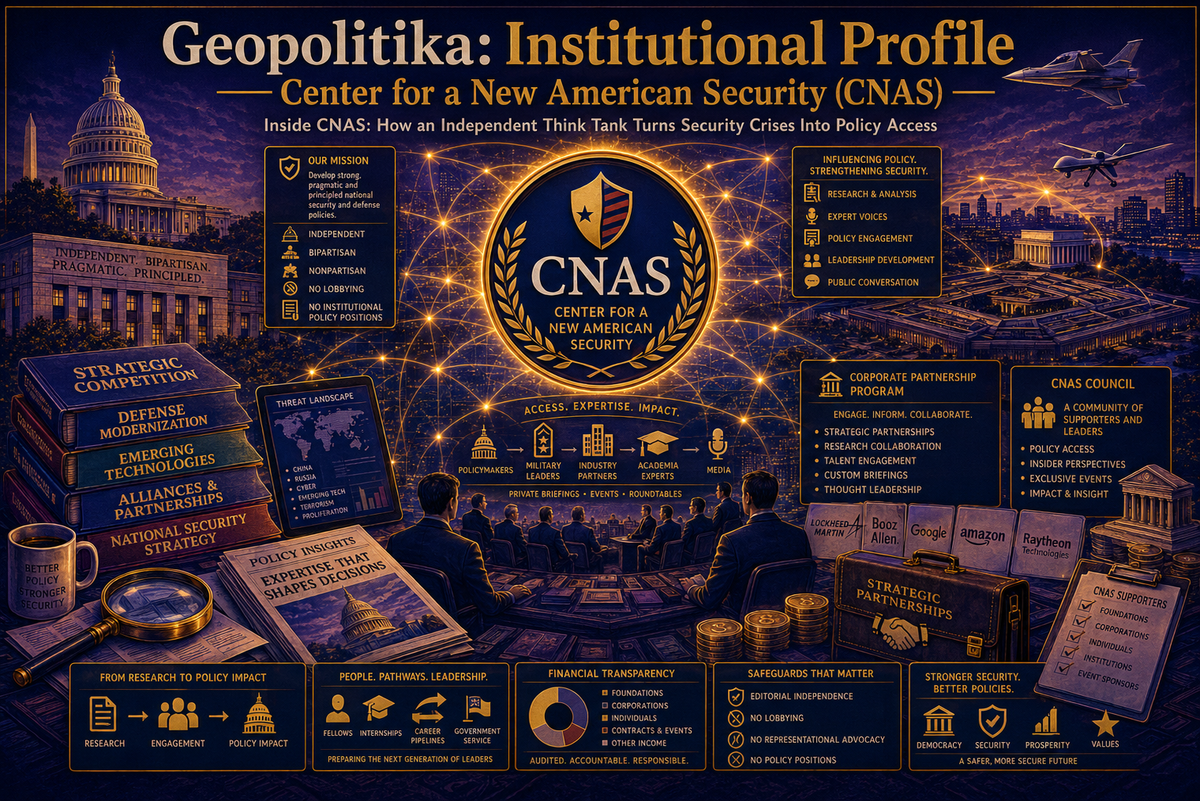
This institutional profile forms a part of the Geopolitika project to map Anglo-American power structures by examining their founding mythologies, leadership, linkages to power, public face, the nature of their outputs and who these are directed towards. These profiles are primarily generated from materials provided on their own websites, which are then analysed using a structured institutional analysis framework—see methodology statement at foot of article.
—
Executive Summary
The Center for a New American Security presents itself in the language of public service: independent, bipartisan, pragmatic, principled, and focused on strengthening national-security and defence policy. That public face is not incidental—it forms a core part of the institution’s power.
CNAS publishes reports, hosts events, supplies experts to journalists, trains fellows, and convenes policymakers, corporate representatives, military figures, researchers, donors, and former officials around the language of national security. Its public materials portray a serious Washington policy institution built to influence debate, prepare leaders, and speak into government-facing conversations.
Those same materials also reveal something more specific. CNAS discloses supporters, publishes financial information, maintains a board and advisory structure, promotes its Corporate Partnership Program, and offers council access through the CNAS Council. It describes routes for expert access, private briefings, donor updates, events, policy conversations, research-programme interaction, and institutional recognition. It claims editorial independence and states that it does not lobby or take institutional policy positions.
Those safeguards matter. They establish a clear evidence ceiling. This article does not argue that CNAS is secretly donor-controlled. It does not argue that CNAS is a formal lobbying shop. It does not argue that CNAS is a covert state agency or that any donor dictated a particular report. The available evidence does not support those claims.
The stronger finding is structural: CNAS can be formally independent while operating as a donor-supported access, legitimacy, and personnel-routing machine inside the U.S. national-security policy system.
Rather than full visibility, we get selective invisibility. The public can see broad supporters, board members, advisory networks, fellowship structures, formal policies, public outputs, access offerings and audited financial categories. What it cannot fully reconstruct is the linkage layer: which donor supports which programme, which corporate partner interacts with which research stream, who attends private briefings, which contract customer stipulates which specialised study, where fellows later land, and how particular CNAS outputs move into government or private-sector decision-making. That is the central issue: not secrecy in the crude sense, but linkage opacity. CNAS is visible where legitimacy is produced. It is less visible where influence would be traced.
This article begins from a core tension: CNAS may genuinely produce serious policy research, maintain formal editorial independence, and avoid registered lobbying. At the same time, its institutional architecture systematically converts money, elite biographies, expertise, and structured access into national-security policy authority.
To understand why this tension matters, we begin with CNAS’s public face.
The Public Face and the Founding
The Center for a New American Security asks to be read as a serious public-interest institution. It presents itself as a nonprofit think tank developing strong, pragmatic and principled national-security and defence policies. It says it engages policymakers, experts and the public. It says it seeks to prepare future national-security leaders. It says it is independent and bipartisan.
Those words matter.
“Independent” separates CNAS from client advocacy. “Bipartisan” places it above ordinary party conflict. “Pragmatic” signals usefulness to officials. “Principled” gives the institution moral standing. Together, the terms do more than describe CNAS. They make CNAS usable. They tell donors, journalists, policymakers and corporate actors that this is not a campaign shop, not a lobby desk, not a partisan committee, but a sober place where national-security language can be produced and circulated with authority.
CNAS reinforces that public face through formal safeguards. It says it retains editorial control over its research, ideas, projects, publications and events. It says it does not lobby. It says it does not engage in representational advocacy. It says it does not take institutional policy positions. It publicly acknowledges donors and presents funding rules as a barrier between support and control. Those claims should not be dismissed. They are part of the evidence. They show how CNAS distinguishes itself from more direct forms of influence work.
They also increase the value of the institution as a convening platform. A private company, donor, official, journalist or former government figure gains more by appearing near an institution that is understood as independent than by appearing near one that looks openly transactional. The claim of independence is therefore not only a restraint. It is an asset. It makes access more valuable because it makes the room more legitimate.
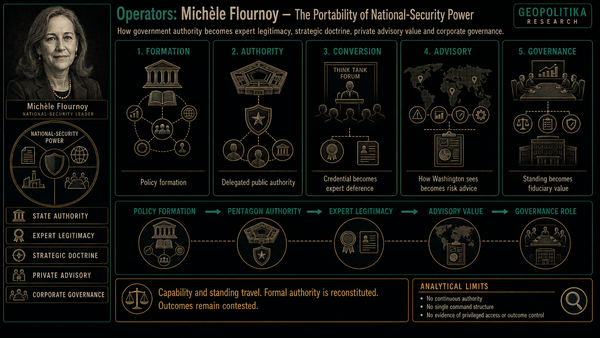
The founding of CNAS makes that logic clearer. Kurt M. Campbell and Michèle Flournoy founded CNAS in 2007. That origin placed the institution inside Washington’s national-security circulation from the beginning. It was not built as a detached academic centre watching policy from a distance. It was built as a policy institution close enough to be heard by government, media, donors and elite security networks.
Campbell and Flournoy matter here not as personalities, but as institutional signals. Their biographies connect CNAS to senior foreign-policy, defence-policy and strategic-advisory worlds. They locate the think tank inside the movement of people between government service, public policy, private-sector strategy, advisory bodies and media-facing expertise.
CNAS’s own materials make that movement part of its institutional story. The organisation notes that its leaders, scholars, interns and affiliates have held or gone on to roles in the Department of Defense, State Department, White House, CIA, Congress and private sector. That statement is not incidental. It describes what CNAS produces.
It produces research. It also produces people, credentials and proximity. A think tank without proximity can publish and be ignored. A think tank with proximity can turn reports into briefings, expert quotes, testimony language, conference panels, staff pipelines and policy common sense. CNAS’s public face gives that proximity legitimacy. Its founding shows why proximity was built into the institution from the start.
The People: Personnel and Power Networks
CNAS’s authority begins with people. A think tank can publish reports, host events and issue policy recommendations, but its influence depends on who stands behind the work, who sits on the board, who advises the institution, who donors recognise, who journalists quote, and who government officials treat as serious. In CNAS’s case, the biographies are not background colour. They are part of the machinery:
- Richard Fontaine, CNAS’s chief executive officer, is a central example. His public biography connects the institution to the State Department, the National Security Council, Senate foreign-policy and armed-services networks, the Defense Policy Board, the foreign-policy circle of John McCain, Georgetown University, the Trilateral Commission, and Anthropic through its Long-Term Benefit Trust. None of those affiliations proves command or coordination. That is not the point. The point is that CNAS’s chief executive sits at the junction of state service, elite foreign-policy networks, advisory legitimacy, technology governance and public-facing security expertise. Fontaine’s role shows one kind of bridge: the executive-legitimacy bridge. He helps route CNAS outward to government audiences, elite policy networks, media-facing expertise and AI-governance-adjacent credibility. The institution’s voice is not just organisational. It is carried by people whose biographies already speak the language of power.
- Paul Scharre, CNAS’s executive vice president, supplies a different route. His biography links CNAS to the Office of the Secretary of Defense, autonomous weapons policy, unmanned systems, directed energy, military technology, the U.S. Army Rangers, and the debate over artificial intelligence and war. In an institution that publishes on AI, autonomy, chips, compute, military technology and strategic competition, that background is not decorative. It gives CNAS a claim to speak from inside the technical and military-security world it analyses. Scharre functions as a technical-security translator. He connects policy language to weapons systems, autonomy debates, battlefield experience and emerging-technology governance. That matters because CNAS does not only comment on AI or military technology from outside. Through figures like Scharre, it can present itself as fluent in the operational and technical terrain being securitised.
- Anna Saito Carson, senior vice president of development, shows another side of the institution: the side that turns policy relevance into financial support. Her background connects CNAS to development strategy, fundraising, the Center for Strategic and International Studies, Deutsche Bank, the World Bank, and Japan-related finance-policy networks. That role matters because donor-supported policy institutions do not reproduce themselves only through research. They reproduce themselves through relationships, donor confidence, institutional relevance and the ability to align money with programme ambition. Carson’s role is a material-flow bridge. It links CNAS’s public policy mission to the development infrastructure required to sustain staff, programmes, fellowships, events, reports and access offerings. A think tank that wants to shape policy must also finance the conditions under which policy-shaping becomes possible.
The board extends the pattern:
- Kurt M. Campbell, CNAS co-founder, connects the institution to senior U.S. foreign-policy and Indo-Pacific strategy networks. His role is a founder-state-policy bridge: he helps locate CNAS inside the world of Asia strategy, diplomatic statecraft and government-facing uptake.
- Michèle Flournoy, the other co-founder, connects CNAS to defence-policy networks and the broader public-private strategic-advisory field. Her role is a founder-defence-policy bridge. Through her, CNAS is linked not simply to past government service, but to the wider circulation of defence expertise between government, advisory institutions, private-sector strategy and elite policy debate.
- Douglas Beck connects CNAS to the Defense Innovation Unit, Apple, McKinsey & Company, Pentagon advisory work and military service. His biography links technology management, defence innovation, corporate strategy and state advisory functions. In an institution focused on AI, defence innovation, chips, compute and public-private security integration, that bridge is structurally important.
- Denis Bovin connects the institution to finance, MIT-linked networks, defence advisory structures and intelligence-adjacent advisory worlds. His role shows how finance and national-security governance can meet at the board layer. Again, the point is not guilt by association.
The point is routing: CNAS draws authority from people who connect it to institutional worlds beyond the think tank itself. These biographies should therefore not be read as a hidden chain of command. They are evidence of circulation.
Former officials bring state authority into CNAS. Corporate and finance figures bring private-sector standing. Military and defence-policy figures bring operational credibility. Technology figures bring innovation and AI-security relevance. Development professionals bring donor infrastructure. Fellows and researchers bring future capacity. Journalists and policymakers receive the outputs as expert language. That is how personnel becomes infrastructure.
The CNAS Board of Directors, Board of Advisors, executive team and research staff are therefore not just governance categories. They are layers in an authority system. The board governs and signals elite confidence. Advisors expand legitimacy. Executives operationalise priorities. Researchers produce policy language. Development staff sustain the material base. Fellows and interns carry the institution forward.
The personnel pipeline makes that system reproduce itself. The Shawn Brimley Next Generation National Security Leaders Fellowship selects a bipartisan cohort of emerging national-security leaders. The stated scale is modest: a group of young professionals, usually around the 27-to-35 age band, moving through a structured leadership programme. The function is larger than the headcount. A fellowship teaches more than skills. It teaches who belongs in the room, which questions count as serious, which vocabulary marks a person as policy-ready, and which institutions form the path to influence. CNAS does not only host established national-security authority. It helps train and credential the next layer.
The full alumni-placement map still needs deeper reconstruction. That remains a reporting lead, not a completed claim. But the visible institutional function is already clear enough. CNAS gathers recognised figures, donors, officials, researchers and emerging professionals into a shared policy environment.
The people supply credibility. The fellowship pipeline shows how that credibility reproduces itself. The people are connected. So is the money.
Money, Access and Outputs
CNAS does not hide that it receives outside support. It discloses supporters, publishes funding policies, issues financial statements, and says it preserves editorial independence. It also says it does not lobby, does not take institutional policy positions, and retains control over its research, ideas, projects, publications and events. Those safeguards matter.
But disclosure is not the same thing as traceability. CNAS is visible at the level of supporter names, access categories, formal policies, financial totals and public outputs. What remains difficult to reconstruct is the path from money to programme activity, from programme activity to private access, and from public output to policy uptake.
The supporter list shows the scale and sectoral mix. CNAS’s 2024–2025 supporter page places contributors into bands. At the $250,000 to $499,999 level, listed supporters include Amazon.com, Inc., Coefficient Giving, Northrop Grumman Systems Corporation, the U.S. Department of Defense Chief Digital and Artificial Intelligence Office, Carnegie Corporation of New York, the Embassy of Japan in the United States, and the Smith Richardson Foundation. At the $100,000 to $249,999 level, listed supporters include Amazon Web Services, Anduril Industries, Boston Consulting Group, Chevron, Cisco, Google, Intel, JPMorgan Chase, Leidos, Lockheed Martin, Meta Platforms, and Open Society Foundations.
That list does not show donor control. It shows something more basic and more durable: sectoral proximity. Many of the represented sectors overlap with CNAS research terrain: defence, artificial intelligence, cloud infrastructure, semiconductors, energy, finance, consulting, economic security, military technology and Indo-Pacific strategy. Donors do not need to dictate reports—CNAS operates where donor interests, state security priorities and live policy debates already meet. CNAS’s access architecture makes that relationship explicit.
The Corporate Partnership Program is priced by tier: Bold Level at $125,000 and above, Innovative Level at $65,000, and Bipartisan Level at $35,000. The benefits include invitations to public and private events, interaction with research programmes, access to CNAS experts, strategic policy conversations, public acknowledgement, a partnership liaison, and participation in Close Calls briefings on breaking policy issues.
At the top tier, the access becomes concrete. Bold Level partners may nominate an executive to join the CNAS Board of Advisors, subject to invitation from CNAS leadership. They may request up to six private briefings with CNAS experts during a membership year. They may attend exclusive events with national-security leaders in New York, San Francisco, Washington, D.C. and elsewhere. They may also request CNAS executive team members, programme directors or senior fellows for corporate conferences, working groups or internal events.
Lower tiers receive fewer benefits but the same basic commodity: structured proximity. Innovative Level partners may request up to four private briefings and attend selected project-specific private roundtables. Bipartisan Level partners may request up to two private briefings.
The CNAS Council offers another access route. Council supporters may receive reserved VIP seating at CNAS’s annual National Security Conference, invitations to selected programming with national-security leaders, private briefing opportunities, Close Calls conference-call briefings, exclusive donor updates, newsletters, a partnership liaison and public acknowledgement.
The financial record shows the institutional base underneath that access. CNAS reported an annual operating budget of $13.6 million in FY2023. Its FY2024 financial statements recorded a term endowment of $3,341,002 as of September 30, 2024, up from $3,222,919 at the beginning of the year, with $118,083 in interest income. The same materials state that board members and organisations affiliated with board members contributed $901,750 during the year.
That $901,750 figure deserves attention. It does not prove improper influence. It does show that the governing layer is not only supervisory. It is also materially connected to the institution’s support structure. That raises ordinary but important accountability questions: which board members or affiliated organisations contributed, in what amounts, under what terms, and with what recusal or conflict-management procedures?
The contract-revenue language is just as important. CNAS financial materials state that contract revenue comes from government agencies and nongovernmental entities, and that CNAS is primarily contracted to conduct specialised studies and publish related research reports as stipulated by customers. Other contract services include fellowship programmes and specialised staffing for U.S. government agencies.
That is a significant disclosure. It is also incomplete. The public record does not fully identify every customer, study scope, deliverable, staffing arrangement, fellowship contract or report pathway. It tells the public that customer-stipulated specialised studies exist. It does not let the public trace all of them.
With funding, access and governance in place, CNAS produces relevance. Its output machine is broad: reports, commentary, expert analysis, podcasts, videos, legal backgrounders, events, private briefings, media appearances and fellowships. Its programme areas map the terrain it treats as national security: defence; technology and national security; energy, economics and security; Indo-Pacific security; Middle East security; transatlantic security; national-security law; and military human capital.
The current-output examples show the conversion mechanism in motion. A piece on AI chip constraints turns semiconductor capacity into national-security infrastructure. Work on who will profit from AI turns private-sector technological gain into a strategic-policy question. Analysis of AI export sovereignty turns trade, compute and industrial policy into security doctrine. Taiwan war games turn a geopolitical flashpoint into planning language. Work on military recruitment medical screening turns personnel administration into national-security readiness. Analysis of Russia’s influence tools in Africa turns regional politics into strategic competition.
Once an issue becomes national security, CNAS becomes relevant to it. A crisis appears. CNAS frames it. A report or commentary follows. An expert speaks. A journalist quotes. A donor sees why the issue matters. A corporate partner sees why access has value. A policymaker receives usable language. A fellow learns the vocabulary. The institution’s authority renews itself.
The event structure amplifies that process. CNAS describes its annual National Security Conference as a day-long flagship event in Washington, D.C., convening more than 800 stakeholders from its national-security community to shape debate and showcase CNAS experts’ work. It describes The Pitch, launched in 2020, as an event for emerging and diverse national-security voices to present policy ideas before judges and a live audience.
These are not side programmes. They are visibility machines. They turn research into audience, expertise into performance, emerging professionals into policy voices, and supporters into recognised participants in a national-security community.
The evidence does not show that every CNAS output serves a donor. It does not show that every author writes toward a funder’s interest. The pattern is broader than individual authorship.
CNAS sits inside a system where policy crises generate outputs, outputs generate relevance, relevance sustains funding, funding sustains access, access sustains networks, and networks make the next output more authoritative.
The reports are visible. The full route from money to access to influence is not.
The System Beneath: Loops, Emergence and Ecosystem Position
CNAS is not only a producer of reports. It is a policy system.
Threats, donor money, officials, former officials, researchers, fellows, corporate partners, journalists and board members all move through it. The outputs are broader than analysis. CNAS produces policy language, expert legitimacy, private access, public seriousness, career capital and institutional continuity.
The routine is visible. A crisis or policy problem emerges: U.S.-China competition, artificial intelligence, chip supply, Taiwan, military recruitment, economic pressure, energy security, trade conflict or a foreign-policy crisis. CNAS frames the issue, publishes analysis, convenes discussion and supplies experts. Journalists quote them. Policymakers receive usable language. Donors and corporate partners see institutional relevance. Fellows learn the vocabulary of the field. CNAS’s authority is renewed through the process.
The cycle does not require central direction. A donor does not need to write a report. A corporate partner does not need to dictate language. A former official does not need to command an event. A journalist does not need to understand the full funding ecology. A policymaker does not need to trace how the expert network was financed. Each actor performs a role within the system, and the combined result is a stream of responsible national-security debate.
That debate is itself part of the product. It helps decide which questions sound serious, which people appear qualified, which language seems pragmatic, and which alternatives are treated as naïve, radical or outside the room. A larger defence-industrial base can appear as innovation. AI export controls can appear as sovereignty. Economic pressure can appear as doctrine. Corporate participation can appear as stakeholder engagement. Strategic competition can appear as common sense.
This is not conspiracy. It is institutional reproduction. CNAS does not create these assumptions alone. Its role is to make them usable: in reports, events, private briefings, fellowships, media quotations and policy conversations. Understanding that internal machine clarifies where CNAS sits in the wider ecosystem.
CNAS belongs to a Washington national-security policy field that includes institutions such as the Center for Strategic and International Studies, the Council on Foreign Relations, the Atlantic Council, RAND Corporation, the Brookings Institution, the American Enterprise Institute and New America. These institutions differ in ideology, age, scale, funding base and tone. They do not perform identical roles. But they share a broad function: translating elite policy concerns into public-facing expertise.
CNAS’s role in that field is differentiated. It is not the largest think tank, not the only defence-policy shop, and not a command centre for the ecosystem. Its niche is more specific: national security, defence, technology, artificial intelligence, Indo-Pacific strategy, economic security, military human capital and policy leadership. It routes those domains through a compact machinery of elite biography, donor support, private access, public research, media expertise and personnel development. In that sense, CNAS is not just a research producer. It operates as a high-throughput policy-language and legitimacy node: a translator between state security priorities, private-sector capacity, donor support, expert authority and future personnel supply. It helps turn crises into serious arguments, corporate and state-adjacent participation into stakeholder engagement, fellows into future policy actors, and public research into private access value.
Moreover, CNAS can bee seen to occupy several layers at once:
- First, CNAS sits in the think-tank legitimacy layer. It produces reports, events, testimony-style language, expert commentary and media-ready interpretation. That layer makes policy arguments appear independent, professional and serious.
- Second, CNAS sits in the public-private national-security layer. Its corporate partnership programme, council benefits, donor base, defence and technology outputs, and government-facing language place it between state priorities and private-sector participation.
- Third, CNAS sits in the personnel-circulation layer. Founders, executives, board members, advisors, fellows, staff and interns move through government, defence, military, corporate, technology, finance, consulting, academic and media networks.
- Fourth, CNAS sits in the strategic-competition layer. China, Taiwan, AI, chips, Iran, Russia, energy, sanctions, trade, alliances and defence innovation recur as policy objects. CNAS helps translate those objects into the language of responsible strategy.
- Fifth, CNAS sits in a donor-supported nonprofit governance layer. It claims editorial independence, publishes financial statements, discloses broad supporters and maintains conflict policies. Yet the public still cannot fully follow donor money, private access, contract customers, programme priorities and policy uptake through the institution.
Context places CNAS inside a broader security-policy think-tank ecosystem and near recurring patterns of defence-policy personnel circulation, donor-supported legitimacy production, public-private security access, AI-security policy handoffs and missing linkage between funding, outputs and policy uptake. That context does not prove coordination, intent or control. It helps identify the institutional type.
The supported claim is narrower and stronger: CNAS is not shown to command the system. It is shown to be useful to it. Other actors command, procure, legislate, regulate and invest. CNAS frames, convenes, legitimates, briefs, staffs and translates. That is enough to matter.
Where the Power Sits
Power in the CNAS system does not sit in one place. It is distributed through roles, access points and institutional routines.
CNAS holds institutional power. It can define problems, publish research, convene officials and corporate actors, host private briefings, credential experts, train fellows and translate live crises into policy language. It does not need command authority to matter. Its power lies in making certain interpretations sound serious, pragmatic and usable.
The Board of Directors holds governance power. It sits over institutional direction, financial health, executive accountability and reputation. Its members bring government, corporate, finance, technology, philanthropic, diplomatic and defence-policy authority into the governing layer.
The Board of Advisors holds legitimacy power. An advisory board does not need day-to-day control to expand an institution’s reach. It signals credibility. It connects CNAS to military, corporate, academic, former-government and policy networks. It helps make the institution appear serious to the people whose recognition matters.
The executive team holds operational power. It manages the institution, sets priorities, directs research, leads development, speaks publicly and represents CNAS to donors, policymakers, journalists and partners.
Donors and corporate partners hold material power. They supply money, contracts, endowment support, recognition value and operating capacity. Their support does not automatically determine research. The evidence does not show that. But it finances the institutional setting in which research, convening, private access and policy language are produced.
Government-facing audiences hold uptake power. A report matters more when officials, agencies, congressional staff, committees, military leaders and private-sector strategists treat it as useful. CNAS’s authority depends not only on what it publishes, but on who is willing to absorb its language.
Fellows, staff and interns hold future-field power. They are not merely junior participants. They are part of the reproduction mechanism. They carry CNAS’s language, norms and networks into later roles across government, defence, technology, consulting, finance, media and policy institutions.
Media outlets hold amplification power. A quoted CNAS expert does more than explain a crisis. The quotation helps define what responsible interpretation sounds like.
The least powerful actors are downstream: soldiers, recruits, veterans, taxpayers, workers, technology users, foreign publics and civilians affected by the security policies CNAS helps frame. They are acted upon by the policy field, but they do not receive equivalent access to the rooms where the language is made.
This is not a pyramid with a hidden controller. It is a networked policy machine in which power is only partially visible. The most important missing material appears in the linkage layer.
Omissions, Contradictions and the Trap
CNAS is not hidden. That is what makes the problem harder to see. The institution names its leaders, lists board members and advisors, publishes reports, describes programmes, discloses supporters, issues financial statements, claims editorial independence, and presents funding and conflict policies. The record is not empty. It is structured. The question is not whether CNAS is visible, but whether the visible record allows the public to reconstruct how influence moves. A close reading of its public materials leads to the conclusion that it does not.
Donors are named in broad bands, but the record does not fully connect donor money to programmes, fellowships, events, briefings or outputs. Corporate partners receive defined access benefits, but the public cannot follow which partners interacted with which research teams, around which topics, before or after which publications. Council supporters may request private briefings and join Close Calls calls, but briefing participants, content, questions and follow-up are not publicly mapped. Contract revenue is disclosed, yet customer identities, study scopes, deliverables, staffing arrangements and customer-stipulated reports remain only partially visible. Board-affiliated contributions appear as a category, but not as a full governance trail of contributors, amounts, recusals or conflict-management decisions.
That is the missing layer: not existence, not identity, but linkage. A donor list says who gave. It does not say what the money supported. A statement of editorial independence says what rule CNAS claims. It does not show how the rule operates in each donor-supported, contract-funded, privately briefed, board-adjacent or corporate-partnered case. A financial statement shows broad categories of money. It does not show every restriction, private deliverable, programme allocation, consultant relationship, contract customer or policy uptake path.
This is the first contradiction: CNAS is transparent enough to produce trust, but not transparent enough to make influence fully traceable. Other contradictions follow from it. Editorial independence may prevent direct donor control while donor support still expands institutional capacity, convening power, research scale, event production and access value. Non-lobbying status may separate CNAS from client advocacy while leaving it free to shape policy language, staff pathways, media frames, committee questions, agency assumptions and elite consensus. Bipartisanship may distinguish CNAS from party politics while still reproducing an elite national-security consensus around U.S. global leadership, strategic competition, defence innovation, alliance management and public-private security integration.
The same tension runs through its public mission. CNAS can publish serious research and still defend a U.S.-led security order. Its work can be useful and system-reproducing at the same time. Public reports can educate broad audiences while private briefings turn public credibility into selected proximity.
That is not a simple hypocrisy story. It is a working institutional model: disclosure without full traceability, independence with donor support, public education with insider access, and policy influence without formal lobbying. The contradictions organise the institution. The trap appears downstream.
Earlier articles in the Geopolitika series framed institutions in terms of winners and losers: who gains access, status, recognition, briefing rights, career capital and policy language, and who carries the consequences. These issues are addressed in the next section. The concept of “immobilisation” adds a sharper question. It asks not only who benefits and who pays, but who can meaningfully enter, contest, redirect or exit the system. Immobilisation in this sense does not mean CNAS physically restrains anyone. It means the policy field gives some actors mobility—donors, partners, officials, experts, fellows, journalists—while others are mostly acted upon by the language those actors produce. The powerful can fund, brief, publish, govern, attend, quote, hire, advise or leave. Downstream populations often lack comparable routes into agenda-setting, language-making, policy uptake or exit from the consequences.
The immobilisation trap has eight layers:
- Access immobilisation: Donors, corporate partners, officials, former officials, fellows, journalists and policy elites can enter CNAS spaces through money, credentials, invitation, position or network. Soldiers, recruits, taxpayers, foreign civilians, workers and ordinary technology users do not receive equivalent entry into private briefings, roundtables, donor updates, board conversations or fellowship environments. When CNAS offers private briefings through corporate partnership and council structures, access is formalised; the affected public gets no parallel channel.
- Agenda immobilisation: CNAS can decide that technology and national security, energy, economics and security, defence, Indo-Pacific security, Middle East security, national-security law, or military human capital deserve expert framing. Once an issue enters that frame, it attracts different actors and remedies. AI chips become strategic infrastructure. Sanctions become economic pressure. Military recruitment becomes readiness. Taiwan becomes scenario planning. The people living inside those issue areas rarely set the agenda on equal terms.
- Epistemic immobilisation: CNAS helps decide what knowledge counts as policy knowledge. Its accepted forms include expert reports, military terminology, legal backgrounders, scenario exercises, economic-security models, classified-adjacent fluency and elite conference language. A civilian account of sanctions, a worker’s account of industrial policy, a recruit’s account of military screening, or a user’s account of surveillance risk may be direct and material, but it does not travel through Washington with the same authority as a CNAS paper, panel or briefing.
- Language immobilisation: Terms such as “strategic competition,” “deterrence,” “readiness,” “resilience,” “innovation base,” “economic security,” “export sovereignty” and “national-security human capital” mark a speaker as serious. They also discipline debate. When questions are framed through compute, chips, deterrence, recruitment readiness or economic coercion, objections from outside the professional security field can be dismissed as emotional, local, naïve, ideological or uninformed before their substance is addressed.
- Technological immobilisation: CNAS outputs on AI chips, compute, export controls, AI profits, autonomy and military technology turn technical systems into national-security objects. A report on chip constraints, a commentary on who profits from AI, or analysis of AI export sovereignty moves technology from public infrastructure into strategic-security terrain. That shift empowers officials, firms, defence technologists and policy experts. Technology users, platform workers, coders outside the defence-policy circuit, foreign researchers, surveillance-affected communities and people exposed to military AI deployment do not have equivalent access to the rooms where the security frame is built.
- Diplomatic and geographic immobilisation: CNAS output terrain includes Taiwan scenarios, Iran negotiations, Russia in Africa, Indo-Pacific strategy, Middle East security, South Korea economic security and U.S.-China competition. These are lived geographies, not abstractions. A Taiwan war game, an Iran negotiations analysis, or a Russia-in-Africa brief may shape U.S. policy language while affected foreign publics appear mainly as allies, adversaries, civilians, risks, partners or markets—not equal co-authors of the frame.
- Financial and personnel immobilisation: Corporate partners and major donors can support CNAS and receive proximity. Ordinary taxpayers fund the broader national-security state but cannot purchase equivalent access to think-tank rooms. CNAS also trains and credentials future policy participants through staff roles, internships, fellowships and elite networks. A fellow can become the person trained to speak about recruitment, AI security or Indo-Pacific strategy. A recruit, user, worker or foreign civilian more often becomes the object of that speech.
- Uptake and exit immobilisation: CNAS outputs can travel upward through briefings, citations, expert quotes, events, congressional attention, agency discussion and media repetition. Downstream experience travels less easily: it may be foreign, local, dispersed, classified-adjacent, delayed or politically inconvenient. Powerful participants can disengage. A donor can stop giving. A corporation can leave a partnership. A board member can resign. A journalist can stop calling. But a taxpayer cannot individually exit the national-security budget. A soldier cannot individually exit personnel policy. A foreign civilian cannot opt out of being affected by U.S. sanctions, security doctrine or military planning. A technology user cannot individually exit AI-security policy once it becomes infrastructure.
That is the asymmetry. CNAS’s access architecture points upward and inward—toward donors, corporate partners, officials, experts, fellows, journalists and national-security leaders. Its consequence architecture points downward and outward—toward soldiers, taxpayers, workers, technology users, foreign publics and civilians affected by U.S. security policy. The people most able to access CNAS are not necessarily the people most exposed to the policy world CNAS helps legitimate. That is the trap.
8. The Stakes: Who Benefits, Who Pays, Who Decides
CNAS produces benefits:
- The first beneficiary is the institution itself. Donor support, contract revenue, endowment assets, board-affiliated contributions, corporate partnerships, council access, public events and research outputs sustain CNAS’s operating base. Each crisis it interprets can renew its relevance. Each report, briefing, media appearance or fellowship cycle helps keep the institution inside the national-security conversation.
- Its personnel benefit too. Executives, researchers, fellows, interns, board members and advisors receive platform, status, publication opportunities, networks, media visibility and career capital. A CNAS title can become a credential. A report can become a calling card. A fellowship can become an entry route. A board role can become a public signal of national-security seriousness.
- Donors and corporate partners benefit in a different way. The evidence does not show that they control CNAS research. It does show that they can receive recognition, proximity, expert access, event access, private briefing opportunities, research-programme interaction and strategic policy conversation. Those are not trivial benefits. In a policy system, proximity is a form of value. It lets actors hear the language early, test concerns, become familiar to experts, and appear as responsible participants in the security-policy field.
- Government and media audiences also benefit. Officials, congressional staff, agency personnel, military leaders, private-sector strategists and journalists receive ready-made national-security language. CNAS translates complex crises into usable frames. It helps turn AI, chips, sanctions, trade, recruitment, energy and regional conflict into policy objects that can be quoted, briefed, debated and acted upon.
- The broader U.S. national-security system benefits most of all. CNAS supplies arguments, legitimacy, personnel, convening capacity, expert commentary and policy vocabulary for defence, technology, alliance, economic-security and strategic-competition agendas. It helps make the system speak in a voice that sounds independent, bipartisan and expert.
The costs are distributed elsewhere:
- Foreign publics may become objects of U.S. strategy without becoming participants in the institutions that shape it.
- Soldiers and recruits may be affected by personnel policy without shaping the think-tank consensus around it.
- Taxpayers fund the broader national-security state without receiving equivalent access to its private policy rooms.
- Workers and communities affected by industrial-base, chip, trade, sanctions, energy or defence-technology policy rarely appear as equal counterparties.
- Technology users live under AI-security doctrine without the same agenda-setting power as firms, officials and policy experts.
This is not a claim that CNAS directly harms each group. The mechanism is more indirect. CNAS helps frame, legitimate and circulate the policy language of systems that later act on those groups.That distinction matters. The access structure points one way. A donor can receive a briefing. A corporate partner can enter a strategic policy conversation. A fellow can join the pipeline. A former official can become an expert. A journalist can quote CNAS. A policymaker can attend an event.
The consequence structure points another way. A foreign civilian affected by sanctions or war cannot request equivalent access. A taxpayer cannot enter the same room by virtue of paying for the national-security state. A recruit cannot veto the expert framing of recruitment policy. A worker affected by defence-industrial policy cannot easily become a counterparty to the institution shaping the language of that policy.
Access flows upward and inward. Consequences flow downward and outward. That is the distributional structure. It is why the question is not simply whether CNAS produces serious research. It may. The question is who gains voice, access and legitimacy through that research—and who lives downstream of the policies it helps make thinkable.
All of this evidence builds toward the de facto purpose.
What Is Being Defended
CNAS has safeguards. That should be stated clearly. The Center for a New American Security claims editorial independence. It says it does not lobby. It says it does not take institutional policy positions. It acknowledges donors. It publishes funding rules, audited financial materials and conflict-of-interest policies. Those mechanisms matter. They distinguish CNAS from a client-advocacy firm or campaign operation. But safeguards do not close the system.
A donor list does not show donor-to-output influence. A financial statement does not show private briefing content. A funding policy does not show every restriction, expectation or internal decision. A conflict policy does not show every board recusal. An editorial-independence statement does not show how each programme, event, contract or publication moved from conception to public release.
This is the accountability structure: real surfaces, incomplete linkage. CNAS is most transparent where trust is produced. It is less transparent where influence would be reconstructed. That does not make its accountability fake. It makes accountability a structural function. The institution can comply with formal safeguards while still leaving the public unable to trace how money, access, expertise, contracts, private briefings and policy uptake connect.
That matters because CNAS does not defend only itself. It helps defend a system.
The system is the U.S.-led national-security order: defence strategy, alliance management, strategic competition, technology security, economic security, industrial-base policy, military human capital and public-private security integration. This is not hidden. It is CNAS’s public agenda.
Its programme areas and outputs repeatedly turn China, Taiwan, artificial intelligence, chips, sanctions, trade, energy, Iran, Russia, recruitment, military technology and alliance management into national-security problems. Once those issues enter the security frame, certain responses begin to sound obvious. Experts are needed. Corporate partners should be consulted. Defence innovation becomes public necessity. Private-sector capacity becomes strategic infrastructure. Fellows must be trained. Policymakers need briefings. Journalists need interpreters. Donors can support serious work.
That “of course” is the work of institutional common sense. CNAS helps decide what counts as responsible national-security thought. It helps decide who speaks it fluently. It helps decide which actors enter as stakeholders and which appear only as subjects of policy.
This is not a party-specific finding. It is not a donor-specific finding. The evidence does not support the claim that CNAS is secretly donor-controlled. It does not show that a named donor dictated a named report. It does not show formal lobbying. It does not show CNAS is a state agency or covert state front. It does not show its research is fake or useless. It does not show every donor relationship is corrupt. Those claims should be excluded because the evidence does not carry them.
The stronger claim is structural: CNAS is donor-supported, personnel-dense, access-oriented, formally independent, accountability-surfaced and linkage-opaque. It operates inside a national-security policy field where money, expertise, biography, government proximity, corporate participation and media amplification produce authority together.
CNAS is positioned inside a broader security-policy think-tank ecosystem and near recurring patterns of defence-policy personnel circulation, donor-supported legitimacy production, public-private security access, AI-security policy handoffs and missing linkage between funding, outputs and policy uptake. Those references are context, not proof. They identify institutional type, not culpability.
The expected evidence layers are clear: donor-to-output mapping, programme funding, private briefing logs, contract-customer records, fellowship placement, policy uptake and affected-population voice. CNAS’s record contains some layers and lacks others. That absence is not proof of concealment. It is a structured evidence gap.
Context explains the pattern. The stakes show who benefits and who pays.
What CNAS Actually Does—and Why It Matters
CNAS says it develops strong, pragmatic and principled national-security and defence policies. That is true as self-description. It is incomplete as function.
What CNAS actually does is broader. It converts national-security problems into policy legitimacy. It converts donor money into research capacity, access surfaces and institutional stability. It converts elite biographies into authority. It converts corporate and state-adjacent participation into responsible stakeholder engagement. It converts fellows, staff and interns into future participants in the policy field. It converts live crises into reports, events, briefings, expert commentary and media language. It converts public research into private access value. It converts U.S. strategic assumptions into bipartisan common sense.
No single donor, report, executive or administration explains that function. The institution works because its pieces reinforce one another. A crisis creates demand; CNAS supplies language. Experts speak; journalists quote. Policymakers receive usable framing; fellows learn the vocabulary. Donors see relevance; corporate partners see access value. Public research builds legitimacy; private briefings convert that legitimacy into proximity.
That is the de facto purpose: not secret command, crude purchase or a hidden state office, but a working access-and-legitimacy infrastructure for the U.S. national-security policy system.
This returns the article to its opening tension. CNAS is not exposed by having donors — it discloses many of them. It is not exposed by former officials and policy insiders on its board, staff and advisory networks — those biographies are public. It is not exposed by seeking to influence policy — that is the stated purpose of a policy think tank.
The exposure lies in the combination: donor support, elite biographies, structured private access, public credibility, fellowship pipelines, corporate partnership benefits, council briefings, contract revenue, board-affiliated contributions, media-ready expertise, strategic-competition language and linkage opacity. Taken separately, each element can be explained as ordinary institutional practice. Taken together, they show how national-security authority is produced and reproduced.
That is why the story is not simple scandal. The evidence does not support hidden controllers, donor-dictated reports or covert command. The more durable finding is also more unsettling.
The product is not only reports. The product is seriousness.
Seriousness functions as a patina of legitimacy, a right of entry, and a passport to decisionmakers. It lets a corporate actor appear as a responsible stakeholder rather than a self-interested party. It lets a former official become a credible expert. It lets a donor-supported institution appear above narrow interest. It lets strategic competition, defence innovation, and public-private integration appear as bipartisan common sense rather than contested political choices.
In short, seriousness operates as a gatekeeping mechanism. It determines which ideas, voices, and futures are treated as legitimate, pragmatic, and policy-ready—and which are sidelined as unserious, emotional, ideological, or outside the room.
This is the central tension: CNAS can be formally independent and still structurally useful to concentrated national-security power. It can be accountable in visible ways and still leave the crucial routes from money to access to output to uptake only partially reconstructable. It can produce real expertise and still help decide which voices, questions and futures count as serious.
Finally, the deeper question is not whether institutions like CNAS should exist. The question is what kind of national-security debate America gets when institutions like CNAS become central places where select ok, now coparedonors, officials, corporate actors, experts and future policy staff are anointed with the patina of seriousness—and gain the passport to decisionmakers.
- Who gains structured access to that conversation?
- Who lives downstream of its consequences?
- And what would genuine accountability require if seriousness itself functions as a form of power?
—
Methodology Note: This article is based on a detailed institutional analysis of the [Center for a New American Security](https://www.cnas.org/) using a structured protocol-based framework. The review examined publicly accessible CNAS materials, including its website, mission and self-description pages, leadership and staff biographies, Board of Directors and Board of Advisors pages, research programme pages, current publications and commentary, event materials, fellowship and leadership-pipeline pages, supporter disclosures, Corporate Partnership Program materials, CNAS Council materials, funding and editorial-independence policies, conflict-of-interest language, annual reports, financial statements and tax filings. The analysis examined CNAS across several dimensions: public self-presentation; founding history; personnel and board networks; donor and supporter architecture; corporate and council access benefits; financial categories; contract-revenue language; fellowship and staff-pipeline functions; research-output patterns; synchronisation with live policy crises; private-access structures; accountability surfaces; missing linkage materials; contradictions between independence, funding and influence; downstream affected populations; and de facto institutional purpose. All sourced material used for the article is publicly accessible. The article does not claim donor control, quid pro quo, formal lobbying, covert state direction, or hidden command. Where the public record did not allow donor-to-output, contract-to-study, briefing-to-policy, fellowship-placement, or output-to-uptake chains to be reconstructed, those absences are treated as structured evidence gaps rather than proof of concealment. Base analytic outputs are available on request. For methodological details, including Transparency Score definitions, typology classifications, confidence calibration and protocol logic—see the Geopolitika Series Methodological Statement.