The Operators: Addendum 5a. Historical Biopoliticians
Doctrine, registries, model laws and population programmes before the dashboard
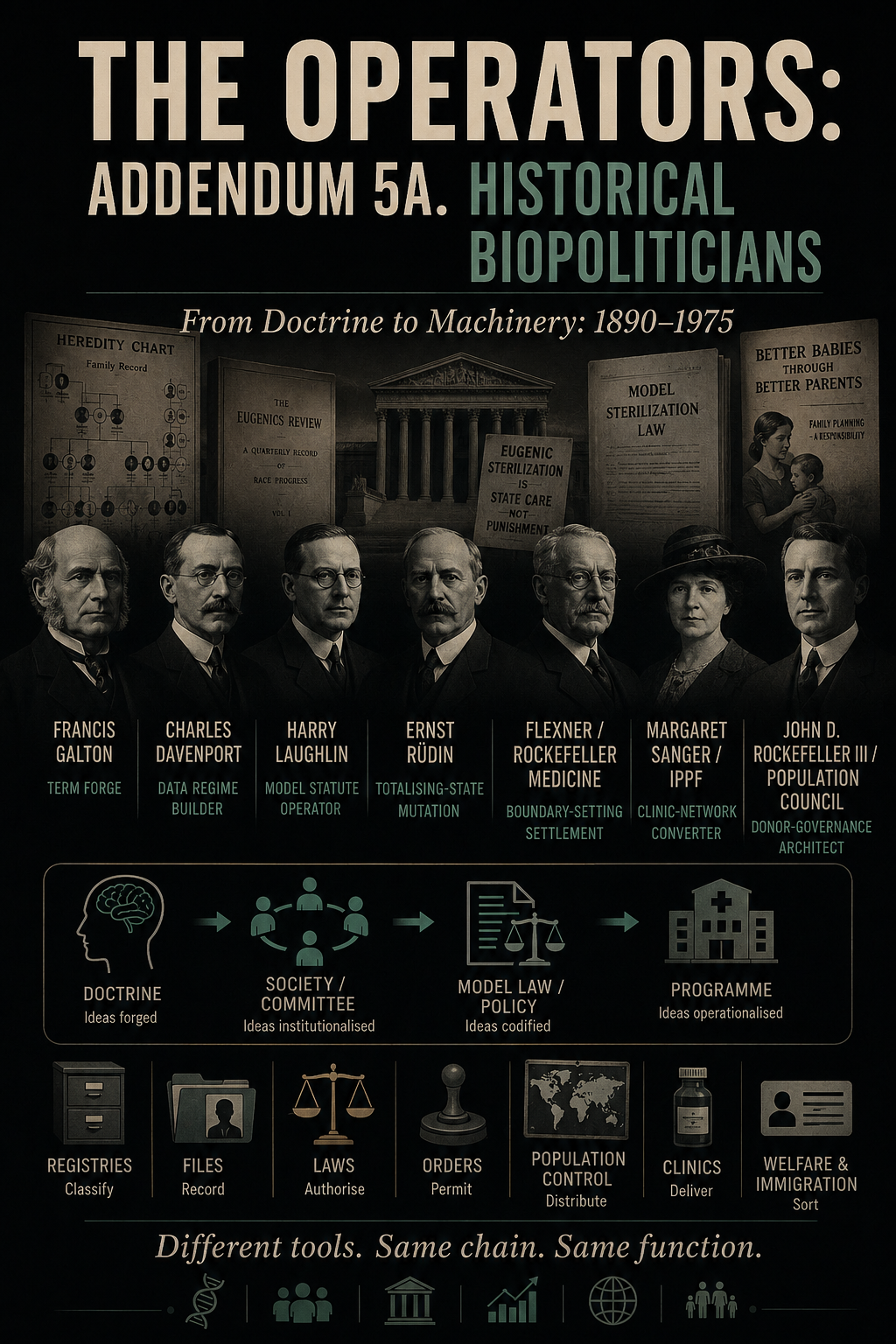
Before public health became a world of dashboards, QR codes, emergency declarations and interoperable credentials, it ran on paper: heredity charts, clinic files, welfare records, immigration categories, medical-school standards, committee reports and model statutes. This addendum traces that older machinery across the period roughly 1890–1975, when eugenic doctrine, medical professionalisation, sterilisation law, population-control advocacy and development-era family-planning programmes supplied the seedbed for later biopolitical administration.
The chain is simple:
Doctrine → Society / Committee → Model Law / Policy → Programme
The figures profiled here are not treated as villains in a morality play. They are read as operators: people who occupied institutional placements, pulled specific levers, and helped mutate ideas into durable machinery. The question is functional, not psychological. How did a term become a society? How did a registry become a statute? How did a statute become a programme? How did philanthropy, medicine, law and government learn to classify bodies at scale?
Addendum 5a follows that paper-age conveyor. Part 5 showed the modern runtime: risk signal, panel, threshold, order, procurement, credential and gate. This addendum shows the earlier version: doctrine, committee, model law, clinic, court and file.
Case Study Index:
- Francis Galton — Term Forge
- Charles Davenport — Data Regime Builder
- Harry Laughlin — Model Statute Operator
- Ernst Rüdin — Totalising-State Mutation
- Flexner / Rockefeller Medicine — Boundary-Setting Settlement
- Margaret Sanger / IPPF — Clinic-Network Converter
- John D. Rockefeller III / Population Council — Donor-Governance Architect
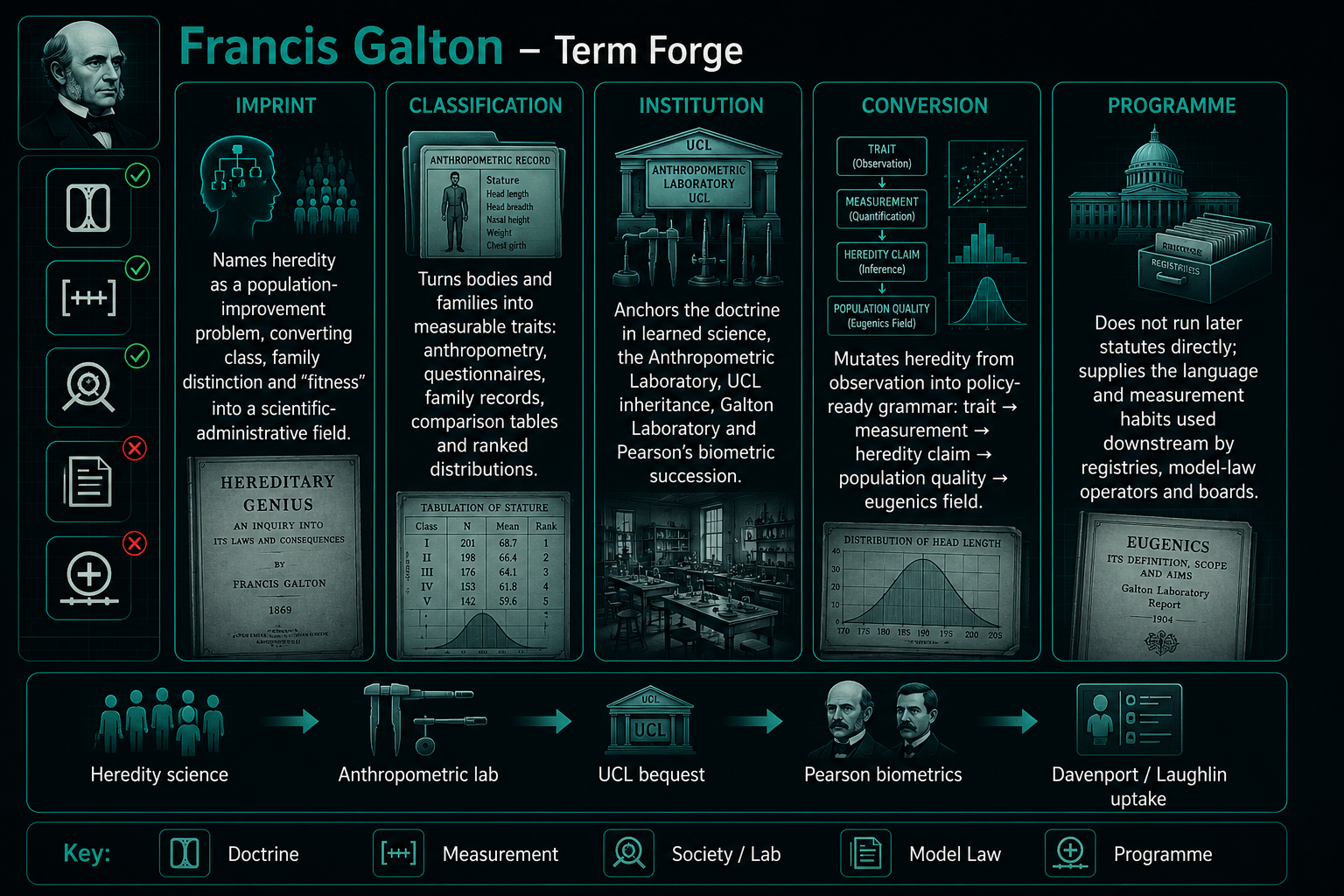
1. Francis Galton — Term Forge
Ribbon: Heredity Doctrine → Eugenics Term → Measurement Regime → Institutional Afterlife
Lane / Era: Victorian heredity science, statistics and early eugenic doctrine | Peak influence: 1869–1911
House(s): Royal Society • Anthropometric Laboratory • University College London • Galton Laboratory
Role Type: Term Forge
Imprint: Name the population problem, make it measurable, and leave an institution to carry the word after death.
Placement
Francis Galton sits at the head of the paper-age biopolitical conveyor because he supplied the first durable operating term. He did not run a ministry, sign a sterilisation order, or administer a clinic network. His placement was earlier and more foundational: Victorian heredity science, statistics, elite learned societies, measurement practice and institutional philanthropy.
That placement mattered. It gave him the authority to convert social hierarchy into a scientific problem and then to propose that human reproduction could be treated as an object of rational improvement. The move was not yet administrative in the later sense. It did not yet look like a statute, court order, clinic quota or immigration file. But it was already classificatory. It taught later operators to see persons and families as legible units inside a population-quality problem.
Galton’s early heredity argument was set out in Hereditary Genius in 1869, where distinction, capacity and family line were treated as connected phenomena. By 1883, Inquiries into Human Faculty and Its Development supplied the operating term: eugenics. The Wellcome Collection records the same bibliographic hinge: the word first appears in that book.
That was Galton’s placement in the chain: not execution, but authorship of the category.
Lever
Galton’s lever was language plus measurement.
The word eugenics condensed a dispersed set of Victorian anxieties — degeneration, poverty, disability, fertility, empire, class, heredity and social burden — into a single field of action. Once named, the field could recruit societies, journals, lecturers, donors, statisticians, physicians, reformers and policymakers. A vocabulary became a venue.
The second lever was the measuring apparatus. Galton did not leave the doctrine floating in prose. He experimented with anthropometry, composite photography, family records, questionnaires and statistical comparison. The body became a file; the family became a dataset; the population became a distribution. His Anthropometric Laboratory at the International Health Exhibition in the 1880s was not a state registry, but it rehearsed the method: collect measurements, standardise traits, compare bodies, rank differences, and treat the resulting distribution as knowledge about population quality.
The third lever was institutional afterlife. Galton’s estate helped fund eugenic research at University College London. UCL’s archive records the Galton Laboratory as the institutional successor to the Eugenics Record Office, with Karl Pearson later carrying the biometric and eugenic programme inside the university. That is the mutation point: a word becomes a research office; a doctrine becomes a permanent academic venue.
Mutation
Galton’s mutation was from observation to prescription.
At the observational stage, human differences were collected as traits: height, reaction time, sensory acuity, family distinction, illness, mental capacity, criminality, talent and physical type. At the classificatory stage, those traits were arranged into distributions and lineages. At the normative stage, some traits and families were treated as socially desirable, while others were coded as burden, degeneration or waste. At the policy stage, later actors could translate that hierarchy into marriage advice, fertility encouragement, immigration sorting, institutionalisation, sterilisation law and population management.
Galton did not complete all those later steps himself. That boundary is important. His function was not the whole machine. His function was the term-forge and measurement seedbed. He made it possible for later operators to say that population quality was not merely a moral, religious or political question, but a scientific-administrative one.
The mutation chain is therefore:
Trait → Measurement → Heredity Claim → Population Quality → Eugenics Field → Institutional Programme
Once that chain existed, others could build on it. Karl Pearson formalised biometric and eugenic research at UCL. Charles Davenport turned heredity records into a more explicit data regime in the United States. Harry Laughlin converted the data regime into model statute and testimony. Galton supplied the grammar and measuring instinct; successors supplied the boards, statutes and administrative throughput.
Output ribbons
Term → Society → Laboratory → Policy Field
The word eugenics gave heredity and degeneration claims a common banner. Once the term existed, societies, laboratories, journals and public lectures could gather around it.
Body → Measurement → Distribution → Rank
Anthropometry converted bodies into comparable entries. The method was not yet a passport or digital credential, but it anticipated the later biopolitical reflex: turn persons into fields, fields into scores, and scores into policy-relevant categories.
Family → Record → Heredity Claim → Intervention Logic
Family histories became more than genealogy. They became evidence for claims about fitness, burden and inherited capacity. The family file became a bridge between private life and public policy.
Philanthropy → Academic Chair → Institutional Continuity
Galton’s bequest helped give eugenics an academic afterlife. The doctrine no longer depended only on one writer’s books. It acquired institutional space, staff, publications and successors.
Science → Improvement → Population Sorting
The moral cover was improvement. The administrative output was sorting: better and worse stock, fit and unfit traits, desirable and undesirable reproduction.
Operator reading
The operator reading is inferred from sequence, not motive. Galton’s importance lies in the conversion pathway. He moved heredity from observation into doctrine, doctrine into a named field, the named field into measurement practice, and measurement into institutional inheritance. That is the operator function: not to command the later apparatus, but to supply the category and tools through which later actors could build it.
In the Part 5 vocabulary, Galton is a pre-digital biopolitical custodian. He did not manage access through QR codes, procurement contracts or credential schemas. He managed legitimacy at the seedbed layer. The later runtime would classify people by risk, eligibility, compliance and burden. Galton’s version classified them by heredity, family, fitness and stock.
The substrate was paper. The habit was already visible: make the body legible, make the population comparable, and make intervention sound like improvement.
Ledger strip
Doctrine terms normalised: eugenics; heredity; stock; fitness; improvement.
Society / committee placement: Royal Society and late-Victorian learned-science networks.
Record systems / data instruments: anthropometric measurement, family records, questionnaires, composite portraits, trait comparison.
Model-law or policy uptake: indirect; supplied the vocabulary later used by societies, record offices and model-statute operators.
Programme outputs: laboratory tradition, eugenics research agenda, heredity classification field.
Funding rails: Galton bequest and institutional support for eugenic research at UCL.
Boundary effect: persons and families became classifiable by inherited quality, projected social worth and reproductive desirability.
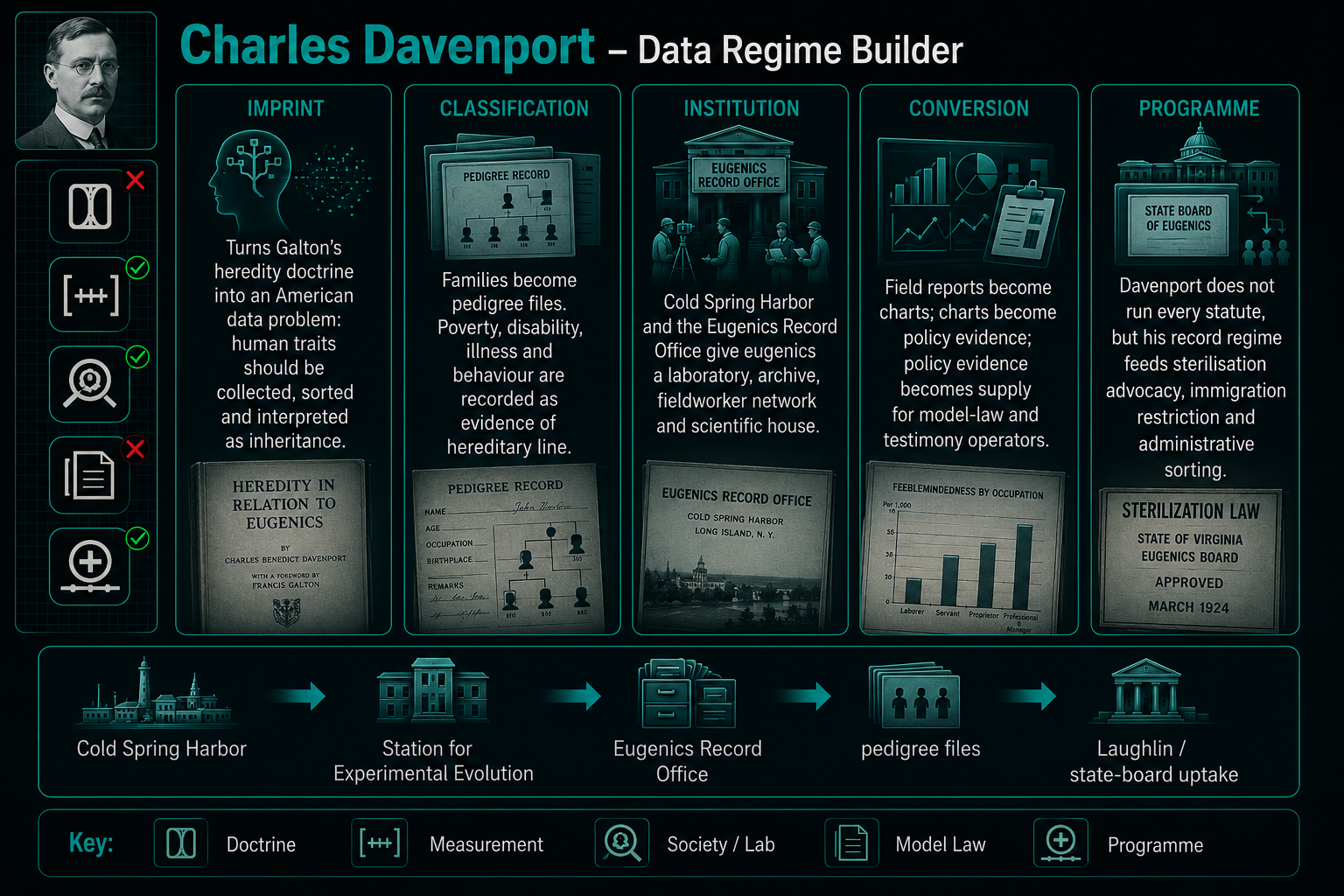
2. Charles Davenport — Data Regime Builder
Ribbon: Mendelian Heredity → Eugenics Record Office → Pedigree Files → Administrative Sorting
Lane / Era: American genetics, heredity records and Progressive-era eugenics | Peak influence: 1904–1935
House(s): Cold Spring Harbor Laboratory • Station for Experimental Evolution • Eugenics Record Office • Carnegie Institution of Washington
Role Type: Data Regime Builder
Imprint: Convert heredity doctrine into records, train fieldworkers, and make family files look like policy evidence.
Placement
Charles Benedict Davenport occupies the second station in the paper-age biopolitical conveyor. Galton supplied the term and measurement instinct; Davenport built the American record machinery. His placement was not the courtroom or the state sterilisation board. It was the laboratory-field station interface: biology, genetics, private philanthropy, heredity data and Progressive-era administrative reform.
That placement mattered because it gave eugenics an American scientific house. Davenport became director of the Biological Laboratory at Cold Spring Harbor in the late 1890s and then helped secure the Carnegie Institution of Washington role in building the Station for Experimental Evolution. In 1910, with support from donors including Mary Williamson Harriman, he founded the Eugenics Record Office at Cold Spring Harbor.
The ERO was the key venue. It did not merely publish opinions. It collected family records, trained fieldworkers, built pedigree files, issued forms, circulated bulletins and supplied data claims to a wider eugenic policy movement. Cold Spring Harbor’s own archival summary describes the ERO as a centre for the “scientific studies of eugenics,” while also noting that its analysis often applied Mendelian principles to complex human traits with little regard for data quality or fit.
That was Davenport’s placement in the chain: not term-forge, but data-regime builder.
Lever
Davenport’s lever was the heredity file.
His 1911 book Heredity in Relation to Eugenics translated Galton’s broader heredity doctrine into an American programme of pedigree analysis, trait inheritance and social sorting. The book presented charts and family studies as if complex behaviours, illnesses, disabilities and social outcomes could be treated through simplified heredity rules. The form mattered as much as the argument. A pedigree chart looked technical. A family file looked empirical. A trait table looked administratively usable.
The ERO extended that method. It trained fieldworkers to collect family histories and classify traits. It gathered information on disability, illness, “feeblemindedness,” criminality, pauperism, alcoholism, sexual behaviour and other socially loaded categories. These records converted private lives into indexed heredity problems. Once filed, coded and compared, they could be used as evidence for institutionalisation, marriage restriction, immigration exclusion or sterilisation advocacy.
The lever was therefore not just “bad science.” It was a working data format. The ERO created the appearance of a population intelligence system: forms, fieldworkers, pedigrees, archives, charts, expert interpretation and policy-facing reports. That format gave later operators something to carry into legislatures, expert testimony, immigration hearings and model-law campaigns.
Mutation
Davenport’s mutation was from doctrine to record.
Galton’s chain ran from heredity term to measurement field. Davenport’s chain ran from heredity claim to institutional data. The mutation was procedural:
Trait → Family History → Pedigree Chart → Record Office → Policy Evidence
Once the record office existed, eugenics no longer depended on a single author’s vocabulary. It had files. It had trained collectors. It had institutional prestige. It had Carnegie-linked scientific standing. It could produce charts and case histories that appeared to translate messy social life into biological inheritance.
That mutation carried two consequences.
First, it expanded classification. People were not only poor, disabled, institutionalised, ill, immigrant, criminalised or dependent. They could be recoded as members of defective lines. The social condition became a hereditary signal. The family became the administrative unit.
Second, it created throughput for others. Davenport did not write the most famous model sterilisation statute; Harry Laughlin did. But Laughlin worked inside the ERO machinery Davenport built. The superintendent, the model-law operator and the expert witness all depended on the plausibility of the record regime. Without the file, the statute had less force. Without the pedigree, the court claim looked thinner. Without the laboratory house, the political programme looked more plainly ideological.
Davenport’s machine thus converted heredity doctrine into bureaucratic supply.
Output ribbons
Doctrine → Laboratory → Record Office → Policy Supply
Davenport shifted eugenics from Victorian term-making into American institutional data. Cold Spring Harbor became a venue where heredity claims could be collected, filed and repackaged for public-policy use.
Family → Fieldworker → Pedigree → Category
The ERO’s fieldworker model turned families into administrative diagrams. Poverty, disability, illness and institutionalisation could be reclassified as family-line evidence.
Mendelian Frame → Complex Traits → False Precision
The ERO’s authority depended on applying simple heredity logic to complex social and biological outcomes. The result was policy-grade certainty built from unstable data.
Private Philanthropy → Scientific House → Public Consequence
Donor and Carnegie-linked support gave the office institutional credibility. A privately funded research apparatus helped shape public law, immigration debate and sterilisation advocacy.
Record Office → Laughlin → Model Statute → State Throughput
Davenport’s direct layer was the record regime. Downstream, Laughlin converted that regime into model law, testimony and administrative channels.
Operator reading
The operator reading is inferred from sequence, not motive. Davenport’s function was to make eugenics operationally legible. He converted heredity doctrine into an institutional data system: records, charts, trained collectors, expert interpretation and policy-facing claims. That is different from saying he personally commanded every law or programme that followed. The more disciplined finding is stronger: he built the record office that made later legal and administrative moves appear scientific.
In the Part 5 vocabulary, Davenport is a pre-digital data-product operator. His system did not use APIs, interoperable credentials or dashboards. It used forms, pedigrees, archives and expert summaries. But the habit is familiar: define the trait, collect the field, standardise the record, and let institutions act on the category.
The substrate was paper. The runtime was classification.
Ledger strip
Doctrine terms normalised: heredity; defect; feeblemindedness; family stock; Mendelian inheritance applied to human traits.
Society / committee placement: Cold Spring Harbor, Station for Experimental Evolution, Eugenics Record Office, Carnegie-linked research infrastructure.
Record systems / data instruments: family-history forms, fieldworker reports, pedigree charts, trait files, institutional case records.
Model-law or policy uptake: indirect-to-strong; supplied data regime later used by Laughlin, sterilisation advocates and immigration restriction networks.
Programme outputs: ERO training, heredity archives, policy-facing studies, eugenic exhibits and classification tools.
Funding rails: Carnegie Institution support; private donor support including Mary Harriman; Cold Spring Harbor infrastructure.
Boundary effect: families became classifiable as hereditary risk lines; social conditions became biological-policy evidence.
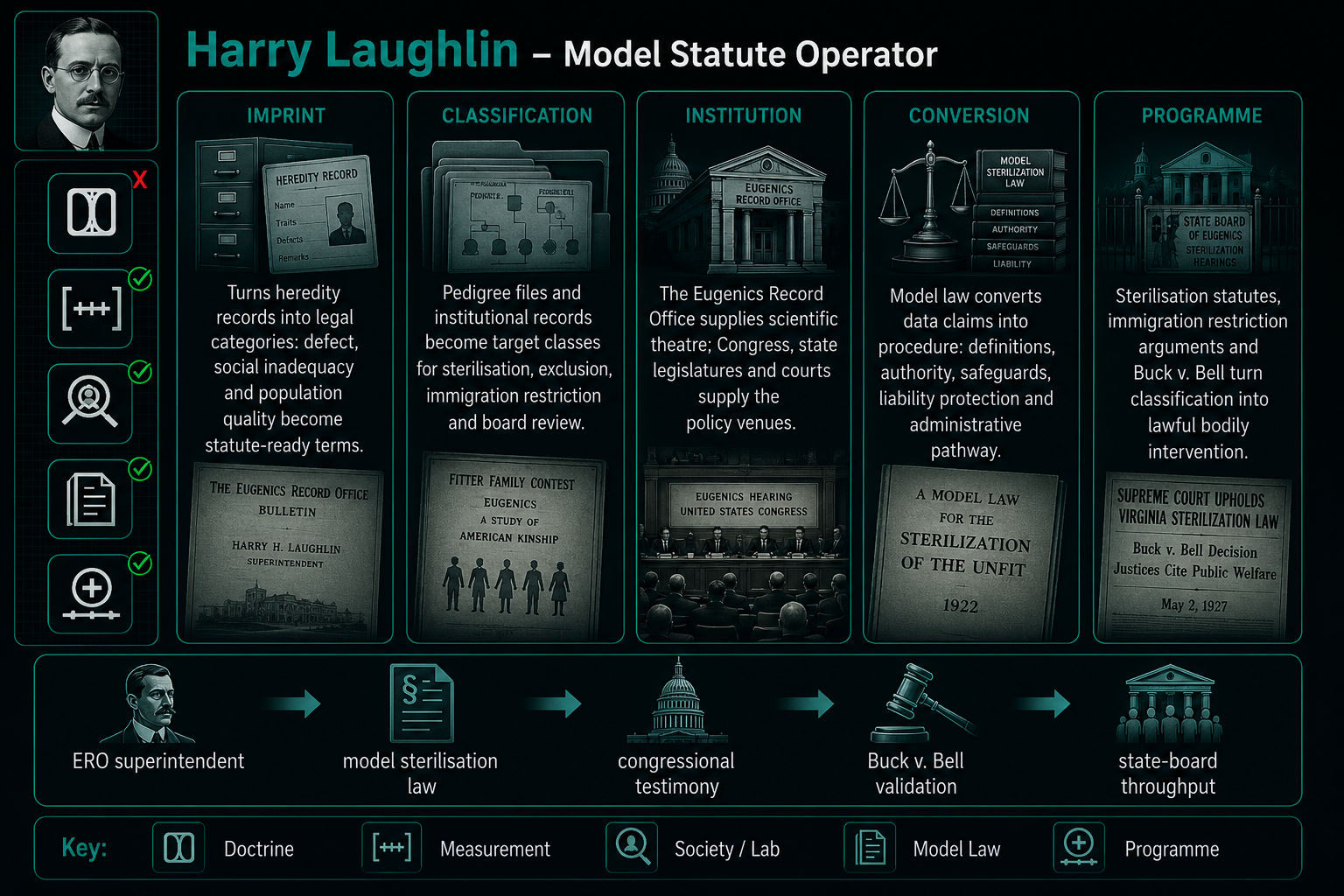
3. Harry Laughlin — Model Statute Operator
Ribbon: Record Office → Model Sterilisation Law → Expert Testimony → Administrative Throughput
Lane / Era: American eugenic law, immigration restriction and sterilisation policy | Peak influence: 1914–1935
House(s): Eugenics Record Office • Carnegie Institution of Washington • House Committee on Immigration and Naturalization • state sterilisation-policy networks
Role Type: Model Statute Operator
Imprint: Turn heredity files into legal categories, then make legal categories usable by boards, courts and administrators.
Placement
Harry Hamilton Laughlin occupies the third station in the paper-age biopolitical conveyor. Galton supplied the term. Davenport built the record office. Laughlin converted the record regime into law-facing machinery.
His placement was unusually precise. He served as superintendent of the Eugenics Record Office at Cold Spring Harbor, working inside the heredity-data apparatus Davenport had built. From that position, he acted not merely as a researcher, but as a translator between files and law. He wrote reports, drafted model statutes, supplied expert testimony, advised legislators and supplied a legal grammar for compulsory sterilisation and immigration restriction.
The ERO gave him scientific theatre: pedigree records, heredity categories, family-line claims and Carnegie-linked institutional authority. Congress and state legislatures gave him policy venues. Courts gave the programme a test of constitutional durability. Laughlin’s role was to connect those sites.
His placement in the chain was therefore not term-forge and not merely data collection. It was conversion: record office → model law → hearing room → board procedure.
Lever
Laughlin’s lever was the model statute.
His 1922 book Eugenical Sterilization in the United States compiled existing state sterilisation laws, reviewed their enforcement, and proposed a “Model Eugenical Sterilization Law”. The format mattered. It did not present sterilisation as an isolated moral demand. It presented the programme as administrative design: definitions, eligible categories, institutional procedures, safeguards, liability protection and enforcement pathways.
That model-law format changed the problem. “Defect” was no longer only a social label or heredity claim. It became a statutory category. The operator question shifted from whether eugenic doctrine was persuasive in general to whether administrators had a usable legal instrument. Laughlin supplied that instrument.
His second lever was testimony. Laughlin became known for his work on eugenical sterilisation and immigration restriction, and his papers catalogue notes that his work on those two subjects was central to his public influence. In immigration debates, he served as “Expert Eugenics Agent” to congressional immigration restriction forces and supplied evidence claiming hereditary differences among immigrant groups. The Eugenics Archive places this work inside the broader restriction campaign of the early twentieth century, where eugenicists argued that newer immigration from southern and eastern Europe threatened American population quality.
The third lever was court enablement. Laughlin did not argue Buck v. Bell before the Supreme Court, but his model-law framework and expert affidavit stood behind the constitutional test. The Supreme Court upheld Virginia’s sterilisation statute in 1927, and the opinion treated sterilisation of institutionalised persons labelled with hereditary defect as a valid exercise of state power. That ruling did not create every sterilisation programme, but it lowered the legal risk of using them.
Mutation
Laughlin’s mutation was from file to throughput.
The record office supplied categories. Laughlin gave those categories legal handles. The model statute identified who could be classified, who could decide, what procedure would be followed, and how the state could protect operators from later challenge. The chain became:
Pedigree File → Defect Category → Model Statute → Court Validation → Board Procedure → Sterilisation Order
This mutation matters because it shows how biopolitical administration becomes durable. A heredity claim by itself can be disputed. A pedigree chart can be attacked as weak evidence. A reform campaign can stall in politics. But a model statute gives officials something to adopt, lawyers something to defend, boards something to administer and judges something to review. It turns doctrine into an instrument.
The Virginia case made the mutation visible. The sterilisation statute upheld in Buck v. Bell operated by classifying institutionalised persons as afflicted with hereditary forms of “insanity” or “imbecility,” then routing the decision through state procedure. The Court’s opinion supplied the legal permission structure. Laughlin’s function was upstream of the signature page but inside the same conveyor: he helped produce the template logic through which classification became lawful bodily intervention.
The immigration lane followed a parallel route. Population-quality claims were translated into congressional evidence, group ranking and quota logic. The person at the border was not treated only as an individual applicant. He or she became part of a hereditary, national, racial or regional stock category. The file moved from family line to population stream.
Output ribbons
Record Office → Model Law → State Uptake
Laughlin’s sterilisation work converted ERO heredity claims into statutory design. The model law gave states an adoptable template for converting classification into intervention.
Category → Procedure → Liability Shield
The model statute did not only name targets. It specified process and protection. That made sterilisation easier for administrators to perform without fear of ordinary legal exposure.
Expert Agent → Congressional Hearing → Immigration Restriction
Laughlin’s testimony moved eugenic sorting into federal immigration debate. Population streams became ranked by presumed hereditary quality, not merely by citizenship status or labour demand.
Affidavit → Buck v. Bell → Constitutional Permission
The Supreme Court’s 1927 ruling gave sterilisation statutes a constitutional shield. The case became a legal accelerant for state programmes already waiting for safer footing.
Paper Category → Bodily Intervention
Laughlin’s operator signature is the hard mutation: a label in a record became a lawful procedure on a body.
Operator reading
The operator reading is inferred from sequence, not motive. Laughlin’s function was to convert eugenic classification into legal-administrative machinery. He did not invent eugenics and he did not personally perform every sterilisation. His significance lies in the handoff: data categories from the ERO were translated into model statutes, expert testimony, court-facing claims and board-usable procedure.
In the Part 5 vocabulary, Laughlin is a pre-digital threshold-and-order operator. His system did not use emergency authorisations, QR credentials or procurement APIs. It used statutes, affidavits, expert evidence, administrative boards and institutional files. But the runtime is recognisable: define the category, legitimise the authority, protect the operator, and route the person through a process whose end is bodily intervention.
The substrate was paper. The gate was law. The output was throughput.
Ledger strip
Doctrine terms normalised: hereditary defect; feeblemindedness; social inadequacy; eugenical sterilisation; population quality.
Society / committee placement: Eugenics Record Office; congressional immigration venues; sterilisation-law advisory networks.
Record systems / data instruments: ERO pedigree files, state-law surveys, heredity classifications, expert affidavits, enforcement tables.
Model-law or policy uptake: strong; 1922 model sterilisation law and testimony supplied adoptable statutory grammar.
Programme outputs: sterilisation-policy expansion, immigration restriction arguments, legal validation through Buck v. Bell.
Funding rails: Carnegie-linked ERO infrastructure; institutional support from Cold Spring Harbor eugenics networks.
Boundary effect: institutionalised, disabled, poor, immigrant and otherwise classified persons became legally available for exclusion or irreversible intervention.
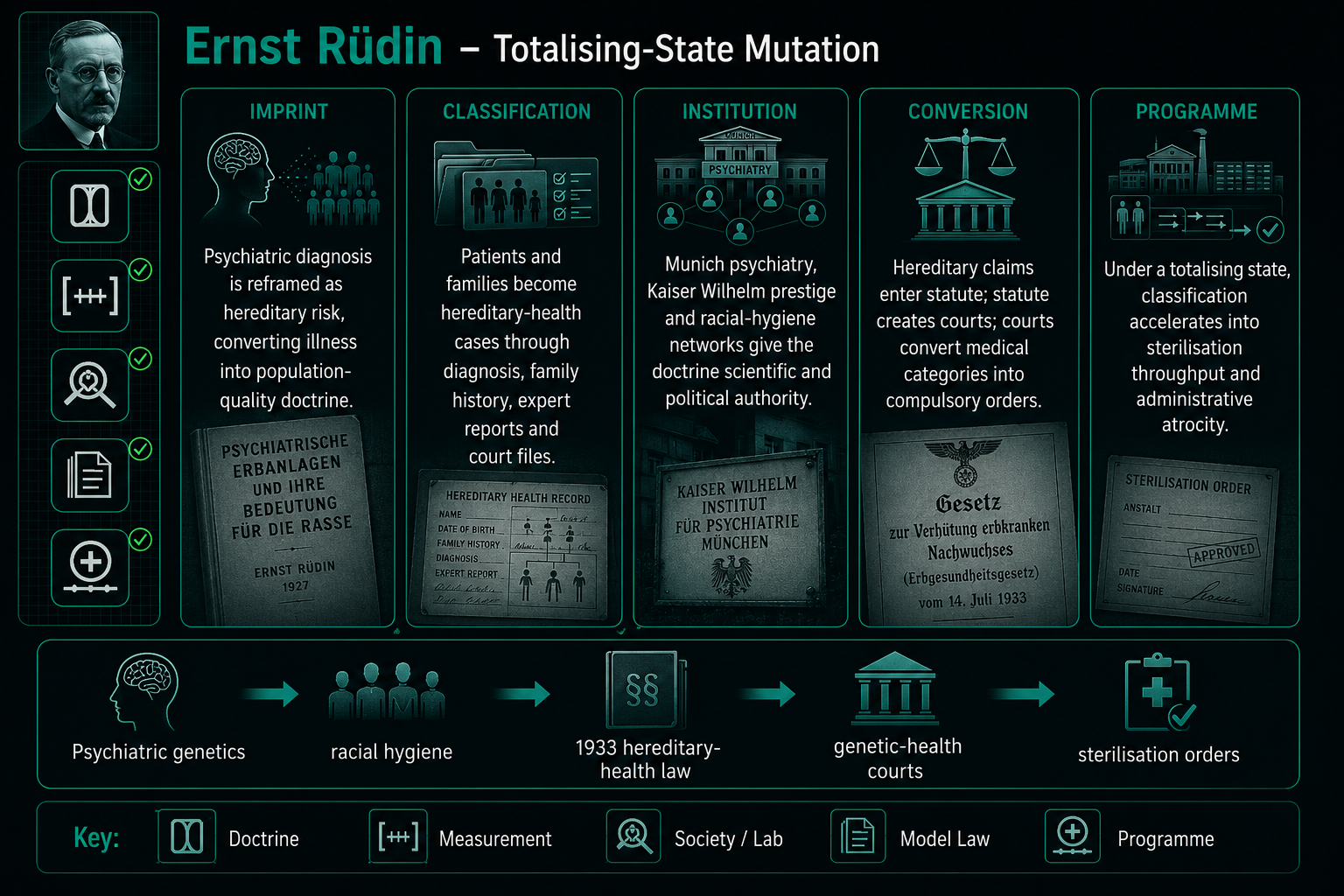
4. Ernst Rüdin — Totalising-State Mutation
Ribbon: Psychiatric Genetics → Racial Hygiene Committee → Hereditary-Health Law → Administrative Atrocity
Lane / Era: German psychiatric genetics, racial hygiene and Nazi sterilisation policy | Peak influence: 1916–1945
House(s): German Research Institute for Psychiatry • Kaiser Wilhelm Institute of Psychiatry • German Society for Racial Hygiene • Nazi hereditary-health apparatus
Role Type: Totalising-State Mutation
Imprint: Show how psychiatric doctrine mutates when a state converts heredity science into compulsory classification, courts and bodily intervention.
Placement
Ernst Rüdin occupies the cautionary station in this historical sequence. Galton supplied the term. Davenport built the record-office model. Laughlin converted heredity files into model-law machinery. Rüdin shows what happens when psychiatric genetics, racial-hygiene doctrine and a totalising state fuse into compulsory administration.
His placement was unusually dangerous because it joined scientific prestige to state power. Rüdin worked in the Munich psychiatric research world associated with Emil Kraepelin and became a leading figure in psychiatric genetics. The German Research Institute for Psychiatry, later connected to the Kaiser Wilhelm system and eventually the Max Planck Institute of Psychiatry, provided the research house. The Kaiser Wilhelm Society provided institutional standing. Racial-hygiene networks supplied the political doctrine. The Nazi state supplied coercive law.
That combination changes the slope. In liberal or parliamentary contexts, eugenic doctrine could move into law through reform campaigns, model statutes, courts and state boards. Under National Socialism, the same classificatory habit entered a much steeper machine: hereditary-health courts, compulsory sterilisation, professional compliance and later the broader medical participation in killing programmes.
This is why Rüdin should be handled as a special card. The point is not to flatten all earlier eugenics into Nazism. The point is to show how the same operator chain mutates when state context changes: doctrine no longer merely advises policy. It becomes state biology.
Lever
Rüdin’s lever was psychiatric heredity joined to racial-hygiene authority.
His research programme treated mental illness and psychiatric diagnosis through the lens of inheritance, family line and genetic prognosis. Modern histories of psychiatric genetics repeatedly identify Rüdin as a founding figure in the field while also stressing his involvement in Nazi racial-hygiene policy and compulsory sterilisation. The lever was not simply one paper or one speech. It was the position from which psychiatric categories could be made available to hereditary-policy machinery.
The decisive policy lever was the Law for the Prevention of Offspring with Hereditary Diseases, passed on 14 July 1933. The United States Holocaust Memorial Museum describes the law as mandating forced sterilisation of people identified as having certain physical or mental conditions assumed to be hereditary. The listed categories included psychiatric and neurological labels such as “congenital feeblemindedness,” schizophrenia, manic-depressive illness, hereditary epilepsy and others.
The instrument also created a procedural apparatus. Genetic Health Courts could decide whether a person should be sterilised. Medical experts supplied evidence. State procedure converted diagnosis into legal order. The individual was no longer only a patient. He or she became a hereditary-risk case moving through a judicial-medical conveyor.
Rüdin’s role sits inside that conversion. He was part of the expert world that legitimised psychiatric heredity as state-policy material and helped supply interpretive authority for compulsory sterilisation. The lever was therefore diagnosis as hereditary classification.
Mutation
Rüdin’s mutation was from psychiatric research to state coercion.
The chain runs:
Diagnosis → Heredity Claim → Racial-Hygiene Doctrine → Statute → Hereditary-Health Court → Sterilisation Order
That mutation is sharper than the American sequence because the state context was different. In the United States, Laughlin’s model law still had to travel through state adoption, judicial contest and uneven administrative uptake. In Nazi Germany, the state made racial hygiene part of its governing identity. The classificatory doctrine did not remain advisory. It became compulsory infrastructure.
The mutation also shifted professional identity. Doctors and psychiatrists were not merely healers or researchers. They became classifiers, witnesses, court participants, evaluators and implementers inside a hereditary-health regime. The medical file became a legal trigger. The diagnosis became an administrative category. The court became the gate. The operation became the output.
Modern historical work on Rüdin’s institute describes the programme and practice of psychiatric genetics at the Munich institute in relation to politics, race and Nazi mental-health policy. The finding to preserve is functional: psychiatric science did not need to invent every later atrocity by itself. It needed to supply categories, legitimacy and expert procedure to a state already seeking biological governance.
That is the totalising-state mutation. The biopolitical chain accelerates when classification, law and coercive sovereignty align.
Output ribbons
Psychiatric Diagnosis → Heredity Claim → State Category
Rüdin’s psychiatric-genetic framework helped make mental illness legible as hereditary-risk material for state action.
Research Institute → Racial Hygiene → Statutory Apparatus
The Munich/Kaiser Wilhelm research world supplied prestige. Racial-hygiene doctrine supplied policy meaning. The Nazi state supplied compulsion.
Medical Expert → Hereditary-Health Court → Sterilisation Order
The 1933 law converted expert classification into legal procedure. Courts processed bodies through medical-legal categories.
Science → State Biology → Administrative Violence
The language of heredity and racial hygiene converted intervention into state duty. The result was not only classification but irreversible bodily harm.
Policy Context → Atrocity Gradient
Rüdin’s card marks the contextual slope: under a totalising state, eugenic doctrine moves faster from theory to coercion and from coercion to atrocity.
Operator reading
The operator reading is inferred from sequence, not motive. Rüdin’s function was not merely to hold bad ideas. His historical significance lies in the conversion pathway: psychiatric diagnosis was reframed as hereditary destiny; hereditary destiny was absorbed into racial-hygiene doctrine; racial-hygiene doctrine was written into law; law created courts; courts generated sterilisation orders.
That sequence is the operator lesson. It shows why the political context around biopolitical classification matters. A registry, diagnosis or heredity claim is not equally dangerous in every institutional setting. It becomes more dangerous when the state treats population purification as a governing duty and professional institutions accept classification as service.
In the Part 5 vocabulary, Rüdin is the hard cautionary case. He is not the origin of every later biopolitical technique, and he should not be used to imply that all public health is Nazism by another name. The precise claim is narrower and stronger: when health science, population classification, professional authority and coercive sovereignty align, the body can be moved from care object to state object with terrifying speed.
The substrate was paper, court file and medical certificate. The runtime was compulsory classification. The output was administrative atrocity.
Ledger strip
Doctrine terms normalised: racial hygiene; hereditary disease; genetic prognosis; biological fitness; hereditary burden.
Society / committee placement: Munich psychiatric-genetics network; German Research Institute for Psychiatry; Kaiser Wilhelm Society; racial-hygiene institutions.
Record systems / data instruments: psychiatric diagnoses, family histories, hereditary assessments, expert reports, court files.
Model-law or policy uptake: strong; psychiatric heredity categories fed the 1933 hereditary-health law and its court apparatus.
Programme outputs: compulsory sterilisation decisions, hereditary-health court processing, professional-medical participation in state racial hygiene.
Funding rails: research-institute infrastructure, Kaiser Wilhelm institutional support, earlier philanthropic and estate support to Munich psychiatric research.
Boundary effect: patients, disabled persons, psychiatric subjects, Roma, “asocial” groups and other classified populations became available for state coercion.
5. Flexner / Rockefeller Medicine — Boundary-Setting Settlement
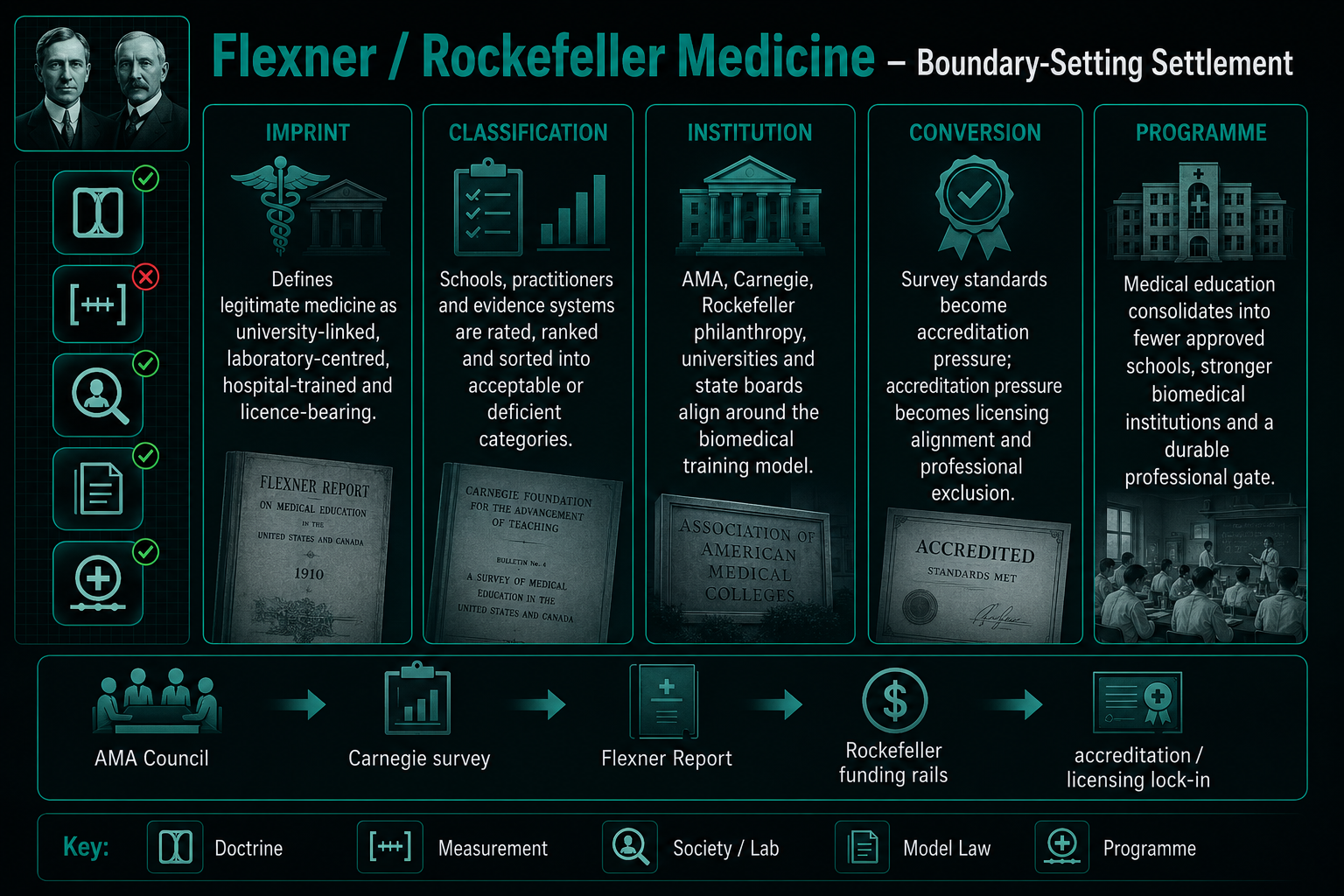
Ribbon: Medical-School Survey → Accreditation Standard → Philanthropic Capital → Licensing Monoculture
Lane / Era: North American medical education, professional licensing and biomedical consolidation | Peak influence: 1904–1930s
House(s): American Medical Association Council on Medical Education • Carnegie Foundation for the Advancement of Teaching • Rockefeller General Education Board • Johns Hopkins model
Role Type: Boundary-Setting Settlement
Imprint: Define legitimate medicine, tie it to universities and laboratories, then let accreditation, licensing and philanthropy close the field.
Placement
Abraham Flexner belongs in this addendum not because he was a eugenicist in the same role as Galton, Davenport, Laughlin or Rüdin. His operator function was different. He helped settle the boundary of legitimate medicine.
That boundary mattered to the biopolitical lineage because population administration depends on recognised experts, standardised training, licensable practitioners and institutions authorised to define evidence. Before the modern credential gate, there had to be a professional gate. Before the health pass, there had to be the licensed doctor, the accredited school, the approved curriculum and the state board able to say who counted.
The institutional precondition was already forming. The American Medical Association created its Council on Medical Education in 1904 to recommend educational policies and evaluate medical education. The Carnegie Foundation then commissioned Flexner to survey medical schools in the United States and Canada. The result was the 1910 report Medical Education in the United States and Canada, usually called the Flexner Report. Carnegie’s archive describes it as a comprehensive report on course of study, finances, medical sects, state boards, postgraduate schools and all operating medical schools in the United States and Canada.
Flexner’s placement was therefore not lawmaker, registrar or clinician. He was the surveyor whose report supplied the professional boundary script.
Lever
The lever was the standard-setting report.
The Flexner Report evaluated medical schools against a preferred model: university affiliation, laboratory science, clinical teaching, adequate entrance requirements, full-time faculty, hospital access and state-board alignment. In the report’s frame, medical education was not a plural field of competing traditions. It was a field to be reconstructed around scientific medicine.
The lever worked because the report translated professional judgement into administrative criteria. A school could be rated, compared, found deficient, merged, closed or starved of recognition. A curriculum could be treated as inadequate. A method could be recoded as sectarian. A practitioner lineage could be pushed outside the licence-bearing centre.
The report’s effects are widely described as transformative. A centennial review in The Yale Journal of Biology and Medicine says the report transformed American medical education, contributed to the elimination of proprietary schools, and established the biomedical model as the gold standard of medical training. Another review notes that the AMA Council on Medical Education had begun rating medical schools before Flexner, and that the Carnegie review amplified a wider reform process.
The Rockefeller layer supplied capital and institutional reinforcement. The Rockefeller Archive Center records that early twentieth-century reforms followed the Carnegie report and that Rockefeller-linked philanthropy participated in medical-education reform worldwide. The Rockefeller role should be stated carefully: not a secret command centre, but a funding rail. Philanthropic capital helped scale the preferred model after the boundary had been named.
Mutation
The mutation was from plural practice to licensed monoculture.
Before the settlement, North American medicine contained regular physicians, homeopaths, eclectics, osteopaths, proprietary schools, weak schools, local apprenticeships and uneven standards. Some were poor-quality; some represented rival therapeutic traditions; many lacked the laboratory and hospital infrastructure Flexner considered essential. The reform problem was real. So was the boundary effect.
The mutation chain ran:
Survey → Standard → School Rating → Accreditation Pressure → Licensing Alignment → Professional Monopoly
Once the report named the model, the field began to reorganise around it. University-linked, laboratory-centred, hospital-based medical schools were treated as the future. Proprietary schools and many sectarian institutions were treated as defects in the system. State boards, professional associations, philanthropies and universities could then converge without requiring a single command instruction. Each institution acted from its own placement: the association rated, the foundation funded, the university absorbed, the board licensed, the state recognised.
That convergence carried racial and gender consequences. Historically Black medical schools were particularly vulnerable. The report’s aftermath left only a small number of Black medical colleges standing, with Howard and Meharry surviving as central institutions. Later medical-education scholarship has treated the Flexner era as a major contributor to the long-term underproduction of Black physicians and to racial inequity in access to medical training. The operator point is not that Flexner alone caused every closure or every inequity. The point is that standards, once tied to money, licensing and prestige, decide who may enter the profession and who may be excluded from it.
The Rockefeller-Flexner settlement therefore belongs in Addendum 5a because it shows a non-sterilisation form of biopolitical boundary-making. It did not primarily classify patients. It classified practitioners, schools and evidence systems. That classification later determined which bodies could speak with authority about other bodies.
Output ribbons
Report → Standard → Closure Pressure
The Flexner Report converted educational judgement into a field-wide rating mechanism. Schools that could not meet the new model lost legitimacy, applicants, recognition and philanthropic plausibility.
Laboratory → Hospital → University → Licence
The preferred doctor became a laboratory-trained, university-linked, hospital-formed practitioner. The knowledge gate and the professional gate fused.
Professional Reform → Boundary Exclusion
The reform raised standards, but it also narrowed legitimate medicine. Homeopathic, eclectic, proprietary and community-based medical schools were pushed out or marginalised.
Philanthropy → Capital Upgrade → Institutional Lock-In
Rockefeller-linked funding helped strengthen institutions aligned with the new biomedical model. Capital flowed toward the approved architecture.
School Gate → Practitioner Gate → Patient Gate
Control over training became control over licensure. Control over licensure became control over who could diagnose, prescribe, testify, certify and govern care.
Operator reading
The operator reading is inferred from sequence, not motive. Flexner’s function was to produce a boundary document. Rockefeller philanthropy’s function was to help capitalise the approved side of that boundary. The AMA and state boards supplied professional and licensing machinery. No single actor needed to “control medicine” in the crude sense. The settlement worked because the layers aligned.
This is why the phrase “Rockefeller medicine” should be handled as critical shorthand, not as a proof claim. The stronger reading is structural: Carnegie commissioned the survey; Flexner authored the standard-setting report; the AMA Council had already created a rating environment; Rockefeller-linked philanthropy helped fund reform around the preferred model; universities and state boards turned the model into durable professional reality.
In the Part 5 vocabulary, this is the professional-gate prehistory of the modern credential gate. Later biopolitical systems depend on authorised expertise, recognised evidence and licensable practitioners. Flexner/Rockefeller medicine helped define that recognised class.
The substrate was curriculum, accreditation and licence. The output was professional boundary control.
Ledger strip
Doctrine terms normalised: scientific medicine; laboratory training; university affiliation; clinical teaching; professional standard.
Society / committee placement: AMA Council on Medical Education; Carnegie Foundation; Rockefeller-linked philanthropic education networks; university medical schools.
Record systems / data instruments: school surveys, ratings, course evaluations, entrance standards, board-exam alignment, institutional reports.
Model-law or policy uptake: indirect-to-strong; standards fed accreditation, licensing-board expectations and state recognition of approved schools.
Programme outputs: school closures and mergers; strengthened university-hospital model; biomedical curriculum consolidation; professional licensing gate.
Funding rails: Carnegie survey infrastructure; Rockefeller General Education Board and related philanthropic medical-education funding.
Boundary effect: practitioners, schools and evidence systems were sorted into legitimate and illegitimate categories; many rival and minority-serving institutions lost standing.
6. Margaret Sanger / IPPF — Clinic-Network Converter
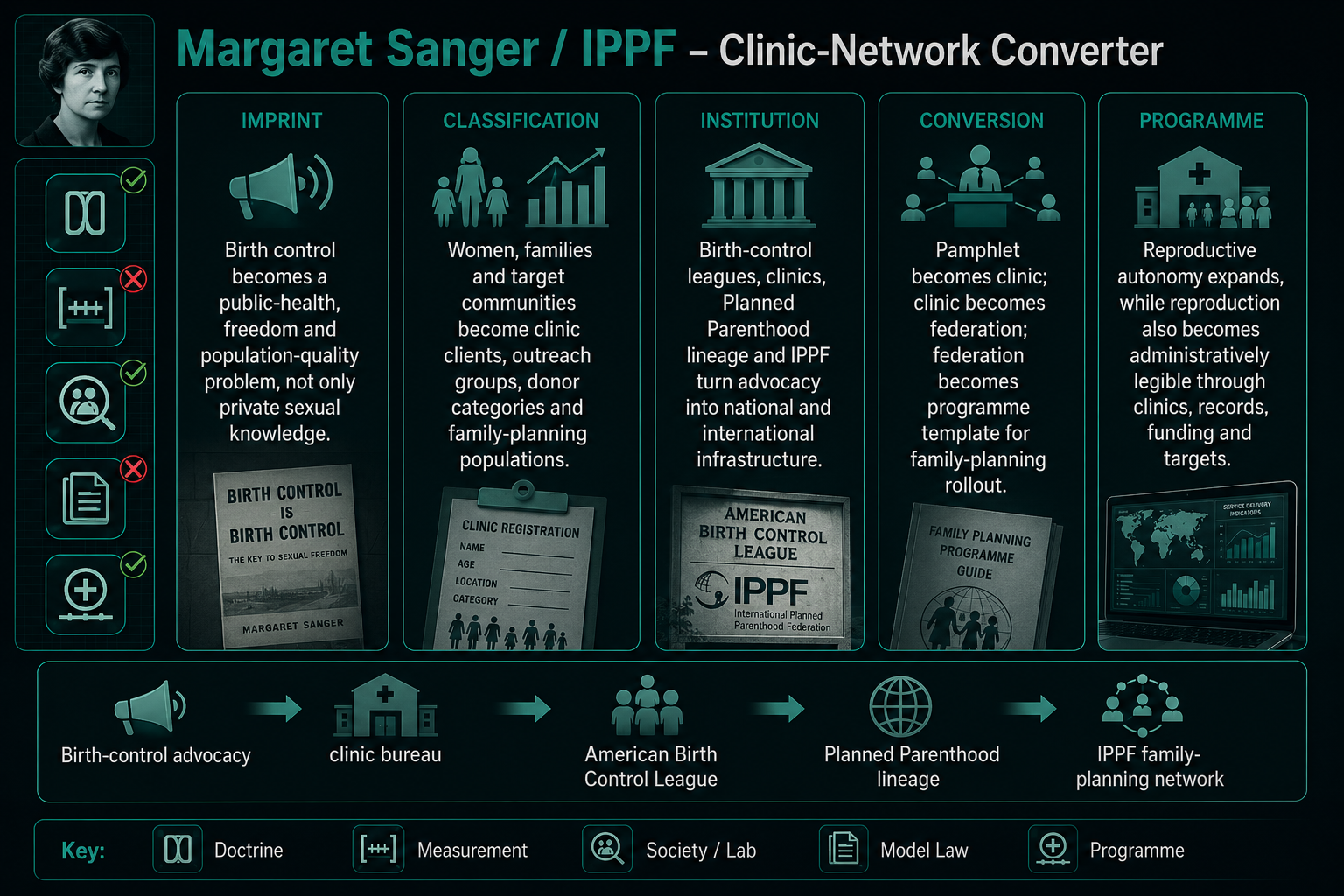
Ribbon: Birth-Control Advocacy → Clinic System → Federation Building → International Family-Planning Programmes
Lane / Era: Birth-control reform, reproductive politics and postwar family-planning internationalisation | Peak influence: 1914–1959
House(s): Birth Control Review • American Birth Control League • Birth Control Federation of America • Planned Parenthood • International Planned Parenthood Federation
Role Type: Clinic-Network Converter
Imprint: Convert reproductive autonomy, poverty relief and population-quality language into clinics, federations, donor channels and programme infrastructure.
Placement
Margaret Sanger belongs in this sequence because she marks the mutation from eugenic doctrine and medical boundary-setting into clinic-network organisation. Galton supplied the term. Davenport built the heredity file. Laughlin converted classification into statute. Flexner/Rockefeller medicine narrowed legitimate professional authority. Sanger moved the problem into another venue: birth control, women’s health, clinic access, reproductive autonomy, family limitation and, later, international family-planning federation.
Her placement was politically hybrid. She was a nurse, public campaigner, publisher, organiser and institution builder. She operated in the conflict zone between women seeking contraceptive knowledge, laws restricting contraception, physicians guarding professional authority, eugenic reformers looking for population-quality tools, philanthropists funding reproductive research, and governments slowly converting private clinic practice into public programme.
That hybridity matters. Sanger cannot be reduced to one lane. She was a feminist birth-control advocate who fought legal restrictions on contraception. She also used eugenic language, published eugenic arguments, and worked in a period when birth control, poverty relief, race, disability, maternal health and population-quality claims were often entangled. Planned Parenthood’s own history now acknowledges this entanglement, stating that Sanger believed in eugenics while also distinguishing her role in expanding birth-control access.
Her placement in the chain is therefore: not heredity scientist, not model-law operator, but clinic-network converter.
Lever
Sanger’s lever was the clinic plus the publication.
Her early public campaign ran through The Woman Rebel and the slogan “birth control,” then through books such as Woman and the New Race and The Pivot of Civilization, which linked contraception to women’s autonomy, poverty, maternal health, social reform and population quality. The writing gave the movement its language. The clinic gave it an operating form.
The 1916 Brownsville clinic is the key mutation point. The Margaret Sanger Papers Project treats Sanger’s Birth Control Clinical Research Bureau and related organisations as central to the institutionalisation of birth-control work. The clinic format converted an illegal or semi-legal informational demand into a professional service model: patient intake, medical supervision, contraceptive advice, records, follow-up and organisational fundraising.
The next lever was federation. The American Birth Control League and later Birth Control Federation of America converted dispersed advocacy into a national organisational field. After World War II, the International Committee on Planned Parenthood and then the International Planned Parenthood Federation converted that field into an international network. The NYU Sanger Papers history records Sanger as a principal force behind the creation of the permanent federation at Bombay in 1952, and later as IPPF president.
That is the lever: publication creates doctrine; clinic creates routine; federation creates scale.
Mutation
Sanger’s mutation was from illegal information to programme infrastructure.
The chain runs:
Birth-Control Advocacy → Clinic Practice → Medical Legitimacy → Federation → International Family-Planning Programme
At the first stage, contraception was framed as a women’s freedom issue: relief from unwanted pregnancy, dangerous abortion, maternal exhaustion and poverty. At the second stage, the clinic converted the claim into service delivery. At the third stage, medical supervision gave the clinic model professional cover. At the fourth stage, national and international federations made birth control a programme field. At the fifth stage, family planning became a development, public-health and population-policy instrument.
The eugenic layer must be handled with precision. Sanger did use eugenic language and worked with eugenic reformers. Her Pivot of Civilization sits squarely inside the period’s population-quality vocabulary. The NYU Sanger Papers discussion of the Negro Project records the controversy around the 1939 project and describes it as one of the first major undertakings of the Birth Control Federation of America. It also shows why crude readings fail: the project sat at the intersection of racial paternalism, public-health outreach, Black professional participation, philanthropic control and organisational deviation from Sanger’s preferred plan.
The operator finding is therefore not motive certainty. It is structural conversion. Sanger helped move birth control from pamphlet and protest into clinic, from clinic into federation, and from federation into international programme. In that move, autonomy language, public-health language, poverty language and population-quality language could be bundled into one operating system.
Output ribbons
Pamphlet → Clinic → Bureau → Federation
Sanger’s work converted contraceptive information into an institutional service model. The clinic became the bridge between private reproductive distress and organised public-health intervention.
Women’s Autonomy → Medical Supervision → Professional Gate
Birth control was sold as freedom from compulsory maternity, but its durable form increasingly required medical supervision, clinic records and approved professional channels.
Eugenic Language → Population Quality → Programme Justification
Sanger’s rhetoric often fused women’s liberation with eugenic and population-quality arguments. That fusion made birth control intelligible to reformers, physicians, donors and policymakers beyond feminism alone.
National Movement → International Federation → Family Planning Field
The organisational line from the American Birth Control League to IPPF helped convert birth control into an international family-planning infrastructure.
Clinic Access → Donor Funding → State Uptake
Private activism and philanthropy helped build models that governments and international agencies could later adopt as development and public-health programmes.
Operator reading
The operator reading is inferred from sequence, not motive. Sanger’s function was to convert reproductive politics into organisational infrastructure. She did not create all later population-control programmes, and she should not be treated as the sole author of state family-planning policy. Her importance lies in the handoff: slogan to publication, publication to clinic, clinic to federation, federation to international programme.
This is why the profile must hold two facts together. Birth control expanded real agency for many women facing poverty, repeated pregnancy, dangerous abortion and legal ignorance. At the same time, the clinic-network form made reproduction administratively legible: patient records, target communities, donor projects, professional supervision, outreach campaigns and population metrics. Liberation and classification travelled together.
In the Part 5 vocabulary, Sanger is a pre-digital access-and-programme operator. She did not run a dashboard or passport scheme. She built a clinic pathway through which reproductive life could be framed, recorded, funded and scaled.
The substrate was pamphlet, clinic card, donor report and federation charter. The runtime was reproductive administration.
Ledger strip
Doctrine terms normalised: birth control; voluntary motherhood; planned parenthood; family limitation; population quality; family planning.
Society / committee placement: American Birth Control League; Birth Control Federation of America; Planned Parenthood lineage; International Committee on Planned Parenthood; IPPF.
Record systems / data instruments: clinic files, patient records, outreach reports, demographic claims, project proposals, federation programme materials.
Model-law or policy uptake: indirect-to-strong; helped shift contraception from criminalised information into medically supervised and later publicly supported family-planning policy.
Programme outputs: birth-control clinics, national federation infrastructure, international family-planning network, donor-supported reproductive-health programmes.
Funding rails: private philanthropy, clinic fundraising, federation support, later donor and government family-planning channels.
Boundary effect: women, poor families, racialised communities and “target” populations became subjects of both reproductive access and reproductive administration.
7. John D. Rockefeller III / Population Council — Donor-Governance Architect
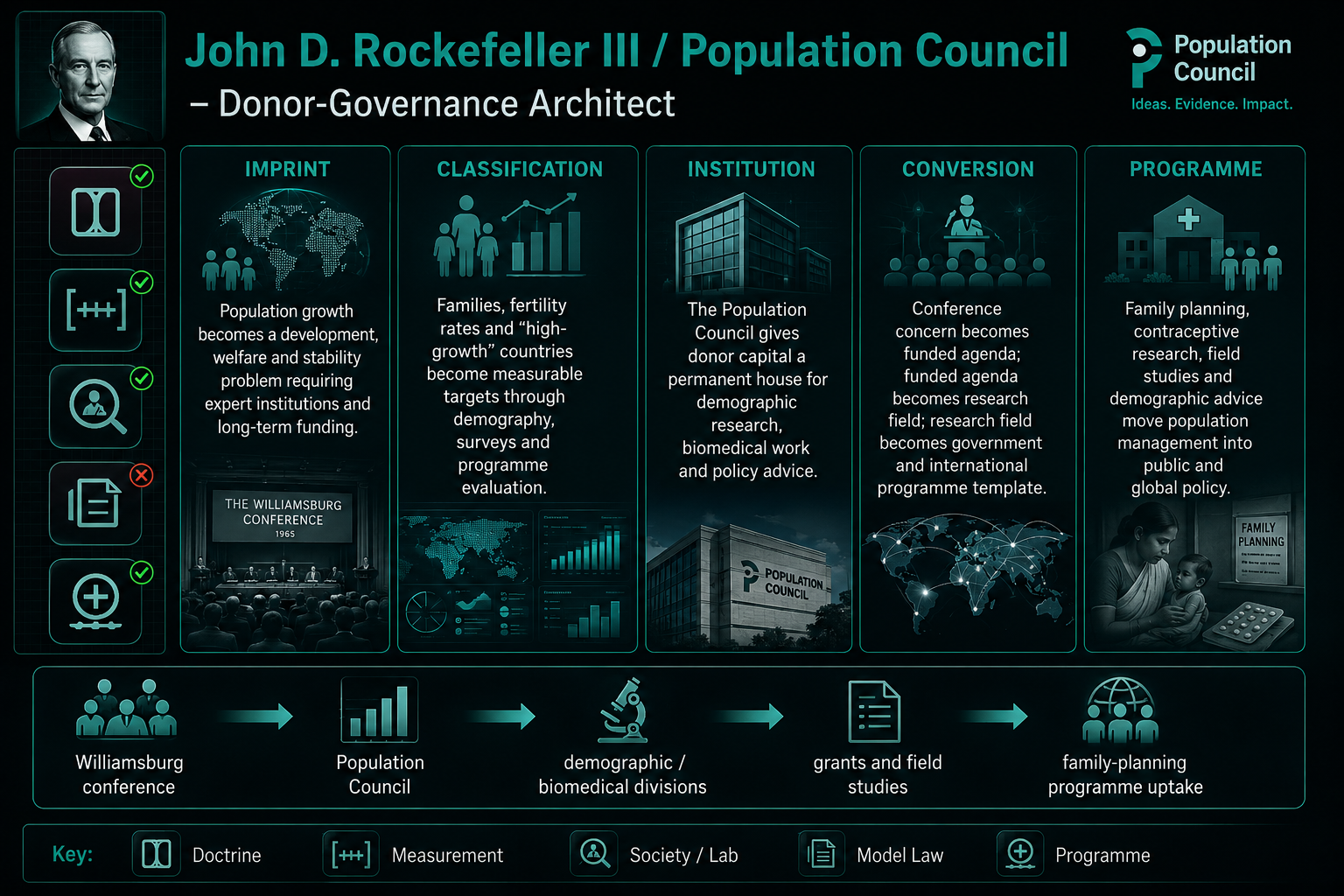
Ribbon: Philanthropic Capital → Population Council → Research Agenda → Global Programme Roll-Out
Lane / Era: Postwar population policy, demographic research and international family-planning governance | Peak influence: 1952–1978
House(s): Rockefeller Brothers Fund • Population Council • Rockefeller Archive Center • Commission on Population Growth and the American Future
Role Type: Donor-Governance Architect
Imprint: Convert private capital into a standing population institution, then use research, convening and grants to make demography a policy field.
Placement
John D. Rockefeller III marks the postwar donor-governance turn in the historical biopolitical conveyor. Galton supplied the term. Davenport built the record office. Laughlin converted heredity files into model-law machinery. Sanger and IPPF converted reproductive advocacy into clinic and federation infrastructure. Rockefeller III moved population policy into the world of philanthropic capital, demographic expertise, biomedical research, development planning and international programme design.
His placement mattered because he sat at the junction of family wealth, foundation networks, elite convening power and postwar development anxiety. The Rockefeller Archive Center records Rockefeller philanthropy’s long engagement with population-related fields, including birth control, social hygiene, family planning and the creation of the Population Council. The Rockefeller Brothers Fund states that the Population Council was founded in 1952 by John D. Rockefeller 3rd to address global population growth, family planning and the health of developing nations.
The Population Council’s own archival record is blunt about the operating field. The Rockefeller Archive Center catalogue describes the Council as founded in 1952 to undertake “significant activities in the broad field of population,” with early work organised through demographic and biomedical divisions. The donor created the house; the house created the programme field.
Rockefeller’s placement in the chain is therefore: not scientist, not statute drafter, not clinic founder alone, but donor-governance architect.
Lever
Rockefeller’s lever was capital plus convening.
The first lever was institutional creation. In 1952, Rockefeller convened the Conference on Population Problems at Williamsburg, Virginia, where discussion focused on food supply, industrialisation and population growth. Shortly afterward, he established the Population Council. That sequence matters. The conference supplied elite problem framing; the Council supplied permanent infrastructure.
The second lever was research agenda control. The Population Council did not merely lobby for an already finished policy. It funded and organised demographic research, biomedical research, contraceptive development, field studies, survey work, population training and advisory networks. The Council made population a technical field: fertility rates, demographic transition, contraceptive acceptability, family-planning delivery, programme evaluation and national policy advice. This transformed a moral or political debate into an expert domain.
The third lever was respectable internationalisation. Earlier eugenic language had become politically toxic after World War II. The postwar vocabulary shifted: population growth, development, maternal health, family planning, demographic transition, welfare, food supply and quality of life. Rockefeller’s own papers catalogue notes that he consistently linked population control to quality of life and became a world leader in combating overpopulation. The phrase changed, but the operator problem remained: how to make reproduction governable at scale.
The lever was therefore not command. It was agenda architecture: fund the field, convene the experts, define the research questions, build the institution, and make governments and international organisations treat population as a technical policy domain.
Mutation
The mutation was from eugenic population quality to development-era population management.
The chain runs:
Population Concern → Elite Conference → Population Council → Demographic / Biomedical Research → Government and International Programme Uptake
This mutation is important because it shows how the biopolitical lineage survived the discrediting of the word “eugenics.” After 1945, direct racial-hygiene claims were no longer publicly respectable in liberal international circles. Population governance therefore moved through a different grammar. The problem became food, development, poverty, maternal health, resource scarcity, national stability and fertility decline. The administrative target remained reproduction and population trajectory, but the idiom changed from heredity purification to development planning.
The Population Council gave that mutation a durable venue. Its demographic division could supply population projections, fertility studies and policy advice. Its biomedical division could support contraceptive research. Its grants could cultivate experts and institutions. Its international work could help governments translate population concern into family-planning programmes, survey instruments, training, clinic delivery and policy planning.
Rockefeller’s later role as chair of the Commission on Population Growth and the American Future, created after President Nixon’s 1969 population message, shows the domestic policy turn. The Commission’s work helped put contraception, abortion, population growth, urbanisation, environment and public policy into one official review frame. That did not mean Rockefeller commanded state policy. It means the donor-governance operator had become a recognised public-policy convenor.
This is the cleanest handoff from Addendum 5a to the modern Part 5 runtime. The subject is no longer sterilisation law or pedigree charts. It is programme architecture: funding, research, panels, expertise, grants, field trials, development logic and administrative scale.
Output ribbons
Donor Capital → Institution → Policy Field
Rockefeller capital created a standing organisation able to make population a permanent research and programme domain.
Conference → Council → Agenda
The Williamsburg conference framed the problem. The Population Council institutionalised it. Population moved from concern to funded operating field.
Demography → Biomedical Research → Programme Design
The Council’s early demographic and biomedical divisions converted fertility and reproduction into measurable, fundable, researchable policy objects.
Eugenics Afterlife → Development Vocabulary → Family Planning
Postwar language shifted away from racial heredity toward development, welfare, maternal health and family planning. The target remained reproductive governance.
Private Philanthropy → Public Policy → International Roll-Out
The Council’s research and grants helped governments, international agencies and clinic networks treat population management as technical policy rather than ideological project.
Operator reading
The operator reading is inferred from sequence, not motive. Rockefeller III’s function was to build the institutional architecture through which population could become a funded, expert-led, internationally portable policy field. He did not invent fertility decline, contraception, demography or family planning. He did not command every government programme that followed. His operator role was to capitalise the venue, convene the field and sustain the research agenda.
This profile therefore requires precision. The claim is not that philanthropic population work was merely eugenics renamed. The claim is continuity of administrative mechanism under changed language. Earlier eugenics sorted by heredity, defect and fitness. Postwar population governance sorted by fertility, growth, development, dependency, maternal health, resource burden and demographic transition. The labels changed. The institutional habit persisted: define the population problem, produce the expert venue, fund the tools, and convert reproductive life into programme administration.
In the Part 5 vocabulary, Rockefeller III is a pre-dashboard donor-governance custodian. His system did not yet rely on emergency credentials or procurement APIs. It relied on grants, expert conferences, demographic surveys, biomedical research, programme pilots and government uptake.
The substrate was donor file, research grant, demographic table and programme report. The runtime was funded population management.
Ledger strip
Doctrine terms normalised: population growth; overpopulation; family planning; demographic transition; quality of life; development.
Society / committee placement: Population Council; Rockefeller Brothers Fund; Rockefeller philanthropy networks; Commission on Population Growth and the American Future.
Record systems / data instruments: demographic surveys, fertility studies, biomedical research files, programme evaluations, national population reports.
Model-law or policy uptake: indirect-to-strong; population research and Commission work fed public family-planning, development and demographic-policy debates.
Programme outputs: Population Council research divisions, contraceptive research, field programmes, expert training, government and international family-planning uptake.
Funding rails: Rockefeller personal capital, Rockefeller Brothers Fund support, later foundation and public-sector population funding channels.
Boundary effect: families, women, developing countries and “high fertility” populations became objects of expert planning, donor intervention and programme design.
Final Reflection
Addendum 5a has traced the paper-age version of the biopolitical runtime. Before dashboards, emergency credentials and interoperable databases, the machinery ran through books, forms, societies, laboratories, committees, reports, statutes, clinics, courts and philanthropic files.
The chain was simple:
Doctrine → Society / Committee → Model Law / Policy → Programme
Galton forged the term and the measurement instinct. Davenport turned heredity doctrine into a record office. Laughlin converted record categories into model statute and testimony. Rüdin showed how psychiatric heredity mutated under a totalising state into compulsory classification and administrative atrocity. Flexner and Rockefeller medicine narrowed the professional gate: legitimate practitioner, legitimate school, legitimate evidence. Sanger and IPPF converted reproductive advocacy into clinic and federation infrastructure. Rockefeller III and the Population Council translated postwar population concern into donor-governed research, demographic expertise and international family-planning programmes.
The operators differed in politics, method and venue. Some worked through books and laboratories. Some through courts and statutes. Some through clinics, philanthropies and international organisations. The common function was not identical motive. It was conversion. Each helped move an idea about bodies into a durable institutional form.
That is the lineage Part 5 needed. The modern biopolitical custodian does not appear from nowhere. The earlier runtime had already taught institutions how to classify bodies, rank populations, define expert authority, fund intervention, protect approved practice and convert contested claims into routine administration. The tools were slower, but the habit was already present: make the body legible, make the category official, and make the programme repeat.
Addendum 5b follows the same operator logic after 1975, when the substrate changes. Risk replaces heredity. Panels replace eugenics boards. Emergency law replaces model statute. Procurement replaces clinic philanthropy. Credentials replace paper registries. Dashboards replace pedigree files. Compliance meshes replace local boards and clinic ledgers.
The mechanism persists because the operator function persists: classify the body, define the threshold, secure the venue, and convert policy into routine.
Published via Mindwars Ghosted.
Overlords: Mapping the Operators of reality and rule.
—
Author’s Note
Produced using the Geopolitika analysis system—an integrated framework for structural interrogation, elite systems mapping, and narrative deconstruction.