Geopolitika: The Club of Rome and the Machinery of Planetary Authority
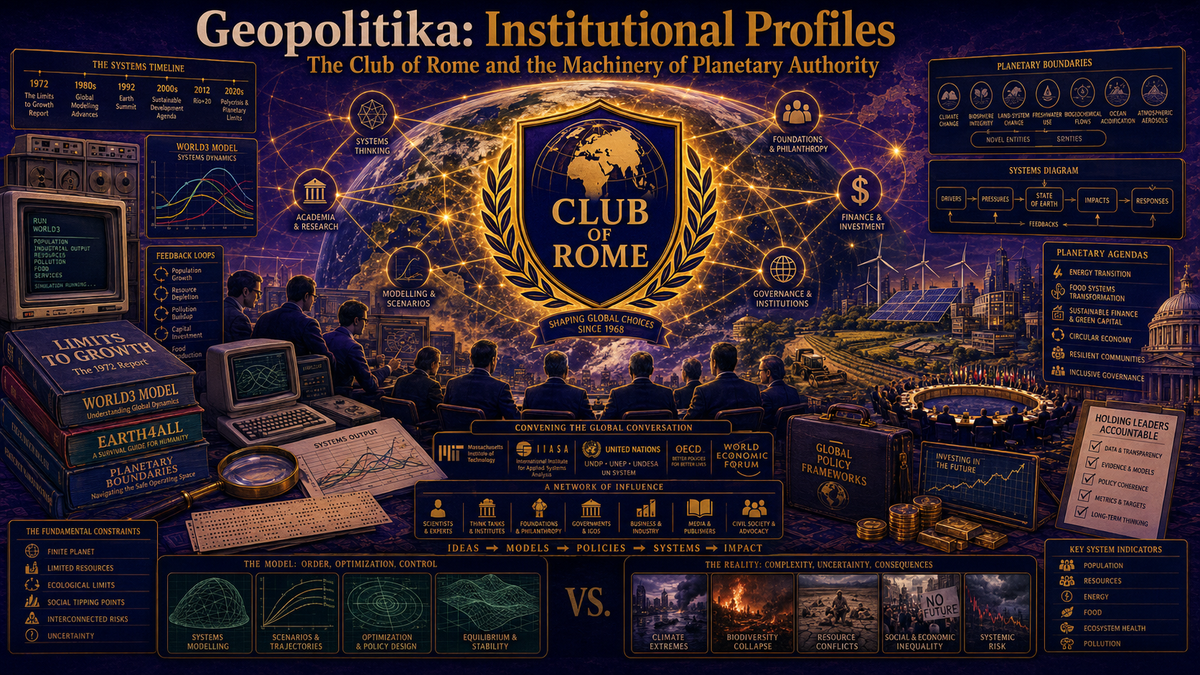
This institutional profile forms a part of the Geopolitika project to map Anglo-American power structures by examining their founding mythologies, leadership, linkages to power, public face, the nature of their outputs and who these are directed towards. These profiles are primarily generated from materials provided on their own websites, which are then analysed using a structured institutional analysis framework—see methodology statement at foot of article.
—
Executive Summary
The Club of Rome presents itself as a long-range systems institution dedicated to “global equity for a peaceful and healthy planet.” It publishes reports, convenes experts across sectors, and openly seeks to influence decision-making. Its founding document, The Limits to Growth (1972), remains the cornerstone of its authority.
Early in its history, particularly in founder Aurelio Peccei’s writings, the Club was associated with a Malthusian-leaning trope — that “humanity itself is the problem” through overpopulation and unchecked consumption. Critics have long highlighted this as a core orientation of the original Club. By its own accounting, the institution has morphed significantly over the decades: from the limits-and-collapse warnings of the 1970s toward a more hopeful language of wellbeing economics, regeneration, equity, cultural transformation, and “a new economic paradigm that puts people and planet first,” as seen in major initiatives such as Earth4All.
That self-described evolution is important evidence, but it is not the final conclusion. The critical question is what the institution actually does when its declared mission is placed beside its personnel networks, funding architecture, outputs, crisis language, modelling lineage, omissions, and downstream consequences.
On the available evidence, the Club functions as a transnational agenda-setting and policy-translation platform: it converts planetary-risk framing and systems modelling into authority, and authority into transformation agendas that enter finance, food systems, energy policy, economic reform, and multilateral governance.
This machinery may produce genuine public goods. It also creates unresolved risks around democratic consent, distributional burdens, donor-enabled scaling, and the conversion of modelled futures into governing priorities.
The Founding Machine: Origins and Core Logic
The Club’s founding story is not a decorative origin myth. It is the first component of its authority engine. The organisation traces itself to 1968, when Aurelio Peccei, an Italian industrialist and philanthropist, and Alexander King, a British chemist and OECD science-policy figure, helped create a network concerned with the long-term “predicament of mankind”. The Club’s own history pages describe its emergence as a response to disciplinary silos, institutional rigidity and short-term policy cycles.
The founding logic was simple and consequential: ordinary institutions were not seeing the whole. Governments were too short-term. Markets were too growth-oriented. Disciplines were too narrow. The Club would supply a global perspective, a long-term view and a systems frame. That may have been intellectually valuable. It also embedded a political claim at the heart of the institution: when existing systems cannot perceive systemic danger, a transnational expert network can legitimately intervene in how the danger is understood.
The 1972 publication of The Limits to Growth made that claim globally visible. The Club’s page for the report says the MIT team fed data on population, industrialisation, food production, resource depletion and pollution into a global computer model and tested behaviour under several assumptions. The report was presented as nontechnical findings from that modelling work. Its core function was not only to warn about ecological limits; it was to make modelling a vehicle for political imagination.
The early modelling work was funded by the Volkswagen Foundation, which gave support to the MIT team behind The Limits to Growth. That does not imply donor control. It does show that from the beginning, the Club’s most influential knowledge product depended on a recognisable architecture: elite convening, foundation support, scientific modelling, global dissemination and institutional controversy.
That architecture still matters. The Club was not founded as a mass democratic movement, a state agency or a conventional academic department. It was closer to an “invisible college”: a semi-formal network of people positioned to think across institutions. That gave it freedom. It also made accountability harder to locate. If an institution operates outside ordinary state channels but aims to influence state, financial and multilateral agendas, it cannot be evaluated only by the sincerity of its mission.
The founding machine was built to warn. The contemporary machine is built to translate warning into transformation. The difference is crucial. A warning institution says: here is a danger. A transformation institution says: here is the pathway. The first asks to be heard. The second asks, implicitly or explicitly, to be followed.
The Authority Engine
The Club of Rome’s authority is cumulative. It draws from historical prestige, scientific lineage, systems language, modelling tradition, elite personnel, global networks, and moral urgency. Its public materials frame it as a platform of thought leaders addressing global challenges through systems thinking, and its publications page states that Reports to the Club of Rome are intended to help understand major global issues and foster civic responsibility.
The institutional vocabulary is central: systems thinking, planetary boundaries, wellbeing, polycrisis, regenerative futures, transformation, global equity, tipping points, and emergency. These terms describe real interdependence, but they also perform political work. They establish a conceptual field in which the Club appears especially qualified to speak. If the problem is systemic, then the systems institution gains authority. If the danger is planetary, the transnational platform gains relevance. If the condition is an emergency, delay and dissent become easier to portray as irresponsible.
Modelled futures intensify that authority. Initiatives such as Earth4All present themselves as driving a shift to a new economic paradigm that puts people and planet first, backed by scientists and economic thinkers, combining science, culture, and advocacy. The associated book, Earth for All: A Survival Guide for Humanity, is described as a major collaboration involving systems analysts and modelling teams.
This is where the model-governance problem becomes central. The Limits to Growth and later work such as Earth4All rely on systems dynamics modelling. These models can capture important structural dynamics — exponential growth, delayed feedbacks, resource constraints, and overshoot risks. Later empirical comparisons by Graham Turner (2008, 2014) and others found that real-world data tracked the original “business-as-usual” scenario more closely than many critics expected in broad directional terms.
However, a model is only as good as its assumptions, parameters, and boundaries. World3 simplified a complex, adaptive human system involving politics, technological substitution, local adaptation, cultural change, institutional unpredictability, and non-linear social behaviour. The GIGO principle (Garbage In, Garbage Out), sensitivity to initial conditions (the butterfly effect), and the inherent difficulty of modelling chaotic systems all limit its reliability for prescriptive governance.
A model can be good enough to warn and still too uncertain to authorise large-scale societal redesign. Directional insight does not equal policy mandate. The downstream-power analysis distinguishes warning from governing authority: model uncertainty is not model invalidity, but model usefulness is not model sufficiency.
The necessary audit questions are not decorative: What assumptions are built into the model? What is the quality of the input data? How sensitive are the outputs to changes in parameters? What is the validation and predictive record? Which harms are counted, and which are excluded? Who decides when a scenario moves from exploratory tool to governing framework?
The Club’s authority engine works by stacking multiple sources of legitimacy: historical memory says it warned early; modelling says it can see future risk; systems language says ordinary politics is too fragmented; elite personnel and networks say it has access; foundation and institutional partners give scale; emergency language adds urgency; and moral language adds ethical cover. The result is a form of authority that is not coercive in the traditional sense, but is still powerfully agenda-setting.
This authority should not be dismissed. In a world of ecological overshoot and institutional short-termism, long-range systems thinking has real value. But because the Club’s authority operates largely outside direct democratic mandate, it must be judged by stricter standards of evidence, transparency, consent, and burden governance.
Platform and Translation Power
The Club is not merely a producer of reports. It is a translation platform. It turns diagnosis into language, language into publications, publications into convenings, convenings into networks, and networks into policy-relevant agendas.
The Club’s own “What we do” material says that since The Limits to Growth, more than 45 Reports to the Club of Rome have appeared alongside policy papers, initiatives and an award-winning podcast. Its podcast page says the Club of Rome Podcast invites thought leaders and changemakers to discuss mindset shifts and policy solutions for complex challenges facing humanity and the planet.
This matters because influence does not require command. An institution can shape political reality by making some concepts portable across venues: “planetary emergency”, “system change”, “wellbeing economy”, “regenerative food systems”, “transition finance”, “Earth4All turnarounds”, “system change compass”. Such phrases travel from reports into policy workshops, from policy workshops into Commission conversations, from Commission conversations into public agendas, from public agendas into funding priorities.
The A System Change Compass report illustrates this translation function. SYSTEMIQ describes the report as co-authored with the Club of Rome and as a framework for implementing the European Green Deal in a time of recovery, with a foreword by then European Commission President Ursula von der Leyen. The Club’s own page says the Compass set out guiding principles and systemic orientations to support rapid rollout of the European Green Deal across the European policy sphere.
This is not proof that the Club controlled European policy. It is evidence that the Club placed its systems language inside a high-level policy translation process. That is the proper level of claim: not command, but agenda insertion; not orchestration, but institutional legibility.
The Planetary Emergency Plan shows the same mechanism in crisis form. The Club’s page says the plan was revised after COVID-19 to reflect the convergence of climate, biodiversity and health crises and to guide the work of the Planetary Emergency Partnership. The language is explicit: emergency, convergence, guidance, partnership.
Platform power therefore lies in movement across contexts. The Club can speak as a historical warning institution, a systems-thinking authority, a convener, a partner, a report producer, a podcast host, an initiative incubator and a policy interlocutor. Each identity reinforces the others. The result is a platform that does not need formal power to shape what formal power sees.
Personnel and Networks
The Club’s personnel are not biographical filler. They are the living infrastructure of its influence. The Club’s organisation pages identify current co-presidents Paul Shrivastava and Silvia Zimmermann del Castillo, and Secretary General Carlos Álvarez Pereira. Shrivastava is described as a sustainability and management leader, formerly Chief Sustainability Officer at Pennsylvania State University and Executive Director of Future Earth. Zimmermann del Castillo is described as an Argentine writer, philosopher and lecturer. Álvarez Pereira is described as having founded the Innaxis Foundation and Research Institute and worked in complex systems, digital technologies and strategic advice.
The former leadership network is equally revealing. Sandrine Dixson-Declève is listed by the Club as Global Ambassador and Executive Chair of Earth4All, with advisory links across climate governance, business and sustainability networks. Mamphela Ramphele is described as a former co-president, activist, medical doctor, academic and global thought leader, with history in South African public life and civil-society leadership. Janez Potočnik is described as an economist and former European Commissioner for Science and Research and for Environment. Jørgen Randers is described as a co-author of The Limits to Growth and a long-running author of Club-related reports including 2052: A Global Forecast for the Next Forty Years and Earth for All.
The pattern is not a classic defence or intelligence revolving door. Analysis of the public materials does not support that claim. The pattern is policy-science-philanthropy-business circulation: people who can move ideas between universities, multilateral bodies, foundations, sustainability networks, corporate advisory spaces, European institutions and public debate.
That circulation is a strength if the problem is fragmentation. Climate, finance, food, biodiversity, labour and resource systems are not governed from one office. Cross-sector networks may be necessary to see the whole. But the same structure creates the governance problem. People with high access can shape options before most burden-bearing publics encounter those options as policy.
The Club’s personnel network gains legitimacy from expertise and moral purpose. Yet expertise and moral purpose are not substitutes for democratic authority. A former commissioner, academic, foundation adviser or systems modeller can help illuminate choices. They cannot alone legitimise the distribution of costs.
Funding and Influence Architecture
The funding architecture must be handled with discipline. The evidence supports convergence and enablement, not command.
The Club’s 2024 financial statements show total income of CHF 2,928,604. Of this, project-specific contributions accounted for CHF 2,524,284—approximately 86% of total income. Regular contributions were CHF 300,000, membership fees CHF 75,622, donations CHF 4,697, and publication income CHF 35,836. This heavily projectised model is structurally significant. Organisations dependent on project grants tend to prioritise work that is measurable, scalable, reportable, and attractive to funders in the sustainability, climate, and systems-change space.
The corpus of public materials shows partial transparency. The corpus shows partial transparency. Named funders and supporters appear in annual reports and project references (including the Laudes Foundation, MAVA Foundation, European Climate Foundation, Robert Wood Johnson Foundation, United Nations University, European Environment Agency, Generation Foundation and others). However, full grant agreements, restriction schedules, project budgets, donor correspondence, and detailed multi-year data are not publicly available. This means direct donor-control claims cannot be substantiated, but it also prevents strong claims of complete independence.
What gets funded, partnered and scaled is revealing. The Club’s major supported workstreams consistently align with large-scale systems-transformation agendas: finance reform aimed at redirecting capital toward planetary boundaries, Earth4All-style national transition pathways, regenerative food systems, material and consumption transformation, and policy engagement around COP reform and European Green Deal implementation. These are not generic environmental projects. They are designed to influence institutional architecture, economic paradigms, policy frameworks and capital allocation at scale.
What is marginal or weakly visible in the analysed corpus is equally salient. The available record shows little central support for decentralised, sovereignty-first, low-tech, labour-led, or explicitly adversarial approaches that would challenge concentrated financial or institutional power more directly. Alternatives emphasising energy abundance, democratic public ownership, community veto rights, or adaptation-focused strategies without heavy modelling and expert-led coordination appear marginal, subordinated or absent from the visible workstream architecture. This creates a medium-confidence finding of solution-selection bias: projects legible to foundations, compatible with multilateral processes, and capable of generating reports, convenings, frameworks and policy submissions are structurally advantaged.
Finance plays a recursive role. It is both a funder category and a target of transformation. Initiatives such as Rethinking Finance and Investing to reconnect financial value with people, nature and the real economy bring together central banks, impact investors, foundations, and policy actors with the explicit goal of redesigning finance to serve “wellbeing within planetary boundaries.” This creates a self-reinforcing loop: finance-related actors help fund the Club’s work, while the Club helps legitimise new forms of transition finance, taxonomies, de-risking mechanisms, and advisory roles.
The strongest funding finding is therefore structural and medium-confidence: the Club’s project-dominated funding model creates strong alignment with its transformation agenda. Funders materially enable workstreams that match their own strategic priorities. This does not prove donor dictation, but it does shape what becomes visible, scalable, and institutionally legitimate—and what remains marginal or unfunded.
Outputs, Timing and Synchronisation
The Club’s outputs should be read as intervention instruments. Reports, policy briefs, open letters, events, workshops, podcasts, commissions and initiative launches do not merely record institutional activity. They carry concepts into the world.
The Club’s publications page states that Reports to the Club of Rome are peer-reviewed studies commissioned by its Executive Committee or suggested by members and collaborators, and that the organisation also publishes shorter policy-oriented documents. Its current catalogue includes reports and policy papers such as Limits and Beyond, Earth for All, the International System Change Compass, Earth4All: Germany, Earth4All: Brazil and Earth4All: Argentina.
The output pattern is longitudinal. The 1972 model-based warning established the Club’s public identity. Later reports translated sustainability, governance, learning, resource efficiency and systems change into successive eras of institutional debate. The contemporary output pattern moves from warning into programme architecture: Earth4All national reports, finance papers, food-system materials, system-change frameworks, youth and leadership materials, and policy-facing documents.
Timing is part of the function. A System Change Compass appeared in the recovery context of the European Green Deal. The Planetary Emergency Plan was revised in the COVID-19 period to address converging climate, biodiversity and health crises. Earth for All was launched in 2022, five decades after The Limits to Growth, explicitly using the 50-year anniversary as a bridge between legacy warning and contemporary transformation.
The corpus also records quantitative institutional signals: more than 150 members, more than 35 national associations, more than 45 reports, significant public media activity, podcast activity, policy workshops, COP engagement, G7-related interventions and European Commission-facing work. These figures should not be overread as proof of impact. They do show scale and repeated intervention across public, policy and expert arenas.
The pattern is not neutral publication. It is agenda maintenance. The Club produces recurring interpretive packages at moments when political systems are seeking frameworks for crisis response. Its outputs make certain concepts repeatable: planetary emergency, limits, turnarounds, wellbeing economy, regenerative agriculture, system change, transition finance, material transformation and cultural transformation.
This is why the output record matters. A single report can be debated as a contribution. A decades-long architecture of reports, initiatives, national strategies, policy workshops and public communications becomes institutional power.
Who Draws the Map: Boundary Power, Preferred Solutions and Downstream Costs
The Club’s deeper power is not simply that it favours certain solutions. It helps draw the map on which solutions are judged.
Its mission boundary defines the problem-space as planetary, systemic and finite: wellbeing for all on a healthy planet; global equity; a peaceful planet; a finite Earth. Once that boundary is accepted, growth-first, sovereignty-first or market-growth frameworks do not disappear, but they become legitimate mainly if they can be reframed inside planetary boundaries. The result is an expanded mandate: economics, finance, food, cities, materials, culture and governance all become proper objects of transformation.
That is boundary-setting power. It decides what counts as the system, which variables matter, which harms are foregrounded, which trade-offs become secondary, and which actors appear qualified to intervene. In the Club’s visible architecture, the relevant system is not a single policy problem but an interconnected planetary field. The preferred solutions then follow from that field: Earth4All-style economic rewiring, regenerative food systems, finance reform, fossil-fuel phaseout, material and consumption transformation, cultural transformation, systems-based governance and European Green Deal implementation.
The intellectual force of this frame is real. Climate, biodiversity, inequality, food insecurity, material throughput and financial short-termism are connected. Fragmented policy can miss those connections. But every boundary is also an exclusion. If the system is defined through planetary limits, modelled futures, capital allocation and institutional coordination, then solutions that can be modelled, financed, convened, scaled and translated into policy language gain authority. Solutions centred on labour power, community veto, sovereignty-first development, energy abundance, low-tech resilience, democratic public ownership or adaptation-first politics become less central unless they can be translated into the Club’s systems vocabulary.
This is why the issue is not only solution selection bias. The solutions are selected after the terrain has already been shaped. Earth4All’s turnarounds, regenerative finance, systems-based EU policymaking and nature-positive recovery are not just preferred options; they are the logical products of the boundary the Club helps establish. Once the crisis is drawn as planetary and systemic, the actors most fluent in systems modelling, transition finance, multilateral policy, foundation-backed initiatives and cross-sector governance become the actors best positioned to administer the response.
That is where gains and costs enter. The primary gain is jurisdiction: the authority to define problems, model futures, convene stakeholders, design frameworks and advise institutions. The Club itself gains platform relevance. Earth4All gains traction. Systems modellers, transition-finance actors, sustainability consultancies, public-private partnership designers and philanthropy-backed networks gain advisory terrain.
But boundary-setting also shapes who pays. If the solutions inside the map require subsidies, guarantees, regulation, infrastructure spending, land-use changes, pricing mechanisms and behavioural adjustment, then costs can fall on households, workers, farmers, producer regions, taxpayers and local communities. The analysis flags precisely these downstream risks: implementation risk shifted to states and communities, transition costs shifted to households and workers if compensation is inadequate, market risk shifted through public finance if transition finance socialises losses, and consent gaps where burden-bearing groups lack clear veto in the corpus.
The central question is therefore not only “who gains and who pays?” It is “who gets to draw the system boundary?” Once the Club helps define the system, it also helps define what counts as a rational solution inside it. That is the institution’s real power: not simply choosing between available options, but helping determine which options become available, serious and fundable in the first place.
The System Beneath: Authority, Omission and Institutional Tension
The system beneath the Club is expert-mediated anticipatory governance. Long-range risk is identified by experts, translated by networks, funded by philanthropic and institutional partners, legitimated through reports and models, and carried into public bodies through convenings, policy language and transformation frameworks.
This system defends several things at once: the authority of systems thinking over fragmented politics; the role of elite convening in crisis response; transition finance as a central instrument of change; public-private and philanthropic-policy ecosystems as legitimate vehicles for planetary governance; and the idea that modelling, scenarios and expert synthesis should guide institutional action before democratic systems have fully processed the choices.
The Club’s ecosystem position is therefore central. It sits between warning and policy, between science and finance, between philanthropy and public institutions, between moral language and technical implementation. It is neither outside power nor identical with state power. It is a mediator. That mediation may be useful, even necessary. But it must be named. The Club is not simply analysing the system. It is part of the system it describes: a system where legitimacy is built through knowledge, access, urgency and networked authority.
The omissions in the corpus matter because they expose the limits of that legitimacy. The analysed materials foreground experts, leaders, members, funders, partners, policymakers and institutional audiences. They do not establish equivalent authority for workers, low-income households, farmers, producer regions, energy users, taxpayers or communities likely to experience the costs of transition. Burden-bearing publics appear more as constituencies to be considered than as actors with binding power over the agenda.
The funding record creates a second limit. Named funders and supporters are visible, but grant terms, project restrictions and donor conditionality are not. That prevents a donor-control claim. It also prevents a strong independence finding. The evidence supports alignment and enablement, not command — but the absence of grant-level transparency leaves the architecture only partially visible.
A third limit is evaluation. The Club reports outputs, influence, engagements and initiatives, but the corpus does not provide robust independent assessment of whether downstream effects were equitable, effective or democratically legitimate. Nor does it answer the liability question: if a transformation pathway raises costs, fails politically, produces backlash, or transfers risk to public balance sheets, who is responsible?
These gaps do not invalidate the Club’s work. They show where its authority outruns the available evidence. Full grant agreements, project budgets, independent impact evaluations, internal dissent records, critical scholarship, burden-bearer testimony, post-implementation audits and evidence that affected populations had binding authority over agenda design would materially change the assessment.
The same legitimacy problem appears as institutional tension. The Club presents itself as a platform and convener, yet its materials also describe aims to influence decision-making, create tools for decision-makers and drive systemic change. A platform hosts conversation. A policy actor pushes direction. The Club appears to do both.
It also speaks in the language of pluralism, youth, intergenerational dialogue and diverse perspectives, while its authority structure remains centred on recognised experts, reports, models, commissions, policy workshops, foundations, former officials and institutional partners. Inclusion exists, but the architecture remains top-heavy.
Finally, the Club’s language of wellbeing, regeneration and global equity softens its crisis framing, while emergency remains an organising principle. Emergency can mobilise necessary action. It can also make refusal appear irresponsible and compress the space for democratic contestation.
These are not minor inconsistencies. They are the operating dualities of the institution. The Club needs to be outside and inside at once: outside enough to claim long-range independence, inside enough to influence decisions. It needs to be both warning institution and transformation platform. It needs crisis to justify urgency and hope to legitimate compliance.
That is the system beneath: not a hidden command structure, but a visible architecture of expert-mediated authority whose democratic safeguards remain under-evidenced.
What It Actually Does
The Club says it exists to help humanity navigate complexity towards wellbeing for all on a healthy planet.
What it actually does is more specific. It functions as a transnational systems-authority platform that converts planetary crisis into transformation agendas. It uses historical prestige, systems modelling, elite personnel, foundation-enabled projects, reports, convenings, policy workshops, public communications and moral urgency to make certain futures governable.
Its downstream function is not simply to warn about danger. It helps construct the authority to act on danger. It expands legitimacy for transition finance, wellbeing economics, regenerative food systems, systems-change expertise, cultural transformation, policy redesign and public-private transformation machinery. It also constrains older systems: fossil-fuel expansion, GDP-only policy, fragmented governance, high material throughput and short-term profit maximisation.
That dual role is why the Club matters. It may contribute to genuine public goods. It may also concentrate authority in networks that are not directly accountable to those who pay the costs of transformation.
The central finding is not “the Club is bad”. It is more precise: the Club is a machinery for making planetary transformation appear necessary, legible and institutionally actionable. That machinery requires democratic scrutiny because its outputs can shape public decisions without carrying public liability.
An Alternative Interpretation
A serious defender of the Club would say this critique mistakes necessary coordination for elite power. Climate change, biodiversity loss, food insecurity, inequality, ecological overshoot and short-term finance are real. Governments have repeatedly failed to act with sufficient speed or systemic understanding. In that context, a network capable of convening scientists, policymakers, business leaders, civil society and youth is not a threat but a public good.
The defender would add that the Club does not command states. It publishes, convenes, warns and advises. Its models are scenarios, not decrees. Its crisis language reflects real danger. Its funders support mission-aligned work rather than control it. Its personnel networks are valuable because crises cross institutional boundaries. Its moral language—global equity, wellbeing, future generations—shows that it is trying to broaden rather than narrow public concern.
Much of that defence is plausible. The evidence does not support claims of hidden control, deliberate crisis manipulation or direct coercion. The Club’s long-range warnings and systems analyses may be valuable. Its critique of short-term growth economics may be justified. Its ability to convene across silos may be socially useful.
But the alternative interpretation does not dissolve the structural critique. An institution can be sincere and still concentrate authority. A model can be useful and still overreach if treated as a mandate. A funder can be mission-aligned and still shape what scales. A consultation process can be real and still fall short of consent. A public good can still impose public costs.
That is why the final assessment remains critical. The Club’s value does not exempt it from scrutiny. It is precisely because its agenda may matter that its power must be made visible.
The Stakes: Who Benefits, Who Pays, Who Decides
The stakes are political, not merely intellectual.
Who benefits? Systems modellers, transition-finance actors, foundations, policy networks, multilateral institutions, sustainability consultancies, regenerative-economy platforms, public-private partnerships and Club-linked initiatives may gain authority, funding, markets or relevance. This is not proof of intent. It is evidence of incentive.
Who pays? Households, workers, farmers, taxpayers, producer regions, energy users, renters, municipalities and future publics may carry the costs if transformation is badly designed, under-compensated or financed through public risk transfer.
Who decides? This is the decisive question. The evidence shows dialogue, convening, policy engagement and public-facing communication. It does not establish binding authority for burden-bearing populations. It does not show that workers, low-income households or affected communities can veto transition pathways. It cannot show consent from future generations.
A planetary crisis may require action. But action without accountable authority becomes governance by urgency. The danger is not only inaction. It is also transformation designed by those with access and paid for by those without it.
Conclusion
The Club of Rome is not a neutral profile subject. It is a power-bearing institution in the politics of planetary transformation.
Its stated purpose is global equity, systems thinking, long-range warning and wellbeing on a healthy planet. Its observable function is to translate crisis into authority and authority into transformation agendas. Its outputs, personnel, funding architecture and policy engagements show an institution that does not merely describe the world; it helps define what powerful institutions think must be done about it.
The strongest criticism is not that the Club invented crisis. It did not. It is not that its models are useless. They may be useful. It is not that its personnel are unqualified. They are often highly qualified. The strongest criticism is that real crisis, useful models, impressive people and sincere public purpose can still create concentrated authority, narrowed alternatives and uneven burdens.
The Club asks humanity to think in systems. The same standard must be applied to the Club itself. Its reports are part of a system. Its funders are part of a system. Its experts are part of a system. Its policy workshops are part of a system. Its language is part of a system. Its omissions are part of a system.
The question is not whether planetary danger should be ignored. It should not. The question is whether planetary danger should be governed through expert-convened transformation architectures whose legitimacy rests on crisis, modelling, elite networks and moral urgency—or through democratic forms strong enough to make transformation answerable to those who will live with its consequences.
—
Published via Mindwars Ghosted.
Geopolitika: Tracing the architecture of power before it becomes the spectacle of history.
Methodology Note: This analysis draws primarily on publicly available materials from the Club of Rome website collection captured on 16 May 2026. The primary corpus includes: Club of Rome website pages; institutional history and legacy materials covering the organisation’s founding in 1968 and subsequent evolution; activity-report excerpts; annual-report and financial-material excerpts, including Annual Report 2025 material; leadership and governance references; member and co-president references; programme pages for initiatives including Earth4All, the Planetary Emergency Partnership, material transformations, cultural transformations, finance and economics reform, youth and intergenerational work; publication listings including Reports to the Club of Rome; event and policy-engagement references; podcast and media-output references; and disclosed funder / supporter material where available. The corpus was treated as a recent public-facing institutional snapshot, not as a complete archival, legal, audited or independently verified dossier. The analysis was conducted using a structured institutional analysis framework examining self-presentation, personnel networks, funding architecture, output patterns, synchronisation, contradictions, missing materials, and de facto purpose. All sourced material is publicly accessible. Base analytic outputs are available on request. For methodological details—including Transparency Score definitions, typology classifications, and confidence calibration—see the Geopolitika Series Methodological Statement.
Mindwars Ghosted is an independent platform dedicated to exposing elite coordination and narrative engineering behind modern society. The site has free access and is committed to uncompromising free speech, offering deep dives into the mechanisms of control. Contributions are welcome to help cover the costs of maintaining this unconstrained space for truth and open debate.
If you like and value this work, please Buy Me a Coffee.