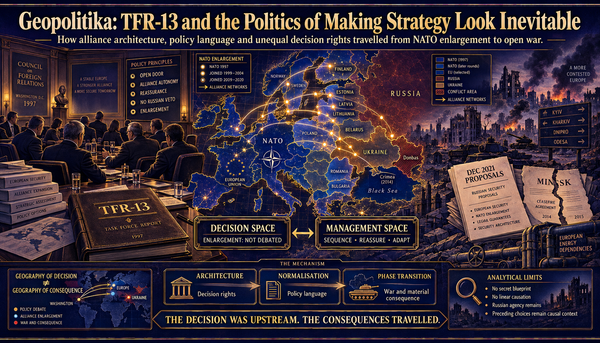
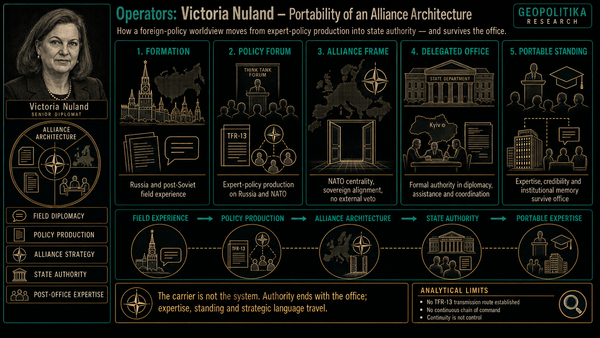
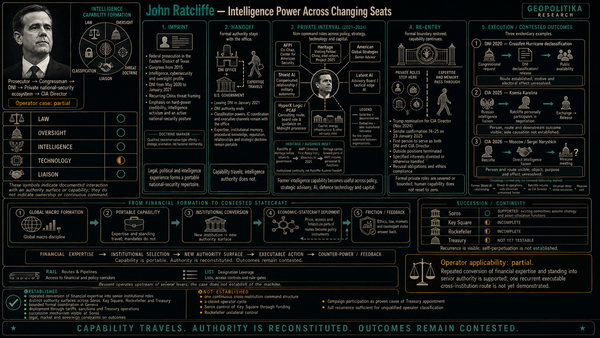
Geopolitika: Institutional Profile – The Council on Foreign Relations (CFR)
This institutional profile forms a part of the Geopolitika project to map Anglo-American power structures by examining their founding mythologies, leadership, linkages to power, public face, the nature of their outputs and who these are directed towards. These profiles are primarily generated from materials provided on their own websites, which are then analysed using a suite of custom protocols run on a commercial AI platform.
—
The Council on Foreign Relations (CFR) is presented as the premier non-partisan institution for understanding America’s role in the world. Its website declares a mission: “to inform U.S. engagement with the world.” It describes itself as “non-partisan, independent,” a “national membership organisation, think tank, educator, and publisher” that generates “policy-relevant ideas and analysis” and convenes “experts and policymakers”—all “to have impact on the most consequential issues facing the United States and the world.”
“CFR takes no institutional positions on matters of policy,” the organisation states in its Living Our Values section. “CFR has no affiliation with the U.S. government or any political party.” Scholars who wish to engage in political activity, it notes, “must take a leave of absence to do so.”
This is the face the Council on Foreign Relations presents to the world: a neutral clearing house, a safe space where ideas can be exchanged without the taint of partisanship or special interest, a resource for anyone seeking to understand the complexities of global affairs.
Beneath this carefully maintained surface lies a different story. The CFR is not merely a non-partisan forum. When looked at more closely it operates as what may be termed a System-Neutralising Legitimacy Engine—an institution whose architecture reveals a sophisticated apparatus for circulating elite personnel, legitimising policy preferences under the cover of scholarship, and amplifying those preferences to shape public and policy debate. Its personnel network, funding structure, and output patterns tell a story that its mission statement obscures.
The Architecture: Personnel and Power
Who runs the Council on Foreign Relations? The answer reveals the first major gap between self-presentation and reality.
At the top stands David M. Rubenstein , who serves as Chairman. Rubenstein is co-founder and co-chairman of the Carlyle Group, one of the world’s largest private investment firms. He previously served as Deputy Assistant to President Jimmy Carter for Domestic Policy. He is joined by Blair W. Effron , Vice Chairman and cofounder of Centerview Partners, who serves on the President’s Intelligence Advisory Board. Jami Miscik , another Vice Chairman, is a former Deputy Director for Intelligence at the CIA and now serves on the boards of Morgan Stanley, General Motors, and HP Inc. Michael Froman , the current President, served as U.S. Trade Representative in the Obama administration and previously as Deputy National Security Advisor for International Economic Affairs.
Of CFR’s top leadership—President, two Vice Chairmen, and Chairman—four of five (80 percent) have held senior government positions. Of the 32 identifiable board members, approximately 47 percent have documented backgrounds in government, military, or intelligence.
This is not a random collection of distinguished individuals. It is a network.
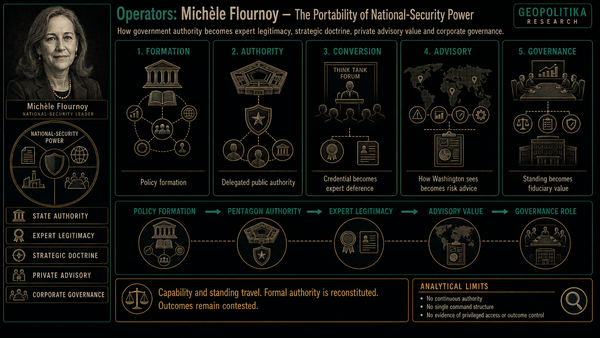
Board members include Michele Flournoy , former Under Secretary of Defense for Policy, who co-founded the Center for a New American Security (CNAS) and the strategic advisory firm WestExec Advisors, and serves on the board of defence contractor Booz Allen Hamilton. Thomas Donilon , former National Security Advisor to President Obama, now chairs the BlackRock Investment Institute. Janet Napolitano , former Secretary of Homeland Security and Governor of Arizona, serves on the board of defence technology firm Fortinet. James Taiclet , Chairman, President, and CEO of Lockheed Martin—one of the world’s largest defence contractors—serves on the board.
The revolving door between government and CFR is not incidental; it is structural. Board members move from the National Security Council, the CIA, the Pentagon, and the Treasury Department directly into CFR leadership—and from there, often into corporate boardrooms. This pattern is significantly above the sector average for think tanks, suggesting that CFR is not merely a place where former officials land but a central hub in a system designed to circulate elite personnel across government, policy, and corporate sectors.
The board interlocks extend outward. CFR shares board members with the BlackRock Investment Institute, Morgan Stanley, General Motors, Lockheed Martin, Booz Allen Hamilton, and WestExec Advisors, among others. These are not arms-length relationships. They are documented connections—individuals who sit at the centre of overlapping institutional networks, shaping policy discourse while maintaining ties to the industries that stand to benefit from that discourse. Many of these board members are also among CFR's largest donors—a pattern examined in the next section.
The Architecture: Funding and Influence
What funds the Council on Foreign Relations? The institution discloses significantly more than many of its peers—but still leaves critical questions unanswered about who pays, how much, and what they receive in return.
CFR's 2024-2025 Annual Donor Listing names: 30 Century Society donors (gifts of $100,000 or more), 60 Chairman's Circle donors ($50,000-$99,999), 114 Harold Pratt Associates ($25,000-$49,999), and hundreds of additional donors in lower tiers. The document provides full names of individual donors and foundations, though exact amounts are disclosed only by tier range. At least seven anonymous donors appear at the highest tiers—individuals or entities whose identities are withheld from public disclosure.
What the document does not show: corporate contributions. CFR's corporate members—including Lockheed Martin, Boeing, Northrop Grumman, BlackRock, and Morgan Stanley—are listed separately on the organisation's website by tier (Gold at $100,000+, Silver at $75,000, Bronze at $50,000) without accompanying contribution amounts. The 2025 Annual Report notes $7 million in corporate memberships, but the public cannot determine how much any single corporation contributes.
The Quincy Institute for Responsible Statecraft, in its January 2025 report Big Ideas and Big Money: Think Tank Funding in America, rated CFR with a Transparency Score of 3 out of 5—“partially transparent.” This places CFR above “dark money” think tanks that disclose no donor information, but below the 18 percent of top U.S. think tanks that disclose all donors with exact amounts. According to Quincy data, between 2019 and 2023, CFR received at least $2.1 million from top 100 defence companies—a figure that represents only disclosed contributions and likely undercounts total corporate funding.
When Donors Govern: The Board-Funding Interlock
The donor listing reveals something the institution does not advertise: CFR's largest private donors are disproportionately its own board members.
Of the 30 Century Society donors—individuals who gave $100,000 or more in 2024-2025—at least 12 serve on CFR's Board of Directors or in its top leadership. Chairman David Rubenstein donates at this level. So do Vice Chairman Blair Effron, board members Kenneth Chenault, James Gorman, Deven Parekh, Charles Kaye, Stephen Freidheim, and former board member Laurence “Larry” Fink.
When Donors Govern: The Board-Funding Interlock
The donor listing reveals something the institution does not advertise: many of CFR’s largest private donors are also its own board members or top leadership.
Of the 30 Century Society donors (gifts of $100,000 or more), at least 12 serve on the Board of Directors or in senior leadership. Chairman David Rubenstein donates at this level. So do Vice Chairman Blair Effron, board members Kenneth Chenault, James Gorman, Deven Parekh, Charles Kaye, and Stephen Freidheim. Former board member Laurence “Larry” Fink also appears among the top donors.
Fink’s case is particularly striking. As BlackRock CEO, he donates personally at the Century Society level while his company holds Gold corporate membership. Meanwhile, Thomas Donilon—former National Security Advisor and current Chairman of the BlackRock Investment Institute—sits on CFR’s Board. This creates a closed loop: the CEO funds the institution personally and corporately, while his senior executive governs it.
This is not a conventional conflict of interest. It is a structural interlock: the people who govern CFR are among those who fund it. The distinction between donor and fiduciary has collapsed. Board members who donate at the highest levels cannot be expected to scrutinise funding practices with detached objectivity. External oversight is structurally limited when the institution’s largest supporters sit on its governing body.
What Remains Unknown
Even with the donor listing, critical gaps persist. The exact amounts of individual donations are not disclosed—a Century Society member could give $100,000 or $10 million, and the public would not know. Corporate contributions are not itemised by company. The full scale of defence contractor funding—beyond the Quincy Institute's estimates—remains opaque. And the donor listing does not reveal whether any of these contributions are earmarked for specific programs, fellows, or research initiatives.
The institution states that it “does not accept funding from corporations for research projects” and that “corporate members have no influence over the outcome of such projects.” But the presence of a Lockheed Martin CEO on the board—and documented funding from Lockheed Martin, Boeing, and Northrop Grumman through corporate memberships—creates a structural channel for influence that a policy statement does not erase. Board members who donate at the highest levels are not outsiders seeking access; they are insiders who control the institution's direction while financing its operations.
What cannot be documented from public materials is what, if anything, these donors receive in return—beyond the standard benefits of membership (access to events, briefings with fellows, the legitimacy that affiliation confers) and the social capital that comes with being named in the Century Society or serving on the board. Whether donations shape research priorities, fellow selection, or event programming remains, from the public record, a question that cannot be answered.
The Outputs: Patterns and Priorities
The Council on Foreign Relations does not primarily produce dense policy papers in the traditional think-tank mold. It produces influence at scale.
In the 2025 fiscal year, CFR fellows generated more than 800 articles, op-eds, and reports — but the truly striking figure is 17,500+ media hits across print, broadcast, and digital platforms. Approximately 95 percent of CFR’s documented outputs consist of media appearances. This is not a quiet research centre. It is a media amplification node—a sophisticated machine designed to inject elite analysis directly into the bloodstream of public and policy debate.
The most prolific voices in the sample were senior fellows with deep government backgrounds: Amy Zegart on intelligence and technology, Steven A. Cook on the Middle East, Rush Doshi on China, Edward Fishman on sanctions. Their expertise is genuine, but their institutional positioning is strategic. CFR outputs do not emerge from neutral academic inquiry; they emerge from a network of former national security officials whose analysis is consistently timed and framed for maximum impact.
The thematic focus mirrors the priorities of the national security establishment that populates CFR’s board and leadership: China strategy, defence innovation, U.S. economic statecraft, Middle East geopolitics, and Ukraine. These are not abstract scholarly topics. They are the live issues around which policy, budgets, and alliances are negotiated.
Synchronization: Timing as Strategy
When CFR produces its outputs matters as much as what it produces.
- Anticipatory synchronization: In October 2024, as the U.S. presidential election approached, CFR published candidate foreign-policy trackers, hosted election forums in battleground states, and partnered with Brookings on a virtual series examining U.S.–Europe relations — positioning itself as the go-to resource well before voters went to the polls.
- Rapid response synchronization: In April 2026, as the Iran conflict intensified, CFR released the podcast “Gulf States Under Fire” within days of major escalations. The same week, fellows produced analysis on ripple effects, including Asian energy security and the Strait of Hormuz.
- Strategic timing: In 2025, the Task Force on Space Policy released Securing Space: A Plan for U.S. Action precisely as the Munich Security Conference convened and shortly after the U.S. Space Force marked its fifth anniversary.
These are not coincidences of scheduling. CFR’s outputs align systematically with diplomatic events, political cycles, and international summits. The institution functions not as a passive observer but as an integrated part of the policy ecosystem — calibrated to deliver analysis at the precise moments when it is most likely to shape elite and public understanding.
This combination of enormous media volume (95% of outputs) and precise synchronization makes CFR uniquely effective as a narrative relay and amplification node. It does not merely produce ideas; it ensures those ideas reach the right audiences at the right time, under the legitimising banner of non-partisan expertise.
The Cracks: Contradictions
Superfically the CFR appears to be an institution where contradictions are resolved through nonpartisan expertise. Its public materials reveal something else: an institution held together by tensions it cannot resolve—and does not try to. Between what CFR claims to be and what its architecture reveals, four contradictions stand out. Each is not a failure of execution but a structural feature. Each reveals what the institution actually is:
- “Non-partisan” vs. Personnel Composition:
CFR claims to be non-partisan, with “no affiliation with the U.S. government.” Yet 80 percent of its top leadership and 47 percent of its board have documented backgrounds in government, military, or intelligence. This is not a failure of execution; it is a structural feature. CFR’s independence is not from government but for government—a platform for the revolving-door elite to continue shaping policy under the cover of non-partisan scholarship. - “Independent” vs. Corporate Board Presence:
CFR states that it “does not accept funding from corporations for research projects” and that corporate members “have no influence.” Yet the CEO of Lockheed Martin sits on its board. Major defence contractors are corporate members. This is not a firewall; it is a permeable membrane. Board-level presence creates a structural channel for influence—whether through the framing of research agendas, the selection of fellows, or simply the shared social networks that shape what counts as legitimate policy discourse. - “Forum” vs. Amplifier:
CFR describes itself as a “continuous conference”—a forum for the exchange of ideas. Yet 95 percent of its documented outputs are media appearances. This is not a conversation; it is a broadcast. The institution is not a neutral space where ideas are debated; it is a production facility where elite consensus is refined and amplified for public consumption. - “Oversight” vs. Self-Sponsorship:
CFR's board is charged with overseeing the institution's finances. But as documented above, board members are among the largest donors. The board cannot independently scrutinise funding practices when board members are the funders.
What these contradictions collectively reveal is an institution whose self-presentation as a neutral, independent forum masks its actual function: providing scholarly legitimacy to the policy preferences of the revolving-door elite and amplifying those preferences to shape public debate.
The Missing: What Is Not Public
CFR’s website is unusually rich in information — donor tiers, corporate membership lists, detailed annual reports, and thousands of outputs are all publicly accessible. At first glance, this appears to demonstrate genuine transparency. In reality, it functions as a more sophisticated form of opacity: transparency theater. The institution floods the public with data while carefully withholding the connections that matter most — exact contribution amounts, earmarking of funds, and the direct interlock between its largest donors and its governing board. The volume of information creates the appearance of accountability while the critical power relationships remain structurally obscured. This is not minimalist hiding; it is maximalist deflection.
What would a complete picture of CFR require? Several categories of materials are not present — or not presented in actionable form — in the publicly available corpus:
- Founding documents would reveal the original intentions of the bankers, lawyers, and academics who established the institution in 1921. These remain unavailable.
- Full donor lists with exact amounts would show the true scale and concentration of corporate and individual funding. Annual reports disclose donors by tier and range, but the top category ($100,000+) remains a nebulous bracket.
- Meeting transcripts or minutes would reveal what is actually discussed in the private sessions that form much of CFR’s membership programming. These are not public.
- Fellowship alumni career tracking would illuminate the long-term outcomes of CFR’s cultivation pipelines. The institution does not systematically publish where its fellows go after their tenures.
Without these materials, analysis of CFR’s internal decision-making, its full funding dependencies, and its long-term network effects remains incomplete. These gaps are not accidental omissions. They are structural features of an institution that operates partly in public view and partly in the shadows of elite conviviality.
The Typology: What Kind of Institution
What kind of institution is the Council on Foreign Relations? The evidence supports classification across several types:
- Revolving Door Incubator:
Personnel circulate between government, CFR, and corporate sectors. Board members move from the National Security Council to CFR to BlackRock; from the Pentagon to CFR to Booz Allen; from the CIA to CFR to Morgan Stanley. The institution is a central node in the system that moves people and ideas through the American national security establishment. - Media Amplification Node:
Ninety-five percent of CFR’s outputs are media appearances. The institution is not a research centre but a production facility designed to inject elite analysis into public debate. Its fellows appear in the New York Times, the Washington Post, CNN, MSNBC, and PBS on a daily basis—shaping how global events are understood by policymakers and the public alike. - Legitimacy Engine:
CFR confers scholarly credibility on policy positions. Its non-partisan brand allows it to frame advocacy as expertise, preference as analysis. When a CFR fellow testifies before Congress or publishes an op-ed, the authority of the institution lends weight to the argument—regardless of the argument’s actual grounding in evidence or its alignment with donor interests. - Agenda Seeding Platform:
CFR initiates and sustains long-term narrative campaigns. The China Strategy Initiative, Climate Realism Initiative, and RealEcon Initiative are not isolated projects; they are multi-year efforts designed to shape how policymakers think about their core challenges.
CFR is not primarily a think tank in the traditional sense. It is a hybrid institution that circulates elite personnel, amplifies elite narratives, confers elite legitimacy, and seeds elite agendas—all while maintaining a public face of non-partisan scholarship.
The Stakes: Who Benefits, Who Pays
Who benefits?
- The national security establishment benefits when CFR provides a platform where former officials can continue to shape policy without the constraints of government service. The revolving door ensures that the people who made policy continue to influence it—now under the cover of independent scholarship.
- Defence contractors benefit when CFR’s board includes their CEOs, when their corporate memberships buy them access to policymakers, and when CFR’s research agendas align with their commercial interests. The Quincy Institute data shows that the defence industry has contributed more than $34.7 million to top U.S. think tanks since 2019. CFR is among the recipients.
- Financial institutions benefit when CFR’s leadership includes their board members, when CFR’s events bring them into contact with policymakers, and when CFR’s analysis frames their interests as national interests. BlackRock, Morgan Stanley, and others are corporate members; their executives serve on CFR’s board.
- Board members who are also donors benefit from a circular arrangement in which their financial contributions help govern the institution that confers legitimacy upon them. The social capital of being named in the Century Society or serving on the board is not incidental—it is, in part, what the donations purchase.
Who pays?
The public pays when elite coordination happens in private, when policy debates are narrowed by the consensus of the revolving-door class, when alternatives are foreclosed because they lack the legitimising stamp of a non-partisan institution. Taxpayers pay for the policies CFR advocates—policies shaped by a network of former officials who now draw salaries from the defence contractors and financial institutions that profit from those policies.
The questions that remain—who funds CFR and what they receive in return, what is discussed in private sessions that never appear in public outputs, where CFR’s fellowship alumni go and what they do—are not academic. They go to the heart of whether an institution that presents itself as a non-partisan resource for understanding the world is, in fact, a sophisticated apparatus for legitimising and amplifying the preferences of the American national security elite.
Conclusion
The Council on Foreign Relations is not merely what it claims to be. It is a System-Neutralising Legitimacy Engine—an institution whose architecture is designed to absorb the contradictions between elite governance and democratic legitimacy, to produce the knowledge that elite governance requires to sustain itself, and to amplify that knowledge into public debate under the cover of non-partisan expertise.
Its personnel network reveals a revolving door that moves people from government to CFR to corporate boardrooms. Its funding structure reveals dependencies that are only partially visible. Its output patterns reveal an institution that functions primarily as a media amplifier, not a research centre. Its synchronisation reveals an institution timed to influence policy at moments of peak relevance. Its contradictions reveal an institution whose self-presentation is systematically at odds with its operational reality.
These findings establish with high confidence that CFR is not merely a non-partisan forum but a central node in the American national security establishment—an institution that provides the scholarly veneer that allows elite consensus to masquerade as objective analysis.
What remains unknown—the full donor list, the exact amounts of corporate contributions, the career trajectories of fellowship alumni, the content of private sessions—are gaps in the public record that limit complete understanding. What is known, from the donor listing, is that CFR's largest donors are disproportionately its own board members—a closed loop of self-sponsorship that challenges the institution's claims to independent oversight. But even with these gaps, the architecture is clear: the Council on Foreign Relations is a machine for producing and legitimising elite consensus, and its public face of non-partisan independence is the engine that makes that machine work.
Published via Mindwars Ghosted.
Geopolitika: Tracing the architecture of power before it becomes the spectacle of history.
—
Methodology Note: This analysis draws on publicly available materials from the Council on Foreign Relations website, including the “About CFR” section, “Board of Directors” biographies, the 2025 Annual Report, the “Living Our Values” page, the 2024-2025 Annual Fund donor listing and corporate membership roster, and biographical profiles of 30+ board members, leadership, and fellows. All sourced material is publicly accessible. The analysis was conducted using a structured institutional analysis framework that examines self-presentation, personnel networks, funding architecture, output patterns, synchronisation, contradictions, and missing materials. External benchmarking data on think tank funding transparency is drawn from the Quincy Institute for Responsible Statecraft’s report Big Ideas and Big Money: Think Tank Funding in America (January 2025). The analysis was conducted using an AI powered structured institutional analysis framework examining self-presentation, personnel networks, funding architecture, output patterns, synchronisation, contradictions, missing materials, and high-signal flags. All sourced material is publicly accessible. Base analytic outputs are available on request.
Mindwars Ghosted is an independent platform dedicated to exposing elite coordination and narrative engineering behind modern society. The site has free access and committed to uncompromising free speech, offering deep dives into the mechanisms of control. Contributions are welcome to help cover the costs of maintaining this unconstrained space for truth and open debate.
If you like and value this work, please Buy Me a Coffee