Geopolitika: Institutional Profiles – The Institute for the Study of War (ISW)
This institutional profile forms a part of the Geopolitika project to map Anglo-American power structures by examining their founding mythologies, leadership, linkages to power, public face, the nature of their outputs and who these are directed towards. These profiles are primarily generated from materials provided on their own websites, which are then analysed using a suite of custom protocols run on a commercial AI platform—see methodology statement at foot of article.
—
On February 28, 2026—as the United States and Israel conducted strikes on Iran—the Institute for the Study of War published its Iran Update Special Report. The same day, its Russian Offensive Campaign Assessment asserted that Russia’s boilerplate condemnations of the strikes against Iran highlighted the continued limits of Russia’s ability to support Iran and the asymmetry of the Russian-Iranian relationship. A day later, its China & Taiwan Update reported that the People’s Liberation Army Navy may be preparing to launch its first Type 09V guided missile nuclear submarine.
These reports are merely a part of the daily the rhythm of an institution for whom war is not a subject but a sustenance.
The Institute for the Study of War presents itself differently. Its website declares a mission: “to advance an informed understanding of military affairs through reliable research, trusted analysis, and innovative education.” It describes itself as “non-partisan,” a “non-profit public policy research organisation” that takes “no US or foreign government money or contracts.” It claims a “strict conflict-of-interest policy” and states that it does not accept corporate sponsorships for its analytic programs.
The Institute presents as a neutral research organisation, a source of disinterested expertise, a non-governmental provider of open-source intelligence.
But if we look closer, beneath this carefully curated surface lies a different story. The daily Ukraine war maps are not isolated analytical products. They are the lifeblood of an institution whose entire identity, operational rhythm, personnel network, talent pipeline, and funding model are structurally optimised for sustained high-intensity conflict. The Institute for the Study of War is not merely a think tank that happens to study war. It is a war-dependent operator network—an institution whose relevance, output cadence, and institutional reproduction require the continuation of the very conflicts it analyses.
The Architecture – Personnel and Power
The Institute exhibits extraordinary revolving-door density. Approximately 73 percent of its documented board members have held senior US government, military, or intelligence positions. The board interlocks connect ISW to the American Enterprise Institute (AEI), KKR, Mandiant, and the Secretary of Defense Policy Board.
Key figures include:
- Dr. Kimberly Kagan, President and Founder, who advised US commanders in Iraq and Afghanistan.
- General Jack Keane (Ret.), Chairman, former Vice Chief of Staff of the US Army.
- General David H. Petraeus (Ret.), board member and former CIA Director, now Partner at KKR.
- Kevin Mandia, board member and CEO of Mandiant (cybersecurity government contractor).
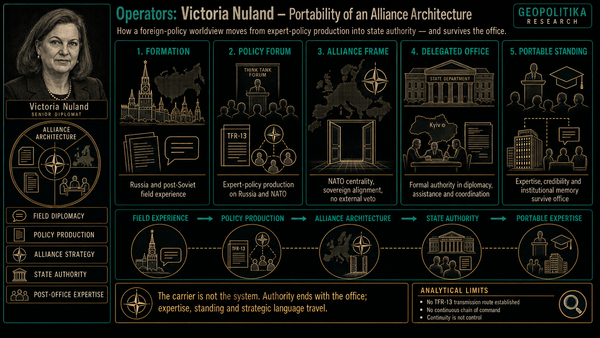
These connections extend beyond individual careers into a dense family network. Kimberly Kagan is married to Frederick Kagan, a military historian and resident scholar at the American Enterprise Institute who has co-authored work with her and advised on Iraq and Afghanistan strategy. Frederick Kagan is the brother of Robert Kagan, a prominent neoconservative writer and co-founder of the now defunct Project for the New American Century (PNAC). Robert Kagan’s wife is Victoria Nuland, who served as Assistant Secretary of State for European and Eurasian Affairs (2013–2017) and later as Under Secretary of State for Political Affairs. Nuland played a highly visible role in US policy toward Ukraine, including public support for the 2014 Maidan events and subsequent diplomatic efforts to counter Russian influence.
This Kagan-family nexus—spanning think tanks (ISW and AEI), government (State Department), and advisory roles to military commanders—illustrates a concentrated circulation of personnel and ideas within a hawkish foreign-policy ecosystem. The revolving door thus operates not only at the individual level but across familial and ideological lines, lending institutional authority to analysis while concentrating influence among actors who have long advocated sustained US military engagement in multiple theatres.
The revolving door further extends to authorship. Many senior analysts and fellows are retired military or intelligence officers. This visible core consists largely of former government and military officials whose experience lends authority to analysis presented as independent expertise.
What remains partially concealed is the full extent of board members’ corporate and advisory affiliations—and the broader network density created by these family and ideological ties—limiting external assessment of potential conflicts of interest.
The Architecture – Talent as Infrastructure
ISW's most durable asset is not its maps or its daily assessments. It is its people—not just the senior analysts who produce today's outputs, but the pipeline of emerging leaders who will produce tomorrow's.
ISW has institutionalised this pipeline under the General David H. Petraeus centre for Emerging Leaders—a dedicated hub whose explicit mandate is to “select, develop, and launch emerging national security leaders.” The centre's name, drawn from a board member who embodies the military-intelligence-private sector revolving door, signals the intended terminus: not academic debate, but operational national security roles.
The pipeline operates as a deliberate progression. High-achieving undergraduates enter through the selective Hertog War Studies Program, a two-week immersion taught by Kimberly Kagan and Frederick Kagan (AEI). Top performers advance to fellowships (War Studies, Evans Hanson) where they embed directly in ISW research teams. Interns—across tracks for Russia/Ukraine, China/Taiwan, Geospatial Intelligence, and Cognitive Warfare—produce the daily maps and assessments that constitute ISW's public output. Alumni join a network of “up-and-coming national security leaders” populating government, think tanks, consulting firms, law firms, and the media.
The curriculum is not neutral. Hertog seminars transmit ISW's specific analytical framework: open-source intelligence, daily operational assessment, battlefield mapping, and a worldview that emphasises military necessity. Fellows learn to produce the daily updates that define ISW's output style. Interns internalise the rhythm of war-as-daily-product.
The pipeline's most sophisticated function is not producing analysts—it is producing customers. An alumnus who becomes a Hill staffer requests ISW briefings. An alumnus who becomes a Pentagon analyst imports ISW's daily assessment rhythm. An alumnus who becomes a journalist cites ISW maps. By the time participants leave ISW, they do not merely understand its conclusions—they reproduce its methods, and they create demand for its products, across the national security apparatus.
This is not career support. It is career construction—and, through that construction, the reproduction of an analytical ecosystem that requires sustained conflict to remain relevant.
The pipeline's output—the analysts it produces—then generates ISW's public outputs. Those outputs, in turn, reinforce the pipeline's curriculum. The daily Russian Offensive Campaign Assessment, the Iran Update, the China & Taiwan Update—these are not merely products for external consumption. They are also training materials for the next cohort of fellows and interns, who learn to produce them by producing them. This circularity—pipeline → outputs → training → pipeline—is the institution's core reproductive logic.
The Architecture – Funding and Influence
ISW's funding is almost entirely opaque. The Institute discloses only what it does not accept: no US or foreign government money or contracts, and no corporate sponsorships for its analytic programs. It provides no donor names, no donation amounts, no annual reports, and no 990 forms.
This negative-only disclosure creates a classic dark money structure. Transparency Score: 1 (dark money) per the Quincy Institute's classification. Without positive transparency, it is impossible to determine whether defence-adjacent corporations, foundations, or private individuals with ties to the military-industrial complex provide funding—or how such funding might shape research priorities.
The Accountability Gap is stark: an institution that claims strict independence while refusing to disclose who funds its daily war assessments cannot be fully evaluated for potential influence.
The Outputs – War as Developmental Context
ISW's entire output architecture is built around ongoing armed conflict. Its flagship products—the daily Russian Offensive Campaign Assessment (running since February 2022), the Iran Update, and the China & Taiwan Update—are synchronised with battlefield developments and diplomatic escalations.
The Institute produces maps, assessments, and briefings that are rapidly picked up by major media outlets and cited by policymakers. Its Geospatial Intelligence Team creates visual products used by world leaders and military professionals. This is not traditional long-form scholarship. It is real-time operational analysis designed for immediate consumption.
Without sustained war—particularly the high-visibility, attritional conflict in Ukraine that became its developmental context—ISW would face an existential challenge. Its daily assessment rhythm, media relevance, talent pipeline, and ability to attract donors and attention are all deeply dependent on the continuation of major armed conflicts.
Methodological Blind Spots
ISW claims to provide “reliable research” and “trusted analysis” based on open sources. Yet its outputs reveal recurring structural blind spots that parallel—and institutionalise—patterns seen in earlier open-source initiatives associated with the Atlantic Council.
The Atlantic Council’s Digital Forensic Research Lab (DFRLab), working closely with the Bellingcat collective, pioneered high-profile open-source investigations into events such as the Buk missile launcher that supposedly downed MH17 (tracing it to a Russian military unit) and alleged chemical weapons use in Syria (analysing munitions, craters, and videos to attribute responsibility to regime forces). These efforts were presented as independent, citizen-driven OSINT that delivered rapid, visually compelling attributions for policymakers and media.
ISW extends this model into a sustained, daily operational cadence. Its geospatial intelligence team and flagship products (the Russian Offensive Campaign Assessment, Iran Updates, China & Taiwan Updates) produce near-real-time battlefield mapping and threat framing. However, recurring structural blind spots persist:
- Layer-4 Exclusion: Civilian voices—Russian, Ukrainian, Iranian, Palestinian—are almost entirely absent. The Institute (like much of the DFRLab/Bellingcat ecosystem) maps battlefield control and attributes specific incidents but rarely consults or platforms the populations living under that control.
- Omission of External and Western Constraints: NATO expansion, prior US interventions (1953 coup in Iran, support for Iraq during the Iran-Iraq War), and arms control alternatives are minimised or erased. Problems are framed as originating almost exclusively from the target state—a selective lens also visible in Atlantic Council-linked Syria chemical weapons reporting.
- Failure to Acknowledge Prior Planning: The Institute does not reference documents such as RAND’s Extending Russia (2019) or Brookings’ Which Path to Persia? (2009), which modelled ways to pressure the very adversaries ISW now analyses.
- Historical Erasure: Coverage often begins at convenient inflection points (2022 for Russia, post-1979 for Iran), sidelining slow variables and longer historical context.
These blind spots are not random. They reflect an institution (and a broader OSINT-to-policy ecosystem) whose relevance and output rhythm depend on presenting conflicts as clear-cut struggles requiring sustained Western military involvement, intelligence support, and narrative reinforcement. Where Bellingcat/DFRLab delivered episodic “gotcha” attributions, ISW provides the continuous mapping and analytical infrastructure that normalises prolonged engagement.
The Cracks—Contradictions
Several contradictions are structural rather than accidental:
- “Non-partisan” and “independent” claims versus personnel reality. The institution claims to be non-partisan and independent. Yet its board and staff are overwhelmingly drawn from US military and intelligence backgrounds—and its founder personally advised active-duty US commanders in Iraq and Afghanistan.
- “Open-source intelligence” branding versus elite access. ISW brands itself as an open-source intelligence (OSINT) provider, relying only on publicly available materials. Yet its founder and senior analysts have maintained direct advisory relationships with US commanders—access that goes far beyond what any OSINT analyst could obtain.
- Strict conflict-of-interest policies versus funding opacity. The Institute claims a strict conflict-of-interest policy. But it operates with complete funding opacity—no donor names, no annual reports, no 990 forms on its website—while its board includes defence-adjacent figures such as General David Petraeus (partner at KKR, a private equity firm with defense investments) and Kevin Mandia (CEO of Mandiant, a government cybersecurity contractor).
- “Educational mission” versus closed-loop talent pipeline. ISW states a commitment to “innovative education.” But its educational pipeline—the Petraeus Center, Hertog War Studies Program, fellowships, and internships—functions as a closed-loop system that feeds directly into ISW's analytical workforce and the broader national security apparatus. It produces not just analysts but customers: alumni who become Hill staffers, Pentagon analysts, and journalists who then request, import, or cite ISW's products.
- Internal logical contradiction in ISW's own analysis. The February 2026 report on Russia's internet crackdown argues that censorship demonstrates Putin's weakness. Yet the same report warns that Russia is building a “Soviet-style police state”—which requires substantial state capacity. A weak state cannot build a police state. This logical tension within ISW's own output suggests its framing is shaped by the need to present Russia as both brittle (to justify pressure) and dangerous (to justify vigilance).
These tensions are not failures. They are structural features. They enable the Institute to maintain legitimacy while limiting scrutiny.
Typology—What Kind of Institution
The Institute for the Study of War functions as a War-Dependent Operator Network. Its primary roles within the broader foreign-policy ecosystem include:
- Revolving Door Incubator:
Circulates senior military and intelligence personnel into analysis roles. Approximately 73% of documented board members have held senior US government, military, or intelligence positions, with interlocks to the American Enterprise Institute, KKR, Mandiant, and the Secretary of Defense Policy Board. - Narrative Relay Node:
Provides daily framing of ongoing conflicts aligned with US strategic objectives. Daily updates synchronised with battlefield developments and diplomatic escalations; outputs consistently emphasise the necessity of sustained Western support. - Media Amplification Node:
Produces maps and assessments designed for rapid media pickup. ISW’s geospatial products and assessments are regularly cited or republished by major outlets including the Washington Post, Wall Street Journal, CNN, Reuters, and Associated Press. - Legitimacy Engine:
Converts military operations into “objective” expert analysis. Board includes high-profile figures such as Gen. David H. Petraeus (Ret.) and Gen. Jack Keane (Ret.); outputs are presented as neutral “research” rather than advocacy. - Agenda Seeding Platform:
Sustains long-term narratives that justify continued engagement. The Russian Offensive Campaign Assessment has been published daily since February 2022, providing a consistent operational narrative across multiple theaters. - Talent Cultivation Hub:
Selects, trains, and places emerging national security professionals. Petraeus Center for Emerging Leaders; structured pipeline from the selective Hertog War Studies Program through fellowships and internships into ISW staff or broader national security roles. - War-Dependent Operator:
Institutional relevance requires sustained high-intensity conflict. Without major ongoing conflicts such as the war in Ukraine, ISW’s daily assessment rhythm, media relevance, and talent pipeline would face an existential challenge.
Signature Pattern
ISW’s signature pattern is war-dependence. Its daily operational assessments, talent pipeline (Petraeus Center), and institutional relevance are structurally optimised for sustained high-intensity conflict. Where other think tanks analyse war, ISW requires it — and its outputs, maps, and trained alumni help sustain the conditions that make its analysis necessary.
The Stakes – Who Benefits, Who Pays
Who benefits?
- The national security establishment benefits when ISW provides a platform where former officials can continue to shape policy without the constraints of government service—and where the next generation is cultivated to do the same.
- Defence-adjacent board members (Petraeus/KKR, Mandia/Mandiant) benefit from ISW's framing of threats, though whether their corporations fund ISW is unknown due to funding opacity.
- The broader US national security state benefits most directly. ISW functions as a legitimacy engine, translating military operations into “objective” expert analysis while its talent pipeline supplies the next generation of operators.
Who pays?
- Populations in targeted countries pay a direct human price. Russian, Ukrainian, Iranian, and Palestinian civilians are mapped, assessed, and analysed—but never consulted. Their lives become data points in daily updates.
- The broader public and taxpayers bear the downstream costs of policies ISW's framing supports: continued military aid, sustained pressure on adversaries, and the normalisation of war as a daily analytical product.
- Democratic discourse pays a price. Systematic omissions—NATO expansion's role in the Ukraine conflict, prior planning documents that anticipated pressure on Russia and Iran, diplomatic alternatives—narrow the range of thinkable policy options.
Conclusion
As with the other think tanks examined so far in this series, the Institute for the Study of War is not what it claims to be. It is a war-dependent operator network whose personnel, outputs, talent pipeline, and relevance are structurally linked to ongoing high-intensity conflict.
Its own materials reveal the pattern: daily assessments timed to battlefield developments, heavy revolving-door personnel from the US military and intelligence community, a tiered talent pipeline—Petraeus Center → Hertog → Fellowships → Internships → Alumni—that manufactures both analysts and customers, complete funding opacity, and systematic omissions of Western constraints and prior planning documents.
In a hypothetical period of reduced great-power conflict, ISW would face an identity crisis. Its daily cadence, media citations, talent pipeline, and institutional prestige all depend on the existence of wars that require constant Western military involvement and analysis.
This dependence helps explain why the Institute's framing consistently emphasises the necessity of sustained engagement and the futility of diplomatic alternatives. ISW does not merely study war—in important ways, it requires war to remain what it is, and it helps reproduce the ecosystem that wages it.
The broader Geopolitika series shows that ISW is not exceptional. It is one node in an interconnected ecosystem where different institutions perform complementary roles. Understanding ISW's war-dependent nature helps illuminate how parts of the foreign policy architecture are incentivised not just to respond to conflict, but to sustain the conditions in which conflict analysis—and the policies it justifies—remains central.
Published via Mindwars Ghosted.
Geopolitika: Tracing the architecture of power before it becomes the spectacle of history.
Methodology Note: This analysis draws on publicly available materials from the Institute for the Study of War's website, including the “About” section, “Our History” page, “People” biographies (board, leadership, senior fellows, program staff), education pages (Hertog War Studies Program, fellowships, internships, Petraeus Center), the Map Room, output snapshot (April 1-4, 2026: Russian Offensive Campaign Assessment, Iran Update Special Report, China & Taiwan Update), and the long-form report “Putin's Internet Crackdown Is Rooted in Weakness” (February 24, 2026). The analysis was conducted using a structured institutional analysis framework examining self-presentation, personnel networks, funding architecture, output patterns, synchronisation, contradictions, missing materials, and high-signal flags. For methodological details—including Transparency Score definitions, typology classifications, and the Layer-4 gap as an ecosystem feature—see the Geopolitika Series Methodological Statement. All sourced material is publicly accessible. Base analytic outputs are available on request.
Mindwars Ghosted is an independent platform dedicated to exposing elite coordination and narrative engineering behind modern society. The site has free access and is committed to uncompromising free speech, offering deep dives into the mechanisms of control. Contributions are welcome to help cover the costs of maintaining this unconstrained space for truth and open debate.
If you like and value this work, please Buy Me a Coffee.