Geopolitika: Institutional Profiles – The Atlantic Council
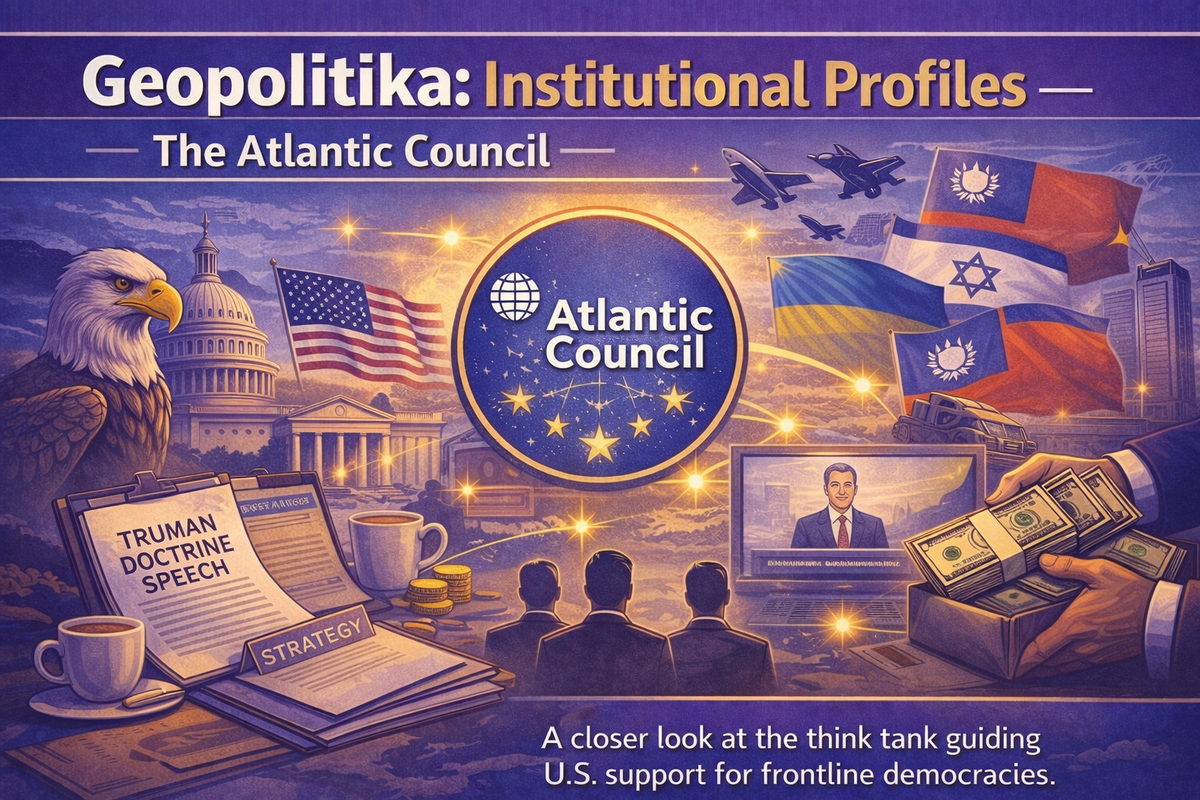
This institutional profile forms a part of the Geopolitika project to map Anglo-American power structures by examining their founding mythologies, leadership, linkages to power, public face, the nature of their outputs and who these are directed towards. These profiles are primarily generated from materials provided on their own websites, which are then analysed using a suite of custom protocols run on a commercial AI platform.
—
On March 12, 2026—the 79th anniversary of President Harry Truman’s historic address to Congress—Atlantic Council Vice President Matthew Kroenig and International Republican Institute President Dan Twining appeared on the Vandenberg Coalition YouTube channel to reflect on The Truman Doctrine Speech: The Beacon of Liberty, Ep. 3. The discussion framed the 1947 doctrine as an unambiguous success that delivered “80 years of peace and prosperity,” arguing that the same logic of supporting “free peoples” resisting “attempted subjugation by armed minorities or by outside pressures” remains essential today. Ukraine, Taiwan, and Israel were presented as the new “frontline democracies” requiring steadfast US engagement, while critics of such support were portrayed as hoping for American “retreat.”
This polished historical analogy, delivered with institutional authority and moral clarity, exemplifies how the Atlantic Council presents itself to the world.
The Council describes itself as a non-partisan, intellectually independent think tank dedicated to “shaping the global future together.” Its materials position the organisation as a convener of expertise and a bridge between Washington and its allies, applying first-rate analysis to the world’s defining challenges.
The website declares that the Atlantic Council “galvanizes US leadership and worldwide engagement, in collaboration with allies and partners, to shape solutions to global challenges.” It claims to be “non-partisan.” Its Intellectual Independence Policy states that the Council “does not adopt or advocate positions on particular matters” and that its publications “always represent the views of the author(s) rather than those of the institution.”
The homepage reads:
“Through first-rate analysis and high-level convenings, the Atlantic Council promotes US cooperation with allies on the world’s defining challenges,”
This is the public face the Atlantic Council presents: a neutral convener, a source of disinterested expertise, a bridge between Washington and its allies.
But beneath this carefully curated surface lies a different story. The Truman Doctrine commentary is not an isolated historical reflection. It is a representative output of a sophisticated multi-node operator network whose personnel circulate between government and policy advocacy, whose funding is the highest among US think tanks for both foreign governments and defence contractors, whose outputs consistently amplify hawkish US foreign policy positions, and whose contradictions—non-partisan claim vs. partisan output, transparency claim vs. partial disclosure—are structural features rather than failures. In effect, the “nonpartisan” claim is procedural not substantive, in that its experts are quite evidently partisan actors.
What emerges from an examination of the Atlantic Council’s public materials is an institution that functions as a Revolving Door Incubator, a Narrative Relay Node, and a Media Amplification Node—a legitimacy engine for establishment foreign policy, not a neutral research organisation.
The Architecture—Personnel and Power
Who Is Visible: The Revolving Door Core
The Atlantic Council exhibits extraordinary revolving-door density. Approximately 60 to 70 percent of documented leadership have held senior US government positions. Board interlocks connect the Council to the Council on Foreign Relations, the Trilateral Commission, major defence contractors, and major financial institutions.
- John F.W. Rogers is Chairman of the Atlantic Council. He is an executive vice president and secretary to the board of Goldman Sachs. He previously served as an under secretary of the United States Department of State and as an assistant to the president at the White House.
- Frederick Kempe is President and CEO (since 2007). He is a former Wall Street Journal editor and a member of the Council on Foreign Relations.
- James L. Jones, Jr. is Executive Chairman Emeritus. He is a former National Security Advisor and former US Marine Corps commandant.
- Adrienne Arsht is Executive Vice Chair. She is a major donor whose name adorns multiple centers.
- Stephen J. Hadley is Executive Vice Chair. He is a former National Security Advisor and a principal at Rice Hadley Gates & Manuel LLC.
- General David Petraeus is a board member. He is a former CIA director and a partner at KKR.
- Paula Dobriansky is Vice Chair. She is a former under secretary of state and a senior fellow at Harvard’s Belfer Center.
The revolving door extends beyond the board to authorship. Multiple former US government officials serve as “independent experts” for the Council’s output series:
- Thomas Warrick (former DHS/State) writes on Iran.
- Alan Pino (37 years at CIA) writes on Iran.
- Nate Swanson (former NSC director for Iran) writes on Iran and US national security.
- Daniel Shapiro (former US ambassador to Israel) writes on Israel-Iran.
- Allison Minor (former NSC) directs the N7 Initiative.
- Julia Nesheiwat (former Homeland Security Advisor) writes on Arctic security.
- Tressa Guenov (former Principal Deputy Assistant Secretary of Defense) writes on intelligence alliances.
- Kingston Reif (former Deputy Assistant Secretary of Defense for Threat Reduction and Arms Control) writes on nuclear posture.
Ukrainian former officials—Serhii Kuzan (former adviser to Ukraine’s Ministry of Defense) and Oleksiy Zagorodnyuk (former adviser to Ukraine’s National Security Council)—write for the Council’s UkraineAlert blog.
This visible core consists largely of former government officials whose government experience lends authority to policy advocacy presented as independent expertise. The revolving door pattern is significantly above sector average.
What Is Concealed and Why It Matters
The Atlantic Council’s board of directors lists over one hundred members, but biographies are not provided for most. The International Advisory Board lists dozens of members—including CEOs of globally significant companies and former prime ministers and presidents—but detailed affiliations are limited.
Without full disclosure of board member biographies and affiliations, external researchers cannot fully map network connections, assess conflicts of interest, or identify the full extent of interlocking directorates. The Council offers enough visibility to signal legitimacy (key leaders are visible) while keeping the broader network shaping its strategic direction partially opaque.
The Council’s authority rests primarily on the perceived credibility of its experts (many of whom are former officials) and its institutional prestige rather than on full transparency of its personnel network.
The Founding Network: Sanitised Origins
The Atlantic Council was founded in 1961 by Dean Acheson, Christian Herter, Will Clayton, William Foster, Theodore Achilles, and other distinguished Americans. The founding context—rooted in Cold War Atlanticism, the consolidation of US citizens' groups supporting the Atlantic Alliance, and the promotion of constructive US leadership against the Soviet threat—is present in current materials but flattened. The website states: “The Council launched in 1961, just as the Cold War threatened to turn hot.”
This framing serves a naturalisation function: it makes the Council’s present orientation seem determined by history, transferring urgency from the Cold War to contemporary threats. The founding narrative positions the Council as an enduring response to existential threat—a mythology that lends urgency to its current outputs.
What is omitted is any discussion of the Council’s historical role in specific Cold War interventions, its relationship to intelligence agencies, or the evolution of its funding from that period to the present. The founding is presented as origin story, not as ideological inheritance.
High-Signal Flags
Several anomalies signal potential conflicts of interest or unusual network density:
- Active clearance + corporate board: General David Petraeus holds active security clearance (as former CIA director) while serving on the board of KKR, a global investment firm. This creates a potential influence pathway: classified access → corporate strategy → policy advocacy.
- Defense contractor + policy role: Board member Linden Blue is Co-Owner and Vice Chairman of General Atomics, a major defence contractor. Multiple other board members have defence industry affiliations. The honor roll includes Lockheed Martin, Northrop Grumman, Boeing, and RTX as donors.
- Cross-institutional bridge: Multiple board members (Hadley, Dobriansky, Petraeus) hold simultaneous positions at the Council on Foreign Relations and the Trilateral Commission, creating interlocking directorates across elite institutions.
- Revolving door into authorship: Former US and Ukrainian officials write as “independent experts” on the conflicts they once helped manage, creating an extended revolving door where policy experience becomes expert authority.
- Funding opacity + defence ties: The Council has the highest defence contractor funding among US think tanks (Quincy data) but does not disclose donation amounts for most donors on its website.
These flags are not necessarily evidence of impropriety, but they are structural features that warrant scrutiny. They suggest the Council is not merely a think tank but a node in an integrated elite network spanning government, intelligence, military, corporate, and policy advocacy sectors.
The Architecture—Funding and Influence
Another high-signal flag is the Atlantic Council’s selective transparency in funding. The Council publishes an annual Honor Roll of Contributors listing donor names by tier ($1 million+, $500,000–$999,999, $250,000–$499,999, etc.). It includes a disclaimer that the Council “retains intellectual independence and control over any content funded.”
This constitutes tiered disclosure rather than full transparency. Donor names are provided, but donation amounts are not disclosed for the vast majority of contributors. No comprehensive donor list with exact amounts, no annual consolidated financials beyond a summary, and no 990 forms are prominently featured on the Council’s website.
What the Honor Roll Reveals
The Council’s 2024 Honor Roll provides tiered disclosure of major donors but does not reveal exact contribution amounts for most of them. Top-tier donors ($1 million and above) include Adrienne Arsht, Bahaa Hariri, Chevron, and the United States Departments of Defense and State.
Subsequent tiers feature significant contributions from Amazon Web Services, John F.W. Rogers of Goldman Sachs, SAAB, and the Jeffrey M. Talpins Foundation — a key backer of the N7 Initiative. Lower tiers include major corporations such as Airbus, Apple, Aramco Americas, ExxonMobil, Google, Microsoft, and PepsiCo.
Defence industry ties are prominent throughout the list, with Lockheed Martin, Northrop Grumman, Boeing, RTX (Raytheon), General Atomics, SAAB, Thales, Leonardo DRS, and Textron appearing as donors. This reinforces the overlap between the Council’s funding base and its advocacy for military spending and alliance reinforcement.
Foreign governments also feature heavily. The Embassy of the United Arab Emirates and the Government of the United Kingdom appear in the top tier, while additional notable funders include the Royal Norwegian Ministries of Foreign Affairs and Defense, the Ministry of Foreign Affairs of Sweden, the German Federal Foreign Office, and embassies from Bahrain, Denmark, Canada, Lithuania, and Switzerland.
This structure — donor names without amounts for most contributors, combined with heavy representation from defence contractors and foreign governments — creates a clear pattern of managed transparency.
What IRS Filings and External Data Reveal
The Council’s financial summary is marked “unaudited.” No 990 forms are publicly available on its website. However, external data from the Quincy Institute’s 2025 report, Big Ideas and Big Money, provides a more complete picture:
- Between 2019 and 2023, the Atlantic Council received a minimum of $20.9 million from foreign governments—the highest of any US think tank.
- In the same period, it received a minimum of $10.3 million from defence contractors—also the highest of any US think tank.
- It received a minimum of $8.1 million from the US government.
- Its transparency score is 3 out of 5 (partially transparent).
The N7 Initiative represents a direct funding-to-influence pathway. It is a partnership between the Atlantic Council and the Jeffrey M. Talpins Foundation (a $250,000–$499,999 tier donor). The N7 Initiative organises congressional delegations to Gulf states and is explicitly designed to “advance US interests by strengthening relations among key partners and allies in the Middle East, Africa, and Asia.”
The Accountability Gap
The structural tension is clear: the Atlantic Council receives the highest defence contractor and foreign government funding among US think tanks—including from the UAE, a key N7 partner—yet claims intellectual independence and non-partisanship. Its outputs consistently advocate for policies that align with these funding sources (continued military spending, containment of Russia and Iran, regional integration excluding Palestinians). Comparable funding structures in adversary nations would almost certainly trigger scrutiny about “capture” or “influence.”
This is managed transparency in action: the public learns the true scale of defence contractor and foreign government funding not from the Council’s own prominent materials, but from external audits (Quincy Institute) and from piecing together honor roll disclosures.
The Outputs—Patterns, Priorities, and Geopolitical Alignment
The Atlantic Council produces a wide range of outputs across multiple series, programs, and centres. For this profile, analysis focused on a representative sample chosen to reveal functional specialisation and cross-series patterns, consistent with the approach used for prior Geopolitika institutional profiles.
Key artefacts examined include the 2024 Annual Report (“greatest hits”), the Russia Tomorrow series (14 reports, 2024–2026), Iran War coverage (March–April 2026), ongoing UkraineAlert dispatches, Israel-Iran war coverage and the associated N7 Initiative, the US National Security collection (February–April 2026), the China collection (2022–2026), and the Syria transition collection (December 2025).
Functional Specialisation
Across these outputs, the Council displays a clear division of labour that reveals a designed network rather than a collection of independent research efforts. Meta-integration across the analysis packages identified a predictable output hand-off pattern: long-term strategy documents feed into rapid-response advocacy, which in turn supports institutional projects and congressional engagement. This coordination enhances both efficiency and plausible deniability.
- Strategy Hubs:
The Russia Tomorrow series formulates long-term containment doctrine. It consistently portrays Russia as a “serial aggressor” and “kleptocracy,” advocating sustained sanctions and military support for Ukraine while systematically excluding realist perspectives that link the conflict to NATO expansion. A 2022 report explicitly calls for “a new strategy of containment to deter Russia militarily.”
The US National Security collection develops nuclear and great-power posture doctrine. One brief argues that the expiration of New START “is good news for US security” and calls for expanding to roughly 2,400 operationally deployed warheads. Another acknowledges limited arms-control value while prioritising adjustment and expansion.
The China collection frames US-China relations as binary great-power competition, positioning the Global South largely as contested terrain rather than an independent actor, and largely excludes analyses attributing tensions to US strategy or NATO dynamics. - Rapid Response & Advocacy Nodes:
These strategy hubs feed directly into faster-moving nodes. The Iran War collection delivers timely framing during escalation. Articles describe Iranian retaliation as reflecting a “peculiar sense of symmetry” and assess post-Khamenei scenarios or Kurdish offensives. The series notably omits foundational historical context such as past aggressive actions against Iran across more than 70 years, starting with the 1953 CIA-orchestrated coup.
UkraineAlert provides sustained advocacy. Dispatches argue that Europe possesses the resources but lacks the political will to contain Russia, and that Ukraine’s best security guarantee lies in the ability to strike inside Russian territory. Ceasefire or negotiation options are effectively absent from the framing. - Institutional Project:
The handoff continues into institutional-level work. The Israel-Iran coverage functions as both war commentary and platform for the N7 Initiative—a partnership with the Jeffrey M. Talpins Foundation. N7 Director Allison Minor’s dispatches document bipartisan congressional delegations to Gulf states. The series promotes regional integration under the banner of “Pan-Abrahamism” while systematically excluding Palestinian political voices. The single article addressing Palestinian issues frames reconstruction in Gaza as a technical matter of “financial agency” (banking and digital wallets) rather than rights or sovereignty.
A representative illustration of this blending of historical authority and contemporary advocacy appears in the March 12, 2026 Vandenberg Coalition video featuring Matthew Kroenig and Dan Twining. Marking the 79th anniversary of the Truman Doctrine, the discussion presented the 1947 speech as an unqualified success that delivered “80 years of peace and prosperity,” arguing that the same principle of supporting “frontline democracies” now applies directly to Ukraine, Taiwan, and Israel. - Meta-Legitimacy Layer:
The Annual Report celebrates “relevance at speed” and a “diversified donor base” while offering procedural transparency claims (donor names by tier, intellectual independence policies). A 147 percent increase in liabilities between 2023 and 2024 receives no substantive discussion. - Humanitarian Exception:
The Syria transition collection stands apart by including direct victim testimony—such as Khaled, who recounts losing fifteen family members in the highly disputed 2013 chemical attacks, and Alaa, who lived in hiding after refusing conscription (a common occurrence among young men in many countries, including the United States). It focuses on transitional justice and features co-author Ahmad Helmi, a survivor of three years of imprisonment and torture under the Assad regime.
Differential Weighting and Geopolitical Alignment
A consistent pattern runs through the sampled outputs. Russia is cast as a “serial aggressor” requiring containment, with NATO expansion absent as a causal factor. Iran is depicted with a “peculiar sense of symmetry” in its responses, while key historical US actions are omitted and regime change is treated as desirable though difficult. China is framed as a systemic challenger in binary competition, with the Global South reduced to passive terrain. Israel benefits from a jurisdictional carve-out: the Israel-Iran series promotes “Pan-Abrahamism” and technical solutions for Gaza while marginalising Palestinian political agency. By contrast, the United States is normalised—its nuclear expansion and intelligence posture are presented as prudent responses, with little scrutiny of its own role in generating adversarial dynamics.
This is not neutral analysis. It is a geopolitically aligned output system that legitimises sustained pressure on designated adversaries while carefully managing legitimacy for the United States and its partners. The strategy-to-advocacy-to-institutional handoff, visible from Russia Tomorrow and US National Security documents through Iran War/UkraineAlert commentary to N7 congressional briefings, demonstrates designed coordination across the network. The Truman Doctrine commentary, the N7 Initiative dispatches, and the broader corpus show how historical authority, rapid-response framing, and selective omission work in concert to narrow the range of thinkable policy options.
Methodological Blind Spots
The Atlantic Council presents its work as “first-rate analysis” and “unparalleled expertise.” Yet a meta-analysis of its output series reveals recurring blind spots that operate as structural features of the framework rather than isolated oversights.
Universal Exclusion of Affected Populations (Layer-4 Gap)
Across nine of the ten series examined, the voices of those who bear the human costs—Iranian, Russian, Ukrainian, and Palestinian civilians—are almost entirely absent. Israeli civilians appear briefly in one dispatch—a young child in a bomb shelter—while the Syria collection offers a partial exception through some victim testimony. The corpus remains dominated by elite perspectives: former officials, analysts, and experts. Freedom and conflict are assessed without consulting the populations living under the policies being advocated.
Omission of External and Western Constraints—and the Planning Documents That Preceded Them
Every series systematically downplays or erases Western actions as causal factors, framing problems as originating almost exclusively from the target state. This pattern is especially striking because the Council does not acknowledge the existence of earlier strategic planning documents from closely allied institutions that explicitly modelled ways to pressure or reshape those same adversaries.
- The Russia Tomorrow series makes no mention of NATO expansion (1999–2024) as a contributing dynamic in the Ukraine conflict. A 2022 report calling for “a new strategy of containment” omits it entirely. Nor does it reference RAND’s 2019 report Extending Russia, which openly examined cost-imposing options—including military posture adjustments and economic pressure—designed to overextend Moscow and exploit its vulnerabilities.
- Iran War coverage omits the 1953 CIA-orchestrated coup, the 1988 downing of Iran Air Flight 655 (killing 290 civilians), and US support for Iraq during the Iran-Iraq War. It also makes no reference to Brookings’ 2009 Which Path to Persia?, which surveyed a menu of options toward Iran ranging from engagement and sanctions to airstrikes and regime-change pathways.
- Similar omissions appear in the China and US National Security collections, where analyses attributing regional tensions to US strategy or prior NATO-related dynamics are largely excluded, and arms control alternatives receive minimal attention.
This is not accidental oversight. By failing to acknowledge these prior planning documents, the Council presents current events as spontaneous reactions to adversarial aggression rather than outcomes that were at least partly anticipated and modelled by Western strategic thinking. This constitutes a clear form of boundary maintenance: the network erases the planning stage while amplifying the policy prescriptions that flow from it.
Selective Victim-Centered Framing and Differential Standards
The Council’s outputs display selective humanitarianism. In the Syria transition collection, for example, it includes testimony from Sunni Arab victims of the Assad regime while largely erasing victims of the new order, failing to disclose that Transitional President Ahmed al-Sharaa is former Al-Qaeda leader Abu Mohammad al-Jolani (until only recently subject of a US$10 million bounty), and downplaying sectarian violence against Alawites, Christians, Shiites and other minority groups.
This selectivity is particularly notable coming from an institution whose host country—the United States—has its own extensive record of documented abuses, including the systematic torture at Abu Ghraib (revealed through leaked photographs and documents), the indefinite detention and waterboarding of prisoners at Guantanamo Bay, and the denial of due process to detainees held for over two decades in cage-like conditions. The Council’s framework appears far more willing to foreground abuses by designated adversaries than to apply equivalent scrutiny to comparable practices involving the United States or its allies.
Historical Erasure and Temporal Flattening
History in these outputs typically begins at a politically convenient inflection point. For Russia, coverage often starts in 2022, sidelining NATO expansion and the 2014 Maidan events. For Iran, it begins after 1979, erasing the 1953 coup. For Israel-Iran material, the focus is frequently post-October 7, 2023, with limited engagement on the longer trajectory of occupation. Slow variables—decades of NATO enlargement, long-term sanctions and embargoes, or entrenched territorial disputes—receive little systematic integration. The framework lacks mechanisms for weighing structural, long-term trends against immediate events.
Circular Reasoning and the Closed Epistemic Loop
The Council predominantly draws on a narrow network of like-minded sources: the CFR, CSIS, RAND, and its own prior publications. Authors are overwhelmingly former US (and sometimes Ukrainian) government officials. Non-Western observer missions, realist critiques, or alternative policy frameworks (such as renewed arms control or diplomatic engagement) are rarely engaged and often implicitly dismissed. This creates a largely unfalsifiable system in which the premises themselves define what counts as valid analysis, narrowing the range of thinkable responses.
Asymmetric Jurisdictional Boundaries and Differential Weighting
A revealing pattern emerges in how boundaries are drawn. The Israel-Iran coverage and N7 Initiative material separate Israel proper from the occupied territories, allowing Israel to retain a primary framing as a threatened democracy and regional partner. This jurisdictional carve-out is not extended to other actors: Russia receives no equivalent exemption for Chechnya or occupied Ukrainian territories, nor does China for Xinjiang or Tibet.
This asymmetry contributes to broader differential weighting. Adversarial states are subjected to consistent categorical scrutiny, while US allies benefit from contextual leniency or technical reframing. In the Israel-Iran series, regional integration is promoted under “Pan-Abrahamism,” and the single piece addressing Palestinian issues reduces Gaza reconstruction to questions of financial and digital infrastructure rather than rights or sovereignty. Such choices reinforce a geopolitically calibrated lens in which pressure on adversaries is legitimised and legitimacy for the US and its partners is carefully managed.
Preference for Elite and Anti-Regime Aligned Sources
When addressing adversarial states, the Council shows a structural preference for former US officials, exile communities, and opposition-aligned voices. These sources are positioned as authoritative on issues of repression and governance. On-the-ground perspectives that do not align with anti-regime narratives are largely absent. This sourcing pattern reinforces the Layer-4 gap and tilts framing toward external networks rather than balanced domestic realities.
Taken together, these blind spots form a coherent methodological architecture. It privileges elite, Western-aligned perspectives, erases or fails to acknowledge prior strategic planning documents that anticipated pressure on Russia and Iran, flattens historical causality, and applies boundaries and scrutiny unevenly according to geopolitical alignment.
The Cracks—Contradictions
Between the Atlantic Council’s self-presentation and its documented operations, several contradictions emerge. These are not mere analytical failures but structural features that enable the institution to function as it does.
- The Council claims to be non-partisan and intellectually independent. In reality, its board includes figures such as Kellyanne Conway (former Trump advisor), multiple former officials from both Bush and Trump administrations, and executives linked to major defence contractors. Its outputs, meanwhile, consistently advocate for specific policy orientations—containment of Russia and China, military pressure on Iran, expanded nuclear forces, and regional integration frameworks that favour US allies.
- It asserts strict intellectual independence while receiving the highest levels of foreign government and defence contractor funding among US think tanks, according to Quincy Institute data—a structural reality that is not prominently disclosed on its own website.
- It claims transparency in funding through its annual Honor Roll, which lists donor names by tier. Yet exact contribution amounts are withheld for most donors, and full annual financial reports or IRS 990 forms are not made readily available on the site. This creates a gap between procedural transparency and substantive disclosure.
- The Council states that it “does not adopt or advocate positions on particular matters” and that its publications reflect only the views of individual authors. In practice, its output series across Russia Tomorrow, Iran War coverage, UkraineAlert, Israel-Iran/N7 Initiative, US National Security, and China collections display a remarkably consistent hawkish orientation: advocacy for containment, long-range strikes, nuclear expansion, and alliance reinforcement.
- It presents itself as a global institution. In practice, the large majority of its board members and senior staff are US-based, and its analytical lens remains firmly centred on advancing US leadership and transatlantic priorities.
- It naturalises its own origins, describing its 1961 founding as a response to the Cold War “threatening to turn hot.” This framing transfers historical urgency to contemporary threats while erasing pre-1961 context and the Council’s deeper involvement in specific Cold War-era interventions and intelligence-adjacent networks.
These contradictions are not weaknesses to be resolved or failures, but structural features that enable the network to function. Non-partisan claims provide moral and scholarly legitimacy. Selective application allows geopolitical alignment without overt partisanship. Managed transparency signals openness while limiting meaningful scrutiny. Historical naturalisation supplies a sense of inevitability and continuity. Together they create layered plausible deniability: the institution can present itself as a neutral convener while operating as a sophisticated operator network that translates elite interests into public-facing policy advocacy.
The Typology—What Kind of Institution
The Atlantic Council is best understood not as a conventional think tank but as a Multi-Node Operator Network—a sophisticated system of interlocking components that performs distinct yet complementary roles. This architecture allows the Council to translate elite interests into public-facing policy advocacy while maintaining layered legitimacy and operational resilience. The following typology captures its primary functions:
- Revolving Door Incubator: The Council systematically circulates personnel between senior positions in government, the military, intelligence agencies, and policy advocacy. With approximately 60–70 percent of documented leadership having held high-level US government roles, and many continuing to serve as authors and experts, it converts official experience into institutional credibility. This creates a steady pipeline where former officials analyse conflicts they once helped shape, lending the weight of government authority to outputs presented as independent analysis.
- Narrative Relay Node: The Council acts as a transmission belt for elite foreign policy consensus. Across its series on Russia, Iran, Ukraine, Israel, China, and US national security, its outputs consistently echo and amplify establishment positions—containment, military pressure, alliance reinforcement, and nuclear expansion—framing them as the natural conclusions of objective expertise rather than ideological preferences.
- Media Amplification Node: The Council specialises in rapid-response commentary and high-visibility placement. Its experts appear frequently in major outlets as both bylined authors and quoted sources, converting internal strategy documents into timely public narratives that help shape the broader information environment and policy debate.
- Legitimacy Engine: Through its branding as a source of “first-rate analysis” and “unparalleled expertise,” the Council lends scholarly and institutional credibility to specific policy positions. By housing former officials and producing polished reports, it transforms advocacy into something that appears neutral and authoritative, helping establishment views withstand public or political scrutiny.
- Agenda Seeding Platform: The Council initiates and sustains long-term narrative campaigns. The Russia Tomorrow series (14 reports over two years) seeded containment thinking well before major escalations, while UkraineAlert has maintained steady advocacy since 2022. These efforts shape the parameters of debate over extended periods rather than reacting only to immediate events.
- Boundary Maintenance Institution: The Council defines the boundaries of acceptable discourse within US foreign policy circles. Its outputs systematically exclude or marginalise anti-interventionist, realist, non-aligned, or arms-control perspectives, making certain options (diplomatic engagement, restraint, negotiation) appear unrealistic or irresponsible while normalising hawkish defaults.
- Operator Coordination Architecture: Certain initiatives reveal explicit coordination across nodes. The N7 Initiative—a partnership with the Jeffrey M. Talpins Foundation—organises congressional delegations and advances regional integration goals. The Scowcroft Center for Strategy and Security functions as a central hub that links strategy formulation, rapid response, and policy influence pathways.
The Atlantic Council does not merely study power—it actively participates in it. Its multi-node design allows different components to perform specialised tasks (long-term doctrine, rapid commentary, elite convening, congressional outreach) while the overall system maintains coherence, resilience, and plausible deniability.
The Stakes—Who Benefits, Who Pays
The Atlantic Council’s multi-node architecture does more than analyse global affairs—it helps shape the policy environment in which decisions are made. This raises a fundamental question: who gains from its particular form of influence, and who bears the costs?
Who Benefits?
- Defense contractors such as Lockheed Martin, Northrop Grumman, Boeing, and RTX benefit when the Council consistently advocates for sustained military spending, nuclear force expansion, and stronger alliance commitments. Their executives frequently appear on the board or in the Honor Roll, creating direct channels between corporate interests and policy advocacy.
- Foreign governments, notably the UAE, the United Kingdom, Norway, and Qatar, gain when the Council promotes US policies aligned with their strategic goals. Their embassies and ministries rank among top-tier donors, and initiatives like the N7 Initiative—explicitly designed to advance regional integration among the US, Israel, and Gulf states—translate financial contributions into tangible policy influence.
- Financial institutions including Goldman Sachs, KKR, and Blackstone benefit from the Council’s central position in elite networks and its defence of a US-led global order that protects open markets, capital flows, and investment stability. Their executives occupy key board seats, reinforcing the overlap between financial power and foreign policy doctrine.
- The broader US national security state benefits most directly. The Council functions as a legitimacy engine, translating establishment priorities into polished, expert-branded analysis that appears independent. Former officials, in turn, use the Council as a career way-station—maintaining relevance, access, and influence between government rotations.
Who Pays?
- Populations in targeted countries pay a direct human price. Iranian civilians face sanctions and the threat of military action; Russian civilians endure economic pressure; Palestinian civilians see their political rights reduced to technical questions of “financial agency.” These groups are routinely assessed and classified, yet rarely consulted. Policies shaped or legitimised by the Council’s framing—sanctions, military aid, diplomatic isolation—affect their daily lives without their voices shaping the analysis.
- Affected populations more broadly are systematically excluded. Across nine of ten output series, the lived experiences of ordinary Iranians, Russians, Ukrainians, Palestinians, and others are absent. The Council measures freedom and analyses war without consulting the unfree or the war-affected, privileging elite and institutional voices instead.
- The broader public and taxpayers bear the downstream costs. When elite coordination occurs behind layers of plausible deniability, when policy debates are narrowed to “engagement versus retreat,” and when alternatives are foreclosed, citizens ultimately fund the resulting policies: continued military support for Ukraine, long-range strikes inside Russia, nuclear expansion, confrontation with China, and sustained pressure on Iran.
- Democratic discourse itself pays a price. Systematic omissions—the 1953 CIA coup, NATO expansion’s role in the Ukraine conflict, viable arms control alternatives, and meaningful Palestinian political voices—shrink the range of thinkable options. When purportedly objective analysis consistently aligns with specific funding streams and revolving-door networks, public debate loses depth and imagination. The result is a narrower spectrum of legitimate policy choices than a genuinely open discourse would allow.
In short, the Atlantic Council’s operator network distributes benefits upward—toward contractors, allied governments, financial elites, and the national security establishment—while externalising costs onto populations whose voices are marginalised and onto a public discourse that is subtly but systematically constrained.
Conclusion
The Atlantic Council is not what it claims to be.
Across the Geopolitika series—from the Foundation for Defense of Democracies to the Trilateral Commission, Council on Foreign Relations, and Freedom House—a consistent pattern has emerged. Institutions that present themselves as neutral forums, independent analysts, or impartial scorekeepers repeatedly function as nodes within a larger Anglo-American foreign policy architecture. The Atlantic Council fits this pattern with particular clarity.
Meta-integration analysis across all of the materials examined from the Council’s website, reveals the Council as a Multi-node Operator Network with well-defined functional specialisation. It is a Revolving Door Incubator that circulates senior government, military, and intelligence personnel into policy advocacy; a Narrative Relay Node that transmits and amplifies establishment positions; a Media Amplification Node that specialises in rapid-response commentary; and an Operator Coordination Architecture exemplified by the N7 Initiative. Its outputs show remarkable consistency: hawkish orientation across Russia, Iran, Ukraine, Israel, China, and US national security; systematic omissions of Western constraints and prior planning documents; and near-total exclusion of affected civilian voices.
Its own materials provide the evidence. Despite claims of non-partisanship, the board includes partisan figures and defence contractor executives. Despite assertions of intellectual independence, it receives the highest foreign government and defence contractor funding among US think tanks. Despite promises of transparency, the Honor Roll lists donor names without amounts for most contributors. And despite stating that it “does not adopt positions,” its series consistently advocate containment, military pressure, nuclear expansion, and selective regional integration.
The Syria collection illustrates the network’s flexibility: it can deploy victim-centered framing when politically useful, yet still erase inconvenient realities such as Jolani’s terrorist background and violence against Alawites and Christians. The Truman Doctrine commentary shows how historical authority is selectively deployed to legitimise current policy preferences for Ukraine, Taiwan, and Israel.
This is not inconsistency—it is layered legitimacy. Procedural transparency, expert branding, and historical naturalisation create plausible deniability while the underlying operator network coordinates funding, personnel, and messaging with impressive resilience.
Significant gaps remain: exact donation amounts, full 990 filings, internal decision-making processes that sustain the hawkish orientation, and any serious engagement with prior strategic planning documents such as RAND’s Extending Russia or Brookings’ Which Path to Persia?. A system that treats defence contractor executives on its board as normal while framing similar arrangements in adversarial states as “capture” does not apply consistent standards.
The Atlantic Council could choose greater transparency—full donor disclosure, complete financial reporting, consistent application of scrutiny to all actors, and explicit acknowledgment that many of its outputs constitute advocacy rather than neutral analysis. Until then, its claims to non-partisan expertise merit sustained scepticism.
The broader picture emerging from the Geopolitika series is not one of isolated institutions but of an interconnected ecosystem. The Atlantic Council is neither rogue nor exceptional. It is a particularly efficient and well-adapted node—one that helps translate elite interests into the language of expert consensus, while keeping the underlying architecture partially obscured from public view.
Published via Mindwars Ghosted.
Geopolitika: Tracing the architecture of power before it becomes the spectacle of history.
—
Methodology Note: This analysis draws on publicly available materials from the Atlantic Council’s website, including the “About” section, board and staff biographies, the 2024/2025 annual report ("greatest hits"), the 2024 Honor Roll of Contributors, financial summary, policy documents (government funding review, donor acceptance, intellectual independence), the Russia Tomorrow series (14 reports), Iran war dispatches, UkraineAlert coverage, Israel-Iran war coverage, the US national security collection, the China collection, Global Foresight 2025, and the Syria transition collection. External sources cited include the Quincy Institute’s “Big Ideas and Big Money” (January 2025). The analysis was conducted using an AI powered structured institutional analysis framework examining self-presentation, personnel networks, funding architecture, output patterns, synchronisation, contradictions, missing materials, and high-signal flags. All sourced material is publicly accessible. Base analytic outputs are available on request.
Mindwars Ghosted is an independent platform dedicated to exposing elite coordination and narrative engineering behind modern society. The site has free access and committed to uncompromising free speech, offering deep dives into the mechanisms of control. Contributions are welcome to help cover the costs of maintaining this unconstrained space for truth and open debate.
If you like and value this work, please Buy Me a Coffee