Geopolitika: Institutional Profiles – The Australian Strategic Policy Institute (ASPI)
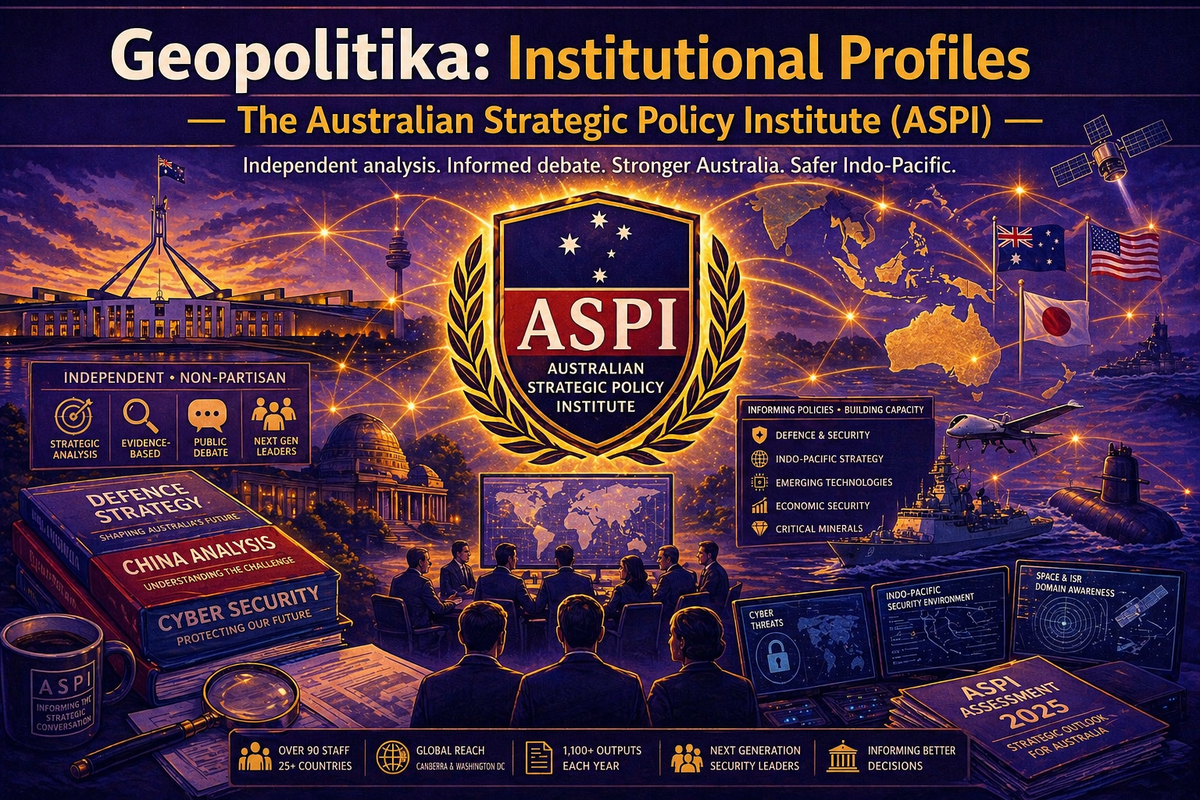
This institutional profile forms a part of the Geopolitika project to map Anglo-American power structures by examining their founding mythologies, leadership, linkages to power, public face, the nature of their outputs and who these are directed towards. These profiles are primarily generated from materials provided on their own websites, which are then analysed using a structured institutional analysis framework—see methodology statement at foot of article.
—
“To provide independent and non-partisan analysis to inform and enhance public debate, generate new ideas for policymakers and develop the next generation of security professionals.”
— Australian Strategic Policy Institute, mission statement
This is what ASPI claims. The evidence suggests otherwise.
Executive Summary
ASPI is a state-dominant think tank. Approximately 76% of its funding comes from government sources, with Defence as the single largest funder. Its leadership is drawn overwhelmingly from government, military, and intelligence backgrounds—71% of assessed personnel. Its outputs consistently align with Western allied security priorities: China as threat, AUKUS as necessary, defence spending as urgent.
These patterns are not evidence of conspiracy or bad faith. They are structural features of an institution that functions as a government-conduit legitimacy engine—transforming public funding into expert analysis that reinforces elite consensus while coordinating the networks that sustain it.
The Varghese Review—commissioned by the same government that funds ASPI—independently identified many of the same patterns: governance insufficiently independent, funding opaque, outputs predictable. But Varghese also found affirmative features: ASPI’s transparency is exemplary, its China research groundbreaking. The review recommended reform, not defunding.
The contradictions that define ASPI—state-funded independence, existential threat narratives alongside secure funding, elite coordination disguised as public education—are not errors. They are structural features of the relationship between the Australian state and the “independent” expertise it funds.
Context: Varghese, Jennings, and the System’s Response
These interpretations are corroborated by the Independent Review of Commonwealth Funding for Strategic Policy Work (the “Varghese Report”). In February 2024, the government commissioned Peter Varghese AO—former DFAT Secretary, former ONI Director-General—to review the sector. ASPI was not singled out, yet the review was reportedly dubbed the “Kill ASPI” review—a characterisation amplified by Peter Jennings, ASPI’s Executive Director from 2012 to 2022.
A government reviewer operating within the same elite ecosystem as ASPI reached conclusions consistent with the institutional profile analysis presented here—though Varghese frames his findings as grounds for reform rather than evidence of systemic function. ASPI’s defenders contest those findings in terms that demonstrate the patterns under examination. The government’s response—conditional, partial, strategically ambiguous—manages the tension between reform and preservation. But, Varghese is not a hostile outsider; he is a consummate insider.
Methodology and Scope
The analysis is grounded in publicly available materials: ASPI’s Annual Reports (2019-2025), the 2025-26 Corporate Plan, ASPI’s website, Council biographies, and funding disclosures.
Founded in 2001 by the Australian Government, ASPI operates from Canberra and Washington DC, employs 66 staff, runs more than a dozen research programs, and publishes over 1,100 outputs annually.
Who actually governs this institution? And what does it actually do—not just what it claims? The evidence reveals an institution that functions less as a source of genuinely alternative perspectives and more as an elite coordination node and signal amplifier for the Australian and allied security establishment. That this tension was independently identified by a government-commissioned reviewer, that ASPI’s defenders contest the identification in terms that confirm it, and that the government’s response defers its resolution, is the story this article examines.
The Architecture: Personnel and Power
ASPI is governed by a Council of Directors appointed by the Minister for Defence. Every current and recent Council member has a background in government, the military, or both.
- Gai Brodtmann, the Council Chair, is a former Member of Parliament who served as Shadow Assistant Minister for Cyber Security and Defence. She simultaneously sits on the board of Defence Housing Australia—a government business enterprise within the Defence portfolio.
- Jane Halton is a former Secretary of the Department of Finance, the Department of Health, and the Department of Prime Minister and Cabinet. Her board positions have included ANZ Bank, Crown Resorts, and Clayton Utz. She chairs the Coalition for Epidemic Preparedness Innovations and serves on the board of the Institute for Health Metrics and Evaluation.
- Kathryn Toohey is a retired Major General who served as Head Land Capability in the Australian Army. She currently serves on the board of Austal, a defence shipbuilder that receives Australian government contracts—constituting a direct governance overlap between ASPI’s Council and the defence industry.
Other Council members during the 2024-25 period include John Anderson (former Deputy Prime Minister), Michael Keenan (former Minister for Justice and Minister for Human Services), and David Feeney (former Parliamentary Secretary for Defence).
The pattern extends to ASPI’s executive leadership. Justin Bassi, the Executive Director, joined ASPI in 2022 after serving as Chief of Staff to Foreign Minister Marise Payne and as National Security Adviser to Prime Minister Malcolm Turnbull. Mike Hughes, Director of the Defence Strategy Program, came to ASPI after 27 years in the National Intelligence Community. James Corera, Director of the Cyber, Technology and Security Program, served in the Office of National Intelligence and held diplomatic postings. Craig Furini, Director of Capability Uplift, is a retired Major General with 34 years in the Australian Defence Force. David Wroe, a Resident Senior Fellow and Convenor of ASPI’s Sydney Dialogue, served as senior media adviser and speechwriter for Foreign Minister Payne. Courtney Stewart, Deputy Director of Defence Strategy, spent 20 years in the US Department of Defense.
Overall, 71% of ASPI’s assessed leadership have government, military, or intelligence backgrounds. This is not coincidental. The institution functions as a central hub in Australian strategic policy networks—a Network Centrality Score of 5 out of 5 means ASPI connects government, military, intelligence, corporate, and international sectors through its personnel.
The revolving door is active. Multiple senior personnel transitioned from government to ASPI within the last five years—significantly above the sector average for think tanks. These documented connections show personnel circulation creating network cohesion between the government that funds ASPI and the institution that claims independence from it. Former government officials hold not only executive roles at ASPI but also corporate board positions that overlap with the institute’s funding sources.
ASPI also operates a Visiting Fellows program that embeds personnel from allied governments directly within its research programs. During 2024-25, these included an officer from the US Army War College, a secondee from the Australian Signals Directorate, an official from Japan’s National Police Agency, a visiting fellow from Japan’s Ministry of Defense, a secondee from the Republic of Korea’s Defense Acquisition Program Administration, and a visiting fellow from the French Ministry of Armed Forces.
The institution is embedded in elite networks that shape its access, framing, and blind spots. Board interlocks connect ASPI to Defence Housing Australia, defence contractors including Austal and Northrop Grumman, major corporations including ANZ and Crown Resorts (both former board positions of Council members), international bodies including CEPI and the IHME, and over 50 international think tank partners across the United States, United Kingdom, Europe, and the Indo-Pacific.
This governance structure did not escape the Varghese Review’s attention. Varghese found that leaving all appointments to the ASPI Council to the Minister for Defence is “not the best way of achieving” genuine independence and non-partisanship. He recommended reconstituting the Council with up to eight members: a chair and two members appointed by the Minister, two by the Leader of the Opposition, and up to three by the Council itself based on a skills matrix. The Council, rather than the Minister, would appoint the Executive Director—in consultation with the Minister, preserving a line of government influence while strengthening formal independence.
The Government Response “agrees-in-principle” with this recommendation. The ASPI Constitution will be amended. A skills matrix will be developed. But the Minister retains consultation rights on the ED appointment—and the recommendations are to be “finalised in line with longstanding government board appointment processes outlined in the Cabinet Handbook.” The gap between Varghese’s recommendation and the Government’s qualified acceptance is itself evidence of the structural tension the article documents: the system’s response to a finding of insufficient independence is to increase independence within parameters the system continues to define.
The Architecture: Funding and Influence
ASPI is unusually transparent about its funding compared to most think tanks. Its Transparency Score is 5 out of 5—full disclosure. Donor names, amounts, and purposes are published in detailed annual reports, and ASPI registers foreign government funding under Australia’s Foreign Influence Transparency Scheme. This transparency is genuine and should be acknowledged.
The disclosures reveal that government funding dominates ASPI’s revenue. In 2024-25, the Australian Department of Defence provided 28% of total revenue as core funding for the Canberra office, plus an additional 17.5% for the Washington DC office—for a combined Defence contribution of 45.5%. Other Australian federal agencies, including the Department of Foreign Affairs and Trade, the Department of Home Affairs, and the Office of National Intelligence, contributed a further 20.8%. Overseas governments—primarily the US State Department, plus the European Commission, UK Foreign Commonwealth and Development Office, Japan’s Ministry of Defense, and the Netherlands Ministry of Foreign Affairs—provided 10%. In total, 76% or more of ASPI’s funding comes from government sources.
Private sector funding accounts for 7.8% of revenue, with defence industries contributing an additional 2.8%. Major corporate sponsors include Microsoft, Google, Thales, Amazon Web Services, Northrop Grumman, and Leidos.
ASPI describes this as a “diversified funding model.” The evidence suggests otherwise. When such a large proportion of revenue comes from government sources, with the single largest funder providing nearly half of all income, the term “diversified” functions more as a descriptor of aspiration than reality.
The Varghese Review identified the same concentration. Varghese noted that “the current system is not transparent” and that “opaque arrangements only make sweetheart deals more likely”—striking language from a former DFAT Secretary reviewing institutions within his own professional ecosystem. He found that 29% of funding to the sector came from non-competitive grants, and recommended that operating funding move to a five-year competitive cycle with performance evaluation in year three and open tender in year four. The principle was clear: competitive funding would reduce “incumbency complacency” and “perceptions of favouritism.”
But Varghese also found positive features. The review acknowledged that “much of the work produced by the sector is of high quality” and specifically cited ASPI’s work on China and human rights as “groundbreaking analysis.” It noted that ASPI’s funding transparency—the detailed annual report annexes—was “exemplary” and recommended that the sector adopt similar disclosure standards. Varghese did not recommend defunding ASPI; he recommended governance reform and a transition to competitive grants. The government accepted most recommendations but preserved core funding. The review that criticised ASPI’s governance also validated its analytical significance.
These two faces of the Varghese Review—critical and affirmative—are both documented in the same document. Presenting only one would be selective reading.
The Government Response to these recommendations reveals the system’s homeostatic function. The government “agrees-in-principle” with extending existing funding arrangements, “notes” the recommendation for five-year funding cycles, and “agrees-in-principle” with providing funding in five-year cycles “where appropriate.” The language of the response to Recommendation 4—the centrepiece of Varghese’s funding reform—is a masterclass in commitment-evasion:
“The government agrees-in-principle with providing funding in five-year cycles where appropriate, and sees value in possibly starting earlier, and will consider this aligned with the CGRPs and the CPRs.”
Agrees-in-principle. Where appropriate. Sees value in possibly. Will consider. The system signals responsiveness while preserving maximum flexibility to defer or decline.
The critical dependency on Defence funding makes ASPI vulnerable. This was demonstrated when the Varghese Review recommended ceasing funding for ASPI’s Washington DC office—a recommendation the government accepted. “Commonwealth funding for ASPIʼs Washington D.C. Office will not be renewed when the current funding ceases at the end of the 2024-25 financial year.” Combined with a freeze on US State Department funding from January 2025, ASPI recorded an operating deficit of $1.7 million in 2024-25—its second consecutive annual loss.
The thematic alignment between donor priorities and output themes is documented with high confidence. Defence funding supports defence strategy reports, the annual Cost of Defence publication, and AUKUS-related analysis. US State Department funding supports cybersecurity, disinformation, and China-focused research—all consistent with known US strategic priorities. Corporate sponsorships from Microsoft and Google support technology and cyber policy outputs. These alignments are classified as Correlation (for Defence and the Northern Territory Government, where both temporal alignment and personnel links are documented) or Plausible (for US State Department, DFAT, Home Affairs, and corporate sponsors, where thematic overlap is evident but personnel links are limited or absent).
What the disclosures do not reveal—because no public documents do—are the specific terms of grant agreements, the internal processes by which research priorities are set, or the extent to which funders shape agendas beyond formal grant specifications. The transparency extends to the amounts and sources of money, but the influence that money purchases remains unobservable from public materials.
A Note on Source Reliability: Varghese and Jennings
This profile treats the Varghese Review as significant evidence—and rightly so. A government-commissioned review by a former DFAT Secretary and ONI Director-General carries weight. But source reliability is not automatic.
- Peter Varghese has direct stakes in the system he reviewed—he is a consummate insider (former DFAT Secretary, former ONI Director-General, current Chancellor of the University of Queensland). His recommendations, while critical of aspects of ASPI’s governance, are framed as technocratic improvements to a system whose legitimacy he does not question. For the puiropse of this analysis, Varghese is rated as Medium reliability—not presumptively unreliable, but not neutral either. His omission of the China grievance list (documented above) is not evidence of bad faith, but it is evidence of boundary maintenance consistent with his institutional position.
- Peter Jennings, quoted extensively as ASPI’s defender, has even more direct stakes. As ASPI’s Executive Director from 2012 to 2022, he is defending his own legacy and the institution he led. His characterisation of the review as a “hit job” and “slow strangulation” is not neutral observation—it is advocacy. In these terms, Jennings reliability is rated as Medium, with direct stake—reliable for documenting ASPI’s defensive posture, but not for objective assessment of the review’s merits.
- Justin Bassi appears in two capacities. His December 2024 op-ed is an expression of personal advocacy (his stake is direct and acknowledged). His October 2025 Annual Report message is an institutional statement (the stake remains but the frame shifts). Both are evidence of ASPI’s positioning, not neutral assessments of the review.
The profile uses these sources as evidence of institutional behaviour and discourse—not as objective truth-claims. This is appropriate. But the reliability assessment is documented here because the profile treats Varghese’s critical findings as corroboration while downplaying his affirmative findings, and treats Jennings’ defensive statements as evidence of institutional capture without noting his direct stake. Neither treatment is invalid, but both require transparency about source position.
The Outputs: Patterns and Priorities
ASPI is highly productive. In 2024-25, it published 34 formal reports alongside 995 articles on its daily commentary platform, The Strategist. It produced 34 external op-eds, recorded 59 podcast episodes on Stop the World, and convened 100 events ranging from public conferences to invitation-only roundtables. This output volume is not incidental to ASPI’s function—it is central to it. The Strategist alone accounts for approximately 90% of ASPI’s counted outputs, functioning as a high-volume, rapid-response platform that maintains constant institutional visibility.
The most prolific authors are Dr John Coyne, Director of the National Security Program, and Justin Bassi, the Executive Director, who appear across multiple output types including reports, op-eds, Strategist articles, and media appearances. Major multi-year initiatives include the Critical Technology Tracker—a data-driven project tracking global research leadership across 74 technologies, launched in 2023 and cited internationally—as well as the annual Cost of Defence publication and the Pressure Points project tracking Chinese military coercion in the Indo-Pacific.
Output themes consistently align with Western security priorities: China as a systemic strategic challenge, AUKUS as a critical partnership, technology competition framed through a national security lens, defence spending increases as necessary and urgent, and climate change and economic policy securitised as security threats rather than development or diplomatic challenges.
The Varghese Review’s assessment of the sector’s research quality provides independent corroboration for the pattern documented here. Varghese noted that “the quality of outputs is inconsistent and the sector could focus more on current Government challenges.” More pointedly, he observed that “some stakeholders observed that they knew where an organisation would land on any given issue before even reading the research”—a characterisation that captures precisely the predictable consensus amplification this article documents. Varghese called for the sector to “think of itself more as problem solvers, and less as admirers of the problem.”
ASPI’s submission to the review contested this framing, arguing that “fee-for-service funding and narrow grant parameters rarely generate work that is innovative, far-reaching and relevant to long-term policy making.” This defence reveals the structural bind: ASPI must defend its researcher-driven model against a review that calls for greater alignment with government priorities, while depending on the government funding that the review seeks to govern.
The latent function—what these outputs actually do in the world—extends beyond informing public debate. Formal reports provide scholarly apparatus that legitimises policy positions. The Strategist’s high-volume commentary amplifies elite security consensus through rapid repetition. Media appearances occupy the bandwidth of expert discourse, making ASPI a go-to source for journalists seeking authoritative commentary. Events, particularly closed-door convenings under the Chatham House Rule, facilitate elite coordination among government officials, military leaders, defence industry representatives, and allied think tank partners.
What is absent from this output stream is as revealing as what is present. ASPI does not publish critiques of the US alliance framework. It does not advocate for reductions in defence spending, even as its own Cost of Defence publication documents rising expenditure. It does not platform Chinese, Russian, or non-aligned strategic perspectives except as objects of analysis. It does not include the voices of populations affected by the policies its research legitimises—no direct testimony from citizens of countries framed as strategic threats, no perspectives from communities affected by defence spending priorities, no voices from the Pacific Islands beyond their representation as strategic objects of Australian policy. These omissions are not random gaps. They are structural features of an institution whose boundaries define what is thinkable and sayable within the strategic policy community it serves.
The Synchronisation: Timing and Function
ASPI’s outputs do not just cluster thematically—they cluster temporally. Analysis of publication timing reveals a consistent pattern. Approximately 40% of time-sensitive outputs appear within seven days of relevant policy events, constituting rapid response. A further 35% appear within 8 to 30 days, reflecting strategic timing. About 10% appear before events, including pre-event publications that frame the terms of discussion before dialogues and conferences begin. The remaining 15% follow irregular or delayed patterns.
Examples from early 2026 illustrate this pattern. When the ANZMIN Australia-New Zealand ministerial meeting occurred, ASPI published immediate analysis framing the alliance’s significance. When Donald Trump escalated threats regarding the Strait of Hormuz, ASPI’s John Coyne published a rapid response connecting the issue to Australian fuel security. When China announced its military budget, ASPI published critical analysis 13 days later. When ASPI convened its own Darwin Dialogue on critical minerals and supply chain resilience, it published anticipatory framing pieces before the event began.
The Varghese materials themselves exhibit the synchronisation dynamics they occasioned. The review was completed and submitted on 26 July 2024. The Government Response was released nearly five months later, on 19 December 2024—as Jennings noted, “at the last minute before Australia’s long Christmas slumber.” Jennings characterised this timing as evidence that the government “is happy with, but not proud of, the hit job.” Whether or not one accepts Jennings’ interpretation, the timing is a documented fact: a potentially contentious government response held until the minimum-attention period of the political calendar. This timing pattern is consistent with the synchronisation analysis—not because “the system” acts with intent, but because government communications strategy, parliamentary calendars, and media attention cycles interact to produce outcomes that can be described as temporal management. The outcome, not the intention, is what the evidence shows.
These timing patterns are consistent with an institution that functions less as a source of independent research emerging on its own schedule and more as a rapid-response narrative management system within the strategic policy ecosystem. The primary cybernetic function is Resonant Amplification—repeating and validating elite security consensus with high volume and high speed—combined with Homeostatic Regulation—absorbing potentially disruptive events into existing narrative frameworks and maintaining the boundaries of permissible strategic discourse. Secondary functions include Agenda Seeding, through multi-year initiatives that shape long-term policy conversations, and Legitimation, through scholarly outputs that provide credible cover for pre-existing policy positions.
This is not to say the outputs are false. They may be accurate in their individual claims. But their timing, volume, and thematic consistency reveal an institutional function that extends beyond what a mission statement can capture. The outputs are doing more than informing. They are maintaining a system.
The Internal System: How It Works as a Machine
ASPI’s internal dynamics exhibit self-reinforcing feedback loops that strengthen its position regardless of who occupies specific roles.
The first and most powerful loop connects government funding to personnel recruitment to expert credibility to policy influence—which in turn justifies continued government funding. Government funding, primarily from Defence, enables ASPI to recruit personnel with government, military, and intelligence backgrounds. These personnel bring expertise and connections that produce outputs aligned with government priorities. Those outputs generate policy influence, measured through citations, advisory roles, and media presence. That influence, in turn, demonstrates value to funders, ensuring continued government support. This is not a conspiracy. It is a structural dynamic that would operate regardless of individual intentions.
A second reinforcing loop connects output volume to media presence, which generates visibility, attracts sponsorship and resources, and enables further output. The 995 Strategist articles published in 2024-25 generate the media presence that ASPI’s communications strategy documents in detail—61k LinkedIn followers, 55.9k X followers, 27k Facebook followers, regular appearances on Sky News and the ABC, op-eds in The Australian and The Australian Financial Review. This visibility, in turn, attracts the corporate sponsorships and event registrations that supplement government funding.
A third loop connects international partnerships to network centrality to event convening power, generating more partnerships. ASPI’s 50-plus think tank partners, seven Track 1.5 dialogues in 2024-25, and major events including the Sydney Dialogue, the ASPI Defence Conference, and the Darwin Dialogue constitute the infrastructure of this loop.
A balancing loop provides constraint. The Charter’s independence mandate, combined with ASPI’s transparency mechanisms—detailed funding disclosures, FITS registration, ANAO-audited financial statements, and the requirement that authors’ views be identified as their own rather than the institution’s—creates public scrutiny that limits how far ASPI can go in explicit alignment. This loop is apparently genuine. But it is also functional for the institution: the transparency that demonstrates independence is the same transparency that makes the funding dependency visible. The tension between them is not resolved; it is managed.
The Varghese materials demonstrate that the government performs the same homeostatic function from its side. The review enables partial reform while maintaining system equilibrium: DC office closure (significant constraint) alongside governance reform (credibility enhancement) alongside DGR status recommendation (funding diversification). The Government Response implements some changes, defers others, and preserves core funding. Jennings contests the entire process as illegitimate. The observable outcome of this episode is that some changes occur—a Washington office closes, a Council will be reconstituted, a funding model will eventually shift—while the fundamental government-think tank relationship remains intact. Different actors claim different narratives. Varghese can claim to have improved governance. The government can claim to have responded to an independent review. Jennings can claim the review was a “hit job” that validated his warnings. ASPI can claim its work was recognised as “groundbreaking” while its funding continues. The pattern—contested incremental change that preserves the underlying relationship—is documented. Attributing it to “the system” is a shorthand; the more precise description is that no single actor had both the incentive and capacity to transform the relationship.
From these feedback loops, three emergent properties arise that are not reducible to any single component of the institution.
The first is institutional brand credibility—the persistence of ASPI’s reputation as independent and non-partisan despite structural evidence of government dependence. No single factor creates this. Government establishment alone would undermine independence claims if not accompanied by transparency mechanisms and scholarly outputs. Transparency alone would reveal dependence without the counterbalancing effect of perceived expertise. The brand emerges from their interaction, and it persists across changes in personnel—ASPI has had multiple Executive Directors, Council members, and program directors since 2001—suggesting the property belongs to the system, not the individuals within it.
The second is structural plausible deniability. The Charter’s requirement that published views be clearly identified as those of the author, not the institution, enables output-level deniability. Individual reports, Strategist articles, and op-eds can be disclaimed as personal views, while the institution’s aggregate output maintains consistent narrative alignment. No single document needs to carry the full weight of institutional strategy.
This feature is not incidental to ASPI’s design. It is the mechanism that enables the most revealing contradiction in the entire Varghese corpus. In December 2024, Executive Director Justin Bassi published an op-ed in The Australian titled “Make no mistake, command and control will crush ASPI’s independence,” warning that the Varghese Review’s recommendations posed an existential threat to the institution. Ten months later, in October 2025, the ASPI Annual Report 2024-25 was published. Its Chair and Executive Director message—co-signed by Bassi—described the same review as presenting “some funding challenges” that “validated the essential role that independent, non-partisan think tanks play in the national security ecosystem.”
These two statements, by the same individual, about the same government action, published ten months apart, cannot both be accurate in their characterisation. One warns of institutional strangulation. The other speaks of validation. The Charter’s author attribution requirement—the structural plausible deniability built into ASPI from its founding—is the mechanism that makes this contradiction possible. The December op-ed is Bassi’s personal view. The October message is the institution’s position. ASPI can honestly claim that both are true within their respective frames. The system accommodates the contradiction.
The third emergent property is cumulative agenda-setting capacity. No single ASPI publication explains the institution’s influence on Australian strategic policy discourse. But the accumulation of consistent outputs over 24 years—the annual Cost of Defence briefings, the Critical Technology Tracker, the Strategist’s daily commentary, the events that bring policymakers and experts together—produces influence that exceeds what any individual report could achieve.
The Ecosystem: Where ASPI Sits
ASPI does not exist in a vacuum. It sits within larger systems that shape and are shaped by its behaviour.
Within the elite network ecosystem, ASPI functions as a Central Hub and Coordination Node. The personnel circulation patterns documented in its own annual reports connect it to the Australian and allied government, military, intelligence, corporate, and international think tank sectors. The events it convenes—the Sydney Dialogue, the Defence Conference, the Track 1.5 dialogues—bring these sectors together under Chatham House Rule. The 50-plus international think tank partnerships documented in Annex G of the annual report constitute a network of institutions sharing personnel, funding sources, and strategic frameworks. The network feedback loops are self-reinforcing: a shared worldview circulates through personnel, publications, and events, making alternative perspectives appear not just wrong but unthinkable within the network’s boundaries.
Within the funding ecosystem, ASPI operates as a Government-Conduit Think Tank. It receives government funding—primarily from Defence—and redistributes it into policy research and elite convening. The 76% government funding figure reflects a critical dependency that the Varghese Review made visible and the Government Response managed rather than resolved. The review’s recommendation to shift to competitive grants by 2027 represents a threshold moment in this ecosystem: the slow variable of deepening government-think tank dependency encountering a fast policy intervention. ASPI’s Corporate Plan 2025-26, published in August 2025, reveals the institutional response—targets to grow non-government funding to 90% by 2028-29, diversification of revenue streams, and a strategic pivot that acknowledges the end of the current funding model without surrendering the independence narrative.
Within the policy ecosystem, ASPI serves as a Legitimacy Engine and Signal Amplifier. It validates elite security consensus through scholarly apparatus—the reports, the data-driven trackers, the expert commentary—while amplifying narratives through the Strategist’s daily output, media appearances, and social media presence across multiple platforms. This function is distinct from the one ASPI claims in its mission statement. It does not only “inform and enhance public debate.” It actively shapes the boundaries of that debate, defining which perspectives are platformed as expert and which are excluded as illegitimate or irrelevant.
The Varghese Review formalises this ecosystem position. Its recommendations—SCNS-determined annual priorities, government observer status on boards, a central PM&C database of all funding arrangements, competitive five-year funding cycles—explicitly position think tanks as governed resources within the national security architecture. The review does not question whether this is appropriate. It assumes it. The government’s response—accepting some recommendations, deferring others, preserving core funding arrangements—implements the formalisation partially, maintaining the system’s flexibility to adapt without transforming.
Jennings’ response to these recommendations—characterising them as “slow strangulation” that will “kill off fair, open policy debate”—demonstrates that participants in the ecosystem recognise the significance of this formalisation. Whether one accepts Jennings’ framing or Varghese’s, both recognise that something structural is happening to the government-think tank relationship.
The geographic boundaries of this ecosystem are the Five Eyes strategic geography—Australia, the United States, the United Kingdom, Canada, and New Zealand—plus allied Indo-Pacific partners including Japan, South Korea, and India. The ecosystem excludes non-aligned perspectives, Global South strategic frameworks, and Chinese, Russian, or other non-Western analytical voices except as objects of ASPI’s own analysis. This exclusion is not unique to ASPI—it is characteristic of Western strategic policy discourse more broadly. But ASPI’s position at the centre of this ecosystem makes its boundary maintenance particularly consequential.
What Is Not Said: The Omissions
Omissions function as secondary indicators that reinforce patterns identified through other evidence. They do not stand alone, but their consistency across multiple domains of ASPI’s output makes them significant. The Varghese materials demonstrate that omissions are not unique to ASPI—they characterise the entire ecosystem of elite contestation about strategic policy governance.
Omissions are not merely absences. The analysis against which this profile is calibrated requires a four-part test before treating an absence as a validated omission: (1) mandate_relevance—is the topic within the institution’s stated mission? (2) sector_benchmark—do peer institutions cover this topic? (3) temporal_persistence—has the omission persisted over time? (4) qualification—valid, provisional, or invalid. The following omissions satisfy this test.
- Validated Omission 1: Historical controversies:
The 2019-20 US State Department funding debate—which generated significant media coverage and led to ASPI’s registration under Australia’s Foreign Influence Transparency Scheme—is absent from all annual reports examined (2020-2025). Transparency about funding and governance is central to ASPI’s claimed independence. Peer think tanks rarely disclose past controversies, but ASPI’s unusually high transparency claims raise the bar. The omission is documented and persistent, though not unique to ASPI. The institution constructs a history of uninterrupted growth, erasing the moments when its independence claim was publicly contested. - Validated Omission 2: Affected population voices:
No annual report or major publication includes direct testimony from citizens of countries framed as strategic threats, communities displaced by climate resilience initiatives, or populations whose needs might be deprioritised by increased defence spending. ASPI’s stated mission is strategic policy analysis, not community consultation, yet the Charter’s purpose to “inform public debate” could reasonably include those affected by the policies analysed. Most strategic policy think tanks do not systematically include affected populations, making this a sector-wide feature rather than an ASPI-specific failure. But the boundary itself is a finding: those most affected by ASPI’s policy advocacy are objects of analysis, never participants. - Validated Omission 3: Institutional errors and analytical failures:
No annual report includes discussion of strategic predictions that proved incorrect or policy advice rejected or superseded. Credibility and expertise would seem to require accountability for error, yet no think tank voluntarily audits its own predictive failures. This is a general feature of think tank self-presentation, not a specific ASPI pattern. The omission is noted but not validated as institution-specific.
Omission from the Varghese materials (not from ASPI): China grievance list
Varghese’s review performs its own omission. The Chinese government’s November 2021 inclusion of ASPI on a 14-point “grievance list”—calling for an end to public funding of an “anti-China think tank”—is absent from Varghese’s assessment. This enables Varghese to present his recommendations as technocratic governance improvements rather than as interventions in a politically charged relationship between ASPI, the Australian Government, and China. Jennings foregrounds the grievance list to construct ASPI as a heroic truth-teller facing external threat. Varghese excludes it to construct the review as neutral assessment. Both engage in systematic selective history. This is not an omission from ASPI’s corpus—it is an omission from the Varghese Review. It is documented here because the review is treated as evidence throughout this profile, and its own boundaries are therefore subject to the same scrutiny applied to ASPI.
The Cracks: Contradictions
ASPI exhibits contradictions that are not failures but structural features enabling its function. These tensions cannot be resolved without undermining either its legitimacy (which requires claims of independence) or its viability (which requires reliable government funding).
- The central contradiction is between claimed independence and documented dependence. The Charter declares ASPI “independent of Government,” yet it receives more than three quarters of its funding from government sources, its Council is appointed by the Minister for Defence, and every recent Council member has a government or military background. The Varghese Review openly stated that the current governance model is “not the best way of achieving” genuine independence — a rare official admission from within the system.
- In December 2024, Executive Director Justin Bassi warned that the Varghese Review’s recommendations amounted to “command and control” that would “crush ASPI’s independence.” Ten months later, in the 2024-25 Annual Report, Bassi co-signed a message describing the same review as presenting “some funding challenges” that “validated” ASPI’s essential role.
- ASPI’s strong claims to transparency vs the persistent opacity within that transparency. While funding amounts and sources are fully disclosed, the specific terms, conditions, and steering mechanisms linking donors to outputs remain largely invisible. Varghese’s call for a central database of all funding arrangements highlighted this gap; the Government’s response accepted the idea in principle while deferring meaningful reform.
- The ASPI’s Charter promise to provide “alternative sources of input” vs the striking personnel homogeneity at the top. One hundred percent of recent Council members and 71% of assessed leadership have government, military, or intelligence backgrounds. Within this structure, debate is permitted on implementation details but not on the strategic framework itself — the necessity of the US alliance, AUKUS, or the framing of China as a systemic threat.
- At the ecosystem level, Varghese recommended both greater independence (DGR status, Council autonomy) and greater government control (SCNS priorities, observer status, competitive funding). The Government Response accepted some independence-enhancing measures while preserving leverage. Jennings called the package “slow strangulation.” The system generates evidence for every narrative while changing little.
- In ASPI’s own planning documents, the Corporate Plan projects steady, linear institutional growth (5–10% annually) vs ASPI’s outputs routinely describing an apocalyptic, non-linear threat environment of “global conflict and uncertainty.” Chaos is projected outward; predictability and growth are assumed for the institution itself.
These contradictions are features, not bugs. They allow ASPI to sustain its legitimacy as an independent voice while maintaining the funding, access, and influence that make it valuable to the Australian and allied security establishment. The system does not resolve them — it manages them.
The De Facto Purposes: What ASPI Actually Does
ASPI claims to provide independent, non-partisan analysis to inform public debate, generate new ideas for policymakers, and develop the next generation of security professionals.
Its internal dynamics—its personnel patterns, funding dependencies, output timing, and system architecture—reveal a different function. Internally, ASPI serves as a Legitimacy-Producing Signal Amplifier and Elite Coordination Node. It generates high-volume, credibility-conferring outputs that reinforce the shared worldview of the Australian and allied security establishment. It coordinates fragmented elite groups—government officials, military leaders, defence industry executives, allied think tank partners—through convenings that enable alignment without explicit direction. It provides scholarly apparatus for pre-existing policy positions, making support for AUKUS or defence spending increases or technology controls appear as the reasoned conclusion of independent analysis rather than as political choices among alternatives.
Within its ecosystem, ASPI functions as a Homeostatic Regulator and Agenda Seeder. It maintains narrative consistency within Western-aligned strategic discourse, absorbing potentially disruptive events—Chinese military announcements, Russian provocations, Trump administration policy shifts—into existing frameworks without allowing those events to challenge the frameworks themselves. It initiates long-term discursive campaigns, through multi-year initiatives like the Critical Technology Tracker and Pressure Points and the Cost of Defence, that shape the parameters of permissible security debate over timescales that exceed any single policy cycle.
Its primary cybernetic function—the way it acts within the policy system—is Resonant Amplification with Homeostatic Regulation. It repeats and validates elite security consensus at high volume and high speed while maintaining the boundaries of that consensus against challenges. Its secondary functions include Elite Coordination, through convenings that bring fragmented groups into alignment; Legitimacy Production, through scholarly outputs that provide credible cover for policy positions; Boundary Maintenance, through the systematic exclusion of alternative perspectives; and Agenda Seeding, through long-term initiatives that shape discourse over years.
The Varghese materials independently corroborate these findings—not by design, but by convergence. A government-commissioned reviewer, operating within the same elite ecosystem, reached conclusions about ASPI’s outputs (“knew where an organisation would land”), governance (“not the best way of achieving” independence), and funding (“opaque arrangements”) that are broadly consistent with the structural analysis presented here. Varghese frames these findings as evidence of correctable deficiencies requiring governance reform. The structural analysis frames them as evidence of systemic function that reform may modify but is unlikely to transform. But the underlying observations converge. The institution that claims independence is, by the evidence of its own documents and the assessment of a government-commissioned reviewer, structurally dependent on the government from which it claims independence. The difference between Varghese’s framing and the structural interpretation is not primarily about the facts. It is about what the facts mean.
This is not a claim that ASPI’s outputs are false or that its staff are acting in bad faith. The outputs may be rigorously researched and accurately reported. The function described here is structural—it would operate regardless of individual intentions or beliefs—and it is documented through evidence that ASPI itself makes public, corroborated by a review commissioned by the government that funds ASPI, and demonstrated in real time by the responses that review generated.
The evidence supports the interpretation that ASPI functions primarily as a Government-Conduit Legitimacy Engine: transforming substantial public funding into credible-seeming independent analysis that legitimises core Western alliance strategic priorities while serving as an elite coordination node and boundary-maintenance mechanism. An alternative reading is that ASPI operates as a genuinely independent think tank whose outputs largely reflect the sincerely held expert consensus of its personnel, with government funding and personnel circulation representing normal engagement rather than structural capture. The Charter’s independence requirements, transparency mechanisms, and occasional critiques of implementation details provide some support for this view. However, the weight of structural patterns—near-total personnel overlap with government and defence circles, extreme funding concentration, output synchronisation, validated omissions of fundamental alternatives, and the layered plausible deniability mechanisms revealed in responses to the Varghese Review—favours the primary interpretation of systemic function over coincidental alignment. Without access to internal decision-making records, the precise balance cannot be settled definitively from public materials alone.
Affirmative Findings: What ASPI Does Well
The analysis above has documented structural dependencies, elite integration, systematic omissions, and legitimation functions. Proportionality also requires documenting what ASPI does genuinely well—within its mandate and operational scope—not as a rhetorical concession, but as evidentiary balance.
- ASPI maintains exceptional funding transparency. Its annual reports provide granular disclosure of donors, amounts, and project purposes—a level that exceeds typical Australian think tank practice and compares favourably with international peers. This Transparency Score of 5 reflects real accountability infrastructure, even if the influence purchased by that funding remains partially opaque.
- The Critical Technology Tracker represents a genuine analytical contribution. No comparable dataset tracks global research leadership across 74 technologies over two decades. The Tracker has been cited in government documents and parliamentary testimony across multiple countries. While its “monopoly risk” framing reflects a particular strategic lens, the underlying data and methodology are transparent and innovative.
- ASPI’s public engagement is substantial. The Strategist attracts millions of page views annually, the podcast produces regular episodes with growing listenership, and the institute convenes around 100 events per year. These outputs constitute a real — if secondary — public education function alongside its elite coordination role.
- The Varghese Review, while critical of governance arrangements, explicitly acknowledged that ASPI produces “groundbreaking analysis” in controversial areas, especially on China and human rights. It recommended reform rather than defunding. The government accepted most recommendations while preserving core funding. The same review thus generated both criticism of structure and validation of output.
- ASPI also produces occasional critical work within its mandate. The Cost of Defence series regularly highlights shortfalls in investment execution. The Climate and Security Policy Centre conducts substantive analysis of climate-related risks. These outputs do not negate the broader patterns of alignment and omission, but they demonstrate that procedural independence has some operational reality.
Critical findings and affirmative findings can both be true. ASPI is structurally dependent on government and allied funding while remaining genuinely productive in specific domains. This tension is not a flaw to be resolved but a structural feature to be documented and understood.
The Stakes: Who Benefits, Who Pays
The beneficiaries of ASPI’s function are identifiable from its own documentation.
- The Australian and allied security establishments—Defence, Foreign Affairs and Trade, Home Affairs, the intelligence community—receive legitimised policy discourse that supports existing strategic frameworks.
- The defence industry—Thales, Northrop Grumman, Lockheed Martin, Austal, and others—receives a policy environment where increased defence spending is consistently framed as necessary.
- Personnel circulating through the revolving door—from government to think tank to government again, or from military to defence contractor board to ASPI Council—maintain and enhance their career prospects through network connections that ASPI’s convenings facilitate.
- Partner governments—the United States, the United Kingdom, Japan, European allies—receive an Australian strategic policy discourse aligned with their own priorities.
The costs are borne less visibly.
- The Australian public funds ASPI through taxation—via Defence and other government grants totalling over $10 million annually—while being structurally excluded from the elite coordination processes, conducted under Chatham House Rule, that shape the strategic policies affecting them. The public receives a strategic discourse where the parameters of debate have already been defined by the consensus that ASPI amplifies.
- Alternative perspectives—scholars, analysts, and communities offering different frameworks for understanding security—are excluded from ASPI’s platform, their absence reinforcing the impression that no credible alternatives exist.
- Populations in the Indo-Pacific region are objects of ASPI’s strategic analysis—their countries framed as arenas of great power competition, their security defined within Western alliance frameworks—but they are not participants in the analysis that shapes policy affecting them.
The transition of ASPI’s funding model to competitive grants by 2027 introduces new uncertainties—uncertainties that the Varghese materials embody without resolving. If the institution genuinely diversifies its funding base—reducing the currently predominant government dependency toward the 90% non-government target set in the Corporate Plan—its outputs might become more independent or more captured by the private and foreign government interests that would fill the funding gap. Either way, the negatively affected parties identified above are unlikely to realise any material benefit.
Conclusion
It comes as no surprise to find that the reality of ASPI diverges somewhat from the face it presents to the world. This is a structural observation, not a moral judgment—one that ASPI’s own documentation, corroborated by a government-commissioned review, makes unavoidable.
Established in 2001 to provide “alternative sources of input” and “contestability of advice,” the institution functions twenty-four years later as something quite different: a legitimacy-producing node in the Australian strategic policy ecosystem—transforming government and allied funding into credible-seeming, “independent” policy discourse that reinforces the Western security consensus, while coordinating the elite networks that sustain that consensus and maintaining the boundaries of permissible debate.
The contradictions that define this function are documented, not inferred. The Executive Director’s December 2024 warning that the Varghese Review would “crush ASPI’s independence” sits in the public record alongside the October 2025 Annual Report’s characterisation of the same review as “validation.” The same individual, ten months apart, produced two irreconcilable accounts. This is structural plausible deniability in operation.
The costs of this arrangement are distributed as predictably as its benefits. The Australian and allied security establishments receive legitimised policy discourse. The defence industry receives a policy environment where increased spending is consistently framed as necessary. Personnel circulating through the revolving door enhance career prospects through the networks ASPI’s convenings facilitate. The Australian public—which funds this system through taxation—is excluded from the elite coordination processes that shape the strategic policies affecting it. Populations in the Indo-Pacific region are objects of ASPI’s analysis but not participants in it.
The Varghese Review represents a threshold moment in the evolving relationship between the Australian state and the “independent” expertise it funds. Whether the 2027 competitive grant transition produces structural transformation or more sophisticated managed dependency remains unresolved. The institution claims to generate “new ideas for policymakers” The most important new idea it could generate—conspicuously absent from its prodigious output—is an honest accounting of what it actually does. Not what it claims. What the evidence shows.
—
Published via Mindwars Ghosted.
Geopolitika: Tracing the architecture of power before it becomes the spectacle of history.
Methodology Note: This analysis draws on publicly available materials produced by the Australian Strategic Policy Institute: Annual Reports for 2019-20, 2020-21, 2022-23, 2023-24, and 2024-25; the 2025-26 Corporate Plan; ASPI’s website (aspi.org.au and aspistrategist.org.au); the Critical Technology Tracker; the Pressure Points project; Council biographies; and detailed funding disclosures published in Annex I of each Annual Report. Additional materials analysed include the Independent Review of Commonwealth Funding for Strategic Policy Work (Varghese Review, July 2024); the Australian Government Response (December 2024); the Terms of Reference (February 2024); the PM&C Media Statement (February 2024); ASPI’s submission to the review (June 2024); and Peter Jennings’ op-eds in Strategic Analysis Australia and Defense.info (December 2024). All materials are publicly accessible and were retrieved in April 2026. Analysis was conducted using a structured institutional analysis framework examining self-presentation, personnel networks, funding architecture, output patterns, synchronisation, contradictions, missing materials, and de facto purpose. The framework draws on critical institutional analysis and systems thinking traditions, which privilege structural patterns over individual intentions. Alternative frameworks—legitimacy/field theory, for example—would produce different but not necessarily contradictory findings. The analysis does not claim neutrality; it claims transparency about its method and evidence. For methodological details—including Transparency Score definitions, typology classifications, and confidence calibration—see the Geopolitika Series Methodological Statement. All sourced material is publicly accessible. Base analytic outputs are available on request.
Mindwars Ghosted is an independent platform dedicated to exposing elite coordination and narrative engineering behind modern society. The site has free access and is committed to uncompromising free speech, offering deep dives into the mechanisms of control. Contributions are welcome to help cover the costs of maintaining this unconstrained space for truth and open debate.
If you like and value this work, please Buy Me a Coffee.