Geopolitika: Institutional Profiles – The CIA Part 1. Making an Opaque Institution Visible
How websites, Directors, official histories and public records make a deliberately opaque intelligence institution partly legible.
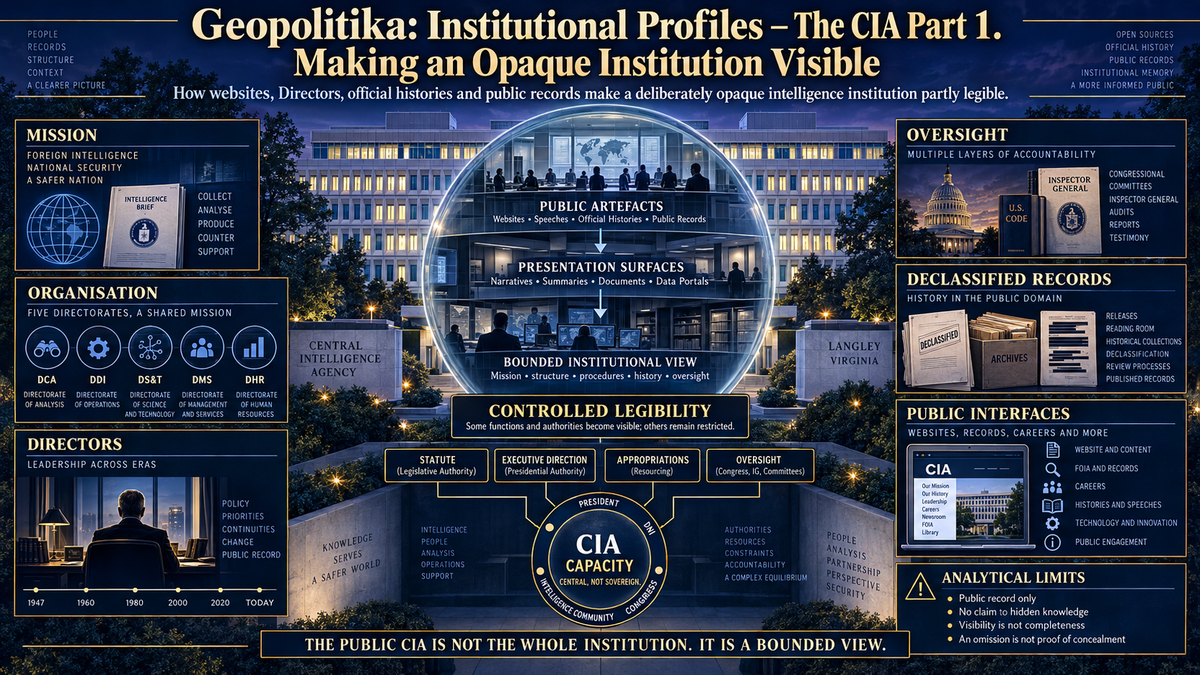
In writing an institutional profile, the CIA presents an unusual analytical problem because secrecy is part of how intelligence functions, yet the Agency cannot be wholly invisible. It must be tasked, funded, overseen, staffed and made visible through public records and interfaces. This article examines those public artefacts—CIA.gov, Directors, official histories, statutes, procedures and declassified records—not as a complete picture of the Agency, but as bounded views of it. Working only from material publicly available, this series presents an analysis of the public record rather than a claim to reveal hidden knowledge. As the first of three articles, Part 1 asks how the CIA becomes visible; Part 2 asks why different audiences encounter different versions of it; Part 3 asks what becomes knowable when clandestine activity later leaves a public trace.
Executive Summary
The Central Intelligence Agency cannot be seen whole from the public sphere. What outsiders encounter are partial surfaces: mission statements, organisational descriptions, legal procedures, congressional records, official histories, declassified documents and a very small number of named leaders. Each fragment is incomplete, but each constructs a view of the whole.
The CIA's Mission and Vision identifies a recurring institutional core: foreign-intelligence collection, analysis for senior decision-makers and covert action when directed by the President. Its Directorate of Analysis preserves an important boundary: CIA does not make foreign policy, even though its intelligence informs those who do.
Institutional continuity, however, is not the same as continuity of legal identity or authority. The statutory CIA dates from 1947, but its lineage passes through the wartime Office of Strategic Services, its dissolution, the Strategic Services Unit and the Central Intelligence Group. Functions, personnel and experience survived those transitions, but the institution did not simply continue unchanged.
The same distinction appears in the 2004–05 intelligence reforms. The former Director of Central Intelligence combined CIA leadership with wider Intelligence Community responsibilities and the role of principal presidential intelligence adviser. Those functions were redistributed: the Director of National Intelligence became the community-wide head and principal adviser, while the Director of CIA remained responsible for the Agency.
The office persisted; the authority bundle changed.
CIA.gov makes this bounded visibility especially clear. Its public leadership surface names only a few senior officials while the larger institution appears mainly through offices, directorates, Mission Centers and functions. Its Profiles in Leadership extends that presentation historically by organising institutional memory around successive Directors.
This article does not assume that public representations are complete, that omissions are deceptive, or that one central strategy determines what becomes visible. It uses controlled legibility to describe the narrower condition: an intelligence institution must make some functions, authorities and relationships visible while others remain restricted.
The public CIA is therefore neither the whole institution nor necessarily a false façade. It is a bounded institutional view.
The Problem of Seeing the CIA
Before asking what the CIA does, there is a more basic problem: what exactly are we looking at when we think we are looking at the CIA?
An intelligence service is unusually difficult to study because secrecy is part of how some of its functions work. Yet the Agency cannot be wholly invisible. It must recruit, receive appropriations, answer to oversight, interact with other institutions and release at least some information into the public sphere.
For most outsiders, the CIA therefore appears through fragments. Some come from the institution itself: mission statements, organisational charts, Directors, legal procedures, official histories and declassified records. Others come from outside it: congressional investigations, journalism, former employees, whistleblowers, memoirs, political argument and popular mythology. Together they produce competing images of the same opaque institution—heroic, sinister, bureaucratic, omnipotent, incompetent, patriotic, lawless or indispensable.
Those fragments do not carry the same evidentiary weight. A CIA publication can establish how the Agency presents itself but cannot independently verify that presentation. A former employee may have direct experience without seeing the institution whole. A whistleblower can expose something hidden without explaining every surrounding function. Investigations can reconstruct bounded episodes; journalism can connect records and testimony; propaganda and popular mythology can organise genuine facts into narratives that extend beyond what the evidence establishes.
The image is therefore kaleidoscopic: the fragments may remain the same while the apparent pattern changes with the angle from which they are assembled.
This trilogy focuses primarily on the artefacts and interfaces produced by, authorised by or institutionally surrounding the CIA. External accounts matter where they test, reconstruct or challenge those artefacts, but media representation and popular mythology are not the principal objects of analysis.
Three distinctions are central:
- The institution is the durable organisation of authority, personnel, systems and functions beneath its public representations.
- An artefact is a concrete output through which some part of that institution becomes observable.
- A presentation surface is the function that artefact performs for a particular audience—what it makes visible, what relationship it enables and what institutional role it helps explain or legitimate.
A mission page, for example, is an artefact. It is strong evidence of how CIA publicly defines its purpose, but not of whether every declared purpose is realised in practice. An organisational page establishes published structure. A legal procedure can establish allocated responsibility. A congressional or commission report may reconstruct conduct using evidence unavailable when the events occurred. A historical publication shows what the institution chooses to preserve and narrate.
None alone establishes the whole operational institution.
The CIA's public website makes this source problem unusually visible. Treated here as a single artefact, the corpus examined for this series contains 636 printed A4 pages spanning mission material, organisational descriptions, procedures, recruitment, history, oversight, public affairs and technical interfaces. It is therefore strong evidence for how CIA publicly describes and organises itself, but much weaker evidence for operational effects, audience reception or what remains classified.
A public artefact can be excellent evidence of how an institution makes itself legible without being complete evidence of what the institution does.
This trilogy uses the term controlled legibility for that condition: the selective production of visibility around an institution whose functions also depend on restricting visibility.
The term does not imply one centrally designed presentation strategy. Different forms of visibility arise from law, classification, operational security, recruitment, administration, oversight and historical release. Nor does absence from the public record prove either concealment or the existence of some hidden opposite. Classification, editorial selection, archival survival and the limits of the available corpus can all leave gaps.
What can be seen is therefore partial, but each fragment still contributes to a view of the whole.
The task is not to decide whether the public CIA is “real” or “false.” It is to ask what each artefact reveals, what function that visibility serves, and what remains outside its field of view.
Before examining how CIA presents itself, what exactly is the institution being presented?
What Is the CIA?
The obvious answer is that the Central Intelligence Agency was created in 1947. The more useful answer is that it emerged through a sequence of breaks, transfers and reconstructions in which some functions survived while the legal structures around them changed.
That matters because the wartime Office of Strategic Services did not simply become the postwar CIA.
On 20 September 1945, President Harry S. Truman issued Executive Order 9621, formally terminating the OSS and dividing its functions between the Departments of State and War. The order was explicit:
“the Office, including the office of the Director of Strategic Services, is terminated.”
That was a real institutional break, but not a clean disappearance. Personnel, records, expertise and selected intelligence functions moved into successor arrangements. The postwar lineage is therefore best understood as continuity through discontinuity.
Four months later, Truman's Directive on Coordination of Foreign Intelligence Activities created the National Intelligence Authority, the Central Intelligence Group and the office of Director of Central Intelligence. The new structure was intended to bring dispersed departmental intelligence together at national level through:
“the correlation and evaluation of intelligence relating to the national security”
and its dissemination inside government.
But centralisation had limits. The Directive prohibited police, law-enforcement and internal-security functions and explicitly preserved existing departmental intelligence bodies:
“The existing intelligence agencies of your Departments shall continue to collect, evaluate, correlate and disseminate departmental intelligence.”
The architecture was therefore centralising without being absorptive. A national intelligence centre was created inside a wider system that retained specialised departmental capabilities.
The Central Intelligence Group was an important predecessor, but it was not yet the statutory CIA. Sidney Souers became the first Director of Central Intelligence, followed by Hoyt Vandenberg, who expanded the central organisation's capacity. The National Security Act of 1947 then created the Central Intelligence Agency as a distinct institution, with Roscoe H. Hillenkoetter as its first Director. The office of DCI therefore preceded the Agency itself.
This also complicates the search for a single CIA founder. William J. Donovan belongs to the OSS predecessor story; Souers and Vandenberg to the first postwar central-intelligence structure; Hillenkoetter to the statutory Agency; and Walter Bedell Smith to a later phase of institutional consolidation.
Allen Dulles also mattered before becoming Director. In 1948 he joined Mathias Correa and William H. Jackson in an NSC-authorised survey of CIA organisation, personnel, activities and interagency relations. The subsequent NSC 50 process shows recommendations moving through State, Defense and National Security Council review before selected changes were passed to the Director for implementation. Dulles was an important reform participant; the record does not make him a hidden founder exercising pre-existing command over the Agency.
The distinction matters analytically. Treating OSS, CIG and CIA as one uninterrupted organisation projects wartime authorities across institutional breaks that changed legal identity and command. Treating 1947 as a completely fresh beginning erases the personnel, practices and functions that survived those breaks.
What persisted most strongly was function: foreign-intelligence collection, national-level synthesis, coordination, common services and an increasingly institutionalised clandestine capability. What did not persist unchanged was legal identity, organisational form or the distribution of authority.
The CIA was therefore neither the OSS rebadged nor an institution created from nothing in 1947. It was a reconstructed central intelligence institution built from surviving wartime capabilities, new postwar authorities and continuing departmental intelligence structures around it.
That founding arrangement established a tension that still matters: the CIA could become a powerful central node without becoming sovereign over the intelligence system around it.
Authority Without Sovereignty
The CIA is powerful, but it is not sovereign.
That distinction is easy to lose because intelligence power combines secrecy, privileged access, operational capability and proximity to the executive. The CIA organisation page presents the Agency as a specialised bureaucracy organised through directorates, Mission Centers and leadership offices, while the Director of the CIA page describes responsibility for collection, analysis, covert action, counterintelligence, human intelligence and foreign liaison.
Those pages make authority visible. They do not create it. The underlying powers come from statute, executive direction, appointment, Intelligence Community governance, appropriations and oversight.
Before the reforms of 2004–05, the Director of Central Intelligence occupied a markedly different position from today's Director of CIA. The DCI simultaneously headed CIA, carried wider responsibility for the Intelligence Community and served as the President's principal intelligence adviser.
That matters because older references to the DCI are not simply using an earlier title for today's CIA Director. A historical DCI could be acting as Agency head, community coordinator, presidential adviser or some combination of those roles. Treating all such activity retrospectively as “CIA authority” risks projecting today's institutional boundary backward.
The 9/11 Commission Report also exposed a weakness in the arrangement: the DCI carried substantial community-wide responsibilities while lacking decisive control over important budgetary, personnel and standard-setting levers across agencies that remained in separate departmental chains. Responsibility could exceed practical control.
The Intelligence Reform and Terrorism Prevention Act of 2004 changed that architecture. The Senate Intelligence Committee's account of the transition records that the new Director of National Intelligence became head of the Intelligence Community and principal intelligence adviser to the President, while the Director of CIA remained head of the Agency.
The reforms therefore did more than rename senior offices. They unbundled an authority structure.
CIA continued to collect intelligence, produce analysis, conduct authorised covert action, maintain liaison and manage Agency capabilities, but the wider community role had moved elsewhere.
The office persisted. The authority bundle changed.
The contemporary Agency remains organised through specialised directorates and Mission Centers, which CIA describes as combining:
“operational, analytic, support, technical, and digital capabilities.”
The Director matters, but is not synonymous with the institution. The President sets direction without personally directing every institutional act. DNI has community-wide authority without detailed command over every CIA operation. Congress funds, confirms and oversees without becoming the Agency's operational manager.
CIA is therefore best understood as substantial institutional capacity inside a distributed system of authority.
Its power is real because exceptional capabilities are delegated to it. Its power is bounded because those capabilities sit inside an architecture larger than the Agency itself.
CIA is central without being sovereign.
CIA.gov: The Public Institution
If controlled legibility describes the problem, CIA.gov is one of the principal public surfaces through which that condition becomes visible.
The website is not simply a repository of information. CIA's Office of Public Affairs describes itself as the Agency's “voice” to the public, while organisational material assigns it responsibility for CIA.gov and official social-media channels. Public communication is therefore itself an institutional function.
Across mission statements, organisational descriptions, careers, procedures, oversight, historical material, declassified records and technical interfaces, the website does not expose the whole Agency. It shows how CIA makes selected parts of itself publicly intelligible.
The starting point is mission. CIA describes itself as a “first line of defense” and its Mission and Vision links collection, “objective all-source analysis,” covert action under presidential direction and protection of secrets to national security and strategic advantage.
But “defense” immediately raises a prior question: what, exactly, is being defended?
The phrase “national security” does not answer that question. It can contain territorial security, state continuity, military capability, alliances, economic interests and strategic position. These may overlap, but they are not identical. Defense of the constitutional state is not automatically the same as defense of a government's current policy; strategic advantage is not necessarily equivalent to protection of an ordinary citizen's material security; protection of institutional capability is not automatically the same as protection of the population in whose name that capability is exercised.
Which object is operative in a particular case therefore has to be established from the policy, authority and mechanism involved.
There is then a second question: defense against what, and how did that threat environment arise?
Threats do not always develop independently of the policies designed to manage them. Alliances, military deployments, sanctions, covert action, interventions and diplomatic pressure can become part of the environment within which resistance, counter-action and new vulnerabilities emerge. This creates the possibility of a feedback relationship:
policy helps shape the strategic environment; that environment generates threats or counter-moves; intelligence interprets those developments and feeds them back into further policy.
The CIA's mission material does not establish such a cycle empirically, nor does it show that the Agency caused any particular threat environment. Still less does it demonstrate that corporate, oligarchic or resource interests are generally what the institution is defending. Those stronger claims require case-specific evidence of mechanisms, beneficiaries and decision routes.
But the question remains. If an intelligence institution defines itself as a line of defence, understanding its function requires asking not only what threatens the state, but which interests are bundled inside “national security,” who bears the costs of defending them, and who benefits when that defence succeeds.
The website also shows how threat definition can be translated into institutional form. In 2021 CIA described creation of the China Mission Center as a “whole-of-Agency” response to the strategic challenge posed by the Chinese government. The phrasing matters. China is presented not simply as another foreign-intelligence subject, but as a problem requiring capabilities to be integrated across the Agency.
That does not establish that China has always occupied the same place in CIA priorities or that the priority originated autonomously inside the Agency. It does show a strategic environment being interpreted as a threat and that interpretation being converted into organisational structure. In that limited sense, the China Mission Center illustrates the possible feedback described above: geopolitical and policy conditions help define the environment; intelligence interprets that environment; and the resulting threat picture can reshape the institution itself.
The same website then presents the capability assembled around such problems. CIA's organisation pages describe five functional directorates operating alongside geographic and functional Mission Centers, which combine:
“operational, analytic, support, technical, and digital capabilities.”
The pages therefore do more than display structure. They present what CIA says it can bring to bear on the problems it defines.
The resulting public image is not simply one of spies and clandestine operations, but of a bureaucracy combining analysis, operations, science and technology, digital systems, logistics, security, recruitment and support. Careers, innovation and technical capability appear as parts of the same institutional world. The website consequently performs an obvious recruitment function while also shaping public understanding of what kind of organisation CIA is.
It also makes visible the interfaces through which institutional relationships are conducted. The Office of Inspector General and Office of Privacy and Civil Liberties present routes of oversight, investigation and complaint. The FOIA Electronic Reading Room and Prepublication Classification Review Board show disclosure and restriction operating alongside one another. The Center for the Study of Intelligence preserves and interprets institutional history, while technology and partnership pages create public entry points for companies, universities and laboratories.
These pages expose the interfaces, not the full relationships behind them.
A complaint mechanism proves a route exists, not that remedy follows. A technology portal shows a route of engagement without proving dependency or private control. An official history shows what CIA chooses to preserve and interpret without independently validating every conclusion it contains.
Taken together, these surfaces construct a recognisable public CIA: professional, technologically capable, mission-driven, rule-governed and historically self-aware; secret, but presented as accountable; powerful, but presented as bounded by law and oversight.
What remains outside view is equally important. Classified programmes, operational failures, detailed dependencies, internal disagreement and the experiences of people affected by intelligence activity are far less visible. CIA.gov is strongest at showing the institution from its own side of the relationship: mission, structure, procedures, history and authorised interfaces.
That does not make the presentation false, nor does it establish that every omission is deceptive or centrally coordinated. The narrower finding is that CIA.gov selects and organises parts of the institution into forms different audiences can recognise, enter and act through.
CIA.gov is not the CIA made transparent. It is a bounded construction of the Agency: a surface that tells different audiences what kind of institution CIA is, what it says it exists to do, and how they are permitted to encounter it.
The Director: A Human Face for an Opaque Machine
An institution built around secrecy still needs a face.
On CIA.gov that human surface is remarkably narrow. The current leadership page names three senior officials: Director John L. Ratcliffe, Deputy Director Michael Ellis and Executive Director Dustin J. Gard-Weiss. Beneath them sits a much larger apparatus presented mainly through offices, directorates, Mission Centers and functions rather than named individuals.
Within that narrow surface, the Director dominates. The office gives the public a person who can be nominated, confirmed, questioned, photographed, quoted and held up as the representative of an organisation whose workforce and operational hierarchy remain largely anonymous. The Director therefore performs two functions at once: he or she exercises real institutional authority, but also makes the institution humanly legible.
The distinction between the person and the office becomes clearer when the office is compared with the Director of National Intelligence. Since the 2004–05 reforms, DNI has occupied the community-level leadership and coordination position that once formed part of the older Director of Central Intelligence role, while the Director of CIA remains the head of a distinct operational institution concerned with collection, analysis, covert action and Agency management. The two offices sit inside the same Intelligence Community architecture, but they are not interchangeable.
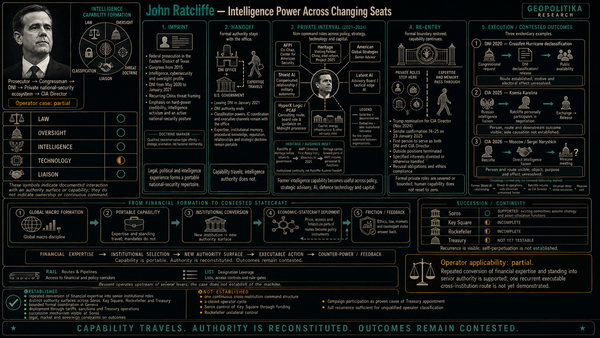
John Ratcliffe's career makes that distinction unusually visible. He served as Director of National Intelligence from May 2020 to January 2021 and later entered CIA through a separate nomination, confirmation and appointment. Experience, relationships and institutional knowledge could travel with him; formal DNI authority could not. The earlier Operators profile described that distinction as capability travelling while authority is reconstituted.
That should not be mistaken for saying the Director is the CIA.
The comparative record points in the opposite direction. Across the Agency's canonical director chronology, presidents have selected military officers, career intelligence professionals, diplomats, congressional figures, lawyers, administrators and officials drawn from elsewhere in the national-security state. There is no durable CIA-director archetype. What persists more clearly is the institutional seat into which those different people are placed: a statutory office, a career bureaucracy, classified collection and analysis systems, liaison relationships, technical capability and recurring executive demand for intelligence.
The face changes more readily than the machinery behind it.
But that does not reduce Directors to interchangeable figureheads. Individual office-holders can materially reshape the machine when the institutional route is visible.
John McCone, for example, established the Directorate of Science and Technology in 1963 to improve CIA management of research and development, scientific analysis and technical support to operations.
Half a century later, John Brennan's 2015 modernisation created a new Directorate for Digital Innovation and ten Mission Centers designed to integrate operational, analytic, technical, digital and support capabilities around geographic and functional problems.
Those are real leadership effects. They are also institutional effects. McCone did not personally become CIA's scientific capability; Brennan did not personally implement every programme that later passed through a Mission Center. Leadership decisions moved through deputies, directorates, budgets, legal authorities, professional staff and subsequent office-holders before becoming durable organisational structures.
The Director is therefore neither merely a public mascot nor the sovereign author of everything the Agency does. The office is better understood as an institutional conversion point: delegated authority, classified access, professional expertise and bureaucratic capacity converge there and can become management decisions, intelligence priorities, executive advice and sometimes organisational reform.
There is another tension in the public presentation. CIA describes its intelligence function in terms of objectivity and professional independence while the Director necessarily operates in close relationship with an administration's national-security priorities. Those propositions are not automatically contradictory. Elected government can set intelligence priorities while analysts attempt to preserve professional standards. But neither proposition proves the other: a claim to objectivity does not establish insulation from political pressure, while proximity to the President does not establish ownership of presidential policy.
That makes the Director an unusually concentrated presentation surface. A classified institution becomes visible through a succession of named individuals whose biographies, hearings, speeches and reforms can be publicly examined. Yet the institutional machinery they temporarily command is designed to survive their departure.
The Director gives CIA a human face. The institution gives that face its power — and outlasts it.
Writing the Leaders, Writing the Institution
If the Director gives CIA a human face in the present, the Agency's historical publications extend that function backward through time.
The clearest example is the Center for the Study of Intelligence's Profiles in Leadership: Directors of the Central Intelligence Agency and Its Predecessors, 1941–2023. The publication turns institutional history into a succession of named leaders through whom crisis, reform, controversy and continuity can be narrated.
John Brennan's foreword to the earlier edition describes that history in terms of “triumphs, setbacks, and controversy.” The phrasing matters because it shows that controversy is not simply excluded from the institutional story. It is incorporated into one: leadership is presented as a site through which the Agency confronts problems, adapts and continues.
That makes Profiles in Leadership more than a collection of biographies. It is an artefact through which CIA organises institutional memory.
The pattern becomes clearer across individual profiles. Walter Bedell Smith appears in a story of institutional repair after intelligence failure. William Colby is written through scrutiny, disclosure and transition. William Webster appears in the language of integrity and institutional recovery. Michael Hayden is associated with integration and public legitimacy. Leon Panetta with outsider leadership and mission performance. David Petraeus with innovation, controversy and institutional learning.
These are not identical narratives, but they share a structure. The leader becomes the organising unit through which wider institutional change is narrated, with complex processes of reform, crisis and adaptation compressed into a sequence of individual tenures.
That has analytical consequences.
A biography necessarily allocates explanatory weight toward the person. Distributed institutional causes—bureaucratic rivalry, statutory constraints, failures of information-sharing, executive pressure, interagency structures, inherited capabilities—can recede as the leader moves to the foreground.
The contrast is especially visible with the pre-9/11 intelligence system. The 9/11 Commission Report describes failure through dispersed authority, fragmented information and institutional coordination problems. A leadership profile can place the Director at the centre of that history, but the wider causal field is larger than any one office-holder.
An earlier example makes the same point. During George H. W. Bush's tenure as Director of Central Intelligence, the 1976 Team A/Team B exercise brought outside experts into a structured challenge to Intelligence Community assessments of Soviet strategic capabilities and intentions.
Bush agreed to the exercise, but it was not simply his personal project. It arose from pressure within the President's Foreign Intelligence Advisory Board, involved CIA analytical structures and outside participants, and unfolded inside a wider political dispute over how Soviet capabilities and intentions should be assessed.
The episode therefore illustrates the limits of leader-centred institutional history. Bush's role was real and consequential, but the process was distributed across several actors and institutions. Writing it primarily through the Director risks compressing a contested analytical and political process into the story of one office-holder.
That does not make the profiles false. It makes them selective.
Their value is precisely that selectivity. They show how CIA chooses to narrate itself through leaders: which crises are attached to which Directors, which controversies are absorbed into stories of adaptation, and which institutional continuities are made visible through succession.
They also preserve an important distinction between office and institution. Each Director is temporary. The narrative continues.
That continuity is part of the artefact's function. The succession of leaders makes change visible while the publication format makes the Agency appear durable across those changes. The biography becomes a bridge between human turnover and institutional persistence.
What the profiles cannot establish is equally important. They do not prove that every controversy is fully represented, that every interpretation is independent, that leadership alone caused the changes attributed to an administration, or that institutional memory is the same thing as complete historical reconstruction.
CIA writes its leaders, and in doing so it also writes a version of itself: an institution repeatedly personified through temporary office-holders, yet presented as something larger and more durable than any one of them.
Conclusion
The CIA visible in the public record is neither the whole institution nor simply a façade.
Part 1 has shown an organisation made legible through different surfaces: its founding documents, authority structure, website, named leadership and official histories. Each reveals something real. None reveals everything.
That matters because the institution itself is durable while the forms through which it becomes visible change. OSS did not simply become CIA unchanged. The Director of Central Intelligence did not simply become today's Director of CIA under a new title. Directors come and go while institutional capabilities persist. Public websites, histories and leadership profiles make selected parts of that continuity intelligible, but always through particular frames.
The concept of controlled legibility names that condition. It does not mean that every omission is deception or that one centrally designed strategy determines what the public sees. It means that intelligence power operates through unequal and bounded visibility: some functions must be explained, some authorities must be exposed, some relationships must be made usable, while other capabilities remain classified or only partly reconstructable.
The result is a public CIA constructed through fragments — professional, technological, rule-governed, mission-driven, historically narrated and humanly represented through a very small number of visible leaders.
What Part 1 has asked is how that construction works.
Part 2 asks the next question: visible to whom?
Presidents, Congress, the Director of National Intelligence, employees and institutional partners do not require the same CIA to become legible to them. They require different information, different interfaces and different forms of access.
The institution is the same. The view is not.
—
Published via Mindwars Ghosted.
Geopolitika: Tracing the architecture of power before it becomes the spectacle of history.
—
Methodology: This article draws principally on CIA public webpages and institutional publications, statutes and executive directives, congressional and commission records, declassified documents and official historical material. Those sources are not treated as evidentially interchangeable. CIA publications are used primarily to establish institutional self-description, published structure, procedure and authorised historical narration; they do not independently prove operational effect, completeness or the accuracy of contested institutional claims. Statutes, executive records and congressional or commission material are used to establish formal authority, institutional change and documented oversight findings within their respective scope. Declassified records establish what has entered the public record, not the full classified institution. The analysis distinguishes institutional continuity from continuity of legal identity or authority; the Director from the institution; community-level coordination from detailed operational command; public interface from the full relationship behind it; and declared mission from demonstrated effect. The term controlled legibility is an interpretive construct used here to describe the selective production of visibility around an institution whose functions also depend on restricted visibility. It does not imply that CIA operates one centrally designed presentation strategy, that every omission is deliberate concealment, or that absence from the public record establishes a hidden contrary reality. The discussion of national security, threat formation and possible policy–intelligence feedback identifies questions and bounded interpretive possibilities; it does not establish that CIA autonomously creates the threats it later addresses or that particular private interests are the general object of intelligence activity. Prior Geopolitika articles are used only where explicitly identified for conceptual continuity, not as independent evidence for the present analysis. Base analytic outputs are available on request. For methodological details—see the Geopolitika Series Methodological Statement.
Mindwars Ghosted is an independent platform dedicated to exposing elite coordination and narrative engineering behind modern society. The site has free access and is committed to uncompromising free speech, offering deep dives into the mechanisms of control.