The Operators: Addendum 5b. Modern Biopolitical Custodians
Risk, panels, emergency law and procurement after the dashboard
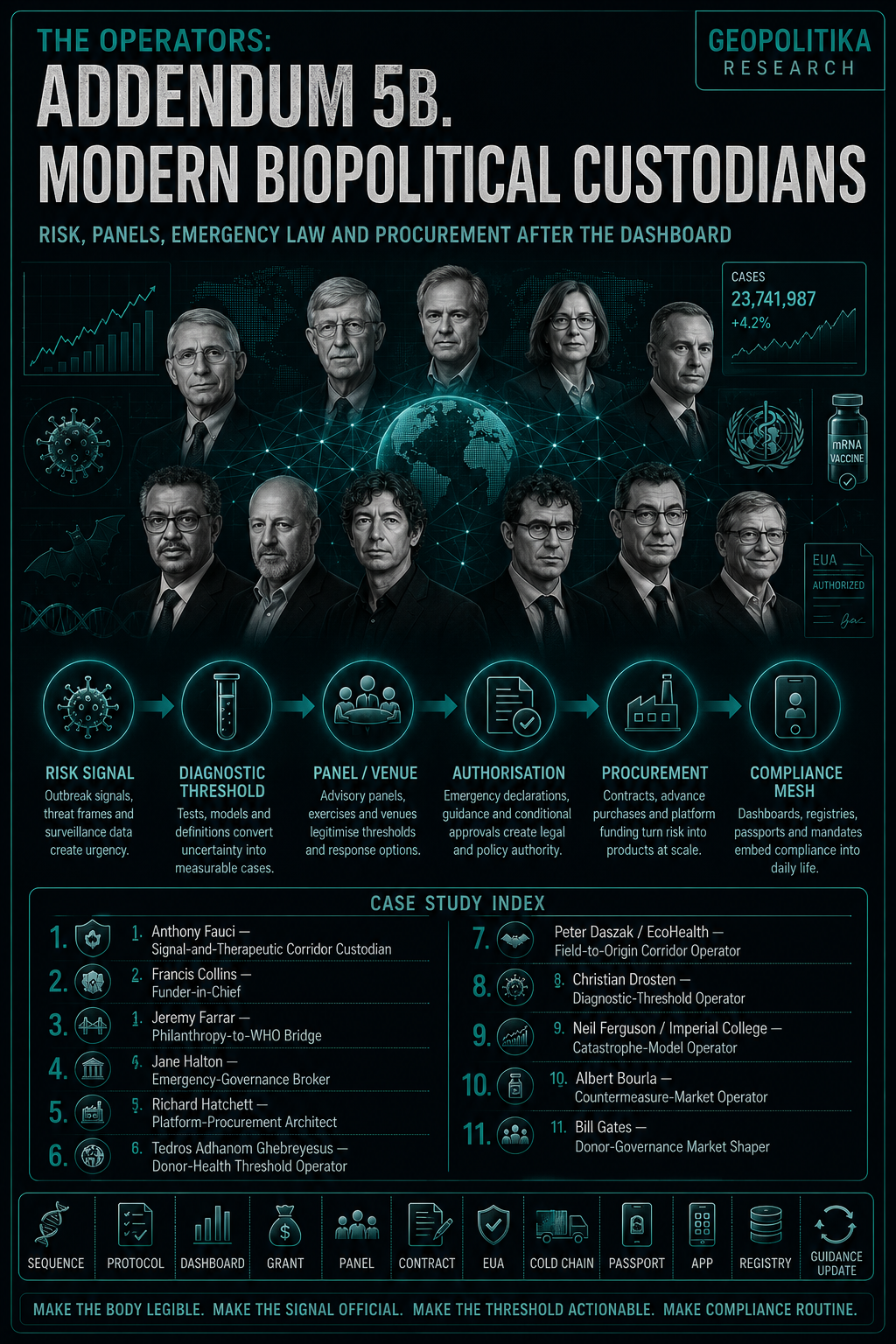
Following on from Part 5. The Biopolitical Custodians, Addendum 5a traced the paper-age runtime: doctrine, societies, record offices, model laws, clinics, courts, professional gates and philanthropic population programmes. Addendum 5b follows the same operator function after the substrate changes. The modern biopolitical custodian no longer needs a pedigree archive, a eugenics board or a model sterilisation statute. The machinery now runs through risk signals, diagnostic thresholds, advisory panels, emergency declarations, trial endpoints, conditional authorisations, indemnified contracts, public-private rehearsal, platform funding, dashboards, surveillance and credentials.
The chain is simple:
Risk Signal → Diagnostic Threshold → Panel / Venue → Authorisation → Procurement → Compliance Mesh
The figures profiled here are not treated as isolated personalities or morality-play villains. They are read as operators: people who occupied institutional placements, pulled specific levers, and helped mutate biological uncertainty into durable governance machinery. The question is functional. How does a wildlife-risk frame become a grant network? How does a sequence become a case dashboard? How does a case dashboard become an emergency? How does an emergency become an authorised product? How does a product become a mandate ecology? How does philanthropy, public health, finance and corporate power learn to govern bodies at scale?
Addendum 5b follows the digital-emergency conveyor. Part 5 showed the modern runtime in general form: risk signal, panel, threshold, order, procurement, credential and gate. This addendum names the operator desks: risk framers, funders, donor bridges, emergency brokers, platform architects, WHO venue operators, field-origin brokers, diagnostic-threshold operators, countermeasure-market operators and donor-governance market shapers.
The substrate is no longer only paper. It is sequence, protocol, dashboard, grant, panel, contract, EUA, cold chain, passport, app, registry and guidance update. But the habit remains familiar: make the body legible, make the signal official, make the threshold actionable, and make compliance routine.
Case Study Index
- Anthony Fauci — Signal-and-Therapeutic Corridor Custodian
- Francis Collins — Funder-in-Chief
- Jeremy Farrar — Philanthropy-to-WHO Bridge
- Jane Halton — Emergency-Governance Broker
- Richard Hatchett — Platform-Procurement Architect
- Tedros Adhanom Ghebreyesus — Donor-Health Threshold Operator
- Peter Daszak / EcoHealth — Field-to-Origin Corridor Operator
- Christian Drosten — Diagnostic-Threshold Operator
- Neil Ferguson / Imperial College — Catastrophe-Model Operator
- Albert Bourla — Countermeasure-Market Operator
- Bill Gates — Donor-Governance Market Shaper
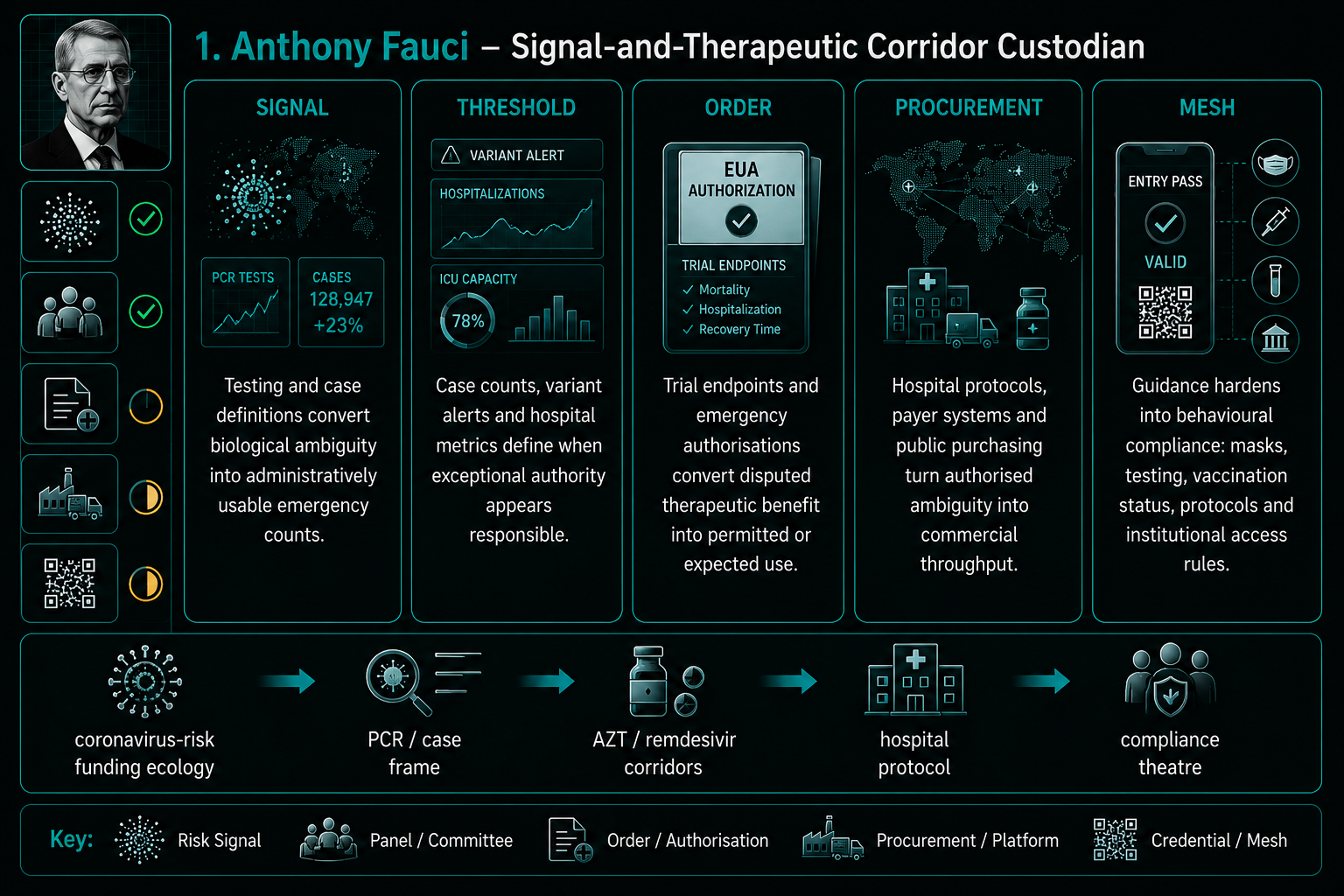
1. Anthony Fauci — Signal-and-Therapeutic Corridor Custodian
Ribbon: Test Signal → Case Frame → Therapeutic Corridor → Protocol Gravity
Lane / Era: U.S. infectious-disease research, HIV/AIDS-to-COVID health security and therapeutic / vaccine-platform governance | Peak influence: 1984–2022
House(s): NIAID • NIH • AIDS Clinical Trials Group ecology • COVID-19 Prevention Trials Network • federal advisory / White House communication ecology
Role Type: Signal-and-Therapeutic Corridor Custodian
Imprint: Define the signal, frame the emergency, select the endpoint, legitimise the corridor, and let agencies, hospitals and employers harden guidance into protocol.
Placement
Anthony S. Fauci belongs at the front of the modern health-security runtime because he occupied perhaps the longest-duration infectious-disease command post inside the American research state. As NIAID director from 1984 to 2022, he sat upstream of many later gates: risk framing, grant power, trial networks, therapeutic endpoints, public advice and advisory influence. He was not the sole regulator, hospital administrator, manufacturer or procurement officer. His operator role was earlier: define the terms under which those downstream institutions could act.
The Wuhan/EcoHealth dispute belongs inside that placement, but not as the whole profile. The question is not only whether SARS-CoV-2 came from a market, cave route, laboratory accident or research programme. That origin binary narrows the field too quickly. The operator issue is broader: NIAID/NIH sat inside the funding and oversight ecology of risky coronavirus research, while the federal health-security complex later defined the pandemic signal, defended institutional trust, shaped response guidance and opened therapeutic and vaccine corridors. The HHS Inspector General later found that NIH and EcoHealth did not effectively monitor awards and subawards from 2014–2021, including subawards to the Wuhan Institute of Virology. The structural burden is conflict-of-function: a system that funds, oversees, classifies and then narrates the risk carries a special burden when the risk materialises.
Lever
Fauci's lever was the emergency frame joined to the test signal and endpoint.
The signal defines the emergency. In COVID, mass testing and case definitions converted biological ambiguity into administratively usable counts: infection, exposure, residual viral material, low-symptom status and disease were often compressed into the public category of "case." Case counts then helped justify emergency posture, behavioural guidance, school and workplace rules, hospital protocols and product demand. The point is not that every test was fake. The point is that case construction became a governing technology.
The therapeutic corridor then turns emergency into market. AZT was the AIDS-era warning light: an extremely toxic drug with early short-term signals became the first major AIDS therapeutic franchise before monotherapy limits and long-term toxicity were absorbed into public understanding. Pediatric HIV/AIDS trials involving foster children added the consent layer; the Vera Institute later identified 532 New York City foster children enrolled in 88 HIV/AIDS clinical trials or observational studies between 1985 and 2005, raising questions about guardianship, vulnerability and protocol oversight.
COVID replayed the corridor with remdesivir. NIAID's ACTT-1 foregrounded faster recovery as the visible success signal, while WHO's Solidarity interim trial found little or no effect on mortality, ventilation or hospital duration. The harder issue is not remdesivir alone, but remdesivir inside a hospital-protocol lane: renal stress, fluid-management risk, pulmonary deterioration, respiratory escalation and high ventilated-patient mortality converged under emergency pressure.
Mutation
Test Signal → Case Frame → Emergency Threshold → Authorisation Corridor → Hospital Protocol → Compliance Mesh
At the front end, the signal is counted. At the threshold layer, the count becomes emergency. At the trial layer, endpoint choice narrows the success test: viral load, symptom change, recovery time or immune marker may displace harder outcomes such as survival, long-term safety or restored health. At the authorisation layer, disputed benefit becomes permitted use. At the protocol layer, hospitals, payers and agencies turn the corridor into practice. At the mesh layer, guidance becomes compliance theatre: masks, tests, vaccination status, treatment protocols, access rules and professional risk.
This is why Fauci is best read as a corridor custodian, not a cartoon command villain. His influence came less from signing every order than from occupying the upstream grammar of risk, evidence, endpoint and trust.
Output Ribbons
- Coronavirus-Risk Funding → Oversight Gap → Trust Burden: Oversight failures don't prove origin but create a conflict-of-function problem when the same system later manages the narrative and response.
- Testing → Case Counts → Emergency Posture: Mass testing converted biological signals into administrative counts sustaining emergency thresholds.
- AZT → Toxicity/Monotherapy Limits → Franchise Lesson: The AIDS corridor shows how emergency need and institutional authority can outrun public understanding of toxicity.
- Remdesivir → Recovery Endpoint → Mortality Dispute: Endpoint substitution—recovery-time signal in one frame, contested survival benefit in another.
- Guidance → Protocol → Compliance Theatre: Once guidance becomes institutional practice, refusal becomes professionally costly and adverse signals can be absorbed as disease severity.
Operator Reading
The operator reading is inferred from placement and sequence, not motive. This profile does not need to prove intent, personal profit or direct command over every downstream death. It maps the corridor. Fauci's role sat where signal definition, trial design, therapeutic authorisation, behavioural guidance and public trust management met.
The central pattern is lethal pathway protection. A health-security system can inflate ambiguous signals into emergencies, recycle dangerous or marginal therapeutics into authorised franchises, route vulnerable subjects through protocols, absorb harms as disease severity, and convert visible behaviours into obedience markers. The runtime does not require bad faith at every node. It requires trusted authority, crisis pressure, endpoint control, institutional uptake and delayed rollback.
Fauci is not the whole machine. He is a front-end custodian of the machine's grammar: what counts as a case, what counts as risk, what counts as evidence, what counts as protection, and what downstream institutions may treat as responsible compliance.
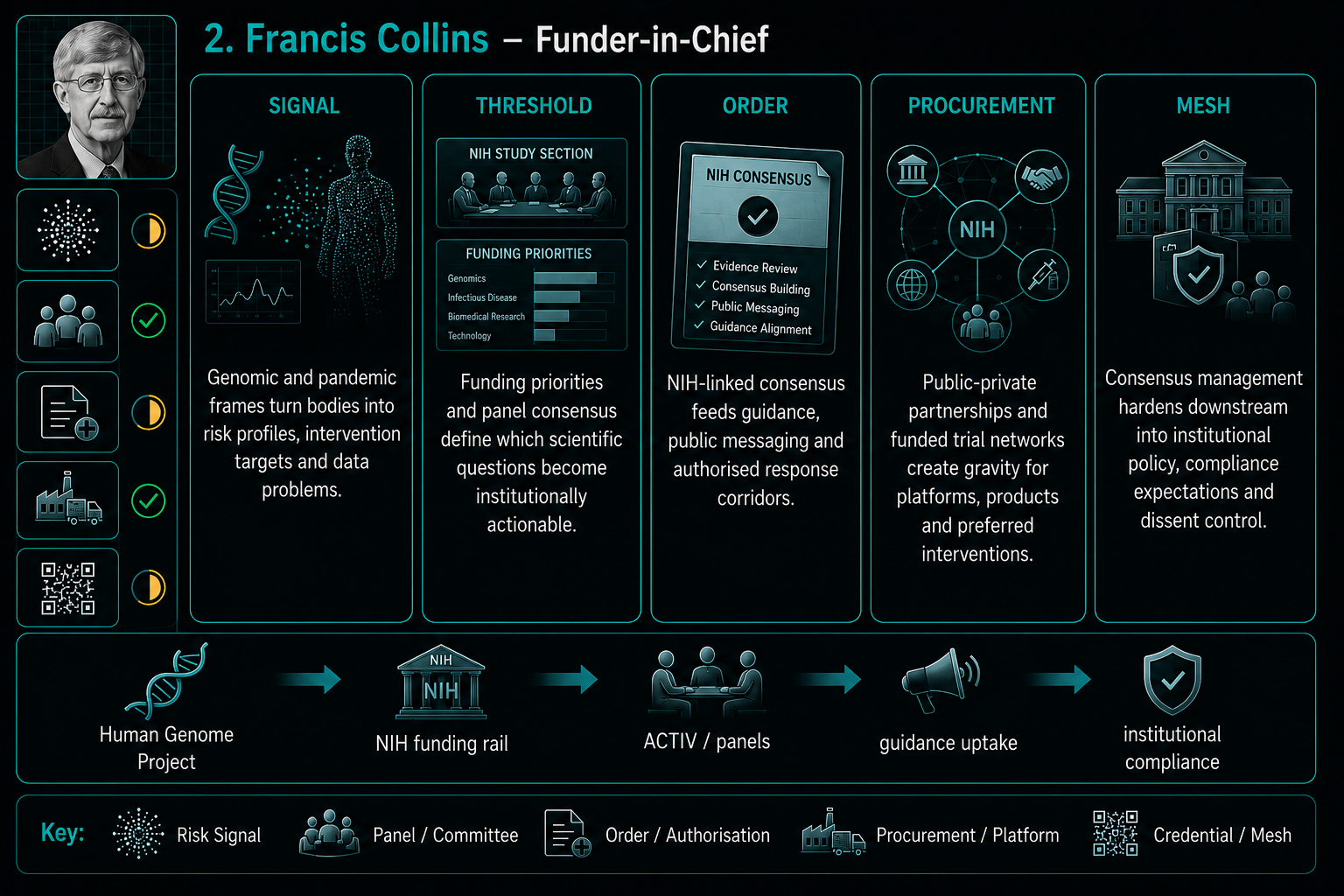
2. Francis Collins — Funder-in-Chief
Ribbon: Genomic Authority → NIH Funding Rail → Panel Wiring → Guidance Uptake
Lane / Era: Human Genome Project, NIH directorate, precision medicine and COVID response | Peak influence: 2009–2021
House(s): NIH • NHGRI • Human Genome Project • ACTIV • federal advisory / White House communication ecology
Role Type: Funder-in-Chief
Imprint: Hold the purse, define the research horizon, wire the panels, and convert funded science into policy gravity.
Placement
Francis S. Collins sits one layer behind Fauci in the modern biopolitical runtime. Fauci occupies the infectious-disease risk corridor; Collins occupies the funding and institutional-authority layer above it. As leader of the Human Genome Project, director of NHGRI from 1993 to 2008, and director of NIH from 2009 to 2021, Collins helped move biomedical governance toward the genomic, platform and precision-medicine frame: sequence the body, classify risk, fund the platform, personalise intervention, and treat population health as a data-and-innovation problem.
That placement matters because NIH is not only a research agency. It is a funding rail, prestige machine and agenda setter. Its grants define what counts as promising science. Its advisory structures shape research priorities. Its trial networks turn hypotheses into evidence corridors. Its public voice tells agencies, universities, hospitals, publishers and media which claims sit inside "the science" and which fall outside responsible discourse.
COVID made that placement operational. NIH stood inside the ACTIV public-private partnership to prioritise therapeutic candidates and trial infrastructure. Collins did not need to sign every rule. The operator function was higher: fund the venue, convene the system, validate the frame and discipline dissent.
Lever
Collins's lever was the funding rail joined to trust management.
The funding rail moves first. NIH resources support laboratories, trial networks, data systems, investigators, public-private partnerships and career hierarchies. That creates scientific gravity. Researchers, journals, universities and hospitals adapt to the questions the funder treats as central. During COVID, that meant platform vaccines, therapeutics, diagnostics, trial harmonisation, genomic surveillance and behavioural messaging.
The second lever was panel wiring. NIH convenes, coordinates and validates panels, workshops, partnerships and guidance channels. Under Collins, pandemic response was a coordinated knowledge regime: funders, agencies, universities, pharma firms and public-health bodies moved around shared priorities.
The third lever was discourse discipline. Collins's email calling for a "quick and devastating published take down" of the Great Barrington Declaration exposed the trust-management function. The issue is not whether the declaration was right or wrong. The operator issue is that the NIH director treated dissenting pandemic strategy from credentialed scientists as a reputational threat to be neutralised quickly, rather than as a disagreement to be tested in public. In a health-security runtime, consensus becomes an instrument.
Mutation
Funding Priority → Panel Consensus → Guidance Uptake → Institutional Compliance
At the funding layer, research agendas are selected. At the panel layer, selected evidence becomes expert consensus. At the guidance layer, consensus becomes agency advice, journal framing, media line and institutional policy. At the compliance layer, universities, hospitals, employers and schools treat the guidance as operational default.
Collins's operator signature is not direct coercion. It is gravity. He represents the layer where money, prestige, panels and public trust converge. Once that layer stabilises a frame, downstream actors can convert it into protocols and rules while presenting themselves as merely following the science.
Output Ribbons
- Genome Project → Precision Frame → Data Body: Collins's earlier authority helped normalise the body as sequence, risk profile and intervention target.
- NIH Budget → Research Agenda → Career Gravity: Funding priorities shaped what universities, labs, journals and investigators treated as legitimate frontier science.
- ACTIV → Candidate Prioritisation → Trial Corridor: COVID therapeutics and vaccines moved through public-private prioritisation structures that narrowed the field of acceptable interventions.
- Consensus Defence → Dissent Management → Trust Regime: The Great Barrington episode shows how public-health disagreement could be rendered as reputational contamination.
- Guidance Uptake → Institutional Policy → Access Conditions: Once NIH-linked consensus hardened, schools, employers, hospitals and platforms could operationalise it as responsible compliance.
Operator Reading
The operator reading is inferred from placement and sequence, not motive. Collins's function was not to personally command every mandate or product rollout. His function was to occupy the funding-and-consensus layer through which biomedical priorities become institutional reality.
Collins is the funder-custodian. He helped define the upstream conditions under which bodies are rendered as data, risk and intervention targets. During COVID, that same structure fused with emergency governance: funding, panels, public-private partnerships, guidance and trust management. The output was not merely research. It was policy gravity.
The substrate is grant, genome, partnership, panel and public message. The runtime is funding-to-guidance conversion.
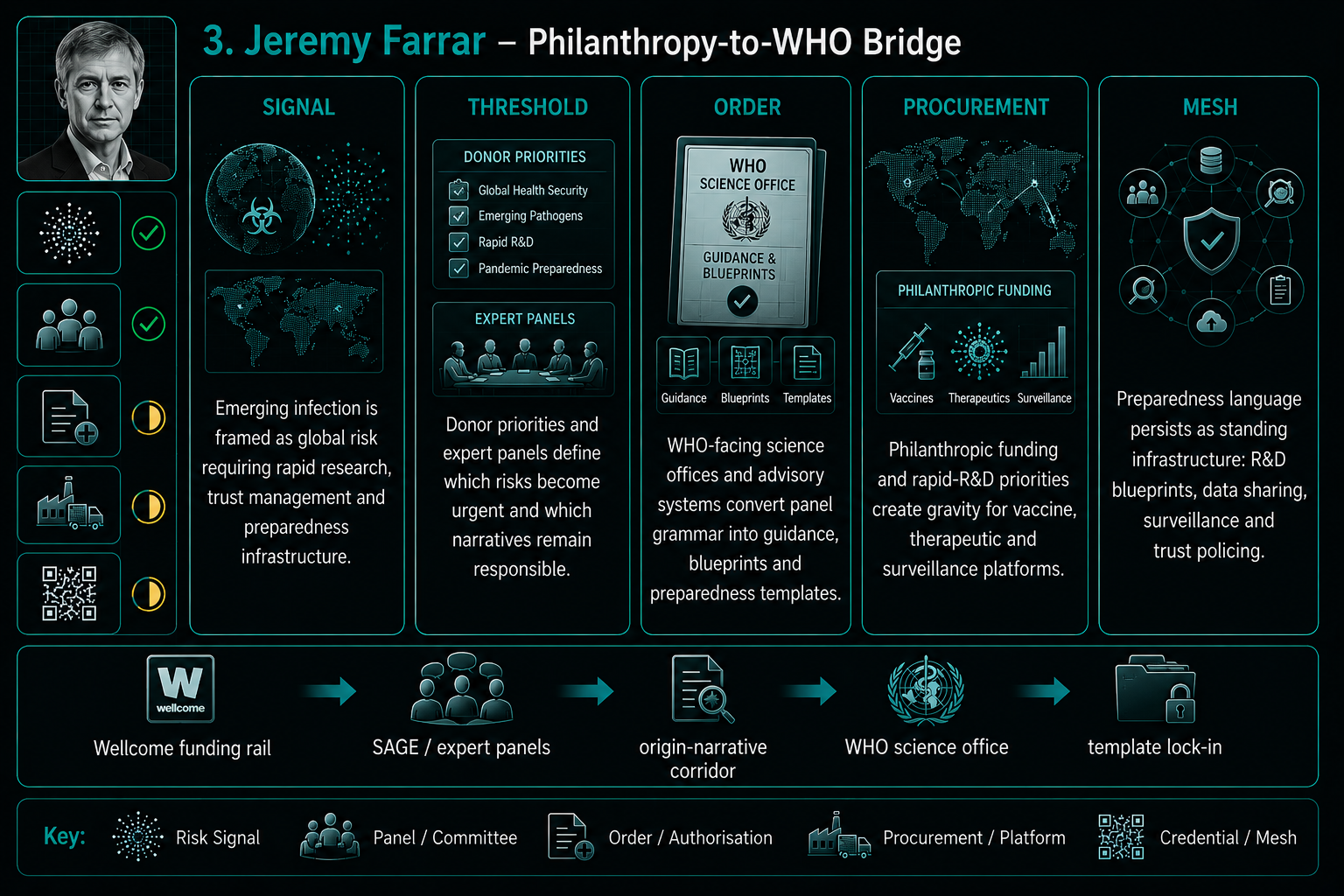
3. Jeremy Farrar — Philanthropy-to-WHO Bridge
Ribbon: Philanthropy Rail → Global Panels → Origin-Narrative Management → WHO Interface
Lane / Era: Emerging infections, global-health philanthropy, pandemic preparedness and WHO science governance | Peak influence: 2013–present
House(s): Wellcome • SAGE • WHO R&D Blueprint • WHO Chief Scientist office
Role Type: Philanthropy-to-WHO Bridge
Imprint: Move from donor capital and outbreak science into global panels, trust management and WHO template authority.
Placement
Jeremy Farrar sits in the bridge layer of the modern health-security runtime. Before joining Wellcome, he spent years in infectious-disease research in Vietnam; Wellcome says he directed the Oxford University Clinical Research Unit at the Hospital for Tropical Diseases in Ho Chi Minh City before becoming Wellcome director in 2013. In 2023, the World Health Organization named him Chief Scientist. That route matters: field outbreak science → philanthropic capital → advisory panels → WHO authority.
At Wellcome, Farrar did not operate as a state regulator. He occupied a donor-governance position: fund research, convene experts, legitimate preparedness priorities, shape what "global health" treats as urgent, and sit inside the advisory ecology that translates outbreak risk into templates. During COVID, he was also a member of the UK's SAGE emergency advisory system, and accounts of his book Spike describe him as an early and central figure in the pandemic's scientific advisory world.
Lever
Farrar's lever is philanthropic science joined to global-panel access.
Wellcome money can make a field real: grants, networks, priorities, challenge frames, institutional partnerships and public messaging. WHO panels can make that field portable: R&D blueprints, priority pathogens, expert groups, guidance language, preparedness templates, and research agendas that travel into national policy.
The COVID-origin episode adds a trust-management layer. Farrar was involved in early high-level scientific discussions about SARS-CoV-2 origins, including the debate that preceded the Nature Medicine "Proximal Origin" paper. Congressional materials and later reporting placed him among figures involved in the early email and teleconference ecology around the lab-origin question. The disciplined claim is narrower than conspiracy: he sat inside the expert-trust corridor where uncertain origin questions, reputational risks, public messaging and institutional authority converged.
That is the operator lever: when donor authority, emergency science and WHO-adjacent panels meet, uncertainty can be converted into a bounded public narrative.
Mutation
Outbreak Signal → Donor Priority → Expert Panel → Trust Narrative → WHO Template
At the signal layer, emerging infection is framed as global risk. At the donor layer, Wellcome funding and convening power make particular questions urgent. At the panel layer, expert groups define responsible science and acceptable response. At the trust layer, public uncertainty is managed so that institutional authority is preserved. At the WHO layer, that authority becomes guidance, R&D priorities and preparedness architecture.
Farrar's operator role is therefore not command. It is route. He connects private philanthropic capital to global public-health authority. The same person can speak as outbreak scientist, donor executive, SAGE participant, preparedness advocate and WHO Chief Scientist. The institution changes; the risk grammar travels.
Output Ribbons
- Wellcome → Research Priority → Preparedness Field: Wellcome under Farrar helped make epidemic preparedness, vaccines, therapeutics, surveillance and antimicrobial resistance into fundable global-health priorities.
- Donor Capital → WHO Blueprint → Research Activation: Farrar's role around WHO R&D Blueprint-style preparedness shows how donor and WHO structures can align around rapid research activation during epidemics.
- Origin Uncertainty → Expert Call → Public Trust Management: The early COVID-origin debate shows the trust corridor: uncertain science, reputational stakes and public messaging compressed into "responsible" narrative management.
- SAGE / WHO → National and Global Uptake: Panel positions create pathways through which expert language enters government response and international guidance.
- Philanthropy → Public Authority → Template Lock-In: The bridge function makes donor priorities appear as neutral global-health infrastructure once absorbed into WHO or state-facing templates.
Operator Reading
The operator reading is inferred from placement and sequence, not motive. Farrar is not rendered here as a secret commander of pandemic policy. He is rendered as a bridge operator: the figure who moved through the donor, panel and WHO layers at the moment when pandemic risk became a global operating system.
His importance lies in conversion. Philanthropic capital becomes research agenda. Research agenda becomes panel priority. Panel priority becomes guidance. Guidance becomes preparedness template. In the origin-narrative lane, uncertainty becomes trust management. In the R&D lane, outbreak risk becomes a standing call for faster vaccines, therapeutics, data sharing and international coordination.
Farrar is a supranational-interface custodian. He helps show how formal sovereignty remains national while operating grammar moves through donors, panels and WHO science offices. The substrate is grant, panel, trust narrative and template. The runtime is philanthropy-to-authority conversion.
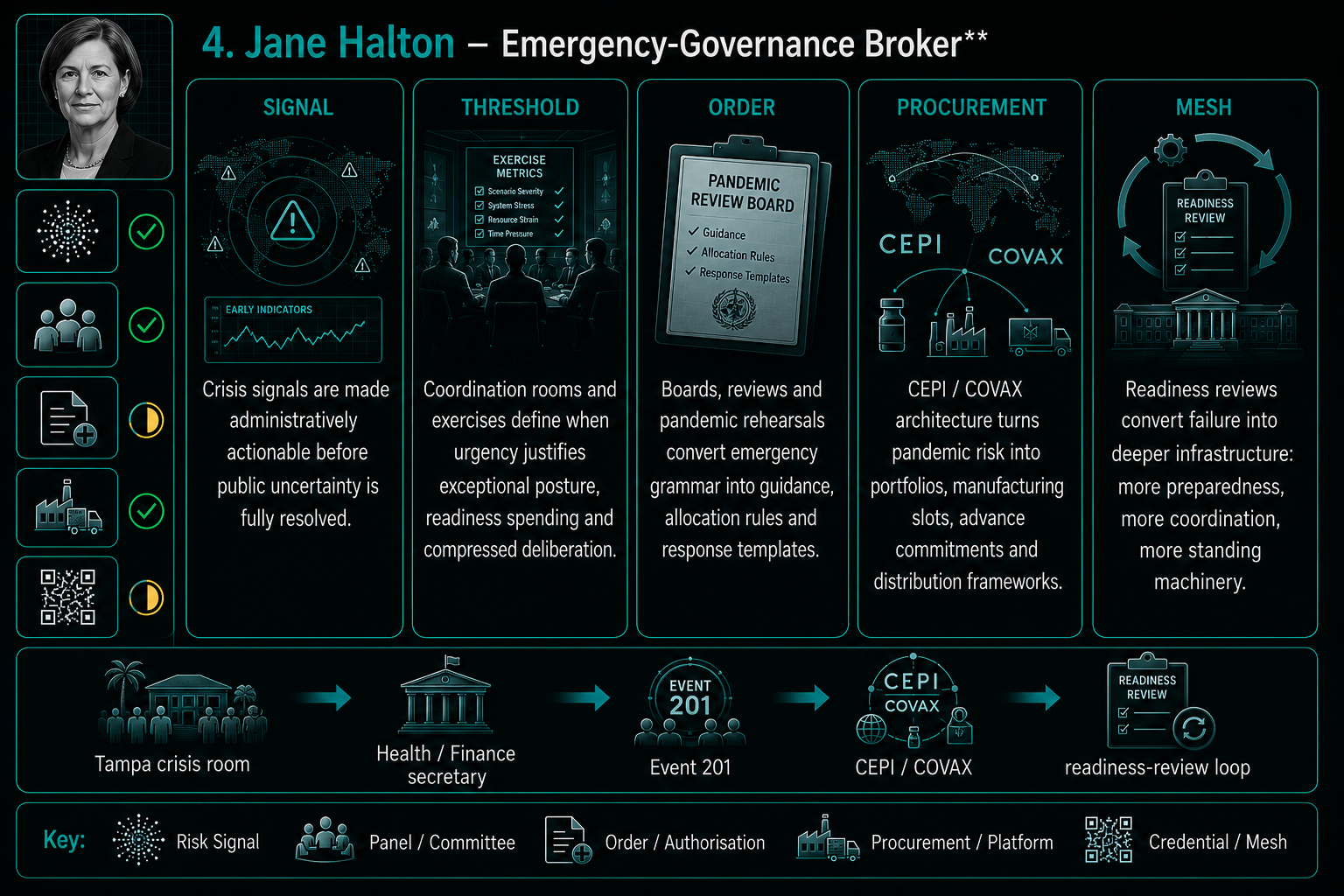
4. Jane Halton — Emergency-Governance Broker
Ribbon: Crisis Narrative → Administrative Coordination → Pandemic Rehearsal → Procurement Architecture
Lane / Era: Australian border-security administration, health finance, WHO governance, Event 201, CEPI / COVAX pandemic preparedness | Peak influence: 2001–present
House(s): Australian Department of Prime Minister and Cabinet • Australian Health / Finance portfolios • WHO Executive Board • Event 201 • CEPI • COVAX
Role Type: Emergency-Governance Broker
Imprint: Manage the crisis room, preserve institutional confidence, rehearse public-private emergency roles, convert urgency into procurement architecture, and review the system toward deeper readiness.
Placement
Jane Halton enters this sequence from crisis administration. In 2001, she chaired the Australian People Smuggling Taskforce during the Children Overboard affair. The Senate inquiry records the controversy around the interaction between Minister Peter Reith and Halton on 10 October 2001, and the taskforce's role in handling claims that asylum seekers had thrown children into the sea. The later evidentiary problem was severe: a crisis narrative moved publicly before the factual substrate was secure.
That episode matters because it shows the administrative imprint: manage uncertainty under political pressure, coordinate agencies, protect the centre, and let operational messaging outrun public verification. The operator reading is narrower than personal culpability: she learned, and later embodied, crisis-room governance where contested signals, whole-of-government coordination and public confidence are managed at speed.
Her later migration into biomedical governance makes the continuity visible. Halton served as Secretary of the Australian Department of Health and Ageing, then Secretary of Finance, and held senior international roles including chair of the WHO Executive Board and president of the World Health Assembly. By 2019, she appeared as a named player in Event 201, the Johns Hopkins/World Economic Forum/Gates Foundation pandemic tabletop exercise—listed as ANZ Bank board member, former Secretary of Finance and former Secretary of Health.
That is the bridge: border crisis → health bureaucracy → finance machinery → pandemic rehearsal → global vaccine procurement.
Lever
Halton's lever is administrative coordination joined to procurement discipline.
Unlike Fauci or Collins, she is not primarily a scientific endpoint operator. Her function is governance architecture: bring agencies, funders, manufacturers, banks, logistics firms and international bodies into a mechanism that can act before normal deliberation catches up. Event 201 is important because it rehearsed exactly that layer: public-private cooperation, economic shock, communications, logistics, countermeasure distribution and political decision-making under severe pandemic pressure. The exercise does not prove foreknowledge. It proves preparedness grammar: the right people in the room, the right crisis scenario, the right institutional roles, and the assumption that public authority and private infrastructure must be pre-wired before the emergency arrives.
In CEPI/COVAX, that grammar became procurement architecture: vaccine preparedness, advance agreements, manufacturing readiness, equitable-access language and global distribution rules.
Mutation
Crisis Signal → Coordination Room → Public Narrative → Tabletop Rehearsal → Procurement/Readiness Architecture → Review Cycle
At the signal layer, a contested event is treated as urgent. At the coordination layer, agencies align around response. At the narrative layer, public confidence and political legitimacy are protected. At the rehearsal layer, future crisis roles are pre-assigned through scenario exercises. At the procurement layer, emergency becomes contract, stockpile, manufacturing slot or allocation framework. At the review layer, failure rarely unwinds the architecture; it usually becomes an argument for more readiness.
Halton's operator signature is not direct command over a product. It is conversion of emergency into a governable system: committees, boards, budgets, pandemic exercises, preparedness reviews and procurement channels.
Output Ribbons
- Tampa/Children Overboard → Crisis Room → Narrative Discipline: The early imprint shows crisis administration under uncertainty, where public claims can harden before facts are secure.
- Health/Finance → WHO → Pandemic Governance: Domestic health bureaucracy and finance discipline migrate into international health-security architecture.
- Event 201 → Public-Private Rehearsal → Preparedness Grammar: The tabletop does not prove foreknowledge; it shows role rehearsal: business, government, logistics, finance, communications and public health pre-aligned around severe-pandemic management.
- CEPI/COVAX → Advance Commitments → Allocation Architecture: Pandemic preparedness turns vaccine risk into manufacturing slots, portfolio bets and distribution rules.
- Review → Readiness → More Infrastructure: Crisis failure is converted into preparedness mandate: better stockpiles, faster platforms, clearer authority, deeper coordination.
Operator Reading
The operator reading is inferred from placement and sequence, not motive. Halton is not rendered here as a scientist, manufacturer or hidden commander. She is a broker of emergency governance. Her role is to make uncertainty administratively actionable: assemble the room, stabilise the message, rehearse the emergency, create the procurement path, and review the system toward greater readiness.
Halton belongs at the interface between sovereign desks, public-private rehearsal and supranational procurement architecture. Formal authority remains distributed, but the operating grammar is shared: crisis, coordination, confidence, contracts, readiness. The substrate is committee, scenario, contract and review. The runtime is emergency-to-architecture conversion.
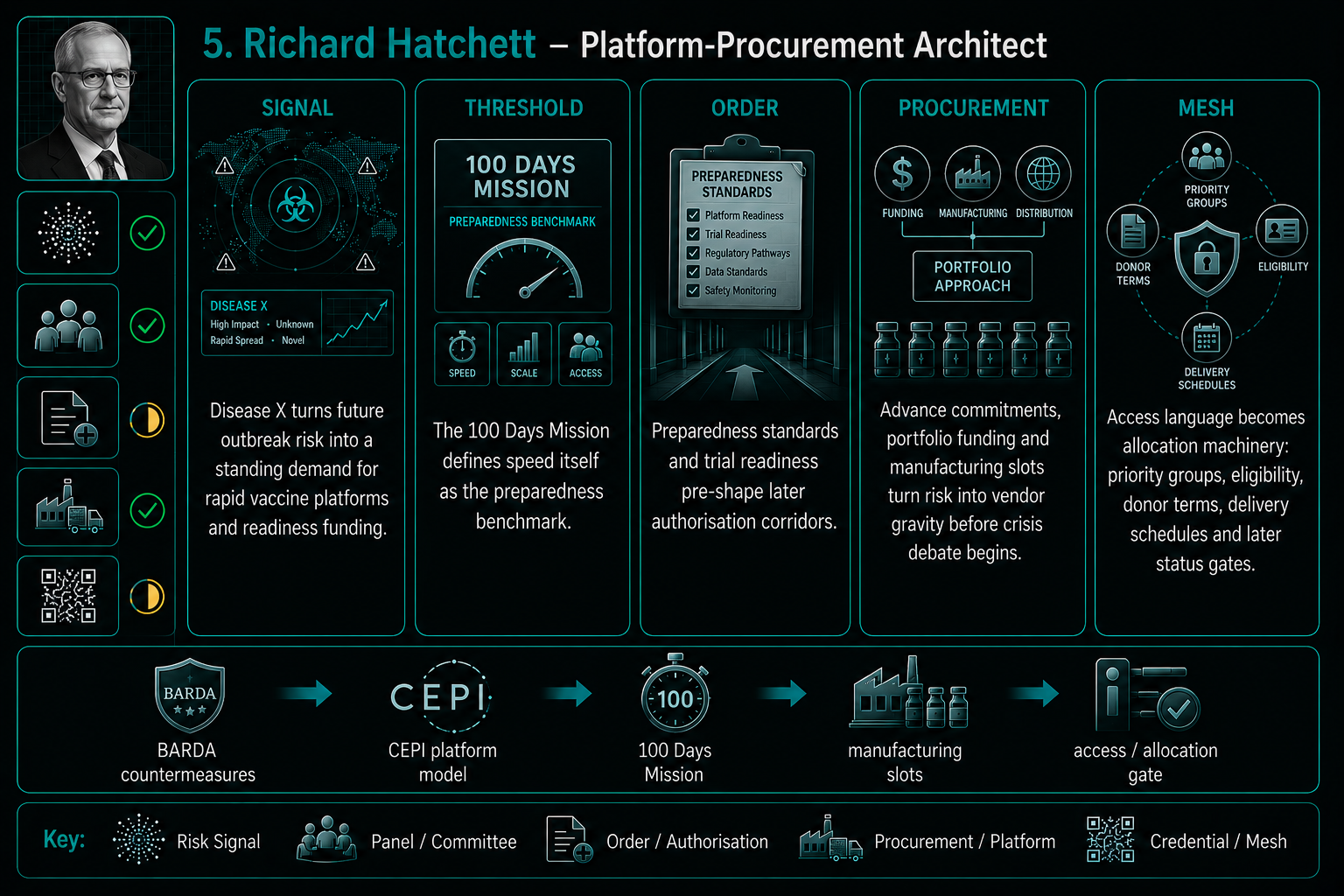
5. Richard Hatchett — Platform-Procurement Architect
Ribbon: Biodefence Countermeasures → CEPI Platform Model → Advance Commitments → Manufacturing Slots
Lane / Era: U.S. biodefence, BARDA medical countermeasures, CEPI pandemic preparedness and vaccine acceleration | Peak influence: 2011–present
House(s): BARDA • CEPI • 100 Days Mission • G7 / G20 pandemic-preparedness ecology
Role Type: Platform-Procurement Architect
Imprint: Convert pathogen risk into platform readiness, advance funding, manufacturing capacity and access claims.
Placement
Richard Hatchett sits where biodefence countermeasure logic becomes global vaccine-platform architecture. Before becoming CEPI’s permanent CEO in 2017, he served at BARDA, including as Deputy Director, Chief Medical Officer and acting Director. CEPI's announcement of his appointment states that he came from BARDA, where he worked on medical countermeasures against chemical, biological, radiological and nuclear threats, pandemic influenza and emerging infectious diseases.
That placement matters. BARDA is the American countermeasure desk: threat assessment, product development, public-private partnership, stockpile logic, manufacturing readiness and procurement. CEPI globalises that grammar. It is a partnership of public, private, philanthropic and civil organisations designed to finance and coordinate vaccine development against high-priority epidemic threats and platform technologies for rapid response.
Hatchett's operator role is therefore not laboratory discovery alone. It is the conversion of emergency risk into a standing vaccine-development and manufacturing pipeline.
Lever
Hatchett's lever is the platform model.
The platform model changes the procurement problem. Governments and funders no longer wait for a fully defined product after a crisis begins. They fund adaptable vaccine technologies, prototype pathogen work, trial networks, manufacturing capacity, regulatory rehearsal and access commitments before the next emergency. CEPI's 100 Days Mission makes this explicit: develop a new vaccine against Disease X within 100 days of recognising the threat. CEPI's own materials place the 100 Days Mission at the heart of its pandemic plan, with outside summaries noting endorsement by the G7 and G20.
The second lever is advance commitment. CEPI does not merely issue grants. It creates portfolios: candidate vaccines, platform bets, manufacturing arrangements, trial preparation, centralised labs, access language and co-funding structures. During COVID, CEPI moved early and built a large vaccine-development portfolio; Gavi's account says CEPI was one of the first organisations to fund COVID vaccine development and that several CEPI-backed candidates were later licensed domestically or internationally.
The third lever is access grammar. CEPI frames the architecture through equity, speed, preparedness and global access. That language matters because it converts vendor support and manufacturing readiness into humanitarian infrastructure. The gate is no longer only a national purchase order. It is a global allocation problem: who gets doses, on what timetable, through which funder, under which contract, with which technology-transfer or supply commitments.
Mutation
Pathogen Risk → Platform Investment → Advance Commitment → Manufacturing Slot → Allocation Gate
At the risk layer, the next outbreak is treated as inevitable. At the platform layer, funders back adaptable technologies before the specific emergency fully arrives. At the commitment layer, money secures development pathways and capacity. At the manufacturing layer, scarce facilities, inputs, IP, know-how and delivery timelines become bottlenecks. At the allocation layer, equity language becomes a gate: eligible countries, priority groups, donor terms, access conditions and distribution rules.
Hatchett's operator signature is procurement before procurement. The purchase order is prefigured by platform strategy, funder confidence, trial readiness and manufacturing reservation. Once the crisis appears, the system can say it is simply executing preparedness. In reality, the market has already been shaped.
Output Ribbons
- BARDA → Countermeasure Logic → CEPI Platform Model: U.S. biodefence procurement grammar migrates into global vaccine-preparedness architecture.
- Disease X → 100 Days Mission → Readiness Standard: A hypothetical pathogen becomes a standing benchmark for speed, funding and institutional readiness.
- Platform Bet → Manufacturing Slot → Scarcity Gate: The crucial asset is not only the vaccine candidate; it is capacity, supply chain, fill-finish, regulatory preparation and delivery timing.
- Advance Funding → Portfolio Logic → Vendor Gravity: Public and philanthropic capital de-risks preferred technologies and makes some vendors structurally closer to emergency uptake.
- Equity Language → Allocation Rules → Access Gate: Global access rhetoric becomes operational through contracts, eligibility, priority tiers and distribution machinery.
Operator Reading
The operator reading is inferred from placement and sequence, not motive. Hatchett's function is not to command every national vaccine decision. It is to build the preparedness architecture in which pathogen risk becomes platform funding, platform funding becomes manufacturing readiness, and manufacturing readiness becomes allocation power.
Hatchett is a procurement-platform custodian. He sits after the signal but before the gate: the point where risk is translated into portfolio bets, contract structures, supply chains and emergency capacity. The public language is readiness and equity. The operating result is market shaping before crisis debate begins.
The substrate is platform technology, funder agreement, manufacturing slot, trial network and allocation framework. The runtime is risk-to-capacity conversion.
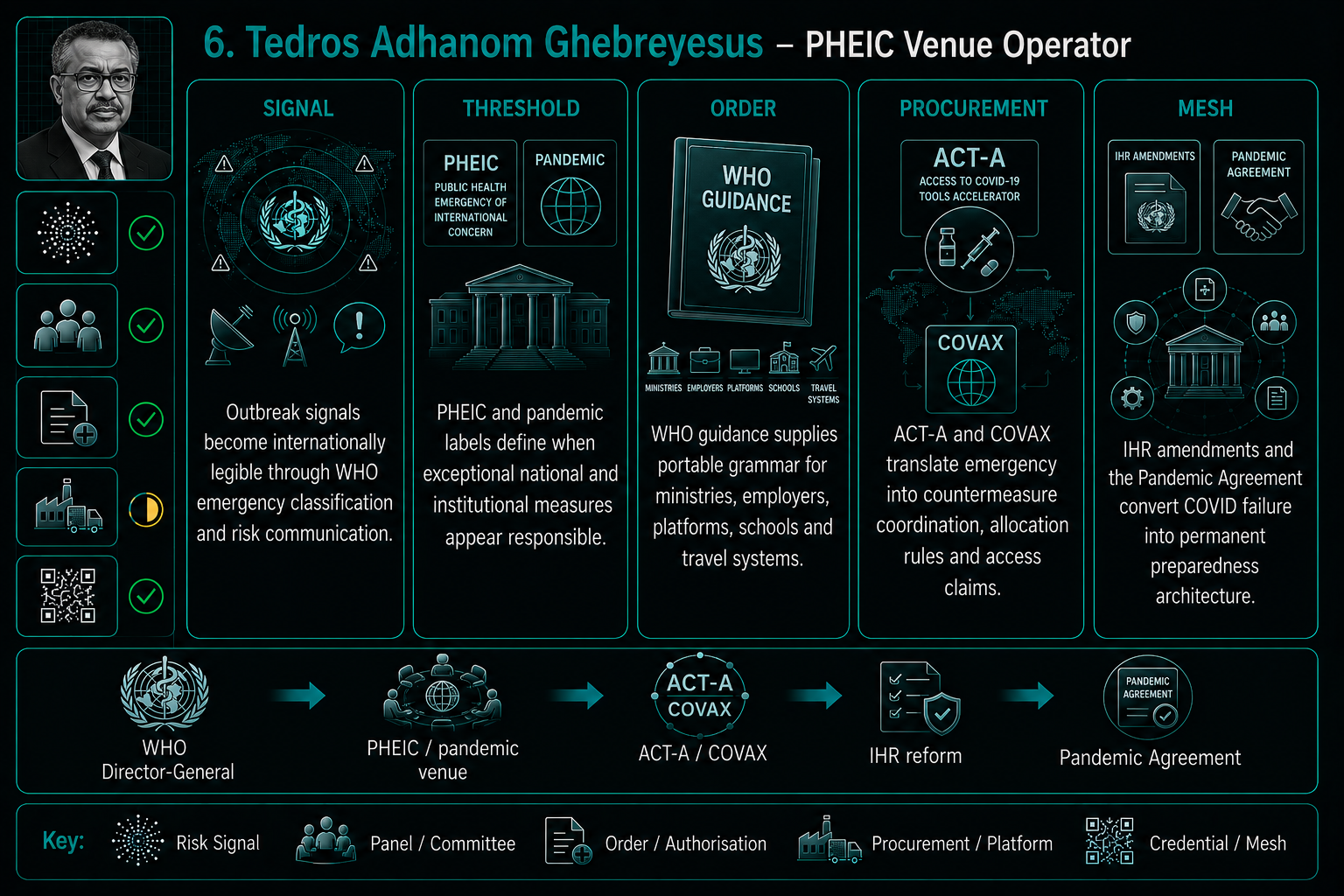
6. Tedros Adhanom Ghebreyesus — PHEIC Venue Operator
Ribbon: WHO Director-General → PHEIC Venue → Global Guidance → Treaty / IHR Drive
Lane / Era: WHO emergency governance, COVID-19 pandemic response, IHR reform and pandemic-agreement architecture | Peak influence: 2017–present
House(s): World Health Organization • International Health Regulations • ACT-Accelerator • COVAX • Pandemic Agreement
Role Type: PHEIC Venue Operator
Imprint: Declare the venue, issue the grammar, coordinate the tools, and convert temporary emergency into permanent preparedness architecture.
Placement
Tedros Adhanom Ghebreyesus sits at the supranational threshold layer of the modern biopolitical runtime. As WHO Director-General from 2017 onward, he did not command national police, sign domestic mandates or purchase every product. His placement was different: he occupied the global health venue through which a signal becomes internationally legible, morally weighted and administratively portable.
The key instrument is the Public Health Emergency of International Concern. On 30 January 2020, WHO declared COVID-19 a PHEIC after the Emergency Committee agreed the outbreak met the criteria. The statement advised detection, isolation, treatment, contact tracing and social-distancing measures "commensurate with the risk." That phrasing matters. It is not a domestic order, but it gives governments a shared emergency grammar.
On 11 March 2020, Tedros publicly characterised COVID-19 as a pandemic. The word did not create the virus; it reorganised the venue. Governments, media, universities, employers, regulators, funders and platforms could now act inside a global emergency frame. WHO guidance became a reference layer for national rules, procurement, risk communication, travel advice, vaccination campaigns and later treaty reform.
Lever
Tedros's lever is venue authority joined to guidance repetition.
WHO does not usually coerce directly. It issues categories, declarations, guidance, technical advice, dashboards, emergency committee statements, target language and coordination calls. Those outputs become portable. National ministries cite them. Donors fund against them. Platforms and media amplify them. Regulators and employers treat them as the responsible baseline.
The second lever was coordination of countermeasure architecture. The ACT-Accelerator and COVAX wrapped diagnostics, therapeutics, vaccines, health-systems support, equity language and procurement coordination into a single global response frame. WHO says COVAX was co-led by CEPI, Gavi and WHO, alongside UNICEF and PAHO delivery channels, and aimed to accelerate development, manufacture and equitable access. The operator point is not that equity language was false. It is that equity became the grammar of global allocation.
The third lever is institutional afterlife. COVID failure did not unwind WHO emergency architecture. It produced the push for IHR amendments and the Pandemic Agreement. The World Health Assembly adopted the Pandemic Agreement in 2025, presenting it as a tool for better international coordination, equitable access to vaccines, therapeutics and diagnostics, and strengthened pandemic preparedness. Emergency became reform mandate.
Mutation
Outbreak Signal → PHEIC → Pandemic Grammar → Guidance Uptake → Countermeasure Coordination → Treaty/IHR Architecture
At the signal layer, an outbreak is identified. At the PHEIC layer, the signal becomes a formal international emergency. At the pandemic layer, the emergency becomes a whole-of-society frame. At the guidance layer, WHO advice gives ministries and institutions a shared language. At the countermeasure layer, diagnostics, therapeutics and vaccines move through global coordination vehicles. At the treaty layer, the temporary crisis produces permanent rules, preparedness commitments and access frameworks.
Tedros's operator function is therefore not command. It is venue conversion. He turns an outbreak into an internationally recognised emergency venue, then helps convert the lessons of that venue into standing architecture.
Output Ribbons
- PHEIC → National Emergency Grammar → Policy Uptake: The declaration gave states, agencies and institutions a shared threshold language for exceptional measures.
- Pandemic Declaration → Whole-of-Society Frame → Behavioural Mobilisation: The pandemic label expanded the response from health ministries into schools, employers, travel, platforms, finance and everyday conduct.
- ACT-A/COVAX → Countermeasure Coordination → Allocation Gate: Diagnostics, therapeutics and vaccines were framed through global access, procurement coordination and priority distribution.
- Infodemic → Trust Management → Speech Boundary: WHO's "infodemic" framing made information control part of emergency governance, turning public-health disagreement into a trust-and-risk problem.
- COVID Failure → IHR/Pandemic Agreement → Permanent Readiness: The declared failures of COVID response became arguments for stronger international instruments, better surveillance, faster access and deeper coordination.
Operator Reading
The operator reading is inferred from placement and sequence, not motive. Tedros is not rendered as a world-government commander. The stronger reading is functional: he occupied the venue that converts outbreak signals into global emergency grammar and then into institutional afterlife.
Formal sovereignty remained national. But the operating language travelled through WHO: PHEIC, pandemic, equity, solidarity, misinformation, preparedness, vaccine targets, treaty reform, IHR amendments. That language gave domestic systems moral cover and technical reference points. Once governments, employers, universities, airlines and platforms cite a global emergency grammar, WHO does not need to operate the gate directly. It supplies the grammar that makes the gate appear responsible.
Tedros is the supranational threshold custodian. His role is not to administer every checkpoint, but to define the venue in which checkpoints become legitimate.
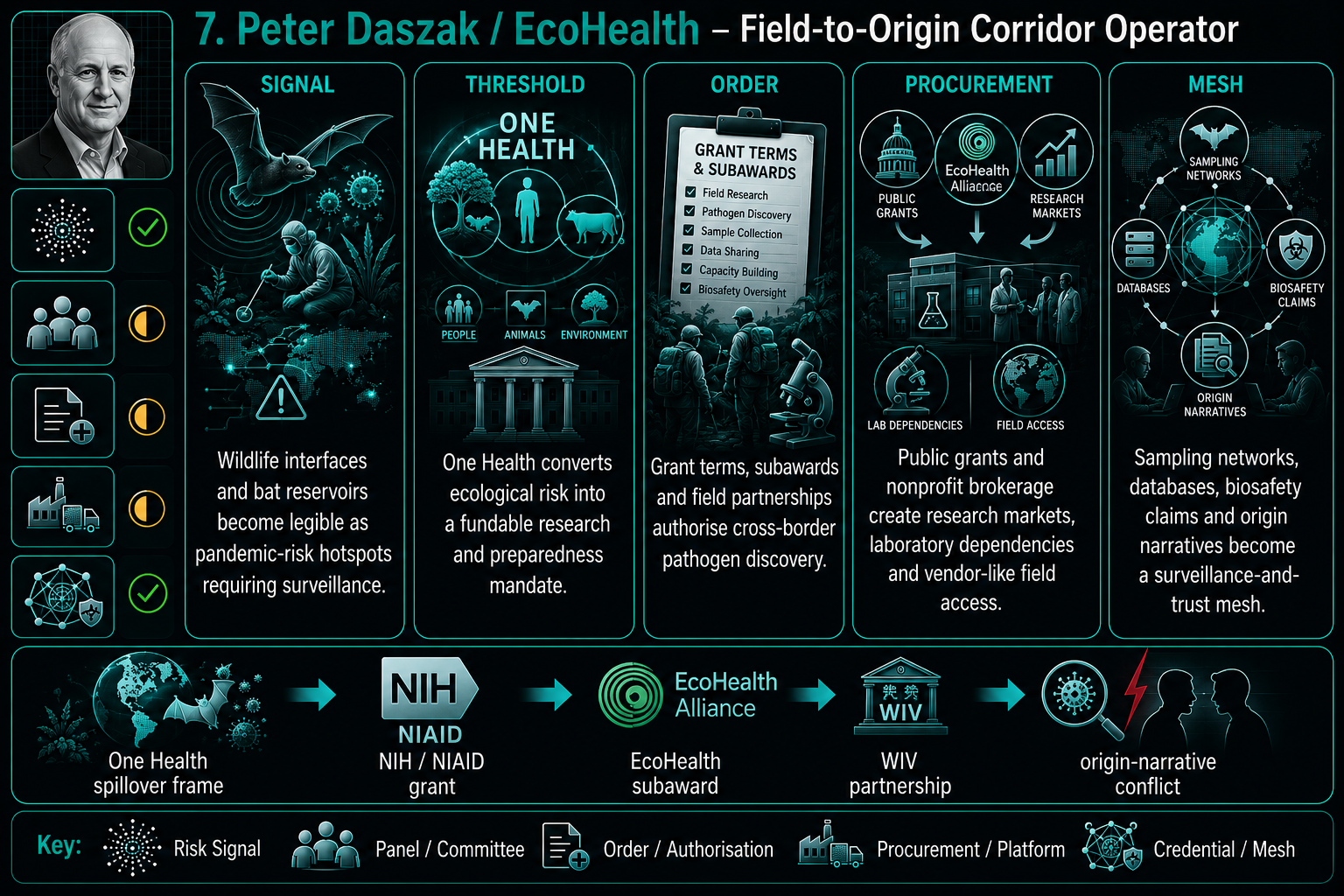
7. Peter Daszak / EcoHealth — Field-to-Origin Corridor Operator
Ribbon: Wildlife Surveillance → Grant Routing → Wuhan Partnership → Origin-Narrative Management
Lane / Era: One Health ecology, virus hunting, U.S.-funded coronavirus research, WHO origins investigation and post-COVID oversight collapse | Peak influence: 2009–2024
House(s): EcoHealth Alliance • NIH / NIAID • Wuhan Institute of Virology • WHO-convened COVID-origins ecology
Role Type: Field-to-Origin Corridor Operator
Imprint: Turn wildlife-risk surveillance into grant infrastructure, route funds through foreign field partnerships, then occupy the narrative venue when the risk materialises.
Placement
Peter Daszak and EcoHealth Alliance sit at the hinge between virus discovery, field surveillance, U.S. grant funding and COVID-origin narrative management. EcoHealth's public identity was "One Health": the claim that human, animal and environmental health form one connected risk field. In operational terms, that frame made wildlife interfaces, bat reservoirs, land-use change, spillover modelling and pathogen discovery into fundable security infrastructure.
Daszak's placement was not that of a minister, regulator or vaccine manufacturer. It was more specialised: broker the field. EcoHealth received NIH awards and issued subawards to research partners, including the Wuhan Institute of Virology. The HHS Inspector General later reported that its audit covered three NIH awards to EcoHealth worth about $8.0 million, including about $1.8 million in EcoHealth subawards to eight subrecipients, among them WIV. The same audit found that NIH and EcoHealth did not effectively monitor awards and subawards during 2014–2021.
That placement made Daszak more than a scientist-commentator. He sat inside the risk-production corridor before COVID and inside the origin-discourse corridor after COVID. The same field that justified surveillance funding became the field whose possible institutional role had to be narrated, bounded or deflected once the pandemic began.
Lever
Daszak's lever was grant routing joined to field access.
EcoHealth's value to funders was not simply laboratory capacity. It was network access: foreign field sites, wildlife sampling, local collaborators, data streams, hotspot maps, pathogen discovery and institutional relationships in places where U.S. agencies could not operate directly. The One Health frame gave that network a moral and technical vocabulary: prevent pandemics by finding threats before they find us.
The Wuhan partnership made the lever concrete. EcoHealth could move U.S. research money into a Chinese coronavirus-research ecology and translate that activity back into the language of surveillance, spillover prevention and preparedness. When questions later arose about experiments, reporting, lab records and compliance, the grant-routing lane became an accountability bottleneck. Science reported that NIH permanently terminated the WIV subaward in 2022 for compliance issues, and the HHS OIG later identified missed oversight opportunities and deficiencies across NIH and EcoHealth monitoring.
The second lever was narrative position. Daszak participated in the WHO-convened origins investigation ecology while his organisation's prior relationship with WIV sat at the centre of the very question being investigated. That is the corridor problem: the field broker becomes an origin interpreter. The same actor who helped legitimate risky surveillance and coronavirus research partnerships then occupies a public-facing role in bounding the origin debate.
Mutation
Wildlife Risk → One Health Frame → Grant Route → Foreign Subaward → Origin Narrative → Oversight Collapse
At the risk layer, wildlife interfaces are framed as pandemic threat. At the One Health layer, that threat becomes a research and surveillance mandate. At the grant layer, U.S. funds move through a nonprofit broker. At the field layer, subawards and partnerships create foreign research dependency. At the narrative layer, the same ecology interprets the origin question. At the oversight layer, missing records, delayed reports, definitional disputes and debarment proceedings expose the fragility of the corridor.
Daszak's operator signature is field conversion. He turns ecological risk into grant infrastructure, grant infrastructure into overseas research access, and overseas access into scientific authority. When the risk materialises, that authority becomes conflicted origin management.
Output Ribbons
- One Health → Spillover Risk → Surveillance Mandate: EcoHealth translated animal-human-environment interfaces into a fundable pandemic-prevention field.
- NIH/NIAID → EcoHealth → WIV Subaward: U.S. public money moved through a nonprofit broker into a foreign coronavirus-research partnership.
- Field Access → Data Dependency → Oversight Weakness: The grantor became dependent on the broker; the broker became dependent on foreign partners; records and compliance became bottlenecks.
- Origins Inquiry → Conflict-of-Position → Trust Damage: Daszak's participation in COVID-origin discourse carried the unresolved burden of EcoHealth's prior WIV relationship.
- Oversight Failure → Suspension/Debarment → Corridor Exposure: HHS suspended EcoHealth funding in 2024, and congressional sources reported that HHS later formally debarred EcoHealth and Daszak for five years in 2025.
Operator Reading
Daszak/EcoHealth represents the field-broker layer of the modern biopolitical runtime. The operator function is not global command. It is infrastructural brokerage: define the hotspot, build the field network, receive the grant, route the subaward, manage the partnership, publish the risk, and then shape the explanation when the hotspot becomes the centre of world history.
This profile also breaks the false bat-virus/biolab binary. If SARS-CoV-2 emerged naturally, EcoHealth still exemplifies the surveillance logic that turns wildlife interfaces into permanent research and monitoring infrastructure. If SARS-CoV-2 emerged through research-related pathways, EcoHealth becomes central to the funding, access and oversight corridor. Either way, the operator function persists: risk is converted into research jurisdiction, and research jurisdiction becomes narrative authority.
Daszak sits before the PHEIC and before procurement. He is not the threshold operator, platform architect or compliance governor. He is the upstream field custodian: the figure who helps make future biological danger visible, fundable, searchable, sampleable and institutionally useful.
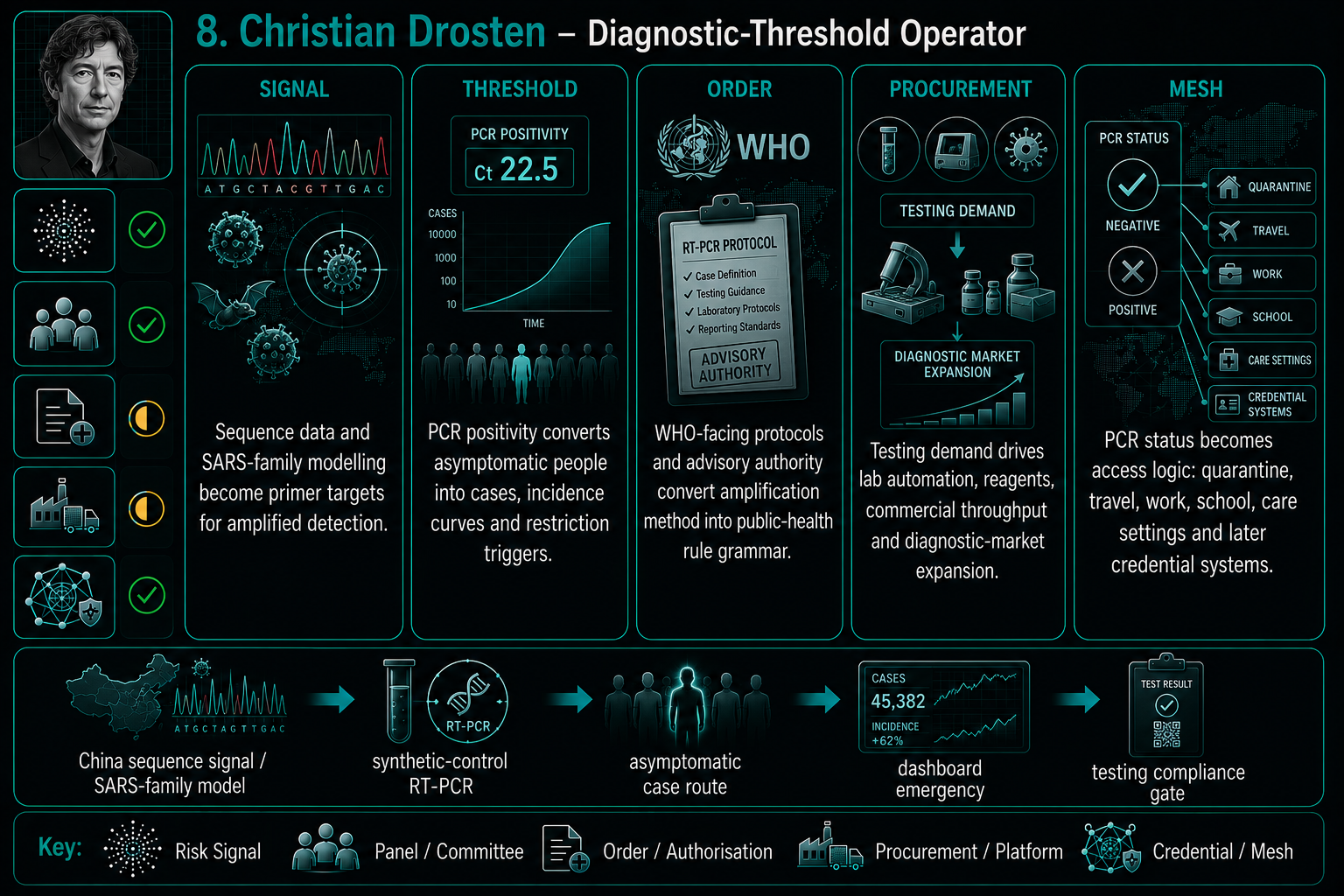
8. Christian Drosten — Diagnostic-Threshold Operator
Ribbon: SARS PCR → Pandemic H1N1 RT-PCR → SARS-CoV-2 Protocol → Dashboard Emergency
Lane / Era: SARS diagnostics, pandemic-influenza testing, Charité virology, WHO-linked COVID diagnostic protocol and German pandemic advisory authority | Peak influence: 2003–2022
House(s): Charité Institute of Virology • Labor Berlin • DZIF • Eurosurveillance • WHO diagnostic-guidance ecology
Role Type: Diagnostic-Threshold Operator
Imprint: Convert pathogen suspicion into amplified signal, convert amplified signal into case count, and let case count become dashboard, restriction trigger and access gate.
Placement
Christian Drosten sits at the diagnostic-threshold layer of the modern biopolitical runtime. He was not a procurement architect, vaccine executive or WHO Director-General. His operator placement was earlier and more technical: make the suspected pathogen countable before political society has settled what the count means.
This was not a COVID one-off. In 2003, Drosten was involved in identifying SARS-CoV and developing early SARS diagnostic testing. In the pandemic-influenza cycle, he worked in the RT-PCR reference layer used to compare and discipline weaker rapid antigen methods. By 2020, he was not merely a virologist reacting to a novel emergency. He was an established outbreak-diagnostics operator: SARS, H1N1, MERS-related coronavirus diagnostics, then SARS-CoV-2.
That lineage matters because PCR is not a clinical diagnosis by itself. It is an amplification method: a process for multiplying targeted genetic material until it becomes detectable. In symptomatic illness, PCR can support diagnosis. In mass screening, especially among asymptomatic people, it can produce an administrative category before illness, infectiousness or social danger has been demonstrated. COVID converted that distinction into a governing route.
Lever
Drosten's lever was diagnostic standardisation under conditions of biological and clinical incompleteness.
In January 2020, the Corman-Drosten group produced one of the first publicly available RT-PCR workflows for detecting the novel coronavirus. DZIF announced on 16 January 2020 that the assay protocol had been published by WHO as a guideline for diagnostic detection. The later Eurosurveillance paper presented a validated workflow for 2019-nCoV, designed at speed before broad access to live virus material and before a mature clinical map of COVID-19 disease existed.
The decisive feature was speed before material certainty. The protocol emerged from sequence intelligence, SARS-family relatedness, primer design and synthetic control material. The laboratory signal was operationalised before the social meaning of the signal was stabilised.
That is the threshold problem. The test could detect targeted RNA. It could not, by itself, decide whether the person was sick, infectious, dangerous or a legitimate object of quarantine. Yet once the protocol entered WHO-facing guidance and national laboratory systems, PCR positivity became available as the governing unit of the pandemic.
The category conversion was simple: RNA detection → infection label → case count → emergency threshold → social gate. A person without illness could be converted into a positive. A positive could be converted into a case. A case could be converted into incidence. Incidence could be converted into dashboard emergency. Dashboard emergency could be converted into quarantine, school closure, mask rule, travel restriction, workplace exclusion, vaccine pressure or credential gate.
The test did not need to be "fake" to become a governing technology. It only needed institutions to treat detection as administratively sufficient.
Mutation
Sequence Signal → RT-PCR Workflow → Asymptomatic Screening → Case Count → Dashboard Emergency → Access Gate
At the sequence layer, genetic information becomes target. At the protocol layer, target becomes test. At the screening layer, people without illness become eligible for detection. At the case layer, detection becomes administrative count. At the dashboard layer, count becomes emergency visibility. At the gate layer, emergency visibility becomes behavioural and institutional control.
Drosten's operator signature is threshold custody. He did not need to order lockdowns. The test layer supplied the signal architecture through which lockdowns, quarantine rules, school closures, travel controls, mask requirements and later credential systems could justify themselves.
Output Ribbons
- SARS/H1N1 → PCR Reference Layer → Pandemic Indicator: Drosten's earlier outbreak work positioned PCR as the authoritative detection layer before COVID turned that layer into mass population governance.
- Sequence Inference → Synthetic Control → Diagnostic Threshold: The early SARS-CoV-2 assay was built from SARS-family sequence logic and synthetic control material before broad live-virus and clinical validation had matured.
- Corman-Drosten Protocol → WHO Guidance → Global Replication: The January 2020 RT-PCR workflow moved rapidly from laboratory design into WHO-facing diagnostic guidance and international uptake.
- Amplification Process → Asymptomatic Screening → Case Manufacture: PCR's movement from diagnostic support into mass screening enabled non-clinical positives to become governable cases.
- Positive Test → Dashboard → Compliance Gate: PCR status became the raw material for incidence curves, public dashboards, quarantine rules, travel barriers, school policy, workplace exclusion and later credential logic.
Operator Reading
Drosten is the diagnostic-threshold operator. His function was not invented by COVID. COVID enlarged a role he had already occupied across respiratory outbreaks: establish molecular detection quickly, make the pathogen countable, and supply public-health systems with the signal layer from which emergency thresholds can be built.
The decisive COVID move was asymptomatic governance. PCR positivity detached the "case" from ordinary illness. A healthy person could become an administrative risk object by amplification result alone. That did not require fraud at the bench. It required institutional agreement that detection was enough.
This is the layer between Daszak's field-risk corridor and Bourla's countermeasure-market corridor. Daszak makes the pathogen-risk field searchable. Drosten makes the pathogen signal measurable. Bourla receives a world already organised by cases, dashboards, emergency authorisations and product demand.
Drosten belongs at the point where laboratory method becomes population management. The substrate is sequence, primer, probe, Ct value, sample, lab report and dashboard. The runtime is amplification-to-threshold conversion.
9. Neil Ferguson / Imperial College — Catastrophe-Model Operator
Ribbon: Outbreak Modelling → Worst-Case Curve → Hospital-Collapse Threshold → Lockdown Runtime
Lane / Era: UK outbreak modelling, SAGE / SPI-M advisory ecology, Imperial College infectious-disease simulation and COVID suppression policy | Peak influence: 2001–2021
House(s): Imperial College London • MRC Centre for Global Infectious Disease Analysis • Jameel Institute • SAGE / SPI-M ecology • Imperial COVID-19 Report 9
Role Type: Catastrophe-Model Operator
Imprint: Convert uncertain outbreak signals into catastrophic projections, convert catastrophic projections into emergency thresholds, and let emergency thresholds become lockdown legitimacy.
Placement
Neil Ferguson sits between the diagnostic threshold and the emergency order. Drosten makes the pathogen signal countable. Ferguson makes the counted signal catastrophic. Tedros, Halton, Hatchett, Bourla and Gates then inherit a world already moved into emergency posture.
This role did not begin with COVID. Ferguson's own UK Covid Inquiry statement records disease-outbreak work since 1995 and long involvement with national and international policymakers. He served on the predecessor of SAGE during the 2001 foot-and-mouth epidemic and on every infectious-disease-related SAGE thereafter: pandemic influenza 2009, Ebola 2014, Zika 2016 and COVID-19 2020. That is the operator placement: not a one-off academic, but an embedded modelling desk inside British emergency government.
The longer record matters. Ferguson's group modelled foot-and-mouth, SARS, swine flu, MERS, Ebola, Zika and COVID. The public pattern is familiar: uncertain pathogen, modelled spread, upper-bound or worst-case curve, media amplification, emergency advice, policy pressure. Some of those projections were scenario warnings rather than literal forecasts. But that distinction is exactly the operator problem. In crisis politics, worst-case scenarios rarely remain academic boundary cases. They become moral pressure devices.
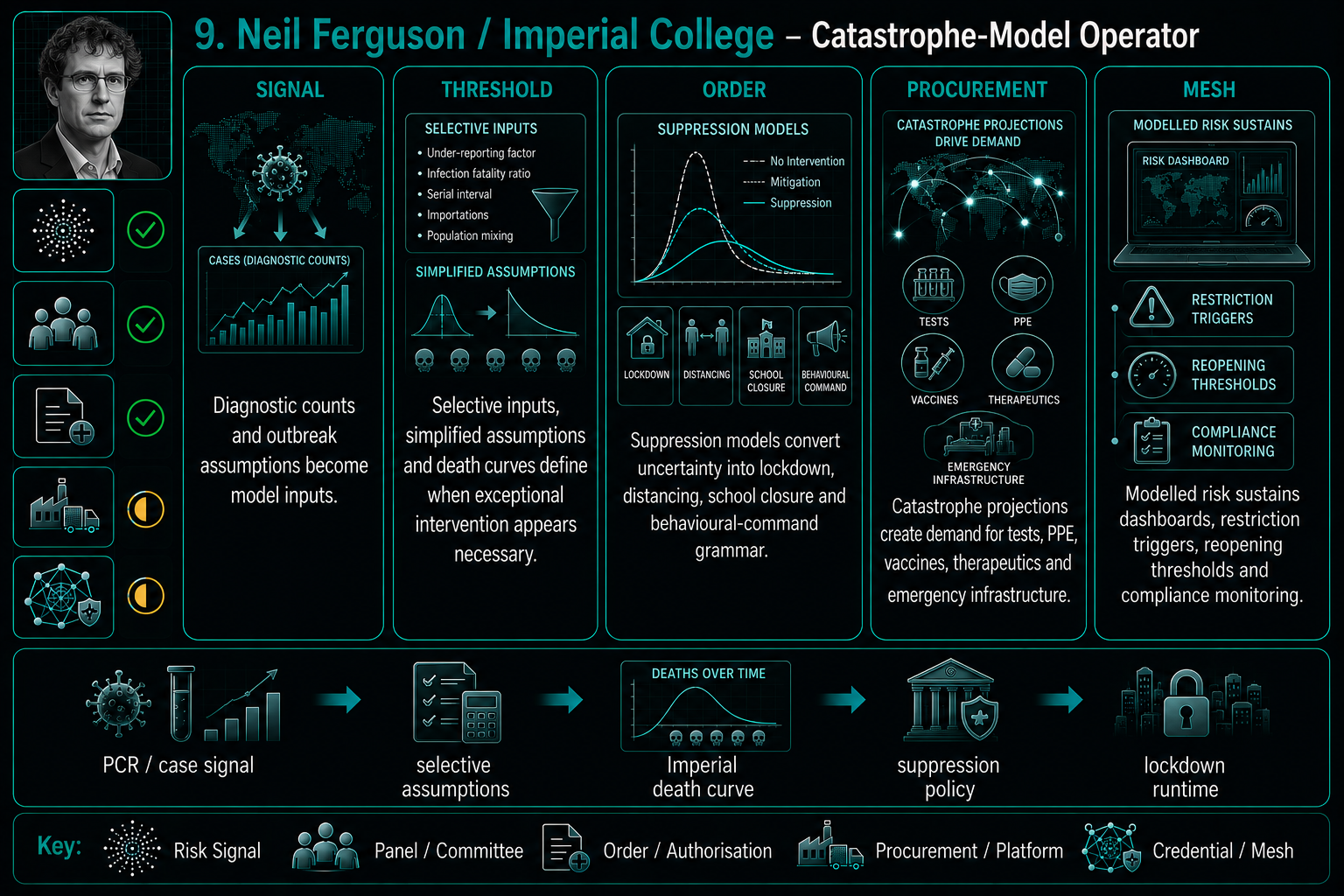
COVID made the desk decisive. On 16 March 2020, Imperial's Report 9 estimated that an unmitigated epidemic could produce approximately 510,000 deaths in Great Britain and 2.2 million deaths in the United States, and that mitigation alone could still overwhelm intensive-care capacity. That document became a threshold instrument. It did not merely describe risk. It supplied the curve through which refusal of suppression could be framed as choosing mass death.
Lever
Ferguson's lever was modelled catastrophe.
The input field came from the diagnostic regime: cases, deaths, assumed transmission, estimated infection fatality, age structure, contact patterns and hospital capacity. The model converted those inputs into projected futures. One future then became politically dominant: a hospital-collapse curve in which ordinary social life became the pathway to mass mortality.
The mechanism was simple: PCR/case signal → model input → death curve → hospital-collapse threshold → suppression policy. That conversion moved governments from outbreak management to social suspension.
The selective-input problem was central. The model's social world was necessarily simplified: households, schools, workplaces, contacts and hospital capacity became compartments and parameters. But transmission did not move only through neat categories. Hotels, care homes, hospitals, migrant-worker dormitories, prisons, transport nodes, multi-generational households, informal labour, border flows and local geography could all alter outbreak dynamics. A national curve could therefore appear more universal than its contact architecture justified.
The code controversy exposed the accountability failure. The source code was released after a delay; Ferguson told the UK Covid Inquiry that the delay reflected time pressure and continuous updating. A later Codecheck review found the Report 9 results reproducible, but reproducibility is not validity. It confirms that the machinery can reproduce its output. It does not prove that the assumptions were sound, the selected inputs were proportionate, the social graph was adequate, or the policy translation was justified.
Mutation
Diagnostic Signal → Epidemiological Model → Worst-Case Curve → Hospital-Collapse Threshold → Suppression Policy → Lockdown Runtime
At the diagnostic layer, positive tests and deaths become inputs. At the model layer, assumptions convert inputs into simulated futures. At the curve layer, one future becomes the visible catastrophe. At the threshold layer, hospital collapse becomes the moral trigger. At the policy layer, suppression becomes responsibility. At the runtime layer, lockdown reorganises society: school, work, worship, travel, assembly, care, commerce and speech.
Ferguson's operator signature is threshold manufacture through simulation. He did not need to issue police orders. The model supplied the scenario in which police orders, stay-at-home rules, school closures and social-distancing mandates appeared necessary.
Output Ribbons
- BSE/Foot-and-Mouth/Flu → Alarm Pattern → Credibility Paradox: Earlier modelling supplied a long record of high-impact catastrophic scenarios. Even when outcomes fell below worst-case projections, the emergency-modelling role persisted.
- PCR/Case Data → Model Input → Death Curve: The diagnostic threshold supplied the input field; the model converted that field into projected mortality and hospital-collapse futures.
- Report 9 → 510,000/2.2 Million → Lockdown Legitimacy: Imperial's March 2020 model became one of the decisive documents shifting Britain and other governments toward suppression.
- Selective Inputs → Flattened Social Graph → Universal Curve: Omitted or simplified environments matter when a model becomes national policy.
- Code Release → Reproducibility Check → Validity Gap: Post-release review could reproduce outputs but did not settle whether assumptions, inputs, uncertainty handling or policy translation were sound.
- Worst Case → Moral Threshold → Policy Compression: Scenario modelling compressed political choice: lockdown became responsibility; refusal became culpability for projected deaths.
- Model Failure Dispute → No Rollback → More Preparedness: Post-hoc disputes over accuracy did not unwind the architecture. They became arguments for better data, better models and earlier intervention.
Operator Reading
Ferguson is the catastrophe-model operator. His desk is simulation: the place where uncertain present signals become frightening futures, and frightening futures become policy permission.
The model did not merely predict deaths. It selected a social world, simplified that world into parameters, and returned the simplification as emergency reality. That is the governing risk. Once a curve is treated as national destiny, omitted settings, crude contact assumptions and flattened behavioural variation disappear from public view, while the policy response expands across everyone.
The accountability failure is central. A model used to close schools, businesses, churches, clinics, borders and civic life must be more than reproducible. It must be interrogable: assumptions exposed, inputs contested, uncertainty visible, counterfactuals bounded, code reviewable and political translation separated from technical output. Ferguson's model moved too quickly from simulation to command grammar. By the time assumptions, code quality and contact architecture were publicly argued over, the lockdown runtime had already been installed.
Ferguson sits between diagnostic count and emergency order. Drosten makes the pathogen signal measurable. Ferguson makes the measurable signal catastrophic. The emergency state then inherits the curve.
The substrate is case data, contact matrix, parameter, codebase, scenario table, death curve and ICU threshold. The runtime is simulation-to-suspension conversion.
10. Albert Bourla — Countermeasure-Market Operator
Ribbon: mRNA Platform → Vaccine Label → Relative-Risk Headline → Indemnified Procurement → Booster Franchise
Lane / Era: Pfizer executive leadership, BioNTech partnership, COVID vaccine emergency authorisation, global procurement and antiviral expansion | Peak influence: 2019–2023
House(s): Pfizer • BioNTech partnership • FDA EUA / approval corridor • EU advance-purchase ecology • COVAX / government procurement channels
Role Type: Countermeasure-Market Operator
Imprint: Receive the emergency signal, carry a novel genetic platform through the vaccine category, convert a relative-risk endpoint into public certainty, secure liability-protected contracts, and turn public-health demand into recurring franchise.
Placement
Albert Bourla occupies the corporate execution desk of the modern biopolitical runtime. Previous operators create the field: Daszak makes pathogen risk searchable, Drosten makes the signal countable, Tedros supplies the global emergency venue, Hatchett builds the platform-preparedness grammar. Bourla receives that field as corporate opportunity: product, contract, rollout, booster, antiviral, revenue.
Pfizer's COVID position was not merely that it had a vaccine. It had the right product in the right institutional corridor: a BioNTech mRNA platform, trial results framed through emergency efficacy, government buyers, liability protections, public fear, media amplification, regulatory fast lanes and a population already sorted by testing, case dashboards and access rules.
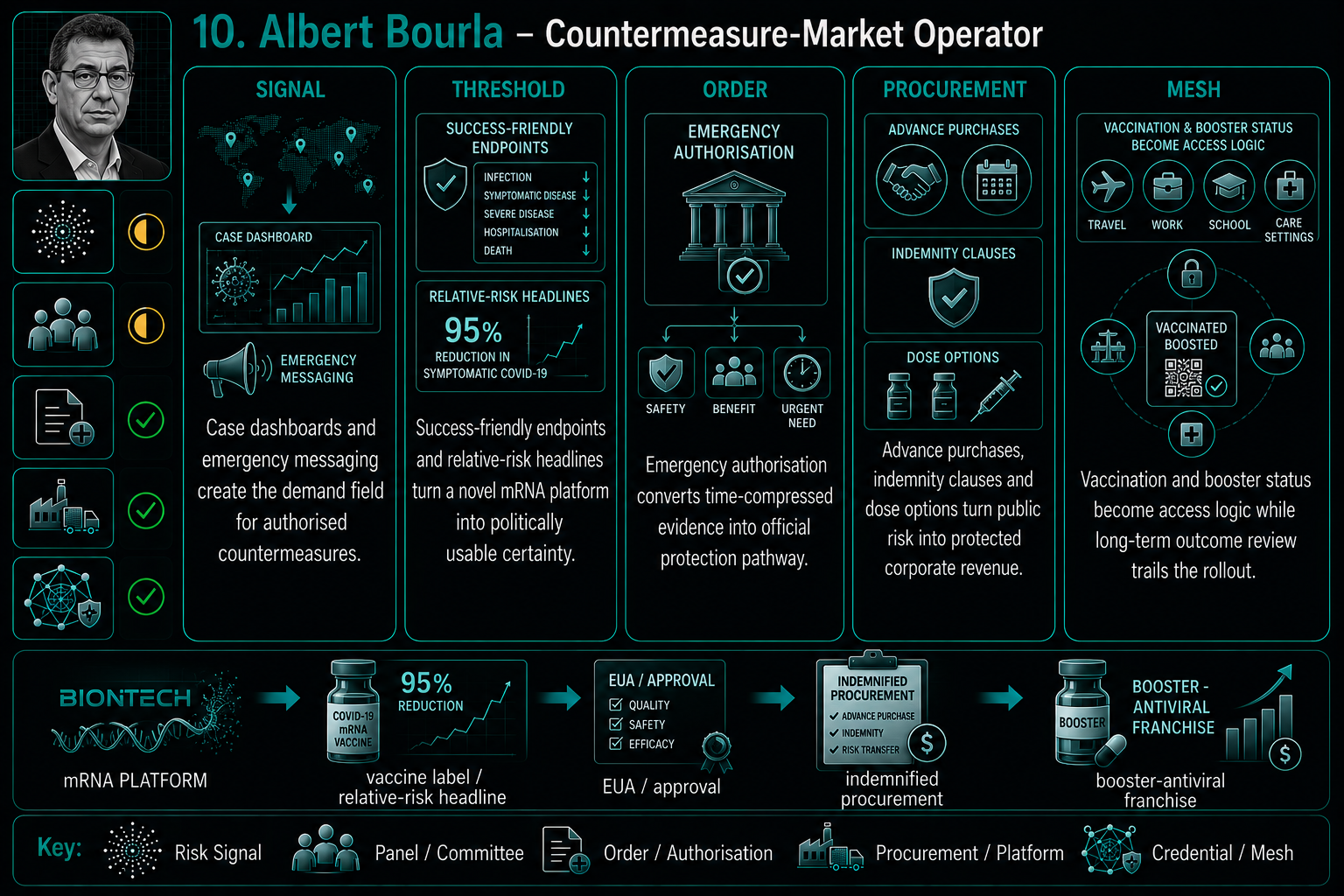
In November 2020, Pfizer and BioNTech announced final Phase 3 results reporting 95% efficacy against COVID-19, based on 170 confirmed cases: 162 in placebo, 8 in vaccine. The FDA authorised the product on 11 December 2020. Full approval for Comirnaty followed in August 2021.
Lever
Bourla's lever was corporate countermeasure conversion.
The first lever was category laundering. The product was publicly carried under "vaccine," but the platform was a genetic-instruction countermeasure: lipid nanoparticles delivering mRNA so recipient cells produce spike protein. Presented as a novel genetic platform without long-term population safety data, it would have faced a different consent environment. Presented as a vaccine during emergency, it inherited a century of public-health trust, school-entry precedent and mandate logic.
The second lever was the efficacy headline. "95% effective" became a market-making number: simple, repeatable, media-ready. But it was a relative-risk figure against a narrow symptomatic-COVID endpoint, not absolute protection across infection, transmission, hospitalisation, death or long-term safety. Critical appraisals placed Pfizer's absolute risk reduction at roughly 0.7%. The operator move was compression: a conditional trial result became a universal public slogan.
The third lever was trial design. Criticism in The BMJ warned that major COVID vaccine trials were not designed to determine whether products would save lives, reduce hospitalisation, prevent ICU use or interrupt transmission. They were built around laboratory-confirmed symptomatic COVID-19, often including mild disease, and could declare efficacy after relatively few endpoint cases. The trial was the bridge from platform uncertainty to procurement certainty.
The fourth lever was transparency control. The FDA's attempted long production schedule for releasing Pfizer licensing records under FOIA became a public scandal because it contradicted the emergency trust claim. A product sold through public urgency, public money and public coercion cannot also depend on delayed public inspection. The court-ordered release exposed the deeper problem: the market had already been made before the documentary substrate was fully open to adversarial review.
The fifth lever was advance purchase and liability insulation. Governments became buyers, distributors and behavioural enforcers. Pfizer publicly stated that it seeks indemnity and liability protections in vaccine agreements, including COVAX. Public authority created demand; private firms supplied product; states absorbed or shielded key risk.
The sixth lever was franchise extension. Comirnaty generated tens of billions in revenue and became Pfizer's dominant product. Paxlovid extended the therapeutic corridor. Boosters, variants, pediatric authorisations and treatment eligibility turned the first emergency rollout into a recurring countermeasure business.
Mutation
Emergency Signal → Genetic Platform → Vaccine Label → Success-Friendly Endpoint → Relative-Risk Headline → EUA/Approval → Government Contract → Liability Shield → Booster Franchise
At each layer, uncertainty is compressed or displaced. Mass testing creates demand. A novel platform inherits vaccine legitimacy. Symptomatic-case reduction supplies a rapid success test while mortality, transmission and long-term safety remain unresolved. Relative-risk efficacy becomes public certainty. Emergency pathways turn time-compressed evidence into permitted rollout. Governments become bulk purchasers. Liability shifts outward. Boosters extend the market beyond the first wave.
Bourla's operator signature is monetised compliance. The product is not sold only to willing consumers. It enters a world where employers, universities, travel systems, hospitals, militaries and states can condition access on product status. Corporate revenue is produced through public-health authority.
Output Ribbons
- BioNTech Platform → Pfizer Scale → mRNA Flagship: A smaller platform company supplied technology; Pfizer supplied global regulatory, manufacturing, commercial and political scale.
- Genetic Platform → Vaccine Label → Mandate Ecology: A novel mRNA platform entered public life under the trusted vaccine category, making coercive rollout easier.
- Success-Friendly Endpoint → Relative-Risk Headline → Market Conversion: Trials could produce fast efficacy signals without first resolving mortality, transmission or long-term safety.
- Relative Risk → Public Slogan → Absolute-Risk Obscurity: The 95% figure compressed a trial endpoint into a mass slogan while absolute benefit remained far less visible.
- FOIA Delay → Documentary Secrecy → Trust Contradiction: The attempted long release schedule revealed the contradiction between emergency trust and delayed inspection.
- Advance Purchase → Liability Protection → Risk Transfer: Governments bought doses and absorbed liability while the company retained upside.
- Comirnaty/Paxlovid → Revenue Surge → Franchise Extension: Vaccine revenue, booster logic and antiviral procurement turned pandemic response into a corporate growth engine.
Operator Reading
Bourla is the countermeasure-market operator. His role is to convert the machine's upstream outputs into product revenue and market power.
The diagnostic layer supplies cases. The emergency venue supplies urgency. The platform-preparedness layer supplies legitimacy. The regulatory layer supplies authorisation. The procurement layer supplies buyers. The compliance layer supplies captive demand. Pfizer then turns that architecture into contracts, doses, boosters, antivirals, public messaging and shareholder-scale returns.
The decisive corporate move was headline-to-franchise conversion. A novel mRNA product was carried through the trusted vaccine category, sold through a relative-risk headline, authorised through emergency pathways, purchased by governments, protected by liability arrangements and enforced downstream through mandate ecology. The long-term safety record, all-cause outcome debate and documentary inspection trailed behind the rollout. The revenue arrived first.
Bourla belongs at the point where biopolitical emergency becomes corporate franchise. The body is already classified by risk, test status, exposure, workplace rule and access condition. The company supplies the authorised countermeasure and captures the revenue stream attached to compliance.
The substrate is trial endpoint, EUA letter, purchase agreement, indemnity clause, booster schedule, cold chain and earnings call. The runtime is emergency-to-franchise conversion.
11. Bill Gates — Donor-Governance Market Shaper
Ribbon: Software Capital → Foundation Power → Vaccine Alliances → Pandemic Rehearsal → Platform Markets
Lane / Era: Gates Foundation, Gavi, CEPI, WHO funding ecology, Event 201, African and Indian vaccine / digital-health corridors | Peak influence: 2000–present
House(s): Bill & Melinda Gates Foundation • Gavi • CEPI • WHO • Johns Hopkins Center for Health Security / Event 201 • COVAX • India / Africa vaccine-manufacturing and delivery corridors
Role Type: Donor-Governance Market Shaper
Imprint: Use private capital to seed alliances, shape vaccine markets, rehearse pandemic response, influence WHO-facing agendas, and turn public-health need into platform, procurement and delivery architecture.
Placement
Bill Gates occupies the central donor-governance desk of the modern biopolitical runtime. He is not a regulator, minister, scientist or manufacturer. His power is infrastructural: capital, convening, agenda-setting, market shaping, partnership design, risk framing and institutional access.
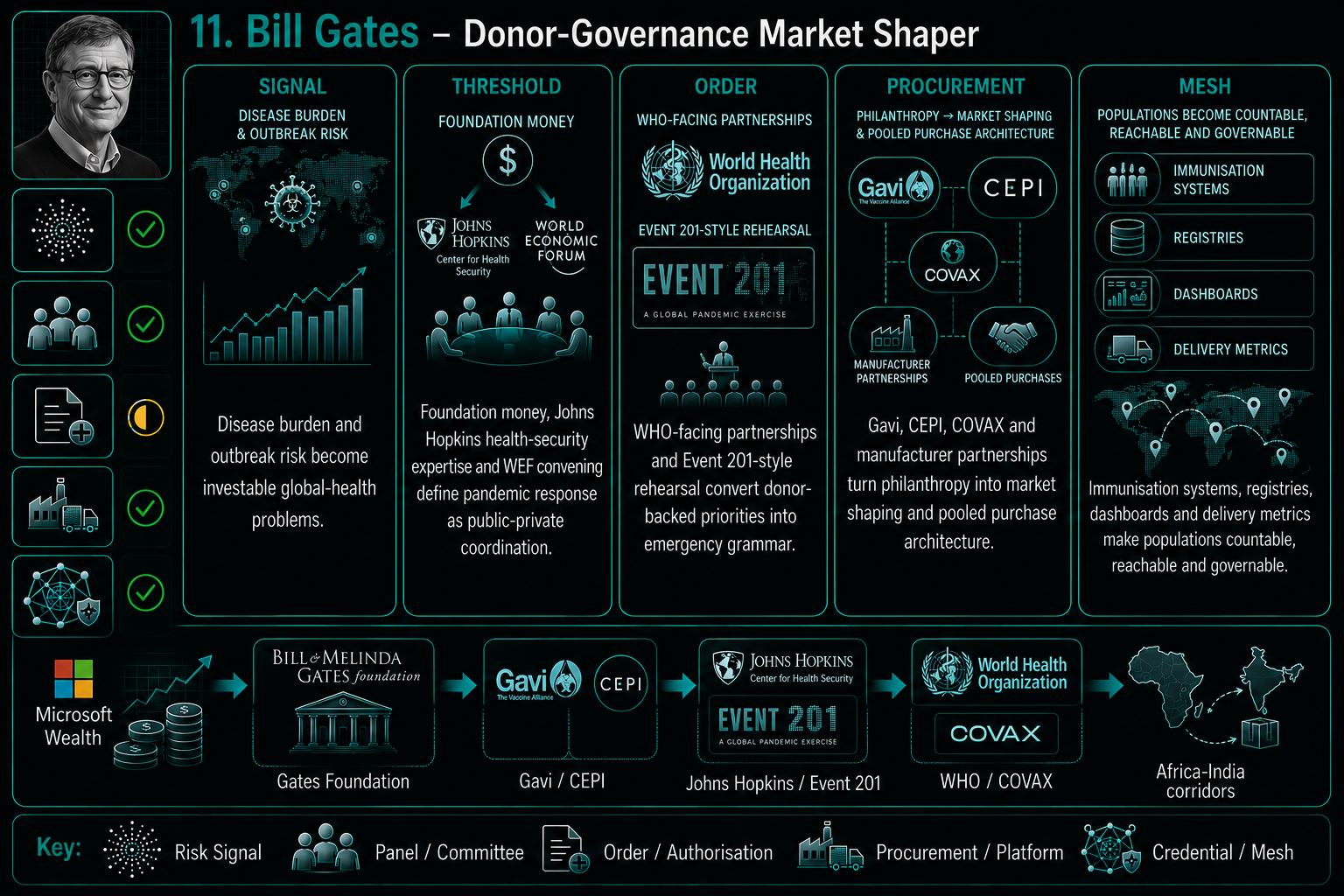
The Gates Foundation seeded and scaled the vaccine-alliance architecture. Gavi records that the foundation pledged US$750 million to help launch Gavi in 1999 and describes it as a key partner in vaccine market shaping, with a permanent board seat and total commitments exceeding US$4 billion. Gavi's own language is the receipt: the foundation plays both a financial and technical role in shaping vaccine markets, gathering data, funding investments, supporting innovation and encouraging new entrants.
The same pattern appears in CEPI, launched in Davos by Norway, India, the Gates Foundation, Wellcome and the WEF. Its founding premise was platform preparedness: develop vaccines against epidemic threats before they become global emergencies. That is Gates's recurring method: do not merely respond to a health problem; build the alliance, fund the prototype, define the delivery channel, and shape the market in advance.
WHO is the supranational venue into which this feeds. WHO's modern operating reality depends heavily on voluntary and often earmarked funding. The Gates Foundation has been one of WHO's largest non-state contributors. The point is not that Gates "owns" WHO. It is that earmarked donor capital shapes what WHO can prioritise, staff, measure and deliver.
The Johns Hopkins / Event 201 lane makes the operating role explicit. On 18 October 2019, the Center for Health Security, the WEF and the Gates Foundation hosted Event 201: a high-level tabletop built around a severe coronavirus pandemic scenario. Its significance is rehearsal. It placed public authority, private platforms, global business, finance, media, health agencies, countermeasure systems and supply chains inside one coordinated emergency frame before COVID arrived.
That is the Gates placement: not one desk inside the system, but the capital-and-convening layer that makes desks interoperable.
Lever
Gates's lever is philanthropic capital joined to market design.
The first lever is alliance seeding. Gavi turned vaccine delivery into a public-private operating system: donor money, manufacturer incentives, country eligibility, procurement support, delivery metrics and board governance. CEPI did the same for epidemic preparedness.
The second lever is rehearsal. Event 201 shows Gates capital operating not only as donor funding but as scenario architecture. With Johns Hopkins supplying health-security expertise and WEF supplying corporate-state convening power, the Gates Foundation helped stage a pandemic operating model: public-private coordination, countermeasures, information management, trade and travel disruption, finance, logistics and public trust. The COVID runtime did not need to copy the exercise for the exercise to matter. The grammar had already been normalised.
The third lever is market shaping. Gates capital helps create the market conditions under which products become viable: advance commitments, pooled procurement, price guarantees, delivery systems, data tools, country eligibility rules and manufacturer incentives. India supplies the manufacturing hinge: the Gates Foundation, Gavi and the Serum Institute of India formed a COVID vaccine collaboration to accelerate manufacturing and delivery for low- and middle-income countries.
The fourth lever is Africa as programme field. Gates-backed global health has long treated Africa as central terrain for vaccine delivery, disease-eradication campaigns, health-system metrics, agricultural and development interventions, and now local manufacturing. Africa is the demonstration field where donor capital, state systems, metrics, delivery partners and pharmaceutical supply chains are fused.
The fifth lever is WHO-facing legitimacy. Gates-backed immunisation and preparedness priorities move through Gavi, CEPI, WHO, UNICEF, the World Bank, COVAX and national ministries. The chain is complete: donor capital, alliance governance, platform preparedness, WHO venue, manufacturer capacity, country eligibility, delivery rule.
Mutation
Private Wealth → Foundation Capital → Alliance Seeding → Pandemic Rehearsal → Market Shaping → WHO Legitimacy → Country Delivery → Data/Compliance Mesh
At each layer, private wealth gains public authority. Software monopoly capital becomes philanthropic authority. Foundation capital becomes agenda power. Gavi and CEPI create permanent public-private machinery. Event 201 pre-aligns governments, business, health agencies, media logic and countermeasure systems. Vaccines become investable and scalable. Donor-backed priorities gain supranational legitimacy. Africa and India become manufacturing, delivery and demonstration corridors. Immunisation systems, registries, dashboards, cold chains, eligibility rules and digital-health tools make populations countable and reachable.
Gates's operator signature is centrality without office. He does not need to run a ministry. He helps build the operating system inside which ministries act.
Output Ribbons
- Gates Foundation → Gavi → Vaccine Market Shaping: Foundation capital helped launch and sustain Gavi, with board-level presence and explicit market-shaping function.
- Gates/Wellcome/States → CEPI → Platform Preparedness: CEPI converted epidemic risk into advance vaccine development and the 100-days logic of countermeasure readiness.
- Johns Hopkins/WEF/Gates → Event 201 → Public-Private Rehearsal: Pandemic response was rehearsed as a corporate-state operating problem before COVID: countermeasures, supply chains, finance, information control, continuity and public trust.
- WHO Funding Ecology → Earmarked Priorities → Global Legitimacy: Large voluntary contributions give donor-backed programmes agenda weight inside WHO-facing health governance.
- India → Serum Institute → LMIC Supply Corridor: Indian manufacturing became the bridge between donor financing, Gavi procurement and mass vaccine supply for lower-income countries.
- Africa → Delivery Field → Manufacturing/Metrics Laboratory: African health systems became central to vaccine delivery, eradication campaigns, local manufacturing and donor-state performance metrics.
- COVAX → Equity Language → Allocation Architecture: COVID vaccine access was framed through equity while operating through contracts, eligibility, pooled procurement, manufacturing bottlenecks and allocation rules.
Operator Reading
Gates is the central market-shaping custodian of the modern biopolitical runtime. He does not sit at the lab bench like Drosten, in the field corridor like Daszak, at the corporate execution desk like Bourla, or in the WHO emergency chair like Tedros. He sits above and between them: the funder-convener whose capital makes institutions interoperable.
The Gates function is to turn health problems into platform markets and delivery systems. Disease burden becomes investment thesis. Vaccine access becomes alliance governance. Preparedness becomes CEPI. Pandemic rehearsal becomes public-private operating grammar. Equity becomes COVAX. African and Indian health systems become delivery and manufacturing corridors. WHO legitimacy turns the architecture into global public-health common sense.
Event 201 is the hinge between philanthropy and operating system. It shows Gates power not merely funding vaccines, but convening the crisis grammar in advance: public health, business continuity, platform cooperation, media discipline, countermeasure supply and political decision-making.
This is why Gates closes the modern sequence. Fauci supplies risk-and-therapeutic authority. Collins supplies NIH funding gravity. Farrar bridges philanthropy and WHO science. Halton rehearses emergency governance. Hatchett builds the platform-procurement architecture. Tedros supplies the PHEIC venue. Daszak supplies the field-risk corridor. Drosten supplies the diagnostic threshold. Bourla monetises the authorised countermeasure. Gates supplies the meta-architecture: money, alliances, rehearsal, legitimacy, market shaping and scale.
Gates is not simply a donor. He is the private-sovereign operator of global health: unelected, formally philanthropic, publicly humanitarian, structurally central.
Final Reflection — The Dashboard Runtime
Addendum 5a showed the older conveyor: doctrine, record office, model statute, clinic, professional gate, donor programme, population council. The modern chain runs through testing protocols, dashboards, advisory panels, emergency venues, trial endpoints, authorisation corridors, advance-purchase agreements, platform markets and compliance systems.
Each operator performed a conversion. Fauci supplied the signal-and-therapeutic corridor. Collins supplied NIH funding gravity. Farrar bridged philanthropy and WHO science. Halton carried crisis-room administration into biomedical preparedness. Hatchett converted biodefence logic into CEPI platform procurement. Tedros supplied the supranational threshold venue. Daszak supplied the field-risk corridor. Drosten supplied the diagnostic threshold. Bourla monetised the authorised countermeasure. Gates supplied the meta-architecture: capital, alliances, rehearsal, legitimacy, scale.
The operators differed in venue—laboratories, ministries, foundations, WHO offices, pharmaceutical corporations, field NGOs. The common function was not identical motive. It was conversion. Each helped move biological uncertainty into an institutional form that could be funded, authorised, purchased, counted, distributed, enforced or defended.
The upgrade is substrate-level: heredity becomes risk, pedigree becomes sequence, record office becomes dashboard, model law becomes emergency authorisation, clinic network becomes platform rollout, philanthropy becomes market shaping, court order becomes access condition, population programme becomes compliance mesh.
The modern machinery is faster because it does not wait for central command. Each layer claims it is merely following the previous layer. Power does not need to announce itself as domination. It can appear as preparedness, equity, trust, speed, safety, access, resilience and science. The body is classified for protection. The category is stabilised as evidence. The threshold is presented as responsibility. The product is purchased as public duty. The gate is enforced as care.
Published via Mindwars Ghosted.
Overlords: Mapping the Operators of reality and rule.
—
Author’s Note
Produced using the Geopolitika analysis system—an integrated framework for structural interrogation, elite systems mapping, and narrative deconstruction.