Geopolitika: The Kushner Routes, Part 5. The View From the Junction
What Jared Kushner reveals about how power moves—and who remains outside the frame.
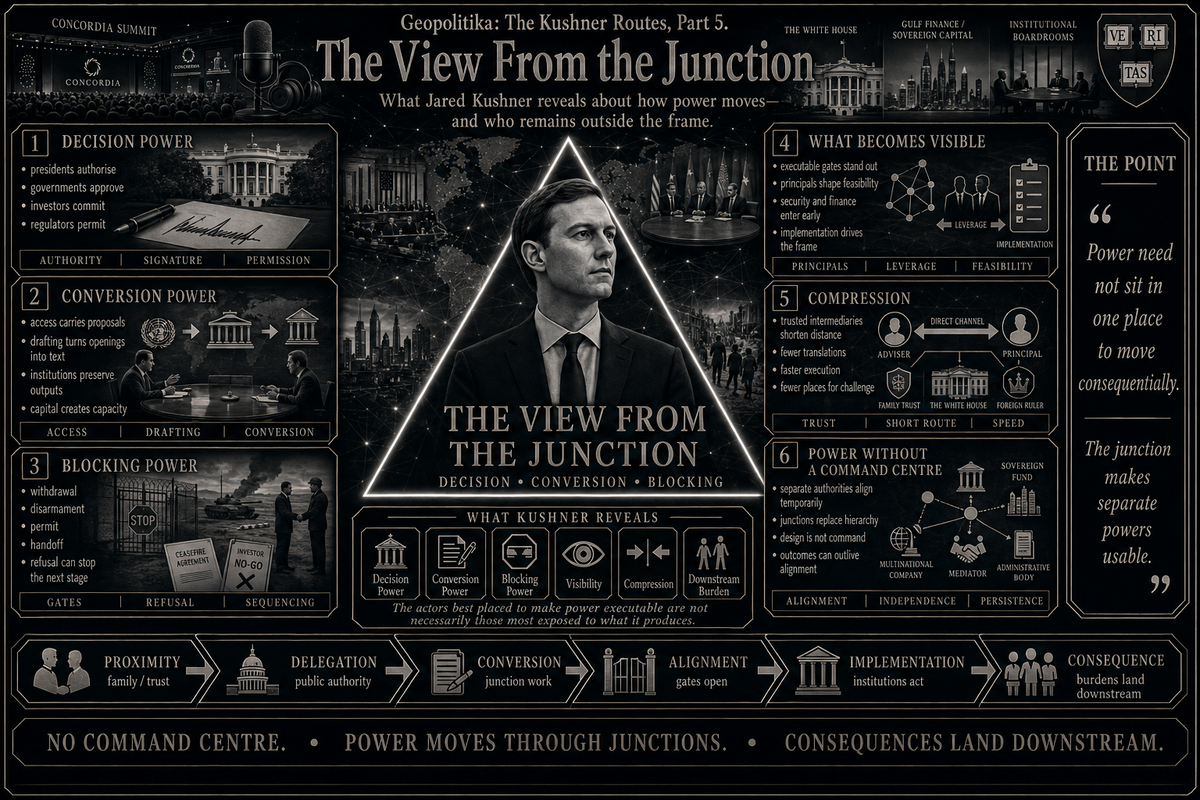
This article is published as part of the Geopolitika project to map structures of power by examining their leadership, institutional position, relationships, public claims, outputs and downstream consequences. The Kushner Routes has followed Jared Kushner not as the centre of a hidden system but as a sequence of positions through which family access, presidential authority, elite relationships, private capital, political ideas and institutional capacity become usable in different settings.
—
Executive Summary
The first four parts of The Kushner Routes followed Jared Kushner through a sequence of positions that are usually analysed separately. Part 1 examined the accumulation of family position, access, relationships, reputation and private institutional capacity. Part 2 showed why those assets should not be mistaken for command: presidents, governments, investors, regulators and counterparties retained powers of their own even when Kushner could help connect them. Part 3 turned to the political grammar accompanying that role—principals, interests, security, incentives, markets, implementation and the recurring distinction between what is treated as practical and what is treated as obstruction. Part 4 asked what happens when those categories become architecture: who receives decision rights, which histories become inherited facts and who is required to live with the resulting arrangements.
This final part turns the lens around. The question is no longer principally how Jared Kushner became powerful, but what becomes visible about power itself when one career repeatedly crosses the boundaries between family, presidency, diplomacy, institutions, sovereign capital, private investment and political implementation.
None of this requires a hidden organisation controlling the actors involved. In fact, the opposite is more revealing. The institutions retain their separate authority. The intermediary does not become the president whose mandate he carries, a relationship with a sovereign principal does not transfer sovereign power, and access to a government does not transfer that government’s legal authority. Nor does blocking power imply authorship: an armed organisation may be able to obstruct an architecture it did not design.
For the purposes of this synthesis, three forms of power are especially useful to keep apart:
- Decision power belongs to actors authorised to make the relevant choice.
- Conversion power belongs to actors who can make separately controlled capacities usable across institutional boundaries.
- Blocking power belongs to actors whose cooperation the next stage requires. If a process depends on a signature, withdrawal, permit, investment decision, disarmament, recognition or administrative handoff, refusal can delay, reshape or stop what follows.
These are not exhaustive categories. They clarify why consequential powers can be distributed among different people and why they do not travel as one portable substance: legal authority can expire while relationships and institutional knowledge remain; organisations can outlive their originators; capital can create private capacity without reproducing public authority; and ideas can migrate into institutional design without proving continuous intention or command.
The more consequential shift comes when the same architecture is viewed from the other direction. Systems organised around implementation naturally foreground actors who possess executable gates: presidents who can authorise, governments that can approve, investors who can finance, regulators that can permit, armed organisations that can refuse and administrators who can implement. Their preferences enter the process early because the process cannot proceed without them.
The people who will live with the result often occupy a different position. They may possess agency, political claims, legal rights, votes, resistance and the ability to reshape events without controlling an equivalent gate through which the architecture must pass. They can consequently become highly visible as beneficiaries, residents, claimants, protesters or burden-bearers while remaining less powerful in determining the conditions established upstream.
That distinction is the final subject of The Kushner Routes. Kushner may be unusual in how many institutional boundaries one biography crosses, but what those crossings expose is less unusual: power need not sit in one place to move consequentially, and the people best positioned to make it executable are not necessarily those most exposed to what it produces.
The View From the Junction
A political biography usually asks what one person did, while a network story asks whom that person knew. Neither is quite enough for Jared Kushner, because across the cases examined in this series his importance repeatedly appears between actors who possess different powers.
What he repeatedly occupies is the junction: not a command centre, but a place where independently controlled capacities can become capable of interacting.
During Trump’s first administration, presidential appointment gave Kushner something his private relationships alone could never provide—delegated public authority. That authority allowed him to enter negotiations as a representative of an American administration and to move propositions between actors capable of making sovereign decisions. The agreements that followed, however, still depended on powers he did not possess. Trump retained presidential authority; foreign governments retained their own calculations and legal powers; diplomats and officials performed other parts of the process; and states made the decisions that could be formalised into agreements.
A government role can terminate at a precise institutional boundary while leaving behind things acquired inside it. Familiarity with particular leaders, knowledge of how they negotiate, reputation created by earlier outcomes, relationships formed through repeated interaction and an understanding of the routes through which future proposals might travel can all persist after the mandate ends.
That is why Kushner’s career is more illuminating when read from the junction than when read as a story of continuous personal power. The same person can move through several domains without carrying the legal powers of one domain into the next; what changes is the institutional mechanism through which the person becomes useful.
Seen that way, the larger question is not whether Kushner possesses “influence” in the abstract. It is what has to happen before one actor’s power can become actionable in another actor’s world.
Power Does Not Move as One Thing
Political language often treats power as though it were a possession. A person has power, acquires more of it, loses it or uses it. The cases examined in this series suggest a less tidy architecture.
A president, a sovereign fund, a foreign government, a negotiator, an armed organisation and a local regulator may all be powerful, but they are not powerful in the same way. Their capacities cannot simply be added together as though they were quantities of one material.
For the purposes of this synthesis, the distinction is best stated directly:
- Decision power is the authority to make a choice the process recognises as consequential: a president can authorise, a government can approve, an investor can commit capital, a regulator can grant permission and an armed organisation can accept or refuse a demand.
- Conversion power makes something controlled by one actor usable in another setting: an intermediary can carry priorities into negotiation, a team can turn an opening into formal text, an achievement can acquire an institution, and a private proposal can enter a governmental approval route.
- Blocking power belongs to actors whose cooperation the next stage requires. An actor need not control the overall architecture to possess substantial power over whether it advances. If a process depends on a signature, withdrawal, permit, investment decision, disarmament, recognition or administrative handoff, refusal at that point can delay, reshape or stop what follows.
These distinctions are not claims that every political system naturally divides into exactly three kinds of power. Their value lies in preventing one visible intermediary from being mistaken for the owner of capacities that remain elsewhere.
This is particularly clear in Gaza. American intermediaries may carry delegated authority into negotiation while Israel retains state and military powers, Hamas retains the ability to resist demands directed towards it, proposed Palestinian institutions exercise only transferred authority, and investors decide whether conditions justify committing capital.
Those capacities occupy the same architecture without becoming one hierarchy. Power can therefore be consequential precisely because it remains distributed.
The useful questions are therefore not simply who is powerful, but who can decide, who can convert another actor’s capacity into something usable, who can stop the next stage, and who may be profoundly affected without controlling any of those gates.
What Moves—and What Does Not
Once power is separated into different capacities, another pattern becomes easier to see: what persists across institutional boundaries is often not authority itself, but the relationships, reputation, knowledge and institutional outputs that earlier authority helped create.
Formal authority is among the least portable forms of power. Kushner could exercise presidentially delegated functions while serving in government because an elected president and the institutions of the American state made those functions available to him. Leaving office removed that authority. Personal relationships did not allow him to continue negotiating for the United States simply because foreign leaders still knew him.
What survived was different. Relationships can remain after the office that created them, as can reputation, knowledge of particular principals, familiarity with bargaining styles, understanding of institutional procedure and memory of how earlier agreements were assembled. This is the basis of the distinction that runs through the section: authority expires faster than relationships.
Those residues do not survive unchanged or remain available in the same form. Their significance is that a later institution can make some of them useful again.
Affinity Partners shows what that conversion can look like in a different domain. When Kushner founded the firm after leaving government, he did not carry American state authority into private investment. He entered the region through another institutional form: the founder of an investment firm seeking capital and opportunities. Gulf sovereign funds became major sources of Affinity’s capital, including states occupying important positions in the diplomatic geography of Kushner’s earlier public career.
That chronology matters because it creates legitimate questions about conflicts of interest, political economy and the permeability between public relationships and private opportunity, but it does not answer those questions automatically. Funding can create dependence, incentives, expectations and access; without further evidence, it does not establish that an investor purchased an earlier public decision, instructed later diplomacy or controlled the recipient’s political actions.
Across the sources and analyses compiled for this series, no evidenced route establishes that Gulf sovereign investment in Affinity translated back into control over Kushner’s later diplomatic activity or American policy. The money and geographic overlap are real, but the causal link back to political control is not established by this corpus.
The narrower conclusion is still consequential. Relationships and standing acquired through public service can coexist with private opportunities after office, and private ownership can create new financial interests if the same person later returns to diplomacy. The structural issue does not depend on proving bribery or purchased policy; it lies in how short the distance can become between the relationships through which public authority once moved and the vehicles through which private capital later moves.
Political achievements can also outlive the authority that helped produce them. The Abraham Accords continued through governments, embassies and commercial relationships after Kushner left office, while the Abraham Accords Peace Institute added an institutional afterlife devoted to sustaining and extending their logic.
Kushner’s documented founder status does not establish command over everything the Institute later says or does. The broader point is that an output can become a platform, accumulating personnel, research, advocacy, relationships and organisational memory of its own.
The pattern is not that power travels intact from one setting to the next. Authority may expire while relationships remain; capital can create capacity without reproducing public authority; institutions can preserve an output after the original political moment; and ideas can migrate into later designs without proving one continuous intention or command structure.
Kushner’s career makes the mechanism unusually visible: power often moves between settings not because the original authority survives, but because something produced around that authority becomes usable later.
The residue of power can be more portable than power itself.
The Junction Changes What Becomes Visible
The junction is not only a place where power moves. It is also a place from which some forms of power become easier to see than others.
That matters because political systems do not encounter every claim in the same form. A president can authorise; a government can sign; an investor can commit or withhold capital; a regulator can issue a permit; an armed organisation can refuse a demand; an administrator can implement a programme. These actors enter a process carrying something that can be translated relatively easily into a decision, threshold or next step.
This helps explain why Jared Kushner’s preferred political grammar—principals, interests, leverage, incentives, security requirements and implementation—fits so naturally with the institutional positions he has occupied. Part 3 showed that his claim to expertise is strongly positional: he has sat with principals, participated in negotiations, watched decisions being made and seen agreements move towards implementation. That experience gives him access to information unavailable to many outside observers, particularly about which proposals particular leaders are likely to accept and which constraints they regard as binding.
Yet every position has a field of vision. Proximity to a principal makes the principal’s constraints unusually legible; it does not make the experience of everyone affected by the principal’s decisions equally visible. Knowing what will unlock a government’s cooperation is not identical to knowing what a population considers legitimate, just as understanding the conditions under which investors will provide capital is not the same as determining which political claims should organise the resulting project.
Part 3 approached this through the politics of expertise. Concordia and the Lex Fridman interview allowed practitioner experience and the Abraham Accords to reinforce Kushner’s account of what works. Harvard was different: Tarek Masoud repeatedly returned bargaining asymmetry, Palestinian agency, civilian consequences and contested definitions of practicality to the discussion.
The distinction becomes more important when that grammar leaves the interview room. In negotiation, regulation, financing or institutional design, some knowledge arrives attached to mechanisms capable of stopping the process. Government security requirements matter because states possess relevant legal, territorial or military powers; investor risk assessments matter because capital can be withheld; regulatory requirements matter because approval can determine whether a project becomes executable.
The asymmetry appears when consequential claims arrive without an equivalent stopping mechanism. Historical attachment, community continuity, popular sovereignty, dispersed property claims, political memory or future burdens may all matter without arriving in a form the process must resolve before advancing.
Claims without executable gates can still be acknowledged, represented, consulted, compensated or accommodated while remaining downstream from decisions that define the architecture. Their political reality does not disappear; their institutional position is different.
What a process must obtain in order to continue becomes unusually visible within that process.
That creates a feedback between power and knowledge. Actors controlling executable gates are not only more powerful within the process; the constraints they carry are harder to treat as optional. Those requirements enter planning assumptions, negotiation thresholds, financing conditions and institutional designs, helping define what is treated as feasible.
Claims that do not control a mandatory threshold can remain recognised while entering later, after important assumptions about security, financing, jurisdiction or implementation have already been set.
Kushner’s career makes this unusually visible because his own expertise is repeatedly built at interfaces where executability matters. He does not merely know powerful people; he operates in situations where the central question is what each actor can actually deliver and what has to change before that capacity becomes usable.
The wider implication extends beyond Kushner. The language of feasibility is shaped not only by the world being described but by the institutional position from which the problem is observed. A process organised around executable agreement will see especially clearly the actors capable of making execution happen.
The next question is what happens to everyone else.
Who Gets a Gate?
Some actors matter to an institutional process because the process cannot proceed without passing through them.
The relevant gate may take different forms:
- Presidential authorisation
- Sovereign decision or signature
- Military withdrawal or ceasefire decision
- Regulator’s permit
- Investor’s commitment of capital
- Armed organisation’s compliance or refusal
- Administrative transfer of authority
Possessing such a gate does not mean controlling the entire system. It means that at a particular stage, something the process requires is institutionally lodged with that actor. This is why blocking power deserves to be kept separate from both command and conversion.
An actor can oppose the architecture and still possess a decisive place inside it because the architecture cannot advance without addressing that actor. Hamas does not need to design Gaza’s proposed governance arrangements for its position on disarmament to affect sequencing. Israel does not need to control every administrative or investment decision for its decisions about withdrawal and security to shape what becomes implementable. Private investors do not govern Gaza simply because reconstruction finance may depend on conditions they consider acceptable.
The harder question concerns people whose lives are most directly changed but who hold no equivalent gate.
Affected populations are not passive. People vote where mechanisms exist; they protest, litigate, organise, refuse, resist, campaign and otherwise reshape the political environment. Popular action can become powerful enough to alter governmental or commercial calculations.
But agency is not the same as an institutional decision right.
A resident may have a profound interest in whether a neighbourhood is rebuilt, demolished, rezoned or transferred without possessing a signature the plan legally requires. A population can reject a settlement or bear the consequences of a security arrangement while immediate thresholds are negotiated by governments, armed organisations and external mediators.
The difference is not between people who act and people who do not. It is between having political agency and occupying a gate through which the architecture must pass.
That distinction clarifies what “outside the frame” means here. It does not mean absent from politics, voiceless or powerless in every sense, and absence from a Kushner-centred analytical corpus does not prove absence from the underlying political process.
It means something narrower: an actor or population can be materially central to the consequences while possessing no equivalent veto, signature, funding decision, permit or other threshold the architecture must satisfy before proceeding.
Such populations can still appear throughout a plan as beneficiaries, residents, aid recipients, workers, displaced people, voters or communities whose grievances require management. Those categories may describe something real without establishing authorship over the architecture in which people are being placed.
In Gaza, the distinction is especially sharp because implementation combines several forms of representation and authority. Palestinian administrators may hold genuine responsibilities; factional approval may provide political acceptance; international institutions may impose technical requirements; Israeli and Hamas decisions can affect sequencing; and external governments can provide sponsorship, money or security support. All can be real while leaving a separate question unresolved: where does the political authority of Gazans as a population enter the design of what Gaza is supposed to become?
The principle extends beyond Gaza. An institution may attend closely to an affected population’s welfare while still treating that population primarily as the recipient of decisions made elsewhere. Benefit is not authorship; consultation is not a decision right; administrative representation does not necessarily confer authority over founding terms.
For negotiators, investors or administrators, the political problem can appear as a sequence of gates: obtain the principal’s agreement, resolve the security constraint, secure legal authority, mobilise capital, establish governance and begin implementation. Downstream, those same steps may arrive as conditions already assembled elsewhere.
That asymmetry is structural. It does not by itself establish bad faith or deliberate exclusion; it reflects where different actors are positioned and which capacities the process must obtain from them.
Those with recognised gates enter the causal sequence early because their cooperation is required. Those without equivalent gates can remain central to legitimacy, justice and long-term stability while entering after many terms of practical possibility have already been defined.
Power therefore shapes more than who gets the final word. It shapes whose agreement has to be secured early enough to determine what the available words can mean.
Compression: The Mechanics of Distance
The previous sections have treated power as distributed: different actors control different gates, and no single participant needs to possess every capacity required for an outcome. That raises a further question. If authority, capital, legal approval, security decisions and political consent remain institutionally separate, what allows some routes between them to become unusually short?
Part of the answer lies in distance.
Institutions create distance deliberately. A proposal moving through government may pass through lawyers, diplomats, intelligence officials, subject specialists, budget offices, regulators and political staff before it reaches the person authorised to decide. That process can be slow, duplicative and frustrating, particularly to a principal who already believes the problem is understood and wants an executable option rather than another round of internal argument.
Trusted intermediaries reduce that distance.
There is nothing uniquely Trumpian about the form. Presidents have long used trusted advisers, personal envoys and private channels because they can test possibilities, carry sensitive information and maintain a short route to the person capable of deciding.
What is more distinctive in Kushner’s case is the compression of family trust, formal White House appointment, business experience, relationships with foreign rulers, diplomatic responsibility, post-government investment and later diplomatic re-entry inside one career.
That shortening changes the mechanics of power. An intermediary who knows the principal personally does not have to infer as much from published policy, while repeated contact with a foreign leader can make bargaining positions and genuine constraints easier to read. Information can move without passing through every layer that would otherwise interpret or formalise it.
Compression has a double effect: it can reduce the translations between judgment and action while also reducing some of the places in which that judgment can be challenged before becoming actionable.
It does not eliminate institutions; it changes the distance between them. Agreements still require governments, projects still require law and finance, and military, regulatory or investment questions still depend on actors possessing the relevant powers.
The Abraham Accords provide the clearest political example in this series. Trusted access to principals allowed positions to be tested through relatively short routes between actors capable of making the relevant sovereign decisions without removing those governments from the process.
From the perspective of execution, that can reduce friction. Trust can lower the cost of testing sensitive possibilities, and fewer translations may reduce misunderstanding.
Yet friction is not merely waste. Lawyers test authority and obligation; regional specialists introduce history; technical agencies expose implementation problems; career officials preserve institutional memory; and internal dissent can identify consequences that committed advocates discount.
Formal procedure can also create places where legislatures, courts, local authorities or affected constituencies intervene. Bureaucracy can preserve expertise and accountability even while it slows adaptation.
This is where Kushner’s political grammar matters. Across the series, he repeatedly treats difficult problems as things made executable by identifying principals, understanding interests, challenging inherited assumptions and constructing an arrangement they can accept.
His method assumes that principals can decide directly. Compression helps make that assumption operational.
A shorter route places the practitioner closer to actors whose consent is immediately required, but it can reinforce the visibility problem described earlier. Claims without an immediate gate may enter only after the core architecture has been shaped by those able to authorise, finance, enforce or block it.
Speed therefore changes more than timing; it can alter the order in which political claims become consequential.
Where fewer intermediaries separate practitioner and principal, a judgment about what is feasible can reach authority quickly. The gain is executability. The risk is that some claims enter only after the problem has been defined—less as premises shaping the architecture than as constraints it must later absorb.
Power can therefore move faster not because institutions have disappeared, but because some of the distance between them has been shortened.
Power Without a Command Centre
This brings the series back to the phrase used in Part 2, now with a broader meaning.
“Power without a command centre” initially described relationships, delegation, diplomacy, sovereign capital and private institutions becoming useful to one another without merging into one organisation. The distinction matters because network diagrams can make association look like coordination, coordination like permanence and repetition like control.
The wider series points to a distributed mechanism: political outcomes can require temporary compatibility among actors who retain different interests before, during and after the episode.
The Abraham Accords illustrate the mechanism. American presidential authority, negotiators, Israeli decisions and Arab governments became sufficiently aligned to produce formal agreements without surrendering their independent interests. Once formalised, the agreements acquired an institutional afterlife through diplomatic practice, commercial relationships and organisations such as the Abraham Accords Peace Institute.
Gaza shows the same architecture under more contested conditions. Negotiating, security, administrative and investment structures can become elaborate while separate actors retain the ability to block one another. Design is not command.
Consequential coordination therefore need not mean either central control or coincidence. Actors can exchange information, coordinate a sequence, align around a limited objective or repeatedly use the same intermediary without becoming one permanent apparatus.
This is where structure and alignment need to be kept separate. Structure describes where capacities are lodged: who controls presidential authority, sovereign recognition, capital, legal permission, coercive force or administrative power, and where the relevant gates are located. Alignment describes whether enough of those independently controlled capacities can be made compatible for a particular outcome.
A command centre solves that problem through hierarchy: one authority directs the relevant actors. A junction solves it differently. It connects actors who retain separate authority and attempts to create enough compatibility for the next stage to become possible.
This is why gates, visibility and compression belong to the same architecture. Alignment depends on actors controlling capacities the process must obtain, which makes those actors unusually visible; compressed routes can help alignment form faster while reducing some of the institutional space in which alternatives enter before agreement hardens.
The model is powerful and fragile for the same reason: the actors remain independent. Alignment can produce outcomes no participant could produce alone, but it can weaken when interests diverge, leadership changes, financing disappears, domestic opposition grows or required security conditions are not met.
When alignments fray, consequences can move downstream to populations that lacked equivalent control over the original arrangement but remain exposed to its failure, delay or redesign.
Repeated use of the same intermediary matters without proving command. A recurring conversion position can accumulate knowledge of where the gates are, which actors can open them and what forms of exchange have worked before.
Kushner is revealing because the same biography repeatedly crosses those interfaces, but the architecture does not depend on him being uniquely powerful. Separately controlled actors can become compatible for long enough to produce a political, institutional or financial outcome.
The outcome can then outlive the alignment that produced it: an agreement can become diplomatic practice, an initiative can acquire an institution, an investment can create ownership rights, and a redevelopment proposal can enter permitting and planning systems.
Power therefore moves through partial dependencies rather than descending from a single centre. Alignment can be temporary while the capacities, institutions and consequences it activates persist.
The question is not who controls the command centre, but who controls the conditions under which alignment becomes possible.
What the Evidence Refuses to Become
The distinction between structure and alignment matters because the Kushner story is unusually vulnerable to escalation by proximity. The same names, governments, financial institutions and political geographies recur across public and private phases of his career. Once those repetitions are placed on one page, sequence can begin to look like design, overlap like coordination and coordination like control.
Several distinctions survive every part of the series:
- Relationship does not become control
- Funding does not become purchased policy
- Repeated proximity does not establish permanent coordination
- Family relationship does not establish an integrated political-business command structure
- Founder status does not prove continuing command over an institution
- Shared geography does not prove shared purpose
- A detailed political architecture does not establish completed implementation
- Recurring methods or language do not by themselves establish one continuous intention across different periods and roles
These are not merely cautions attached to a more important argument. They are part of the result.
The case becomes more interesting, not less, once the command-centre hypothesis is removed. If Kushner does not control the governments, funds, firms, institutions and counterparties around him, then his significance has to be explained through the relationships between separately held powers rather than through ownership of them.
The answer developed across this series is more institutional and less dramatic. Access matters when it reaches someone capable of deciding; relationships when they carry information or proposals across a boundary; capital when it creates executable financial capacity; institutions when they preserve or implement something begun elsewhere; and blocking actors because no design eliminates the need for cooperation at the gates they control.
The same discipline is required in relation to Affinity Partners. The chronology is inherently important: Kushner moved from senior American public service into a private investment firm that received major capital from Gulf states with which he had developed significant relationships while in office. That sequence justifies scrutiny of conflicts of interest, political economy and the permeability between public relationships and private opportunity.
It does not, however, establish that Gulf capital purchased earlier diplomatic outcomes or later American policy. Across the sources and analyses compiled for this series, no evidenced route establishes that Gulf sovereign investment in Affinity translated back into control over Kushner’s later diplomatic activity or American policy. The money and geographic overlap are real; the causal link back to political control is not established by this corpus.
Financial flows are among the easiest forms of power to see because money leaves amounts, dates, counterparties and contractual records. That visibility can tempt the analyst to assign a stronger causal meaning than the evidence can sustain.
Materiality and causality are not the same thing. A capital relationship can create dependence, incentive, access or future conflict without proving direction of political action.
The same restraint applies elsewhere. The Abraham Accords Peace Institute can preserve an institutional legacy without proving Kushner commands its later activity, and overlapping personnel across political, diplomatic and investment environments do not establish one apparatus.
Albania provides another bounded example: investors, government approvals, land, law and local opposition intersected without collapsing into one mechanism. It can show private opportunity moving through independently controlled gates without proving that the same mechanism operates in Gaza, just as Gaza’s distributed architecture does not prove every participant shares one endpoint.
Power is hardest to analyse where it is neither fully centralised nor fully independent.
If every actor answered to one command centre, the structure would be easier to describe; if every actor acted in isolation, there would be little system to analyse. The consequential territory lies between those poles, where separate actors interact through relationships, incentives, agreements and finance.
Those arrangements can still produce durable outcomes, including consequences for people who possessed no equivalent gate over their formation.
That is enough to make the architecture politically consequential. It is not enough to prove a hidden sovereign behind it.
The View From the Other End
From the junction, politics appears as a sequence of practical problems: who can authorise, negotiate, finance, permit, administer or stop the next stage? Seen from there, the world resolves into gates and capacities.
From the other end, the same architecture looks different.
A security threshold can become a restriction on movement. Reconstruction can determine whether someone returns to the same neighbourhood or no neighbourhood at all. Development approval can change land use or ownership; investment conditions can require political stability; administrative structures become the authorities through which people encounter housing, services, permits and policing.
The same institutional step can therefore have two descriptions: one from the side of execution, another from the side of consequence. Neither is automatically false. The danger begins when only one is treated as politically real.
This pattern is not peculiar to Gaza. Infrastructure, urban redevelopment, international lending, resource extraction, military planning and large-scale technological projects all convert diffuse interests into a smaller number of executable institutional decisions.
This tension runs underneath the series. Kushner’s method makes complexity manageable by asking who the principals are, what each can deliver, what each fears, where interests overlap and what arrangement can actually be implemented.
But the method can also inherit the asymmetries already built into the field.
A recognised principal arrives with bargaining status; a government with legal powers; an armed organisation with coercive capacity; an investor with capital; a regulator with a permit. Their concerns are hard to postpone because the process cannot advance without them.
The people most directly affected can occupy a different position. Their homes, territory, livelihoods, security and political future may be central to the consequences while they lack an equivalent threshold through which the plan must pass.
Their agency does not disappear. Populations can protest, litigate, vote, organise, refuse cooperation or otherwise reshape political outcomes, sometimes powerfully enough to alter governmental or commercial calculations.
Yet those forms of power are often less predictable and less easily built into a design process than a signature, permit, financing decision or military order.
Part 4 examined this geographically: maps can show inherited territory while obscuring how political decisions hardened into the geography later politics treats as its starting point. Part 5 adds the institutional equivalent.
A process map can show who controls the next decision while obscuring those whose stake lies principally in the result. People may appear throughout a plan—as civilians, residents, beneficiaries, workers, refugees, voters or property holders—while remaining weakly represented in the sequence that determines what the plan can become.
“Who remains outside the frame” is therefore a question of political position, not simple visibility.
Whose agreement must be secured before the process moves? Others are encountered as people whose needs will be addressed after the structure is agreed. The decisive distinction is between claims that can stop execution and claims that must become persuasive enough to alter someone else’s decision.
Those making the choices may be acting lawfully, competently and with genuine concern for the public interest. A system can care deeply about affected people while granting decisive gates to someone else. The structural question is where their authority enters the sequence that defines the available choices.
The view from the other end therefore changes the measure of effectiveness.
From the junction, success may mean agreement, financing, institutional creation or implementation: the architecture has become executable.
From downstream, the measure is different: who gained security, who lost land, who acquired rights, who absorbed risk, who can return, who can object and who remains bound by the arrangement after negotiators and investors have moved on.
From the junction, success is whether the architecture can move; from the other end, it is what that movement does to people.
These are not rival descriptions of the same politics. Together, they are the politics.
What Kushner Reveals
Jared Kushner is revealing because mechanisms normally dispersed across many biographies sit close together in his.
Family position creates proximity; presidential selection can convert proximity into public authority; diplomatic office creates access to sovereign principals; relationships can outlive office; private capital creates another platform; political ideas can acquire institutions; and later delegation can make accumulated experience useful again.
Its value is diagnostic.
Across the series, power looks less like a possession accumulated until others become subordinate and more like conversions between capacities that remain distributed.
Authority can open a route without owning what travels through it; relationships can reduce distance without transferring sovereign powers; capital can create capacity without purchasing political command; institutions can preserve outputs; blocking actors can reshape architectures they did not design; and affected populations can remain central to consequences while possessing fewer upstream gates.
The absence of a command centre therefore does not make the network politically insignificant; it explains how the network works.
Power moves when separately held capacities become compatible enough for the next stage. Alignment may be temporary, and actors may disagree about almost everything else, but an outcome can emerge when enough gates open in the required sequence.
Kushner’s recurring structural position has been close to those sequences, near actors whose authority, capital, relationships or consent could make something another actor wanted usable.
But the view from the junction exposes its own blind spot.
The actors most visible from there are usually those who can make the process move; the people most affected by where it moves may be somewhere else entirely.
That is the final distinction The Kushner Routes draws: not between people who possess power and people who possess none, but between those whose cooperation the architecture requires and those whose lives are more likely to encounter that architecture as a result.
The central question is therefore no longer how much power Jared Kushner has.
It is the question his career makes unusually difficult to avoid:
Who gets to make power usable—and who is left to live with the answer?
—
Published via Mindwars Ghosted.
Geopolitika: Tracing the architecture of power before it becomes the spectacle of history.
—
Methodology Note: This article draws together the public sources and completed analyses used across The Kushner Routes: material on Jared Kushner’s roles and career; Abraham Accords media and public discussion; his Concordia, Lex Fridman and Harvard appearances; the Abraham Accords Peace Institu te; the Albanian development case; and later Gaza planning and redevelopment material. Relationships, funding, family proximity, institutional adjacency and personnel recurrence are treated as evidence of supported connections rather than automatic evidence of control or coordination. Funding is not treated as proof of political direction or quid pro quo; participation in one stage is not treated as command of an entire process; and historical or current roles are periodised rather than merged into continuous authority. The article distinguishes decision power, conversion power and blocking power as descriptive analytical categories. They do not imply that every case operates through an identical mechanism. Gaza provides the strongest evidence of security classifications functioning as practical gates on later stages of governance, reconstruction and investment; Affinity establishes a material Gulf sovereign-capital relationship without a proven capital-to-policy return route; AAPI demonstrates institutional continuity and advocacy without evidence of founder command; and Albania demonstrates private opportunity moving through independently controlled state, legal and local processes. Historical references to earlier presidential envoys and backchannels are illustrative comparisons only. They are not evidence about Kushner and are not used to infer motive, authority or outcome in his case. The series does not establish system-wide Kushner command, investor control of diplomacy, a unified family apparatus, concealed coordination from personnel or language overlap, private intent from institutional function, or sole causal responsibility for regional outcomes. Affected populations are not treated as lacking agency merely because their direct decision rights are thinner in the available record, while missing voices in the corpus are not interpreted as consent, passivity or absence from politics. The public record supports recurring, bounded mechanisms through which access, relationships, formal authority, institutions and capital can become actionable across different periods while remaining separately controlled and contestable. The article does not claim knowledge of undisclosed communications, private motives or conduct beyond the evidence assembled for the series. Base analytic outputs are available on request. For methodological details—see the Geopolitika Series Methodological Statement.
Mindwars Ghosted is an independent platform dedicated to exposing elite coordination and narrative engineering behind modern society. The site has free access and is committed to uncompromising free speech, offering deep dives into the mechanisms of control.